What does your ideal home look like?

Daily writing prompt
What does your ideal home look like?

What does your ideal home look like?

My ideal home looks exactly like the one I am living in right now. In the country, surrounded by trees, with blossoming crab apples in the front garden and a mountain ash in full view from the kitchen window, what more could I ask for? Blossoms in the spring, a gradual flowering throughout the summer, and now, as fall approaches, the fruit ripening.

Verde, que te quiero verde. – Green, for I love you green. But what exactly is green? I sit on the front porch in the cool of summer, and look out on a sea of greens – green grass, green leaves, light green, medium green, dark green, and all kinds of shades and hues as the sunlight filters a subtle dance of colors through the leaves. The eye distinguishes so many different shades of green. Alas, I do not have the vocabulary to distinguish verbally what I see visually. Ah, poor poet, linguistically damaged, and writing with one hand tied behind my back, I suffer from an ability to feel and an inability to express. Terminological inexactitudes, Winston Churchill called them. But in my case, they are the lies I must create when the truth overwhelms me with its beauty.

And in winter, when the cold winds blow, and the leaves lose the safety of their trees to be blown hither and thither at the wind’s will, what then? A blanket of whiteness, shadows shifting beneath the moon by night, and a million brilliant sparkles beneath the sun by day. And the visitors, every night the deer come, stay awhile, then vanish, only to reappear the next day. At midnight, in the moonlight, I watch them from my window as they dance on their hind legs and nibble the hanging fruit that the mountain ash reserves, just for them, so that they will survive, as they have done for millennia, in this paradise that surrounds my ideal home.

Hide and Seek

Hide and Seek

Pictures and memories play hide and seek.
They hunt the slipper that hides in the words
that slither and slide across my page.

They long to emerge, fully formed, and to step,
without effort, into your mind. They want
to linger there, to baffle, taunt, and haunt you.

Digging through the verbiage, a thought,
a metaphor, a grouping of words will join and
rejoin. This is the grit that the oyster slowly shapes
into the pearl of great price that glows so bright.

Consider the opal. Plain at first sight, yet changing
color, shimmering in sunlight, a chameleon
adapting to mood and shadow, its moon dance
hovering, a butterfly over burgeoning blossoms.

Who could ever forget, once seen, star light
illuminating the bay, the moon gilding the sea,
those summer nights, our secret love flowering.

The veiled will unveil itself and tease its way,
its path over the sparkling waters of the bay.
Knock and it will open. Seek and you will find.

Comment: I had a specific, named place in mind when I first wrote this poem. Then I realized that my secret place was not necessarily the remembered place of other people who had undergone similar experiences. So, I removed the specific and made it generic.

I know you have been there, to your own special place. A warm summer night. Star light over a bay. Or maybe it was an estuary, or perhaps a river bank? The moon appearing, lighting up the waters. Walking, perhaps, hand in hand. Or sitting, as I remember it so well, in a late-night café, watching the night lights on the fishing boats, as the moon spread its golden carpet over the bay.

Flight

Flight

Such a miracle: those first steps to flight
taken by the cormorant over water.
That first one heavy, creating ripples,
the second one lighter, and the third one
scarcely touching the water.

The need to take flight lies deep within me.
Fleeing from what? Flying towards what?
Who knows? All I know is that the future
lies ahead where my bird’s beak points and
the past, a rippling wake, lies behind me.

That white water, trailing its kite’s tail,
tells me where I have been. Machado’s
voice calls out from the past: “Traveler,
there is no road, just a wake across life’s sea.”

Comment: The photo is a golden oldie, one of the first I ever posted on this blog. The poem is part old, part new. In reality, it is a revision, completed today, of the earlier poem associated with that old blog post. It is interesting to compare the two visions – with those seven extra years of creative experience between them. Let me know what you think!

A special thank you to my long-time friend, Dale Estey, for commenting and suggesting an improvement for the fourth line. Spot if if you can!

What do you enjoy most about writing?

Daily writing prompt
What do you enjoy most about writing?

What do you enjoy most about writing?

I love it when a special friend reads one of my books and then takes it to the place where it was composed, and sends me a wonderful photograph of the book cover and the exact spot, at Hopewell Cape, where the cover was drawn. Wow! That is so special. Thank you, Sara, my friend and accomplice, for making even more art out of art and involving nature in the process.

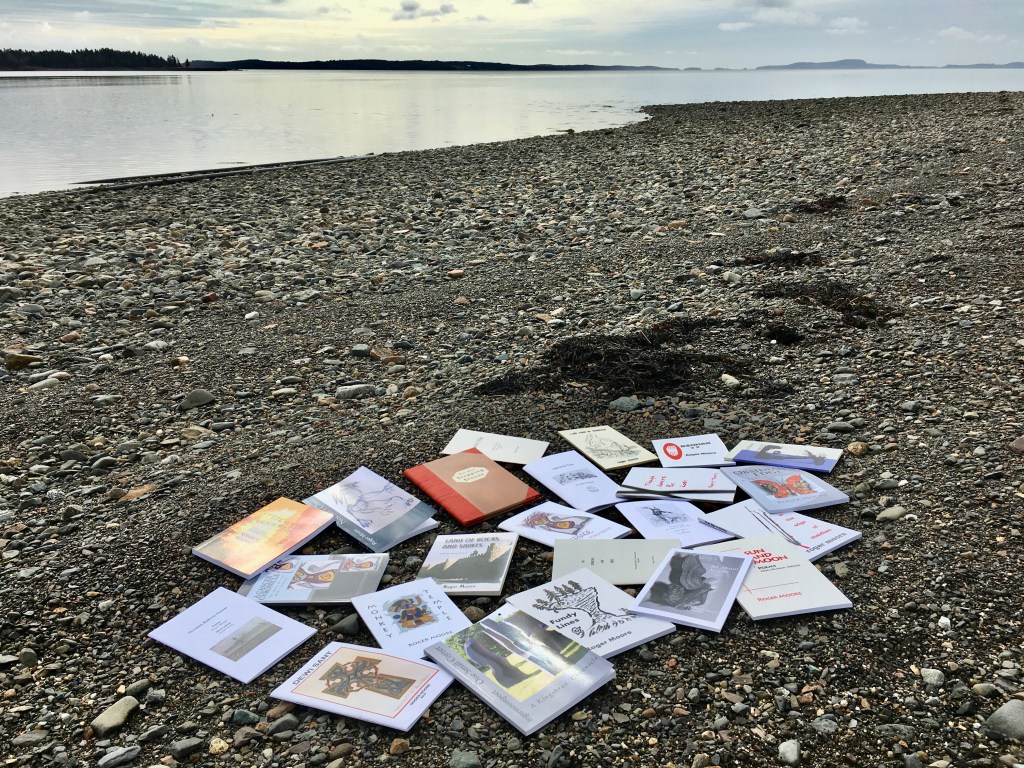
Other friends have done similar things. Here is a collection of my books on the sea shore at Holt’s Point. And yes, Fundy Lines is in there as well. Can you spot it? Another very good friend, Geoff, contributed this very meaningful photo. So much of my life, there, upon the sea shore, waiting for the tide to come in.

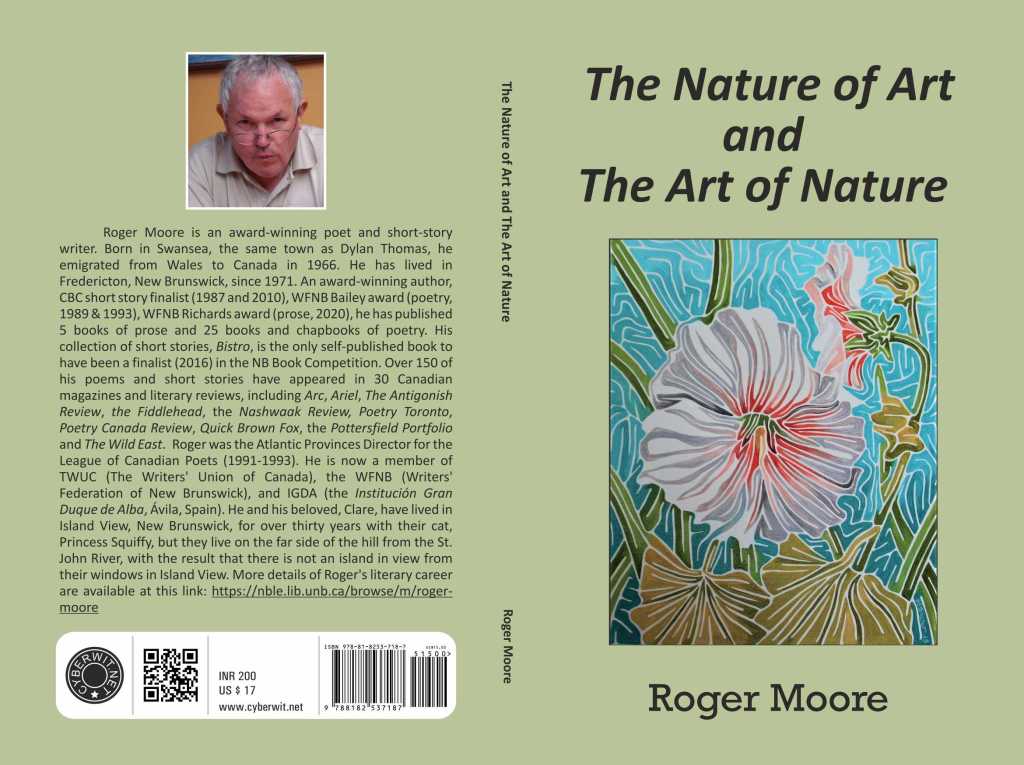
This book, and its cover, are also very special indeed. And here’s why.

Still Life with Hollyhock
Geoff Slater

How do you frame this beaver pond,
those paths, those woods? How do you
know what to leave, what to choose?
Where does light begin and darkness end?

Up and down: two dimensions. Easy.
But where does depth come from?
Or the tactility, the energy, water’s
flow, that rush of breathless movement
that transcends the painting’s stillness?

So many questions, so few answers.
The hollyhock that blooms in my kitchen
is not a real hollyhock. Intertextuality,
visible and verbal: this is a poem about
a painting of a digital photograph of a
hollyhock, a genuine flower that once
upon a time flourished in my garden.

A still life, naturaleza muerta in Spanish,
a nature morte in French, a dead nature,
then, portrayed in paint and hung alive,
on display, in this coffin’s wooden frame.

So, what do I enjoy most about writing? Everything – for whenever creative people create they draw in others into a web of intertextuality that spins its way from mind to mind and, especially in Canada, links shore to shore to shore.

Janus

Janus

I walked backwards into my childhood
a step at a time. I failed to find it
where I thought I had left it.

I opened cupboards, doors, drawers,
searched beneath beds, went outside,
rummaged through garden and garage,
and found absolutely nothing at all.

 My past was as dry as a squeezed orange
when the juice has gone and long days
left on the window ledge has dried it up.

I looked in the mirror, and the man
I saw was not the boy I had seen
the day before. How could he be?

Janus, two-faced, looks forwards and back.
I will no longer seek the self that was

I shall accept the self that is, the one that grew
outwards and upwards from the one
that was before. Acceptance. I can do no more.

Crossing the Bridge

Crossing the Bridge

When I got to there, I couldn’t cross it.
I sat in the coffee shop, over-looking
the River Severn and ordered a cup
of cafeteria tea. Time limped slowly by
and I let my untasted tea grow cold.

What was there for me on the other side?
Empty stood the house where I was born.
Sold, the bungalow, built by my father
and his father, the summer home I loved
so much. Lost the kitchens I remembered
so well, kitchens in which I had come of age.

I tried to picture the ghosts of Christmases
past walking the logs that flamed in the fire.
Ghosts? They inhabit my mind, share my life,
dwell in my days, dream with me most nights
when a golden moon sails past my window,
and silver stars fill my dreams with light.

Underworld

Underworld

In the secret world of my goldfish bowl
I speak in bubbles but only hear silence.

My fish-eye lens bends the pendulum
of the grandfather clock. Westminster chimes,

inaudible, do not intrude. Noiseless are time’s
ripples across the surface of my submarine sphere.

I feel, rather than hear, my troubled heart beat.
The foreboding sounds of distant voices leave

me untouched and becalmed. Rocked in love’s
cradle, these amniotic waters nourish and soothe.

In my beginning will be my end. One day I’ll return
to the beaches of my childhood, where the sun

always shines, and the moon path over the waves
is a welcoming walkway leading to the underworld.

Skype or Zoom

Skype or Zoom

I sit and watch the grandfather clock,
listening to every tick and tock.

So slow, the sullen pendulum swings
as time limps by on leaden wings.

When they arrive, the house will fill
with youthful joy and much goodwill.

Age will flee for a week or two,
then we’ll be alone, just me and you.

Watching the telly, watching the clock,
counting each tick and every tock.

We will be lonely, left here alone,
waiting for them to telephone.

The very best thing to lighten the gloom
is to see them again on Skype and Zoom.

What is the most important thing to carry with you all the time?

Daily writing prompt
What is the most important thing to carry with you all the time?

What is the most important thing to carry with you all the time?

Things I carry with me

            That old black cast-iron stove, wood-fired, that baked the best ever breads and cakes and warmed the bungalow on cold, summer mornings. The Welsh dresser with its age-blackened rails that displayed the plates, and cups, and saucers. The old tin cans that ferried the water from the one tap located at the end of the field. Full and wholesome, its weight still weighs me down as I carry it in my dreams. The Elsan toilet from the shed by the hedge and the shovels that appeared, every so often, as if by magic, as my uncle braved the evening shadows to dig a hole on the opposite side of the field, as far from the bungalow as possible.

            The outhouse at the end of the garden. The steps down to the coal cellar where they went when the sirens sounded, to sleep in the make-shift air raid shelter, along with the rats and mice that scurried from the candles. The corrugated iron work shop in the garden where my uncle built his model ships, the Half-Penny Galleon and the Nonesuch. The broken razor blades I used to carve my own planes from Keil Kraft Kits, Hurricanes and Spitfires, an SE5, and once, a Bristol Bulldog. Twisted and warped, they winged their ways into nobody’s skies, though once we built a paper kite that flew far away in a powerful wind and got tangled in a tree. The greenhouse from which I stole countless tomatoes, red and green. Kilvey Hill towering above the window ledge where the little ones sat when there were more guests than chairs in the kitchen. The old bombed buildings across the street. The bullet holes in the front of the house where the Messerschmidt strafed us.

            The old men spitting up coal dust from shrivelled lungs. The widows who took in lodgers and overnight travelers. The BRS lorries, parked overnight, that littered the street. The steep climb upwards into those lorries. The burrowing under dirty tarpaulins to explore the heavy loads, and many other things. The untouchable, forbidden drawer where the rent money waited for the rent collector’s visit. The old lady, five houses down who, when the shops were shut, sold warm Dandelion & Burdock and Orange pop for an extra penny a bottle.  The vicious, snub-faced Pekinese that yapped fierce defiance from the fortress of her lap. The unemployed soccer referee who on Saturdays walked five miles to the match and five miles back just to save the bus fare, his only financial reward. My father’s shadowy childhood. His first pair of shoes, bought at five years old, so he wouldn’t go barefoot to school. 

            Wet cement moulded onto the garden wall, then filled with empty bottles to be smashed when the cement set solid. The coal shed where the coal man delivered the coal: cobbledy-cobbledy, down the hole. The outside toilet with its nails and squares torn from yesterday’s newspaper. The lamp-lighter who lit the lamps every evening as the sun went down. The arrival of electricity. The old blackout curtains that shut in the light and shut out the night. The hand rolled fabric sausage that lay on the floor by the door and kept the heat of the coal fire in the kitchen. The kitchen itself with its great wooden chair drawn up by the fire. That chair: the only material possession I still have from that distant past.

Describe your life in an alternate universe.

Daily writing prompt
Describe your life in an alternate universe.

Describe your life in an alternate universe.

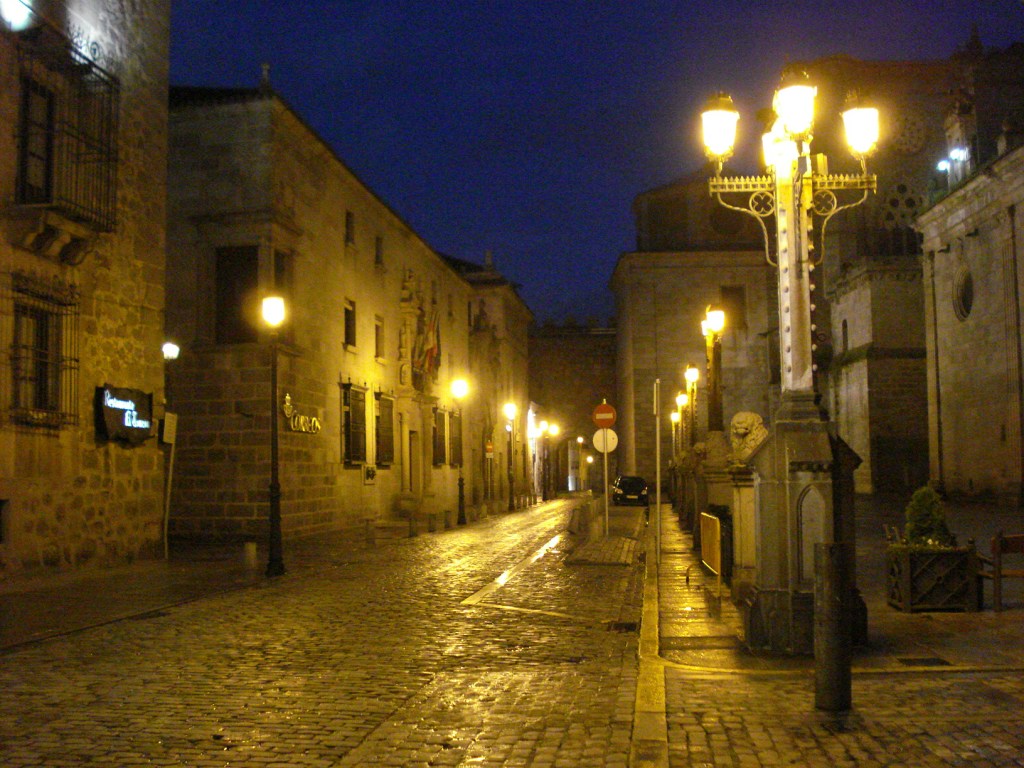
Ávila: A Brief Tour of the City

            Ávila is both a city and a province. The city may be new (walls constructed in 1058), but the province, like the city site, is old; it is older by far than the Romans, much older than the Christians, much, much older than the Muslims and Jews who once lived here. Blessed with water, it has a constant series of fountains and wells, some sealed, some flowing still, in streets and squares. More: it is a secret city, one of earth’s sacred places. The Celts built here, and here they worshipped their wild, pantheistic gods of tree, stone and sky.

            I came here by chance, drawn by the saint’s name as if I were a kite being reeled in from the skies. Often, in former days, I hurried past the city, heading to Santander in search of sun and sand with Ávila’s walls a blur as the train sped past. Then, when I finally had time to stop, I stayed and found sanctuary. There is a silence here, even among the voices; a truth that is built in the stone, not with the stone: a belief in water and rock that transcends Christianity and all the wonders of cloister and cathedral.

            This sequence of poems starts outside the walls of Ávila, in the surrounding countryside. Here there are mountains and valleys, bulls and cattle graze, mist hangs high on steep passes, and the tinkle of bells is heard among dry rocks as the tame goats scramble and the wild sheep climb ever higher. Outside the walls there are valleys and rivers, Roman roads, trade routes which have survived when the names of the tribes are long forgotten, their buildings tumbled down, their wives and children perished. Sometimes the land is magnificent; sometimes it is harsh and dry, the skeletons of older dwellings, their bones picked clean, now structured into newer homes. In places, a harsh, dry countryside holds a single tree, shaped like a parasol, with cattle standing in its shade. Dry stone walls march across the land, dividing field from field, tying the countryside down like a parcel. It is a land of boulders and saints, fought over for thousands of years with each stronghold tumbled down by the latest victors, then built again.

            When I came to the city, I was frightened by the mass of stone. I needed air and light and so I escaped the walls and discovered la ronda antigua. Here, overlooking el Valle del Amblés, I sat and studied the airfield from where, according to local legend, Von Richthofen’s planes took off in 1937 to bomb Guernica. I sat beneath the walls, in the sunshine, on the benches and watched the day’s cycle: the sun moving from left to right, the shadows changing position, the benches moving into and out of the sun, and everywhere, the swifts, knitting the sky with their wings, baptising the tourists from on high, and twittering in and out of the stonework. Above them all, the glory of storks, their wings motionless, hanging like kites just beneath the clouds, or soaring suddenly, borne away on the breeze. Beneath the wall walk, red roofs, grey stone, slates and tiles, cobbled walkways, fields turning into streets and houses as the builders build and the city grows outwards.

            Inside the walls, there are people and slowly but surely I came to know them. I knew the  barmen first, then the waiters and the serving girls, then the shop-keepers and the pharmacist, the policeman on duty, the workmen pulling up the cobbles. Then I met the painters and the poets, the artists who (re)create, again and again, the images on which I feed. I talked to the men and women who walk their dogs and follow them with tissues so the streets will not be stained. I praise the cocker spaniels, the great Dane, the wrinkled Shar-pei who guards the second floor balcony and woofs down at the world, the golden retriever, the English pointer, well-bred dogs, all of them. They are the finest that money can buy, and most are immaculately groomed. Finally, I make friends among the teachers and the walkers, the sitters and the families, the people who visit the same squares as I do, who shop in the same shops, eat and drink at the same restaurants and bars, the citizens who see what I see and take an interest in what I find so entrancing.

            Just outside the walls, but extending through them and into the inner city is La Plaza Grande, also known as La Plaza de la Santa. This area has been rebuilt recently and new buildings stand beside the old. This vast and open space is the training ground for young footballers who play soccer back and forth between the benches as their elders sit and sip coffee or meet for conversation on the benches around the square. During the World Cup, the youngsters act out their roles as super stars, galácticos as they are called by the followers of  Real Madrid. The players dribble, run, defend, attack, centre, corner and shoot at goal. They weep, cry out, appeal, fall to the ground, dive and roll on the stones, banking their shots and passes off trees and walls. Older men, formal and distinguished, sometimes stop to catch a stray ball then burst suddenly into a trot, demonstrate a pass curved with the outside of the foot, shedding twenty years as they do so, smiling, until called back to reality by the stern voices of the wives. Meanwhile,  the old women, arms linked, move through the players and their game, like ships in full sail skirting a harbour full of flotillas of smaller craft as they sail on, undisturbed, in their feminine armadas.

            The cathedral in Ávila is unique. It forms part of the fortifications and is built in and up as part of the city wall. Above the cathedral, on its pointed towers and battlements, a colony of storks looks down at the inferior world of human beings. Once upon a time, the storks returned to their nests  in the spring, raised their families, and departed at the end of July or the beginning of August, to avoid winter’s cold that creeps down from the hills to besiege the city. Now, however, the storks have found the garbage dump outside the city and forage there, long after their departure time, some of them remaining all winter as the world gets warmer. Tourists in the cathedral square strain their necks, looking upwards towards the storks who reign above them. Hawks fly in and out among the nests, young chicks duck down, and pigeons seek the protection of nook and cranny as the predators fly by.

Surrounding the cathedral is the cathedral square, La Plaza de la Catedral. Entering the cathedral itself, you must rub the polished toe of San Pedro, and make a wish. It usually comes true, but take care, the wise men say, with what you wish: fulfillment of the wish does not always bring the joys expected. Exiting from the cathedral, the Calle de la Vida y la Muerte is the narrow street on the left. Here, beneath a rugged, wooden cross, duels were fought, the winner returning home or fleeing into exile, the loser lying in the dust, staining the cobbles with his blood. On either side of the cathedral door, chained lions, and the wild and leafy green men of the woods stand guard.

            Down the hill from the cathedral, past the temple of Nuestra Señora de las Nieves with its wood and metal seat, is the Plaza de la Constitución which changes names according to the age and political commitment of the local inhabitants. Some call it the Plaza de la Victoria; others, the Plaza del Ayuntamiento; still others, the Plaza del Mercado Chico, or simply, El Mercado Chico. According to some, this was the central square of a Roman legionary camp; according to others, the Romans never lived here. Either way, on Fridays, a street market holds sway. Fruit and vegetables, pots and pans, soap and perfume, and, above all, the marvelous spices of the region and beyond: saffron and the various styles of pimentón de la Vera. Here, close to the Puerta del Rastro and the Sanctuario de la Santa where St. Theresa was born, is the emotional heart of the city. Here, within the four walls which surround the square, one can hear the buzz of El Zumbo, the great bell that deeply hums when it is gently rubbed. Here and in its near vicinity are small bars and restaurants, pavement cafes, pedestrian walkways, gift shops, clothing stores, cobbled streets, shop windows for window shopping, art galleries, tiny ultramarinos with their collections of wines, foods, fruit, bread, and cheeses, patisseries, florists, newsagents, churches, and schools, everything that makes the hub of a city strum with life.

            Next door to the Mercado Chico is La Plaza del Medio Celemín, also known as La Plaza de Zurraquín. Here, in one small corner of this smallest of squares, which is actually shaped rather like a trapezium, nestles the Hostal-Bar-Restaurante known as El Rincón. The Rincón is typical of all that is good in that older Spain which survives from my childhood memories: bars laden with tapas,  the richness of tortillas, the tang of queso manchego, tablas ibéricas with chorizo, salchichas, jabugo, and jamón serrano, and beyond that, a variety of tapas and tid-bits: percebes, langostinas, gambas, caracoles de tierra y mar, pulpo, calamares, sepias, and meats of all sorts: costillas, riñones, and callos. But El Rincón is not just a symbol of food. It is a genuine neighbourhood bar filled with local people who run the full gambit from knowledgeable, wise, witty, and well bred to bad-tempered (when the national team loses), ecstatic (when it or the local team wins), disappointed (when someone from Ávila gives ground in the Tour de France or La Vuelta de España), tolerant of friends and intolerant, as people usually are, of idiots and fools. It is a bar of breakfasts and lunches, of mid-morning coffees, of suppers and tapas, of cigarette smoke and lottery tickets, of gambling machines and cigarette machines, and of people with voices so loud that the cares of the day are all drowned out. 

            But El Rincón is much more than a bar. At night, when the guests retire to bed, the rooms of El Rincón are filled with dreams. These dreams knock at the windows and clamour at the doors. Sometimes the city’s secular saints appear, visitors from the past and guests from the future. These include the spirits of the place, the spirits that the Celts worshipped three thousand years ago. They are there in the wells, in the water supply, flitting between the walls, and settling on the head of the bed. The water of the wells attracts them, for, more than anything, they are spirits of water and rock who speak in dreams and talk of wisdom’s ways: how to sit in silence,  how to watch moss grow, how to feel the stone’s blood circulating far beneath its surface, how to sense the hands of the men who carved the stones, how to sit and look in the mirror and watch one’s hair turn white, one’s mind turn in on itself, and time walk slowly by. Not the time on the hands of the clocks, but the centuries of slowness that go into the making of seekers and saints, people like you and me, who drop in for a moment and are caught for a lifetime; people like you and me who turn off the television and listen to the sound of rain and snow, of water flowing, of the slow acceleration of dust as it sparkles in sunlight and gradually grinds down granite.

            Listen carefully. Sometimes at night you can hear the waters slowly rising and filling the well, that deep well within us, where dwells the wellness of spiritual being, the growth of spirit, the slow search, inwards always inwards, for the light that lives at the centre and fills us, slowly, like the gathering water, with love of living and joy of life. This is the love that can watch the sun move round the world outside and inside the walls; this is the joy that can be taken from a falling leaf, from a stork rising into the sky, from birdsong, from cattle grazing under a tree, from the silent dance of leaves, from the sticks of the stork’s nest, from children playing, from the voices that wake us from the very dreams they weave for us as we daydream or sleep.