Milton Acorn and the Jack Pine

Milton Acorn and the Jack Pine

            I met Milton Acorn in the photocopying room of the university in which I taught. I didn’t know who he was, but I soon found out.
            “Oy! You,” he waved his strong, carpenter’s hands, and stabbed me with a gnarled index finger.
            “Are you Milton Acorn,” I asked. “The poet?”
            “Yup. Make this machine work.”
            “I’m meant to be taking you to lunch.”
            “Got this job to do first,” he pointed at the machine. “Turn it on.”
            I typed in my code and the copier leapt into life.
            “Now go away. I need to be alone.”

            A few minutes later, I returned to find him lying on the photocopier, eyes shut, face pressed against the glass. Lights flashed, the copier whirred, and a copy of his face emerged. He descended from the machine and added his face to the pile of photocopies that lay at his feet.
            “Tape,” he said. “I need tape,” he again stabbed me with his finger and held out his hand.
            “I’ll go and get some.”
            I went to my secretary’s office.
            “What the heck is he doing in there?” she asked.
            “I haven’t got a clue. But now he wants some Scotch tape,” I held out my hand and she handed me a roll of tape “Thanks,” I said.

            I gave Milton the tape and watched as he taped the copies together. He had photocopied his whole body, arms, legs, back sides, feet.
            “Me,” he said happily. “That’s me,”
            Triumphant, he showed me his work: a self-portrait, shadowy and cloudy, still warm, with him all whiskered and worn, smelling still of photocopying ink, unique, unmistakable, uncouth, unseemly, but the real Milton Acorn, a jack pine sonnet self-grown in his own poetic image.

Jack Pine and Stars

Jack Pine and Stars

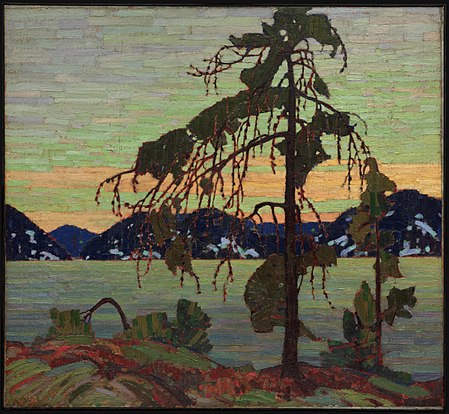
            Sitting on the porch at Tara Manor, measuring the evening shadows as they lengthen and thicken, I study the jack pine’s wild, extravagant growth, the way it reaches out to reject the commonplace of ‘tree’, as Milton Acorn rejected the commonplace of ‘poet’.
            The jack pine grows in radical disorder, sprouting here, there, anywhere the sea wind blows and its capricious nature dictates. Each limb of the jack pine bears a thin layer of salt, borne in from Passamaquoddy Bay by thin fingers of air that sow salt on branches and needles. Broken branches, untidy crows’ nests limb-tangled like grim, bedraggled hair sprout out from on high. Lower down the tree extends a branch, held out towards me like a helping hand.
            Charcoal shadows fill in the gaps between darkening trees. Shy deer emerge, step by cautious step, drifting their sylvan ghosts, delicate, across footpath and lawn. Wrapped in a scarf of peace, I forget the city’s hustle and bustle. Stars poke peepholes in the dark. I try to name each constellation, as it traces its new-to-me path across the indifferent evening sky.
            I look around: more jack pines, no two the same. How could they be? There’ll never be another poet like Milton, another book like his Jack Pine Sonnets, no tale like his own tale told in his own inimitable way.

A Survivor Lights a Candle

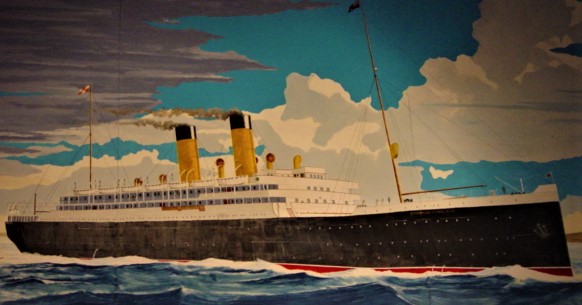
A Survivor from the Empress of Ireland
Lights a Candle During the Old Latin Mass for the Dead
Before the Main Altar at the Sanctuaire Sainte-Anne
Pointe-au-Père

1

I am still afraid of fire:
in principio erat verbum
/ in the beginning was the word.

I am still afraid of the loud voice of the match
scratching its sudden flare,
narrowing my pupils,
enlarging the whites of my eyes:

et lux in tenebris lucet
/ and light shines in darkness.

Booming and blooming,
igniting the soul’s dark night.

Voice of fire:  
et Deus erat verbum
/ and the Word was God.

Flourishing to nourishment,
flames whispering on the flood:
omnia per ipsum facta sunt
/ all things were made by Him.

Wool and water,
this sodden safety blanket;
and what of the cold
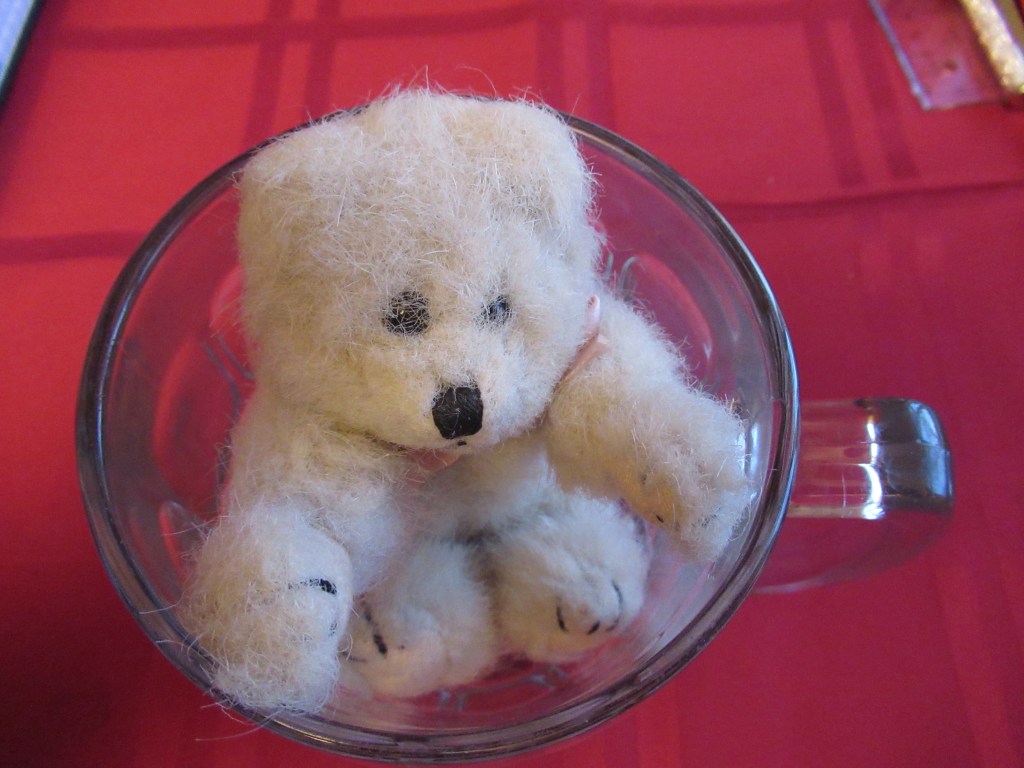
plush of pliant teddy bear,
the staring eyes of the doll:

et tenebrae eam non comprehenderunt
/ and the darkness comprehended it not.

2

The lashes of their eyes bound
together with salt water,
they were doused in a silken mist:
hic venit in testimonium
/ this served as a witness.

Still the patterns pierce my sleep,
hauling me from my opaque dreams,
holding my wrists in this sailor’s double clasp:
non erat ille lux
/ he was not the light.

Oh! Curse these dumb waters rising!
“Not a hair on your head shall be harmed!”
he said,
hauling my sister up by her hair
only to find her staring eyes
belonging to the already dead:
et mundus eam non cognovit
/ and the world knew her not.

3

Night waters rising.
The moon raising
its pale thin lantern glow:
et vidimus gloriam ejus
/ and we saw His glory
shining forth
upon the waters’
mirrored face.

Comment: I searched everywhere, but I could not find a copy of my poetry book Empress of Ireland. Nor could I find a file containing the poems. Lost, I searched everywhere yet again and then, on an old USB, I found the text of the chapbook M Press of Ire. The above poem comes from that chapbook. Empress of Ireland is available on KDP / Amazon. I had forgotten how much I loved the sequence.

WFNB

Moo

WFNB

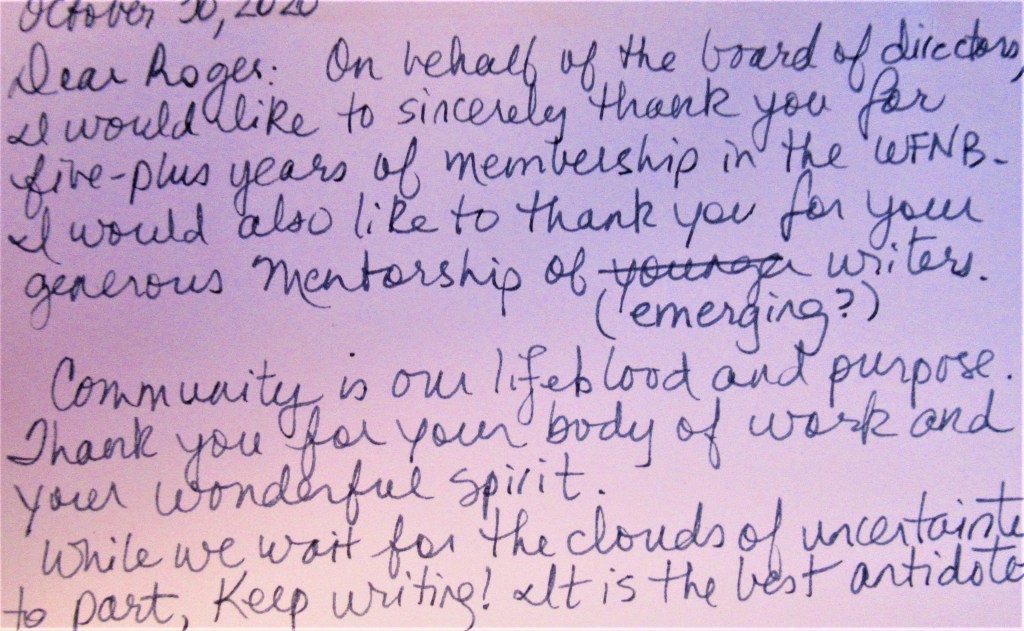
I have been a member of the Writers’ Foundation of New Brunswick for a long, long time. I am not a ‘founding member’, but I think I have been a member since around 1985, and I am sure I was a member in 1986, when Goose Lane Editions, Fredericton, published my second poetry collection, Broken Ghosts. I was most certainly a member in 1989 when my still-unpublished poetry manuscript Still Lives placed first in the Alfred G. Bailey poetry competition.

In the years between 1985-1986-1989 and 2020, I have never received a hand-written communication from any member of the WFNB Board, other than an official communication of one kind or another. Imagine, then, my surprise, when the above postcard, inserted in a hand-addressed envelope, arrived in my mail box yesterday. I was truly amazed and very grateful to the president who wrote these kind words to me. Amidst the panic and the pandemic, it is so nice to be remembered and in such a thoughtful way. Madam President: thank you so much for reaching out to me with this verbal gesture. And yes, you can count on my support for yourself and our Writers’ Federation, I hope for a long, long time to come.

I was in two minds whether to post this or not. However, I wish to emphasize several things: the importance of reaching out, the importance of continuing to believe in ourselves and our creative talents during these difficult times, the necessity of creating alternate communities and of supporting each other as much as possible, the need to avoid total isolation and to maintain human contact in different ways when the physical things — meeting, touching, holding, direct dialog — and the normal activities and relationships of healthy human beings are denied to us, and last, but by no means least, the need to encourage each other and to offer comfort and recognition whenever and wherever possible.

Waiting for inspiration
and
hoping to fly!

Midnight

A great NB Winery

Midnight

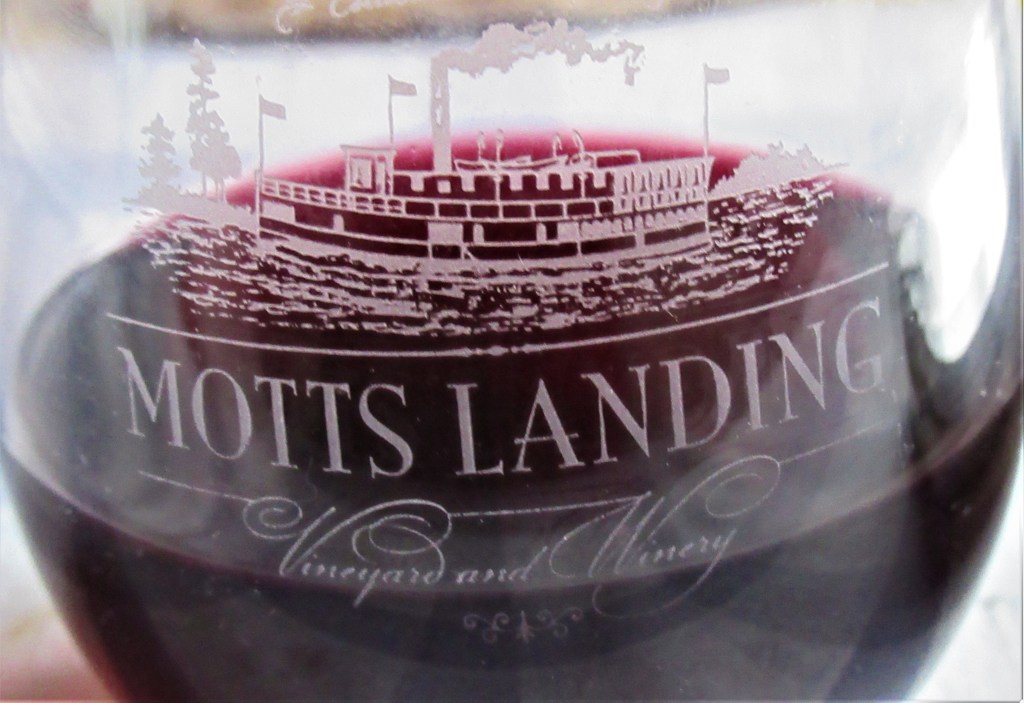
Primary red, this label, and the wine, fresh-drawn,
plucked from the bottle, tumbling tinto, into the glass.

Swirled, streaked ruby by overhead lights, bubbles
bright with hints of garnet, purple, brick at meniscus.

Sniffed, it smells of warm autumn days, scintillating
leaves, just crisping, turning color, and fruit all ripe.

Tasted: fruit bursts into hints of raspberries,
strawberries, spices, a touch of garrigue, mysterious.

Wine descends like water on a dry, hot, dusty day,
or rain after drought, when thirsty lands lap up

liquids, and rejoice in moisture’s blessings.
Raised now the glass, vineyard and vintners toasted,

midnight greeted, saluted the old day past and gone,
welcomed the fresh day walking in, swaddled, new born.

Underwater Road

Underwater Road
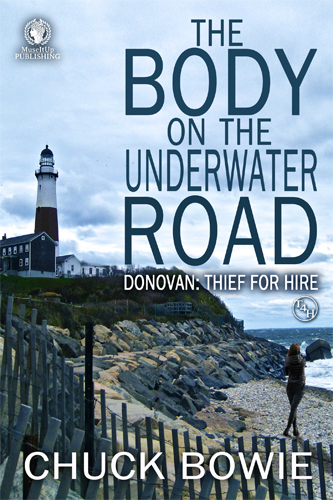
Chuck Bowie

We met at St. Andrews, at low tide, on
the underwater road. In secret we
shared the closed, coded envelopes of thought,
running fresh ideas through open minds.

Our words, brief vapor trails, gathered for
a moment over Passamaquoddy,
before drifting silently away. Canvas sails
flapped white seagulls across the bay.

All seven seas rose before our eyes, brought
in on a breeze’s wing. The flow of cold
waters over warm sand cocooned us
in a cloak-and-dagger mystery of mist.

We spun our spider-web dreams word by word,
decking them out with the silver dew drops
proximity brings. Characters’ voices,
unattached to real people, floated by.

Verbal ghosts, shape-shifting, emerging from
shadows, revealed new attitudes and twists,
spoke briefly, filled us with visions of book
lives, unforgettable, but doomed, swift to fail.

Soft waves ascended rock, sand, mud, to wash
away footprints, clues, all the sandcastle
dreams we had constructed that afternoon,
though a few still survive upon the printed page.

Comment: I wrote this in St. Andrews during my residence at KIRA (June, 2017). Chuck drove down for lunch, and after we had eaten, we sat by the sea and discussed the writing projects on which we were engaged. I was busy writing a poetry collection, One Small Corner (now available on Amazon / KDP), and Chuck was plotting his way through a new novel, based on St. Andrews, with the title The Underwater Road.

More details on The Underwater Road.

Here is the purchase site on Amazon.ca: https://www.amazon.ca/Body-Underwater-Road-Donovan-Thief-ebook/dp/B07CLPRG81/ref=sr_1_1?dchild=1&keywords=The+Body+on+the+Underwater+Road&qid=1604981052&s=books&sr=1-1

… and it may also be purchased  at Westminster Books in Fredericton, and Mill Cove Coffee, in Miramichi.

Ah would some power …

Ah, would some power

“Ah, would some power the giftie ge us / to see ourselves as others see us.” Robbie Burns, a Scottish Poet.

And sometimes I think the flowers would like to be seen as they see themselves, not as we see them with our imperfect eyes, not with the cataracts of the Elderly Monet, not with the blunted vision of many artists who have stopped, and sniffed, and bent their heads, and wondered at the colors that entered their paint brushes through the nostrils. Vision and reality: the photo versus the objects as we see and sense them. The reality versus our own version of it.

So who is this anonymous artist who delivers these visions to my blog and allows me to glimpse alternate realities that are so different to my realities. I think of Lorna Crozier, The Garden Going on Without Us. I think of Kingsbrae Gardens, at night, when the flowers are alone and talk only to themselves. I think of Monet at Giverny as his vision lessened and his instincts grew. Who are we? What are we? Do we see ourselves as others see us? Do others see what we see? Color, shade, light, hue … El ojo que ves no es ojo porque lo ves, es ojo porque te ve / the eye you see is not an eye because you see it, it is an eye because it sees you (Antonio Machado). Does the man or woman looking out at us from the television set see him or herself as we see them?

The night before last I sat alone in a hotel room. The television screen was much, much wider than it was high. All the facial images were greatly distorted. I didn’t recognize the people I saw, except by their voices. Who will distinguish the reality of the flowers, each by each and one by one, privatim et seriatim? Who will listen to their floral voices and call them by the names they have given themselves, rather than by their horticultural names?

Tell me, what reality do we see when we see the flowers? What reality do the flowers see when they see us? The anonymous painter who painted this picture that Geoff Slater, my anonymous friend, framed so nicely did not see those flowers the way that I saw those flowers. Why not? Why can’t I see like him (or her)? and why can’t she (or he) see like me?

Ah would some power …

Kite

Kite Flying

So light, the kite,
a butterfly in flight.

Breeze battered,
sky-blue shattered.

Children stare
seeing the wing-shape
fluttering there
rising on flimsy air.

Diving, dipping,
nylon cord slipping,
finger-flesh ripping.

Here come others,
children and mothers.

Butterflies, bright,
ready for flight,
fighting wind-might:
a child’s delight.

I didn’t have photos of a kite.
I offer some humming birds instead.
Listen closely:
you can hear them hum.

Blue and Green

“Blue and green
should not be seen
without a color
in between,”
thus spoke my mother.

What did she know
of the Peace Park grass
sweeping spring-clean
to head pond waters?

Didn’t she sense the frail
brown fringe of rock
scarfing between green
grass and head pond blue
or the white caps lacing
cow parsley on the stones?

I know she knew nothing
of yellow and red leaves,
brown spotted like an old
man’s hands, freckling waters,
fretting at the fragility
of nature’s delicate balance.