Carved in Stone 36

Carved in Stone
36

Words, cast stones,
ripples spreading out
across water, reaching out
and beyond this shore,
traveling, how long,
in time and space?

Will they last longer,
than the sanderling’s prints,
their silent words upon dry sand,
wet, when waves come in
to wipe them all away.

Gone forever,
until next day,
when the outgoing tide
permits new birds
to create fresh messages.

Commentary:
La poesía se explica sola, si no, no se explica. Pedro Salinas (Spanish Poet, Generation of ’27). Poetry explains itself, if it doesn’t, it’s inexplicable.

The quote certainly works well for this poem! Not much else we can say about it. The phot (taken by Clare at Pointe Wolfe Beach, Fundy National Park) shows sandpipers, sheltering from the wind, not sanderlings. They are both beautiful shorebirds and can often be seen together.

Two New Poems

Two New Poems

1

My Words

My words are black print
on white paper.
My memories flare
 – an aurora borealis of senses
sent crackling down the spine,
in and out of the mind,
tumbling the brain into a world
 … what sort of world?

An unimaginable world.
One never forgotten.
One never re-recreated.
One that never existed.
One that never could exist.
One for which the young child,
six or seven years old,
yearns for the rest of his life.
His unsatisfied life.
His unsatisfying life.
His meaningless life.
His absurd life.

2

Puppy

Oh, pity the poor puppy,
not knowing
 what he has done wrong,
not knowing
how to put things right,
always inadequate,
always in fear
of the angry word,
the quick, sly kick,
the vicious blow,
whining and cringing
at his master’s feet.

“Into your box!”

And always,
that cold puppy bed,
often soiled,
 where the long, chill snakes
of frail, wriggling dreams,
remind him of
the next day’s
punishment.

Commentary:

Both these poems evolved from the comments I made yesterday to my blog post. I have started noticing that those words, beneath the poems, sometimes have a rhythm and a magic all to themselves. I guess it is a little bit of the unconscious slipping upwards and spilling out.

Discovered poems – I never set out to write these two poems. When I re-read my commentary, I thought ‘wow, there’s a poem in there”, and I found not one, but two new poems. Interesting. As I age, I discover something new every day. What a wonderful world it is, unless, like earlier this week, I discover my tap leaking and am forced to call my friend, the plumber, into my water world. Alas, if only that tap were tapped into a maple tree and it weas spring once more. Ah well, I am a dreamer, I can always dream.

Candle Light

Candle Light

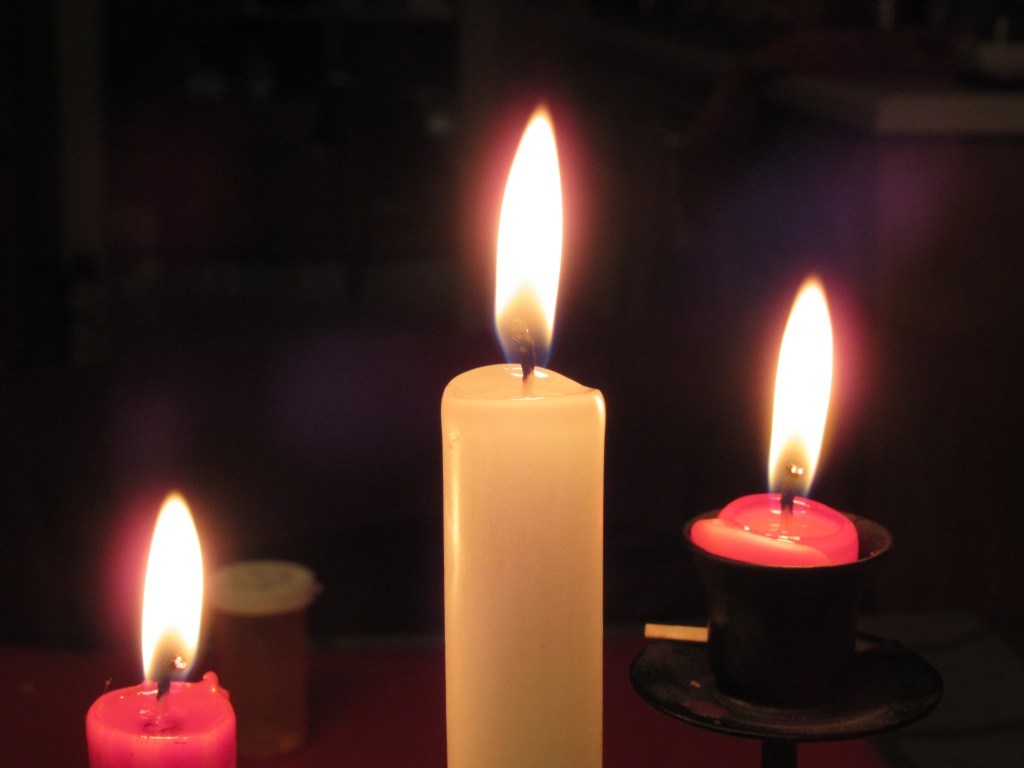
Candle light
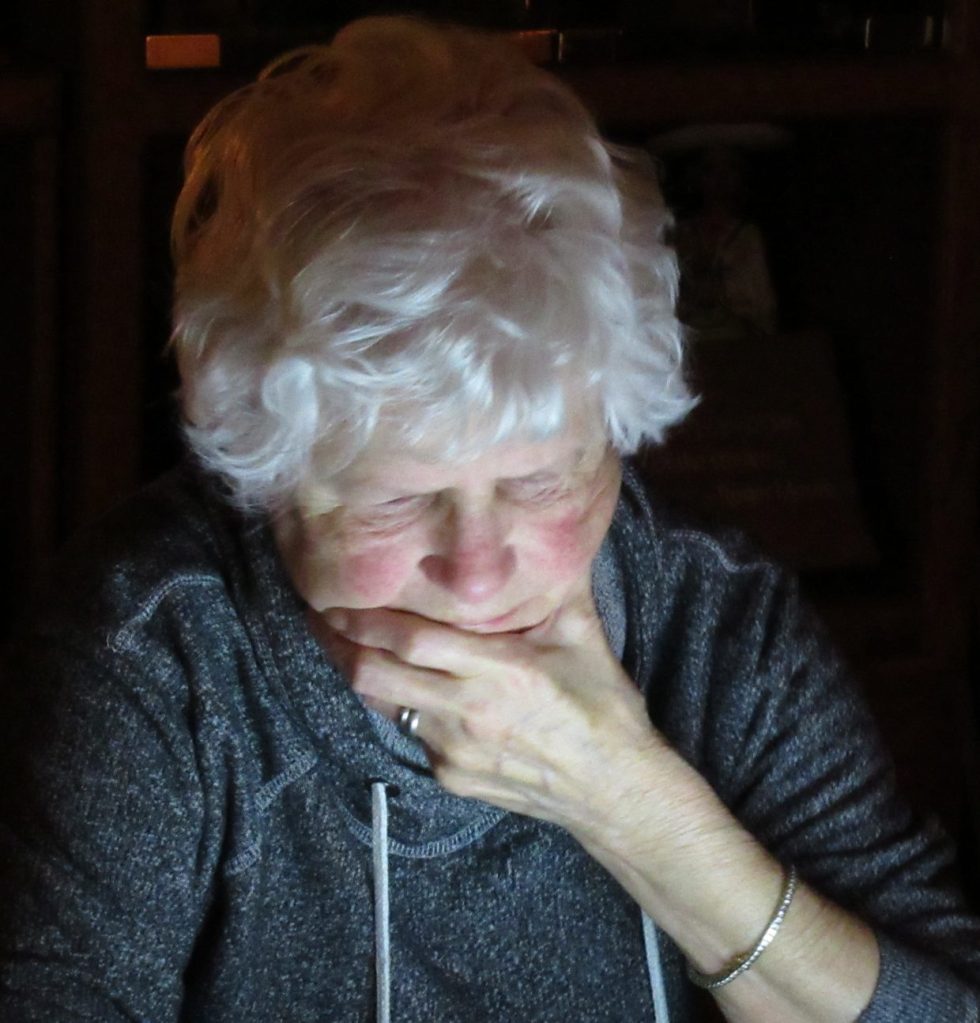
softens your features
brings out the bone shape
makes me forget
the minor flaws
of ageing.

Bone shape,
rock shape,
land scape,
your face contours
traced by the flame,
counting the years,
like tree rings.

Beneath the surface
you are as you always were
and always will be.

When I look into your eyes,
I see your soul
dancing in the candle’s flame.

Great White Egret

Great White Egret

            The Great White Egret is Yolande Essiembre’s first chapbook of poetry. The title poem offers an image, a white egret, that is central to the whole collection. Summarized in this one poem are the concepts of pantheism, mindfulness, self-questioning, and receiving lessons and inspiration from the natural world that surrounds the narrator and her poetic voice.

            Pantheists often consider the universe, or nature, to be identical to the divinity. In simpler terms, it’s the old Greek idea of Gaia, the world spirit – spiritus mundi, in the Latin of Moncton’s Northrop Frye – that links nature and the divinity. Pantheism can be found in both religious and philosophical contexts, with some branches of pantheism rooted in traditional religious beliefs and others stemming from poetic perspectives. In the case of The Great White Egret, the narrative voice sees nature as an all-embracing poetic concept that makes possible a life, both physical and spiritual, in the immediate present.

            The lessons the narrator receives in the course of observing The Great White Egret are (1) to take one step at a time, (2) to be still, and (3) to be one’s own reflection. This third lesson reaches out to include the cover photograph. Verbal and visual blend when the egret, reflected in the water, parallels the reflection of the poet in the stillness of nature. This is further complicated by the double meaning of reflection as mirror image and of the thought process involved during the observation of the bird. The visual and mental images become reminiscent of the hymn “on the wings of a snow-white dove.”

Part of the beauty of Yolande Essiembre’s poetic meditations lies in the extension of image and metaphor beyond the page and into the mind of the reader where they create a mirror universe of reciprocal reminiscence and creativity. Other poems that reach out in similar fashion to explore the deity manifest within the natural world include A Force of Love in Our Universe, Breath of Life, Glimpses, and In the Sanctuary. This last poem works on the basis of repeated images that stand strong and clear, for example, “Life pressing through a blade of grass. / Leaves shimmering, dancing, waving. / Light flickering, casting shadows.” Life and movement, especially movement – pressing, shimmering, dancing, flickering, casting – create a sense of wonder in the natural setting where the poet finds sanctuary.

            Mindfulness is a mental state achieved by focusing one’s awareness on the present moment, while calmly acknowledging and accepting one’s feelings, thoughts, and bodily sensations. It is often used as a therapeutic technique and can be compared with the yoga techniques which our poet practices. This yoga technique is compounded in the poems where breathing is emphasized, as in Breath of Life, for example, where we read “Who are you breath of life / Who fills my lungs with air”. It can also be found in the poem In Your Presence “In the stillness of the morning / I breathe / I listen / I breathe”.         

This chapbook is more than a mere collection of poems. It is a compendium of personal feelings, inner thoughtfulness, and natural observations. It is the work of a thinker and feeler, in tune with the universe and continually seeking answers to some of life’s most important questions. Reading The Great White Egret, you too may start asking similar questions. More important, you may even find some meaningful answers.

The Great White Egret
Sitting, rocking, gazing upon a lake,
Pondering, reflecting, wondering.
How one can choose purpose over comfort?
How does one remain true to oneself?

On a wing span comes an answer.
A bird, a Great White Egret
Lands at the edge of the water.
Tall, magnificent, breathtaking.

Steps in slow motion, into the lake,
Advances one long leg at a time.
Proud, confident, in no hurry.
My first lesson: “Take one step at a time.”

The bird stops, remains still,
Listens, stretches its long neck,
So still that I hold my breath.
We wait.
Second lesson: “Be still.”

The majestic bird gracefully glides
In the calm clear water.
Its reflection a thing of beauty.
Like a mirror, reflects divinity.
Third lesson: “Be my own reflection.”             

Illumination

Two Poems to help you find your way in the dark!

1

Suit of Lights

I am a man of straw
          shivered by raw winds,
frosted by the cold
          enveloping this enigmatic body
with its rattle of drying bones.

I walk with two canes,
          not just a sick man,
but a stick man.

My broken body
          hangs on the coat hanger
of my battered bones,
          its worn-out sack
knitted from skin,
          bonded with blood.

The magic hour descends.

Earth glows
          with a different light,
my world is transformed,
          translucent, bright.

A touch of the almighty,
          this beauty surrounding me,
blessing me.

I wear a sudden clarity
          with this suit of lights.

2

Illumination

You must find it for yourself.
         Were I to tell you what it is
and where it dwells,
          the light it brings you
would be warped,
          untrue.

Only
          you can find
that light.

Only you
          can strike the match,
ignite that blaze,
          trap its warmth
in your own bone cage.

Enlightened,
          you must dig and dig,
deeper and deeper,
          until you lose yourself
in a bottomless pit.

When you are lost,
          look up.

In the dark above,
            you will find
a tiny pinhole of light,
          a star to guide,
a glow-worm
          to light your way
in the darkest night.

Silence

Silence

silence
          between words
tranquil movements
          the world
stands still
          suspended
in space

silent space
          between the stars

Aurora Borealis
          soundless night
drenched
          in silent light

listen –
          can you hear
your heart beat

can you hear
          the silence
of your house

time
          sifting silent
through an hour glass
         filled with light
drifting into
          night

Sun Flowers

Comment:
The poetry flows. But if I publish it here, I cannot use it in competitions and there are many around right now.

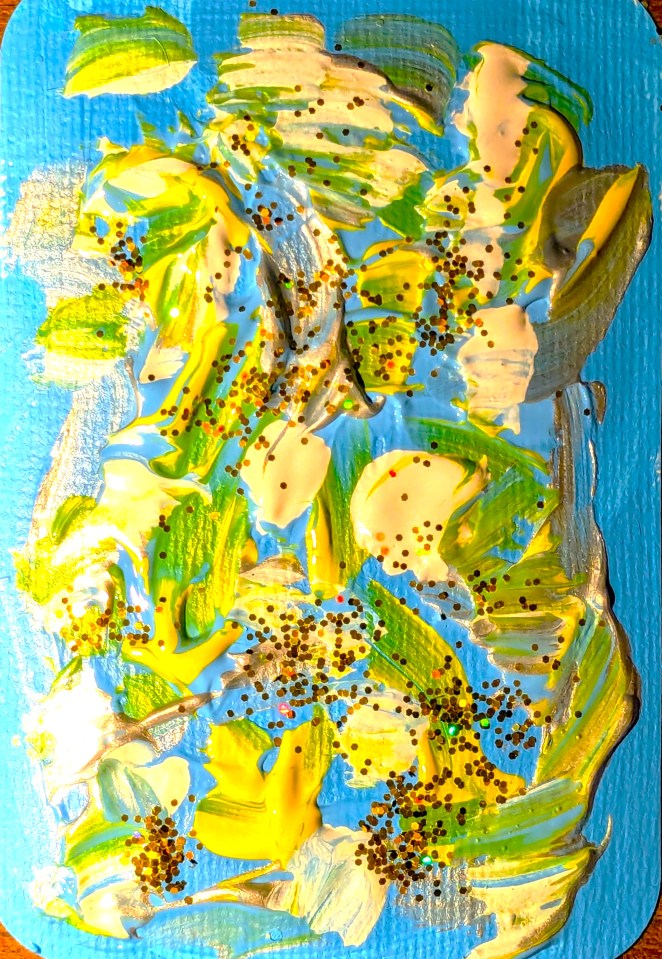
So, instead of a poem in words – a poem in colors and lines. I have portrayed several of my acquaintances and friends in the flower faces. Luckily, I am such a terrible artist that you will be unable to recognize yourselves! So choose one you like – and pretend that it’s you.

I hope this painting will cheer your day and bring some happiness and sunshine to you wherever you are.

What are you most proud of in your life?

Daily writing prompt
What are you most proud of in your life?

What are you most proud of in your life?

The young lady in the photograph above. We met, at a boarding school dance, in England, when we were both seventeen years old. We have been together ever since. Why am I so proud of her? Let me count the ways.

When she discovered my love of Spain and the Spanish language, she took time out from her own career in order to learn Spanish. When I asked her why she was learning the language, she replied ‘because if I am going to be with you, I want to share your life, and that means loving the things you love.’ We became engaged in Santander, Spain, on her 21st birthday. Then, the following year, when I received an offer to study and teach at the University of Toronto, she promised me that if I called her, she would come out and join me.

I called her as a Thanksgiving Gift from my Canadian family. She packed up her clothes and her career, bought a wedding dress, and travelled to Toronto that December. We got married on Christmas Eve. We had very little money. We didn’t have a wedding photographer. Nor did we have a honeymoon. I guess we never needed one. We had just enough money put by to last us until the end of January. So, First week of the New Year, she set out in search of a job. A qualified Diagnostic Radiographer, she was hired by the Doctor’s Hospital in Toronto, and she financed my graduate studies for the next three years.

Our next adventure was a Canada Council (as it was back then) Doctoral Fellowship that took us back to Spain where I completed the research for my thesis at the local library, with its trove of manuscript documents. We returned to Canada after two years, and took up residence in Fredericton, New Brunswick, where we still live. Her adventurous life led her to a certificate in accountancy, taken via a correspondence course. Then, she presented me with our daughter. We bought an American Cocker Spaniel and she started showing and grooming dogs, becoming Show Secretary of the Fredericton Kennel Club. She trained and groomed two Canadian Champions, an ASCOB (Willy) and a Parti-color (Smudge).

Our daughter decided she wanted to be a gymnast. Parents were requested to ‘get involved’ with the local club and my beloved became a gymnastics judge. She rose in the gym circles and became first provincial judging chairperson and then a nationally qualified judge, officiating at the National Gymnastics Championships and also at the Jeux du Canada Games.

She travelled with me to Oaxaca, Mexico, and fell in love with the Pre-Colombian Mexican Codices that we found there in abundance. She studied them carefully and then taught me all about them. I, in my turn, introduced them to my own students. When I took my first Multi-Media Courses at the University of New Brunswick, she followed them with me. The result was two-fold – our first web page which she built with with HTML, no templates in those early days, followed by our online Quevedo Bibliography. This, about ten years later, morphed into the online searchable data base that she built with the assistance of the technicians at the Digital Library in Harriet Irving Library.

Now, we are growing old together – such sweet sorrow. this Christmas we will celebrate 57 years of marriage. And yes, my beloved is still my most valuable Christmas present – and the person of whom I am most proud. I remember the old Worthington beer advertisement. “Behind every good man, there’s a good woman.” The cartoon shows a lady carrying a bottle of Worthington.

My beloved has stood behind me all my life. She has carried for me, not a bottle of Worthington, but the burden of assisting, helping, encouraging, supporting, carrying the load when it became too heavy for me. She has been a silent partner in so many ways, but one without whom I would be nothing.

The Dying of the Light

Rage, rage against the dying of the light.

The world has become such a dark place over the last three weeks or so. At times, I have despaired, lost hope, lost my faith, lost my creativity. Words have not come knocking on at my door. The eyes in my head have seen nothing to paint. Darkness, bleakness everywhere. And yet, light breaks where no light shines, as Dylan Thomas once wrote, and last night I started a painting. This morning I finished it and gave it a title: Rage, rage against the dying of the light.

Yesterday I managed to complete a couple of poems. I attribute this new found creativity to moving my muse out of my office and placing it in my bedroom where it can inspire me at night. It seems to have worked. My muse is a small carving placed between four pyramids. Pyramid power and the muse’s inspiration have brought light back into my world, the light of creativity.

We must band together, we creatives. We must inspire ourselves and then go on to inspire others. We must let the light of our creativity, our faith, our belief spill out into the darkness that surrounds us. Together we must stand united and our light will be a lantern that will enlighten the world, not with chants, slogans, and cults, but with the inner faith and the total belief that genuine creativity brings to the world.

Creatives of the world, unite. Rage, rage against the dying of the light. United together, we can, and will, restore that light.

Hide and Seek

Hide and Seek

Pictures and memories play hide and seek.
They hunt the slipper that hides in the words
that slither and slide across my page.

They long to emerge, fully formed, and to step,
without effort, into your mind. They want
to linger there, to baffle, taunt, and haunt you.

Digging through the verbiage, a thought,
a metaphor, a grouping of words will join and
rejoin. This is the grit that the oyster slowly shapes
into the pearl of great price that glows so bright.

Consider the opal. Plain at first sight, yet changing
color, shimmering in sunlight, a chameleon
adapting to mood and shadow, its moon dance
hovering, a butterfly over burgeoning blossoms.

Who could ever forget, once seen, star light
illuminating the bay, the moon gilding the sea,
those summer nights, our secret love flowering.

The veiled will unveil itself and tease its way,
its path over the sparkling waters of the bay.
Knock and it will open. Seek and you will find.

Comment: I had a specific, named place in mind when I first wrote this poem. Then I realized that my secret place was not necessarily the remembered place of other people who had undergone similar experiences. So, I removed the specific and made it generic.

I know you have been there, to your own special place. A warm summer night. Star light over a bay. Or maybe it was an estuary, or perhaps a river bank? The moon appearing, lighting up the waters. Walking, perhaps, hand in hand. Or sitting, as I remember it so well, in a late-night café, watching the night lights on the fishing boats, as the moon spread its golden carpet over the bay.