Carved in Stone 50

Carved in Stone
50

Here, in the castle of my own home,
I sit and write and patiently wait
for the enemy’s superior forces
to arrive and overwhelm me.

But death is not the enemy.
He is the friend
who has walked beside me
every day, since the day
that I was born.

I know him and I trust him,
though I am unaware
of when he will come to call
and I am ignorant of the shape
he will finally take.

Commentary:

Francisco de Quevedo, the 17th Century Spanish Neo-stoic and Metaphysical poet, wrote “the day I was born I took my first step on the path to death.” And so it is, with all of us. Sometimes we are able to choose our paths, sometimes they are forced upon us, sometimes they appear – with choices – and we make our selection and move on.

There are so many roads to travel. For Antonio Machado (Spain, Generation of 1898) there is no road. There is only a wake upon the sea – “Caminante, no hay camino, solo hay estela sobre el mar.” We must look back, to see where we have come from and where we have been. But there are many other possible paths, beside that of the sea – gravel paths, cobbled ways, log trucking roads in the Canadian Forest, cattle roads, transhumance roads, winding roads, straight Roman roads, roads that run up hill, down hill, or twist and bend following the paths of rivers.

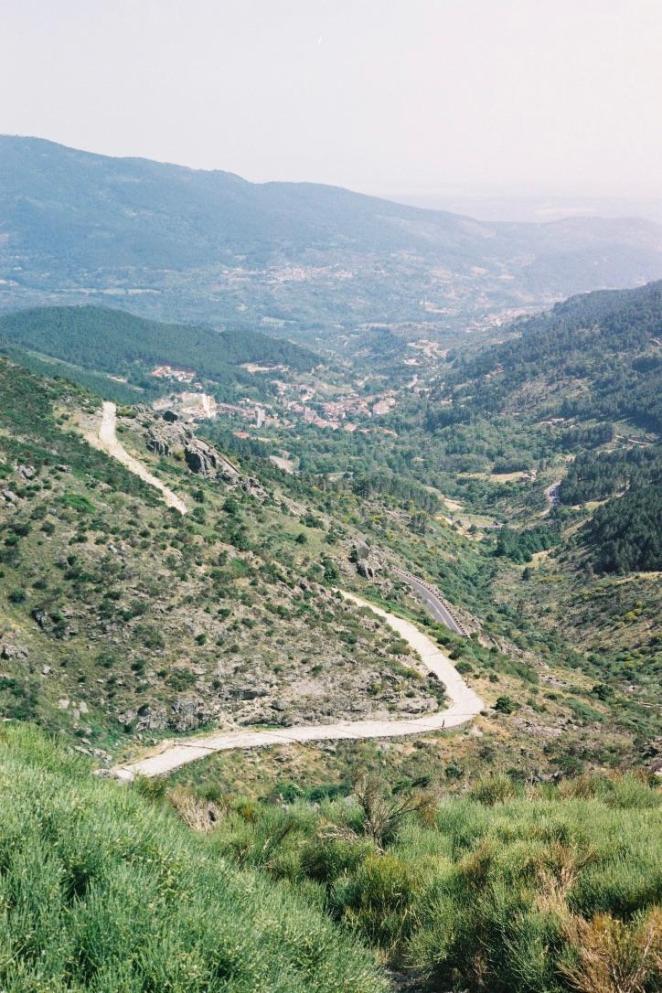
The picture above shows the old Roman Road that leads to the Puerto del Pico, in the province of Avila. It followed the contours of the hill and formed part of the Ruta de la Plata, the road that took Latin American silver from Seville to the Spanish capital in Madrid. Look carefully and you can see the modern highway that runs parallel to the old Roman road. Nowadays, that older road is used for transhumance, the movement of cattle from the valleys in the winter to the hills in the summer. The same road, the same pass, so many different uses, and the road a wake upon the path of so many lives.

Carved in Stone 18

18

Day-dreams, cloud castles,
châteaux en Espagne.

I climb the castle tower
in Segovia, and watch
Golden Eagles flying
in the air below me.

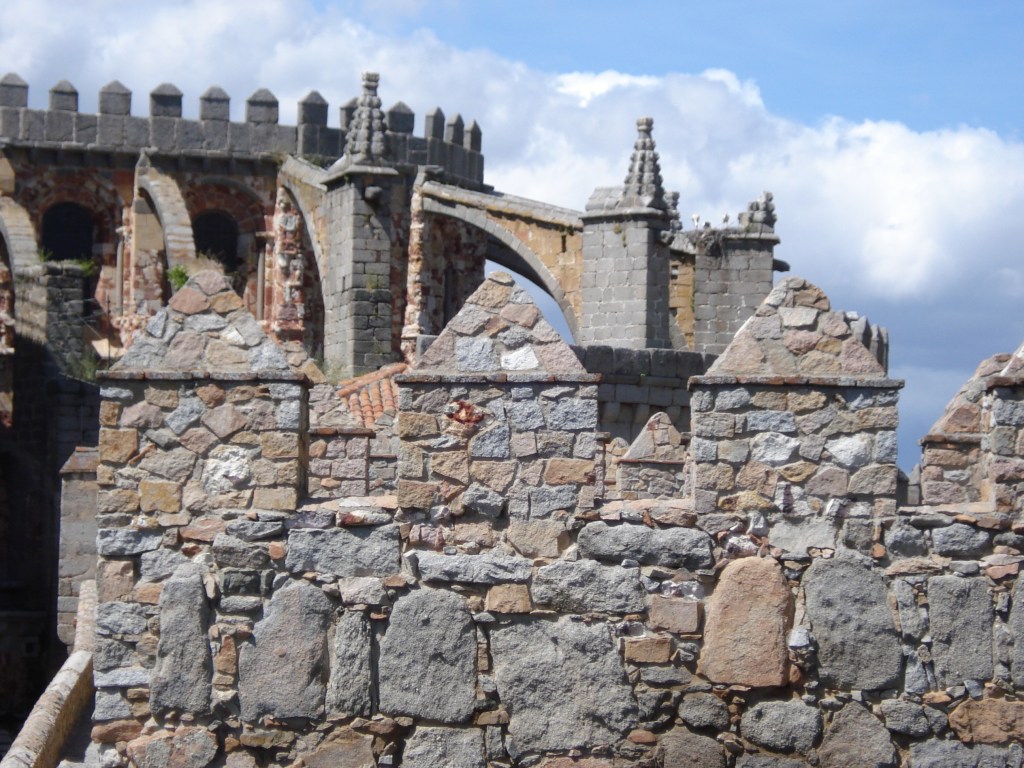
I walk the walls in Avila,
feel the stonework, warm in the sun,
and sense the passing of time
as it slowly gathers,
like clouds in the air
when they foretell a storm.

I trace masonic signatures
on the cathedral’s central façade,
and marvel at the master carvers,
who shaped the statues.


They also created angels
and the praying pay-masters
condemned to kneel there,
seeking forgiveness for their sins,
as flickering candles mark time.

Commentary:

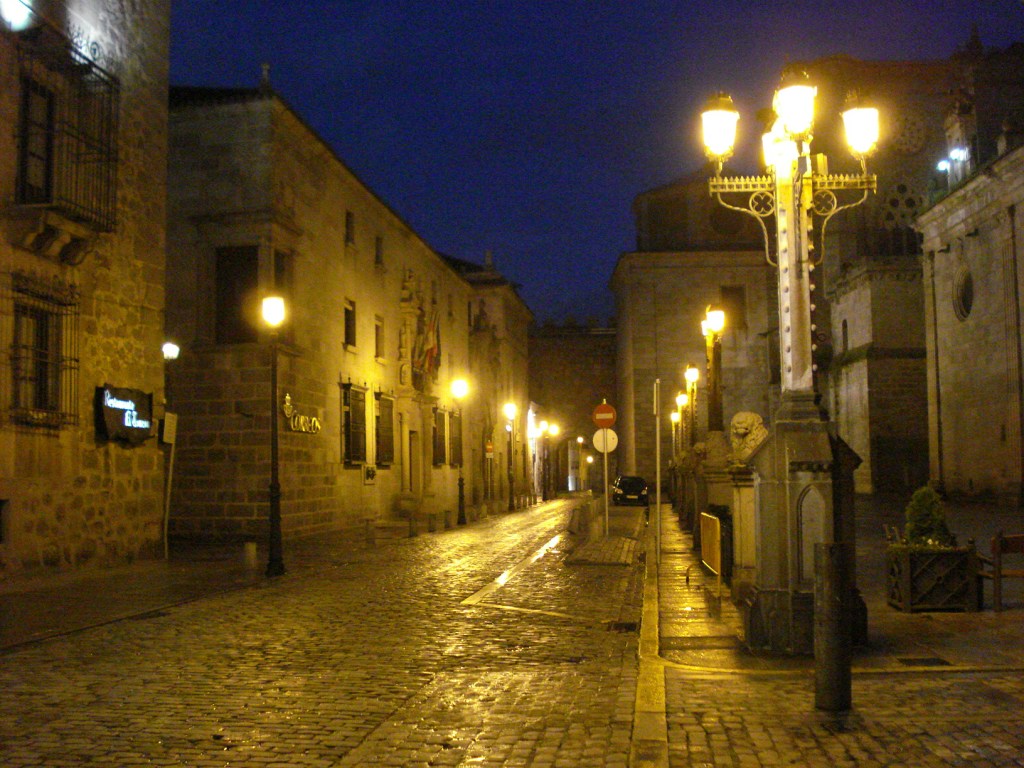
Avila: 3.8 kilometres of walls. 9 entrances. Inside the walls, the old city. I lived for three summers in El Rincon, a Hostal in the city centre just outside the Mercado Chico. I still dream of walking those city streets, visiting the bars each with its different customs and tapas. And I remember the tapas, each bar specializing in something different. The Rincon, a marisqueria, and I learned so much abut sea-food, its transportation, the ways of preparing and cooking it.

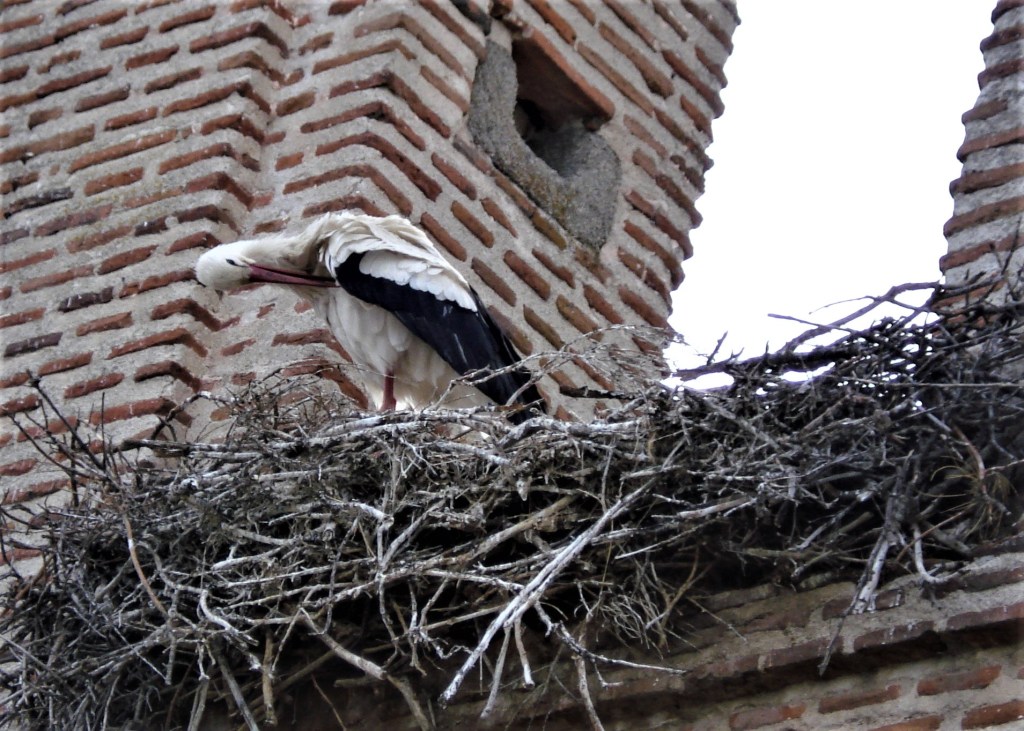
And while in Segovia, you look down at the Golden Eagles, in Avila, an eternity of storks looks down at you. I remember my friend, standing at the door of the Hostal and calling the storks, as they returned from a day in the fields, by the names of the churches in whose towers they built their nests.

I never thought those days would end, but end they did. As all things do. Now I must take a delight in the memories as they walk before me and call me by my name.

Carved in Stone 1

My very own hand-carved verraco
Del Rincon (Avila) a Roger

Carved in Stone

1

Behold me here,
filled with a sort of shallow,
hollowed-out wisdom
accumulated over decades
while listening with my eyes
to the words and thoughts
of writers, long-dead.

Imprisoned in book pages,
do they bang their heads
against walls that bind,
or hammer with their fists
at the barred lines
of their printed cages?

These spirits long to break free,
but they choke on library dust
and pollen from verbal flowers
that bloom unseen.

Those old ones avoided
the traps of temporal power,
or, once trapped,
gnawed off a precious limb
to limp into freedom

Commentary:

Carved in Stone is the second dialog (Chronotopos II) in my Bakhtinian Dialogs with my time and my place. Clepsydra is the first Dialog. You can follow it, in its entirety, starting with this first, introductory post.

Reception Theory – I write, you read. Any meaning that you extract from my poetry will depend on your own culture and background. Tolle, Lege – Take and read. Read slowly, and with care.

I am a poet, a dreamer, if you will. These are my dreams. Tread softly on my dreams, for when you enter my world, you mingle your dreams with mine. The result, I hope, will be an interesting intellectual blend of new creativity.

The hand-carved verraco, in the photo above, was given me by my friends in the Rincon (Avila) where I spent four happy and creative summers. Never forgotten. Blessings and pax amorque.

Clepsydra 33

33

… but the light cannot last forever
     so where do I go
          when the door in my head
               slams shut
         
then I know
     I have lost the key
          to my mind’s labyrinth
               I struggle
                    but I realize
                         there’s no escape

Ariadne’s thread
     the one that should lead me
          out of the labyrinth
               turns into a woven web
                     trapping me
                         leading nowhere

the minotaur
     half-bull – half-man
          bellows
               stifles all thoughts

my heart turns to stone
     indigestible
          in the throat’s gorge
               or the stomach’s pit
                    and my mouth’s
                         too dry to spit

in this starless night
     when fear descends with the dark
          a guillotine slices its way
               through muscle and bone
                    to sever all hope

no glow worm
     can worm its way
          into my mind
               to enlighten the path …

Commentary:

“… the minotaur, half-bull, half-man, bellows and stifles all thoughts …” I asked Moo for a painting of a Minotaur, but he didn’t have one. So I pottered about and found this photo of Los Toros de Guisando, a pre-Roman set of sculptures, in the Province of Avila, carved by the Celts. Not exactly a Minotaur, but certainly a set of taurine images that baffle with their size, silence, and presence. Indeed, they conjure up the images of the poem’s next verse ” … stone, indigestible in the throat’s gorge or the stomach’s pit …”

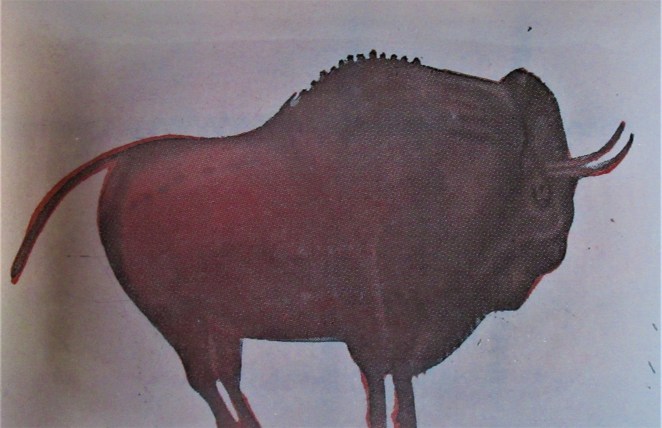
This is the cave painting, circa 5,000 BC of a bull, as found on the wall of the Caves of Altamira. Alas, he cannot bellow. Or should I say, Thank heavens, he can neither bellow nor pursue us. He stands silent on his cave wall. This photo comes from a glass ash tray my father purchased as a souvenir when we visited those caves (circa 1963-65, before they were closed to the public). Intertextuality – this bull as text and the long history of his multiple appearances. Metaphor and magic, mysterious and marvelous.

The idea that “religion is a glow-worm that glows in the darkness” is a metaphorical observation on the nature of faith. Its most famous expression comes from the German philosopher Arthur Schopenhauer. The statement suggests that religion appears most valuable and needed when people are in a state of ignorance, uncertainty, or despair.” Wikipedia – AI Generated. Our poet, that’s me, in case there are any doubts, refers back to this idea when he writes “no glow worm can worm its way into my mind to enlighten the path”. This too links back to the poetry of St. John of the Cross and his references to the dark night of the soul when hope seems lost and we despair of everything. Then we link to Goya’s etching – The Sleep of Reason – “when reason sleeps, monsters are born.”

However dark the night, someone has walked this way before us. We can follow in their footsteps and hope for the dawn. When it arrives, we can rejoice. But never forget the law of circularity, what goes round, comes round. Night will come back, the way will again be dark, but the light will always return once more. Images and symbols, metaphors and mystery, even the unspeakable can be spoken in the ways in which the ancient artists, sculptors, painters, saints, and philosophers have shown us.

Describe your life in an alternate universe.

Daily writing prompt
Describe your life in an alternate universe.

Describe your life in an alternate universe.

Ávila: A Brief Tour of the City

            Ávila is both a city and a province. The city may be new (walls constructed in 1058), but the province, like the city site, is old; it is older by far than the Romans, much older than the Christians, much, much older than the Muslims and Jews who once lived here. Blessed with water, it has a constant series of fountains and wells, some sealed, some flowing still, in streets and squares. More: it is a secret city, one of earth’s sacred places. The Celts built here, and here they worshipped their wild, pantheistic gods of tree, stone and sky.

            I came here by chance, drawn by the saint’s name as if I were a kite being reeled in from the skies. Often, in former days, I hurried past the city, heading to Santander in search of sun and sand with Ávila’s walls a blur as the train sped past. Then, when I finally had time to stop, I stayed and found sanctuary. There is a silence here, even among the voices; a truth that is built in the stone, not with the stone: a belief in water and rock that transcends Christianity and all the wonders of cloister and cathedral.

            This sequence of poems starts outside the walls of Ávila, in the surrounding countryside. Here there are mountains and valleys, bulls and cattle graze, mist hangs high on steep passes, and the tinkle of bells is heard among dry rocks as the tame goats scramble and the wild sheep climb ever higher. Outside the walls there are valleys and rivers, Roman roads, trade routes which have survived when the names of the tribes are long forgotten, their buildings tumbled down, their wives and children perished. Sometimes the land is magnificent; sometimes it is harsh and dry, the skeletons of older dwellings, their bones picked clean, now structured into newer homes. In places, a harsh, dry countryside holds a single tree, shaped like a parasol, with cattle standing in its shade. Dry stone walls march across the land, dividing field from field, tying the countryside down like a parcel. It is a land of boulders and saints, fought over for thousands of years with each stronghold tumbled down by the latest victors, then built again.

            When I came to the city, I was frightened by the mass of stone. I needed air and light and so I escaped the walls and discovered la ronda antigua. Here, overlooking el Valle del Amblés, I sat and studied the airfield from where, according to local legend, Von Richthofen’s planes took off in 1937 to bomb Guernica. I sat beneath the walls, in the sunshine, on the benches and watched the day’s cycle: the sun moving from left to right, the shadows changing position, the benches moving into and out of the sun, and everywhere, the swifts, knitting the sky with their wings, baptising the tourists from on high, and twittering in and out of the stonework. Above them all, the glory of storks, their wings motionless, hanging like kites just beneath the clouds, or soaring suddenly, borne away on the breeze. Beneath the wall walk, red roofs, grey stone, slates and tiles, cobbled walkways, fields turning into streets and houses as the builders build and the city grows outwards.

            Inside the walls, there are people and slowly but surely I came to know them. I knew the  barmen first, then the waiters and the serving girls, then the shop-keepers and the pharmacist, the policeman on duty, the workmen pulling up the cobbles. Then I met the painters and the poets, the artists who (re)create, again and again, the images on which I feed. I talked to the men and women who walk their dogs and follow them with tissues so the streets will not be stained. I praise the cocker spaniels, the great Dane, the wrinkled Shar-pei who guards the second floor balcony and woofs down at the world, the golden retriever, the English pointer, well-bred dogs, all of them. They are the finest that money can buy, and most are immaculately groomed. Finally, I make friends among the teachers and the walkers, the sitters and the families, the people who visit the same squares as I do, who shop in the same shops, eat and drink at the same restaurants and bars, the citizens who see what I see and take an interest in what I find so entrancing.

            Just outside the walls, but extending through them and into the inner city is La Plaza Grande, also known as La Plaza de la Santa. This area has been rebuilt recently and new buildings stand beside the old. This vast and open space is the training ground for young footballers who play soccer back and forth between the benches as their elders sit and sip coffee or meet for conversation on the benches around the square. During the World Cup, the youngsters act out their roles as super stars, galácticos as they are called by the followers of  Real Madrid. The players dribble, run, defend, attack, centre, corner and shoot at goal. They weep, cry out, appeal, fall to the ground, dive and roll on the stones, banking their shots and passes off trees and walls. Older men, formal and distinguished, sometimes stop to catch a stray ball then burst suddenly into a trot, demonstrate a pass curved with the outside of the foot, shedding twenty years as they do so, smiling, until called back to reality by the stern voices of the wives. Meanwhile,  the old women, arms linked, move through the players and their game, like ships in full sail skirting a harbour full of flotillas of smaller craft as they sail on, undisturbed, in their feminine armadas.

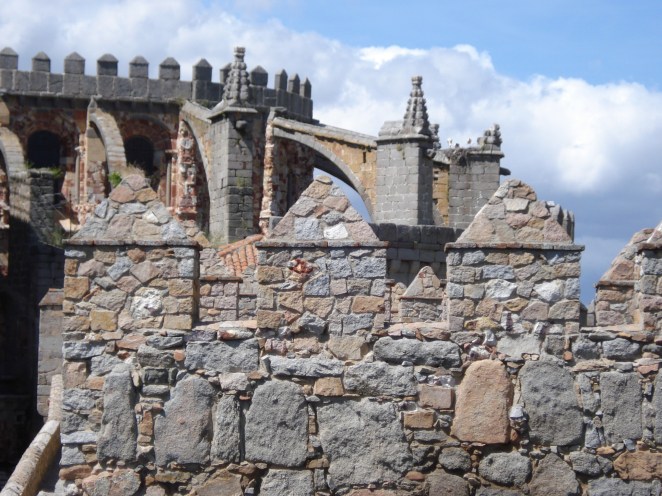
            The cathedral in Ávila is unique. It forms part of the fortifications and is built in and up as part of the city wall. Above the cathedral, on its pointed towers and battlements, a colony of storks looks down at the inferior world of human beings. Once upon a time, the storks returned to their nests  in the spring, raised their families, and departed at the end of July or the beginning of August, to avoid winter’s cold that creeps down from the hills to besiege the city. Now, however, the storks have found the garbage dump outside the city and forage there, long after their departure time, some of them remaining all winter as the world gets warmer. Tourists in the cathedral square strain their necks, looking upwards towards the storks who reign above them. Hawks fly in and out among the nests, young chicks duck down, and pigeons seek the protection of nook and cranny as the predators fly by.

Surrounding the cathedral is the cathedral square, La Plaza de la Catedral. Entering the cathedral itself, you must rub the polished toe of San Pedro, and make a wish. It usually comes true, but take care, the wise men say, with what you wish: fulfillment of the wish does not always bring the joys expected. Exiting from the cathedral, the Calle de la Vida y la Muerte is the narrow street on the left. Here, beneath a rugged, wooden cross, duels were fought, the winner returning home or fleeing into exile, the loser lying in the dust, staining the cobbles with his blood. On either side of the cathedral door, chained lions, and the wild and leafy green men of the woods stand guard.

            Down the hill from the cathedral, past the temple of Nuestra Señora de las Nieves with its wood and metal seat, is the Plaza de la Constitución which changes names according to the age and political commitment of the local inhabitants. Some call it the Plaza de la Victoria; others, the Plaza del Ayuntamiento; still others, the Plaza del Mercado Chico, or simply, El Mercado Chico. According to some, this was the central square of a Roman legionary camp; according to others, the Romans never lived here. Either way, on Fridays, a street market holds sway. Fruit and vegetables, pots and pans, soap and perfume, and, above all, the marvelous spices of the region and beyond: saffron and the various styles of pimentón de la Vera. Here, close to the Puerta del Rastro and the Sanctuario de la Santa where St. Theresa was born, is the emotional heart of the city. Here, within the four walls which surround the square, one can hear the buzz of El Zumbo, the great bell that deeply hums when it is gently rubbed. Here and in its near vicinity are small bars and restaurants, pavement cafes, pedestrian walkways, gift shops, clothing stores, cobbled streets, shop windows for window shopping, art galleries, tiny ultramarinos with their collections of wines, foods, fruit, bread, and cheeses, patisseries, florists, newsagents, churches, and schools, everything that makes the hub of a city strum with life.

            Next door to the Mercado Chico is La Plaza del Medio Celemín, also known as La Plaza de Zurraquín. Here, in one small corner of this smallest of squares, which is actually shaped rather like a trapezium, nestles the Hostal-Bar-Restaurante known as El Rincón. The Rincón is typical of all that is good in that older Spain which survives from my childhood memories: bars laden with tapas,  the richness of tortillas, the tang of queso manchego, tablas ibéricas with chorizo, salchichas, jabugo, and jamón serrano, and beyond that, a variety of tapas and tid-bits: percebes, langostinas, gambas, caracoles de tierra y mar, pulpo, calamares, sepias, and meats of all sorts: costillas, riñones, and callos. But El Rincón is not just a symbol of food. It is a genuine neighbourhood bar filled with local people who run the full gambit from knowledgeable, wise, witty, and well bred to bad-tempered (when the national team loses), ecstatic (when it or the local team wins), disappointed (when someone from Ávila gives ground in the Tour de France or La Vuelta de España), tolerant of friends and intolerant, as people usually are, of idiots and fools. It is a bar of breakfasts and lunches, of mid-morning coffees, of suppers and tapas, of cigarette smoke and lottery tickets, of gambling machines and cigarette machines, and of people with voices so loud that the cares of the day are all drowned out. 

            But El Rincón is much more than a bar. At night, when the guests retire to bed, the rooms of El Rincón are filled with dreams. These dreams knock at the windows and clamour at the doors. Sometimes the city’s secular saints appear, visitors from the past and guests from the future. These include the spirits of the place, the spirits that the Celts worshipped three thousand years ago. They are there in the wells, in the water supply, flitting between the walls, and settling on the head of the bed. The water of the wells attracts them, for, more than anything, they are spirits of water and rock who speak in dreams and talk of wisdom’s ways: how to sit in silence,  how to watch moss grow, how to feel the stone’s blood circulating far beneath its surface, how to sense the hands of the men who carved the stones, how to sit and look in the mirror and watch one’s hair turn white, one’s mind turn in on itself, and time walk slowly by. Not the time on the hands of the clocks, but the centuries of slowness that go into the making of seekers and saints, people like you and me, who drop in for a moment and are caught for a lifetime; people like you and me who turn off the television and listen to the sound of rain and snow, of water flowing, of the slow acceleration of dust as it sparkles in sunlight and gradually grinds down granite.

            Listen carefully. Sometimes at night you can hear the waters slowly rising and filling the well, that deep well within us, where dwells the wellness of spiritual being, the growth of spirit, the slow search, inwards always inwards, for the light that lives at the centre and fills us, slowly, like the gathering water, with love of living and joy of life. This is the love that can watch the sun move round the world outside and inside the walls; this is the joy that can be taken from a falling leaf, from a stork rising into the sky, from birdsong, from cattle grazing under a tree, from the silent dance of leaves, from the sticks of the stork’s nest, from children playing, from the voices that wake us from the very dreams they weave for us as we daydream or sleep.
The Way

The Way

Old Roman Road
Puerto del Pico


I sought the way and thought
I had found the way, but now
I feel I have lost my way.
Long walked I in shadow and sun,
hard Roman road beneath my feet.

Then I found bleached beach sand,
heard the sea-gull’s piercing sound,
walked sun-path, moon-path, bright
across a shimmering bay and knew
that by chance I had found my way.

Then came the way of ice and snow,
Hudson Bay parka, the ski way,
the snow shoe way of winter boots,
and still I believed, eyes wide open
that I knew I was still on the way.

Now my feet are old and slow.
Blood runs cold, bones ache,
head spins, heart is an ambush,
lungs throb and clutch at air,
head in hands I sit in despair,
hoping to be found,
draped over a shoulder,
brought safe to flatter ground,
comforted, and set again on my way.

Click for Roger’s reading on Anchor.
The Way

Driving at Night

Spotify:
Remember to scroll down to the appropriate audio episode.

Driving at Night

Once upon a time,
my hair was brown and curly,
but now it’s straight and as white as
this drifting snow clogging the windshield.

I smooth down my hair with my fingers:
swollen knuckles, crooked joints.
I burn with feverish thoughts
yet cold blood shivers through my arteries.

Headlights blind me in my good eye.
The other one’s useless when I drive at night.
It’s a long time since I last saw,
let alone touched, my toes.
Putting on my socks or tying my shoelace
is a morning no-no.

Short of breath, of agility, with no ability
to climb up stairs: I stop to catch my breath,
pause, and shudder with despair.

What happened to my youth?
Where did my childhood go?

Time

Spotify:
Remember to scroll down to the appropriate audio episode.

Time
A Theory of the Absurd

I wonder what I’m doing here, so far from home, sitting
at the bar, with my beer before me, my face distorted
in half a dozen fairground mirrors, surrounded by
people half my age, or less, all smoking, cursing, using
foreign forms of meta-language, gestures I no longer recall:
the single finger on the nose, two fingers on the forehead,
the back of the hand rammed against the chin with a sort
of snort of disapproval. It’s way beyond my bedtime, yet
I am held here, captured, body and soul, by foreign rhythms,
unreal expectations of a daily ritual that runs on unbroken
cycles of time: morning brandy, pre-lunch wine and tapas,
home for the mid-day meal, a brief siesta, back to the café
for a post-prandial raising of spirits, more blanco, then back
to work at four and struggle on until seven or eight when
the bar routine begins again with pre-supper tapas and tinto.
Time, comprehended in this new life-cycle, lacks meaning.
Time, in a cycle I have long abandoned, is absurd as well.

Memory

Spotify:
Remember to scroll down to the appropriate audio episode.

Memory

Marigolds, Oaxacan flowers
grown to guide the dead,
leave so many memories at my door.

Milk bottles placed on the concrete step:
every morning, sparrows peck holes
in the silver tops to drink the cream.

Memory:
its once open door
now slowly closes.

Keys no longer turn in the lock.
Sleep gathers in forgotten rooms,
falling like dust on silken flowers.

Shadows double themselves in the mirror:
recycled shades carve the shower’s glass.

Wary of shade and flame I bathe beneath
a dust-laden beam of sunlight.

Motes in my mind:
flesh and blood chessmen
playing their game
on checkered boards of day and night.

Black Angel

from an original painting by Rogier van der Weyden (1399/1400-1464)

Black Angel

You cannot hide
when the black angel comes
and knocks on your door.

“Wait a minute,” you say,
“While I change my clothes
and comb my hair.”

But she is there before you,
in the clothes closet,
pulling your arm.
You move to the bathroom
to brush your teeth.

“Now,” says the angel.
Your eyes mist over.

You know you are there,
but you can no longer see
your reflection in the mirror.

Comment:

I first saw the Black Angel in Aldebarán’s cultural store in Ávila (2006). She sat there, in the shop window, along with several other angels, and I worshiped her from the distance of the street. Her image was taken from an original painting from Rogier van der Weyden (1399/1400-1464). This was turned into a 3-D image and then converted into the statue I saw in the shop window.

I brought the statue back to Island View, placed it on the shelf above the fireplace, where it still rests, and wrote several poems on the theme of Angels. I gathered them together in a chapbook entitled All About Angels that I self-published in Fredericton in 2009. The chapbook was dedicated to Clare’s great-aunt, D. E. Witcombe who departed this world on October 15, 2008.

All About Angels was also based on a book of a similar title, Sobre los Ángeles, written by Rafael Albertí, one of the major poets of Spain’s Generation of 1927. I avoided the ambiguity of the Spanish title — Sobre (in Spanish) can mean Above or Beyond as well as About — by limiting my own title to All About Angels.

For Carl Jung, angels are the messengers sent to inform people of the state of their world. For me, they are also the wild creatures that inhabit the world around me and often take the form of chickadees, crows, mourning doves, woodpeckers, deer, foxes, chipmunks, the occasional bear, and other spiritual creatures. They can be best seen in those moments of solitude when we are most open to the natural world around us. Then, and sometimes only then, we can hear the urgent messages they bring.