So, the writing is back. I have reformatted The Nature of Art and the Art of Nature and am now checking it through one last time before I send it to the publishers. This feels good. I haven’t stopped painting though. Luckily the original, hanging on the wall, looks better than the photo. My angles are all wrong and the colours are definitely not as sharp as in the original. As I always said, when introducing Spanish Art via slides and photos: “Do not trust the imitations. Go back to the original.” Easier said than done, especially when the original may be tucked away in a foreign museum hidden in a small town. As Dylan Thomas once said of Swansea Museum: “it’s the sort of museum that ought to be in a museum.”
As for the Introduction of Art, and please note I do not write ‘the teaching of art’, here’s my article on my career as an art facilitator! ‘In the beginning was the picture and the picture was in the book.’ I guess my art career ran parallel to my career as a facilitator of Spanish literature, prose, theatre, and poetry. Some things you can present and introduce. But no, you cannot teach them, not unless you are completely without humility and understanding.
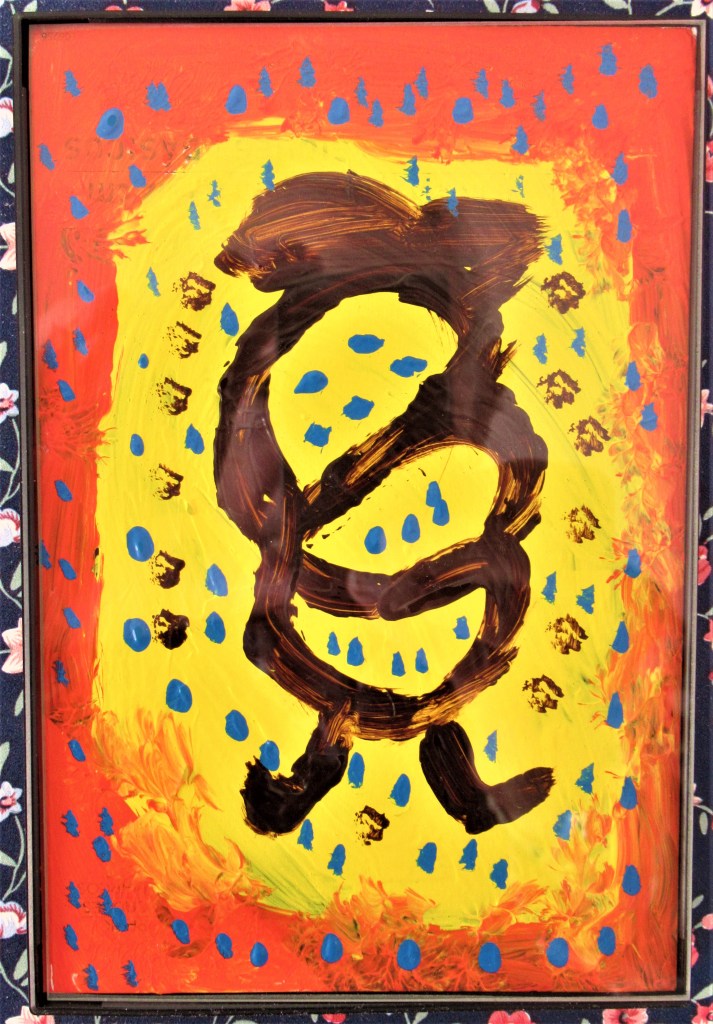
This is a painting inspired by one of Messiaen’s works: Visions from Beyond. His music inspired me to write the Meditations on Messiaen, and I have posted several of those poems on this page. For me, creativity is continuous: verbal and visual. The visual includes painting and photography, the verbal, short stories, poems, and short philosophical pieces on life and art. This is the link to the first poem from the sequence entitled Visions from Beyond. I should add that the audio reading is part of what I call creativity too: audio, visual, verbal. The complete package.
My Thursday thought: I feel that I have been blessed. To be able to see, speak, write, hear, and express some of the beauty of this world around me. I know there is ugliness out there, sickness, ill health, poverty and despair. So far, I have been spared. “Why me?” I think to myself, “Why me?” Then I cease to question and I just say “Thank you” to the Spiritus Mundi and to the Muse when she descends.
Every morning, when I wake, my mind runs through some of the hymns I used to sing as a child. “Songs of praises, I will ever give to Thee.” “Laud, bless, and praise Him all thy days, for it is seemly so to do.” “Good Shepherd may I sing Thy praise, within Thy house forever.” Meanwhile, until that time comes, I will do my best to celebrate and sing the beauties of this world in the oh-so-limited ways I know best, poetry and paint!
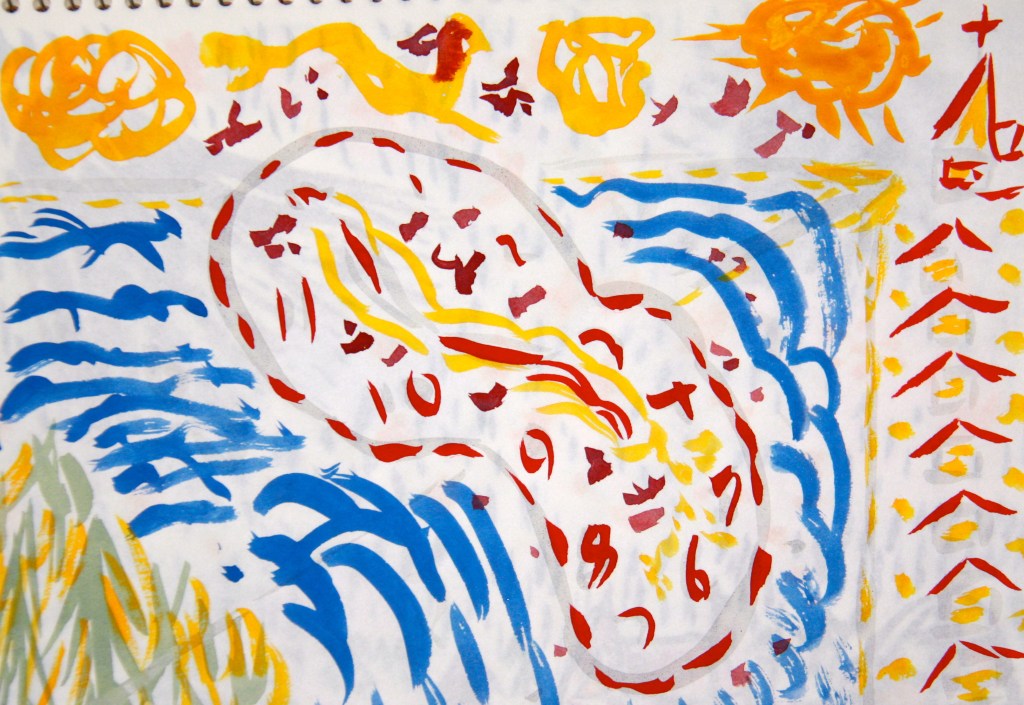
Jackson Pollock it ain’t. But just look at those fledgling storks launching themselves into the air. And yes, those are their nests!
Spotify Scroll down to appropriate episode.
Bird’s Nest Jackson PollockNo5 (1948)
This bird’s nest starts with a startling tweet that wins a trilled, thrilled response. A flutter of heart-string wings, creator, viewer, join
with the creation. Thin threads of life mix and match their tangled weave, existential tapestry, fathered in a feathered nest.
World without end, this labyrinth without an entry point, without a beginning, with a spaghetti-thread middle that meets
not in a breath-catch of the mind, but in a brush-flick of coloured rain, a cycle recycled of circled paint, circular
in its circumnavigation, its square eight by four-foot globe of a new world whirled in stringy whorls, reinvented beauty
drawn haphazardly from the bicycle tour de force of this artist’s inner mind.
Comment: This is a tongue-twister of a poem, much as Jackson Pollock’s painting is a twisted vision twisting the viewer’s eye. And, no, it is not easy to read. Nor is the painting easy to view. Click here for a link > Jackson Pollock < to the painting. Click here for a link to Alejandro Botelho’s reading of < My Grandfather >. Note that Alejandro’s reading of My Grandfather begins at 17.58. And note too that the other poets are also well worth listening to. Once again, thank you for this, Alejandro: your work is very much appreciated.
Spotify Remember to scroll down to the appropriate audio episode.
Sculptures in the Gardens
It’s the only sculpture garden in Canada. It may even be the only one in the world in which the sculptures shake off their shackles and come alive at night when the moon hangs heavy in the sky and shifting shadows prowl beneath Kingsbrae’s trees. Deadly nightshades, roaming with no thought for the humans who walk around by day taunting these sculptures, thinking they are lifeless, mere images set in stone.
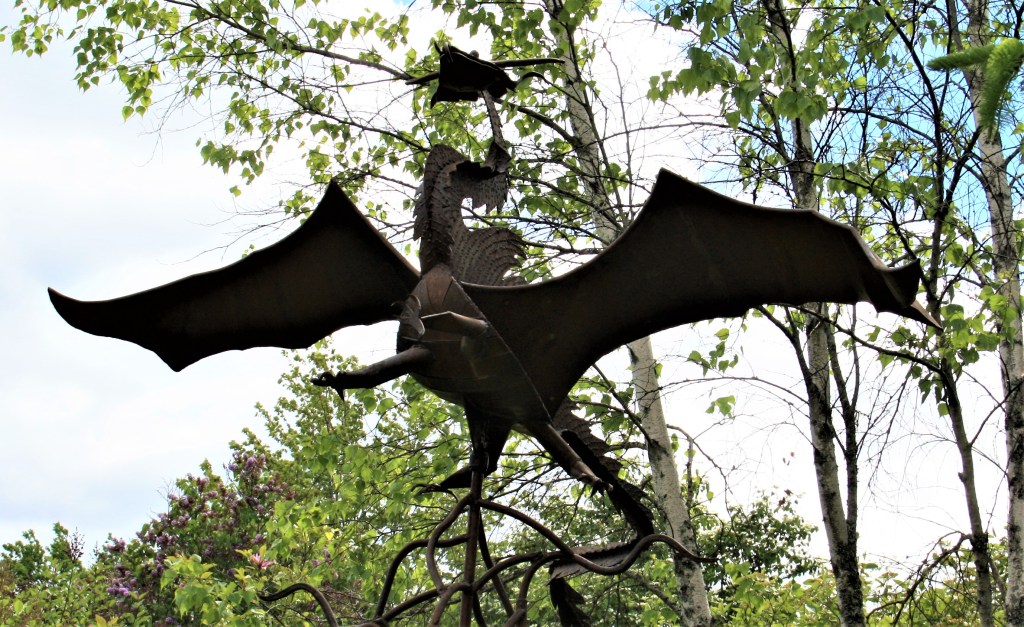
Beard not the lion in his den, nor the fox running wild, nor the chubby bear whose clumsy run belies his speed and strength. The dragon opens iron wings, but beware of the hot forge lodged in the snap-dragon’s mouth.
Have you seen the cerulean whale, marooned and ship- wrecked on these foreign soils? Once upon a time, in a fairy tale, he roamed the seven seas and plundered men and ships with abominable ease. Ease and the easel, plein air paintings, sculpture portraits taken from life and converted to a ship’s canvas that will never sail.
Ask not who is that bearded man, for he might be the one Don Juan invited to supper. Ah, the hard rock ship-shock when with a thunderous knock he arrives, an unexpected guest, at the coward’s door. And shake not his hand lest his fearsome grip turn you to stone or drag you down to hell.
Remember to scroll down to the correct audio episode.
Dalí ‘s Clock Salvador Dalí
A clock, a sheet hung out, strung out, on a canvas washing line. No wind, no pegs, soon to be sun-bleached, dried, then folded in on itself, corner to corner the sheet, and the watch, how will it fold?
Face to face, in half circles, perhaps, or back-to-back with time cut in half, a tick without its companion tock, a stutter of time, halved, then quartered, then in an eighth, a quesadilla of broken springs and tiny wheels within wheels, all disjointed, with glass fragmenting, shattering.
While we watch, our clockwork universe disintegrates before our eyes, in a tiny explosion as all chronological creation implodes into a logic of carnival, absurd our words and world, devoid of meaning, a pocket-watch going over a waterfall, a timepiece soon to break into rusty pieces, painted by a man who dreams he isn’t mad.
Click on the link below to peruse my books for sale.
Jane gave me the honor of writing the foreword to her book and I did so with great pleasure.
Jane Tims: Niche. KDP. Book Review
Niche, the fourth poetry book published by Jane Tims, is a neat configuration of six segments that elaborate and illustrate the poet’s original definition of the multiple meanings of her title word niche. It is very difficult to separate the author from the act of narration as her keenly observed and skillfully executed drawings, together with their verbal representation on the page, are so autobiographical and so much an extension of her artistic and professional abilities that the objective separation of writer and text is scarcely possible. It is hard to forget that Jane Tims was, and to a great extent, still is, a highly competent professional botanist. The harnessing of the professional botanist, with her unique drawing skills and scientific knowledge, to the poet and auto-biographer is a key factor in the reading and interpretation of this text in which acute observation blends with an intimate knowledge of the observed botanical world, both flora and fauna, and this allows the poet, in her role of poetic narrator and lyrical voice, to weave a network of poems that are, at one and the same time, objective and intensely subjective.
The author emphasizes this when she writes in the Preface that “In biological terms, the niche is the quality of a space occupied by a living thing, the sum total of physical, nutritional, biological, psychological and emotional needs gathered together in one place.” She also reminds us that in human terms “niche can be a metaphor for home, community or personal space” and it is within these metaphoric spaces that the poetry text is elaborated. The text becomes a linked mixture of visual drawings, iterative thematic imagery and associative fields, all centred on the multiple meanings of niche. These terms are both biological and human in nature and the poet’s named world meets at this juncture between the human and the natural.
The section occupying space (1-19) bears the subtitle satisfying need and begins with a setting out of what this means in the following 12 poems and 4 accompanying drawings. The poem ‘apples in the snow’ with its companion drawing stands out for me. The section strategy, subtitled solidifying position (21-43) outlines in poetic terms, how plants, animals, and humans ensure their own survival. The section praying for rain, subtitled, avoiding danger and discomfort (45-68), offers views on discomforts and dangers. It also opens the discussion—relocate or stay where we are? The section mapping the labyrinth or places I have occupied (69-83), which contains the wonderful sentence “When I get lost on the road ahead, I look to the road behind me,” throws open the multiple meanings of home. The section new ways for water, subtitled coping with change (85-98), offers a double landscape, first, external, the things seen, touched, examined, remembered and described, and then the internal landscape that reflects upon them and is reflected in them. Finally, forgetting to move, with its subtitle getting comfortable (99-111), presents an autobiography that links observer (the twin personage of author and narrator) to observed (nature, both flora and fauna, and the added element of autobiography and self) via the symbiotic relationship of botanist to botany.
Two moments stand out for me. (1) Sadness is in seeking the space that is never found. (2) Loneliness is in trying to return to a space once occupied but no longer available. The whole concept of the Welsh word hiraeth is summed up in these two lines. Carpe diem, Jane Tims’ poetry indeed seizes the day and, with its minute, intense observation, it preserves so many precious moments. It also pays attention to that which has been lost, those moments that are irretrievable. They will vary for each reader, but hopefully, like me, you will take great pleasure in discovering them for yourself.
Comment: Brian Henry of Quick Brown Fox picked up this review and published it on QBF. Thank you, Brian and thank you Jane, you both do me great honor. Here’s the link: Niche on QBF 14 March 2021
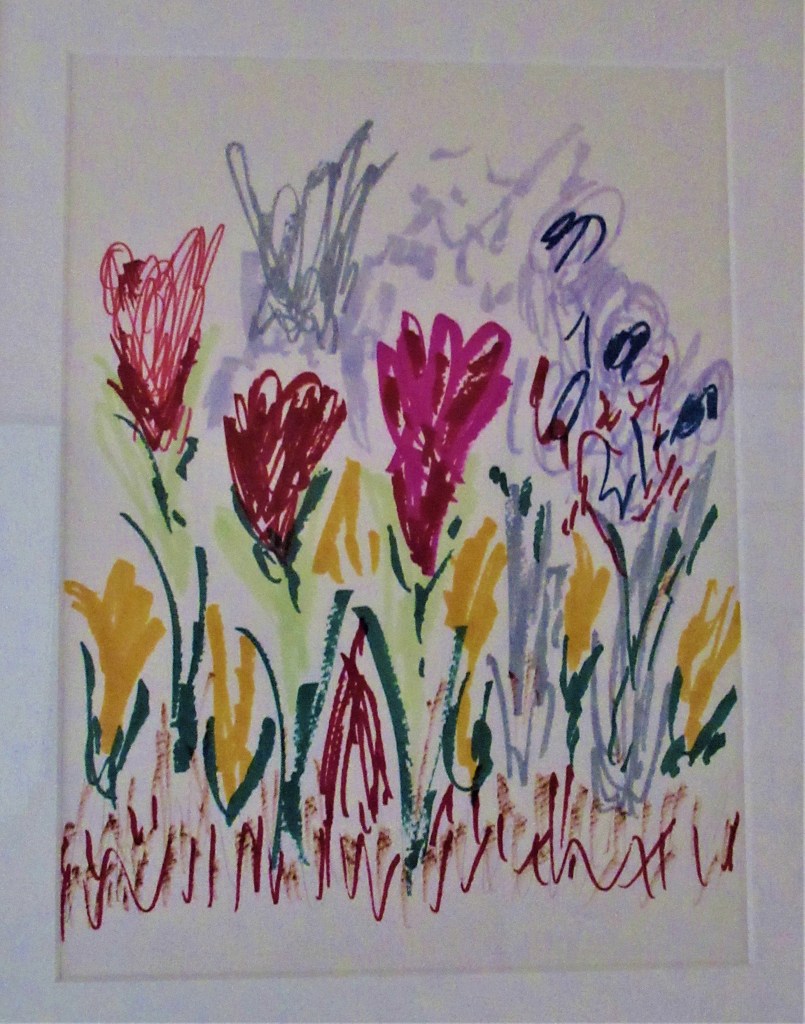
These daffodils were not painted by an unknown painter, but by a painter whose paintings are unknown. There is a subtle difference. There is also something sweet abut covering a blank space with color and shape, even if the hand is unsteady and the eye unsure. This painting is also unframed and belongs in a photograph album or a long-forgotten painting book.
“Fair daffodils, we weep to see thee.” Indeed we do, for they are so transient lasting but a week, or less, cut and placed on the table in a vase of water. So sad to watch them as they stiffen, turn slowly brown, dry up, and then hang their heads in the shame of old age. We are not so dissimilar, those daffodils and me. This photo will capture me forever, or until it is erased, because a photo isn’t a photo anymore. That painting will capture those daffodils too, for little while, until my subscription to the blog runs out and I forget to renew it.
“Poor daffodils, we weep to see you.” But weep not for us, they tell me. Our day is done. Our life is fulfilled. We have brought beauty and scent, however brief, and we have given light to enlighten your daysand joy to light up your heart. And that, I guess, is the message. “Gather you daffodils while you may, for Father Time is flying. And those sweet blooms you pluck today, tomorrow will be dying.”
Thus it is during the Corona Virus 19 pandemic, and thus it was during the Spanish Flu, the Black Death, and all the other plagues that have come to bring understanding and make us see reason. Our lives are as short as the lives of flowers. Seize your life, hold it in both hands, admire it, enjoy it, make the most of the mall things, for they are often, like the smiles of small children and the daffodil’s golden glow, the most important things of all.
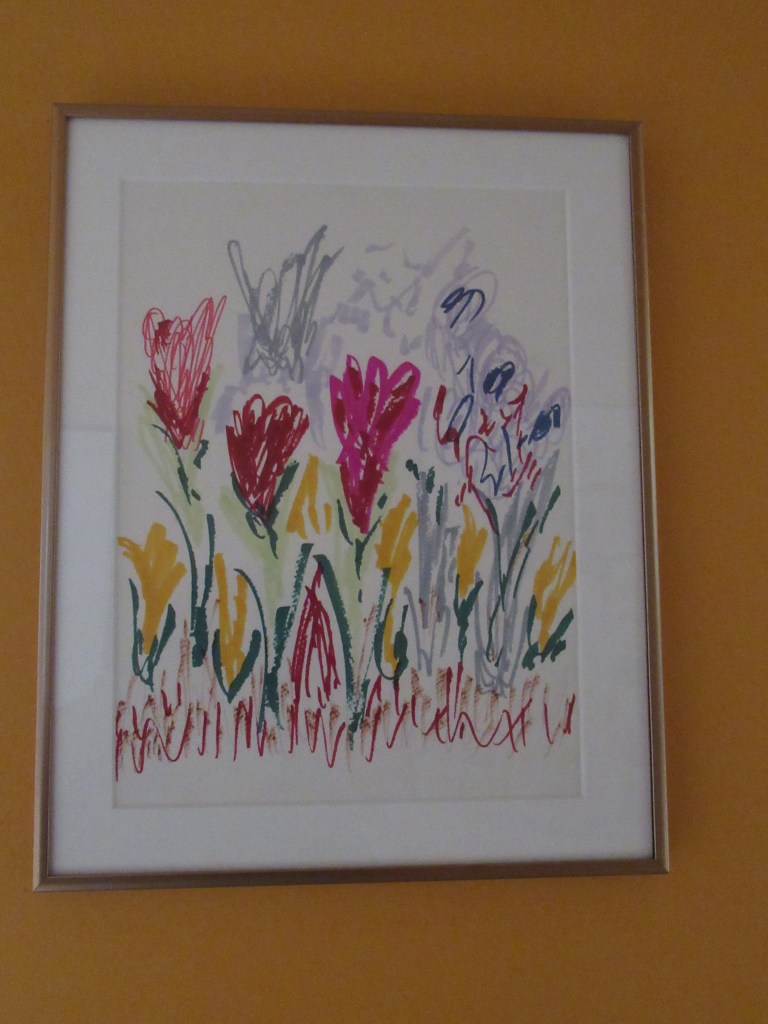
“The flowers that bloom in the spring, tra-la, bring promise of merry sunshine …” Gilbert and Sullivan, from The Mikado, if I remember correctly, and not at all anonymous like the Anonymous Bosch artist who painted this painting. Still, I like it, and it certainly lends a little bit of color to the pale cheeks of these walls.
“And we merrily dance and we sing, tr-la, as we welcome the promise they bring, tra-la, of a summer with roses and wine …” I can remember my grandfather singing that in the kitchen in Swansea. He would conduct with one hand, and encourage me to join in with the other. And I did. Merry days, they were, before the fire in winter and out in the greenhouse in early spring.
So, where have all the flowers gone? Gone with the grosbeaks, everyone. Which reminds me, I saw an Evening Grosbeak at the feeder this morning. The first one in years. There used to be several nesting nearby and they were regular visitors, as were the Gray Jays, aka Whisky Jacks, aka Gorbies, aka Ghosts of the Woods and all of them long, long gone.
Will they naw come back again? Who knows? The world is changing even as I sit at my window and watch it go by. February, March, April, May, June, and now July. The lock down has been lifted, but the fear of going unmasked in the great outdoors is still with us, as are the anonymous givers of the virus, a donation I do not want, and nor does anyone else, in their right minds, compus mentis, and not yet willing to on the anonymous ranks of the Gorbies, the Grosbeaks, the Swallows, and the other birds that have fled elsewhere, leaving our yard to the crows, the blue jays, the squirrels, the chipmunks, and the occasional more colorful visitors.
“Ah, would some power thegiftie ge us / to see ourselves as others see us.” Robbie Burns, a Scottish Poet.
And sometimes I think the flowers would like to be seen as they see themselves, not as we see them with our imperfect eyes, not with the cataracts of the Elderly Monet, not with the blunted vision of many artists who have stopped, and sniffed, and bent their heads, and wondered at the colors that entered their paint brushes through the nostrils. Vision and reality: the photo versus the objects as we see and sense them. The reality versus our own version of it.
So who is this anonymous artist who delivers these visions to my blog and allows me to glimpse alternate realities that are so different to my realities. I think of Lorna Crozier, The Garden Going on Without Us. I think of Kingsbrae Gardens, at night, when the flowers are alone and talk only to themselves. I think of Monet at Giverny as his vision lessened and his instincts grew. Who are we? What are we? Do we see ourselves as others see us? Do others see what we see? Color, shade, light, hue … El ojo que ves no es ojo porque lo ves, es ojo porque te ve / the eye you see is not an eye because you see it, it is an eye because it sees you (Antonio Machado). Does the man or woman looking out at us from the television set see him or herself as we see them?
The night before last I sat alone in a hotel room. The television screen was much, much wider than it was high. All the facial images were greatly distorted. I didn’t recognize the people I saw, except by their voices. Who will distinguish the reality of the flowers, each by each and one by one, privatim et seriatim? Who will listen to their floral voices and call them by the names they have given themselves, rather than by their horticultural names?
Tell me, what reality do we see when we see the flowers? What reality do the flowers see when they see us? The anonymous painter who painted this picture that Geoff Slater, my anonymous friend, framed so nicely did not see those flowers the way that I saw those flowers. Why not? Why can’t I see like him (or her)? and why can’t she (or he) see like me?









 rogermoorepoet