Nunca llueve en los bares / it never rains in the bars.
Sympathetic Magic aka Rain Stick Magic
“Rain, we need rain.” The bruja whirls her rain stick. Rain drops patter one by one, then fall faster and faster until her bamboo sky fills with the sound of rushing water.
An autumnal whirl of sun-dried cactus beats against its wooden prison walls. Heavenwards, zopilotes float beneath gathering clouds. Rain falls in a wisdom of pearls cast now before us.
Scales fall from my eyes. They land on the marimbas, dry beneath the zocalo‘s arches where wild music sounds its half-tame rhythms, sympathetic music released, like this rainstorm, by the musician’s magic hands.
Comment:Bruja: witch, witch doctor; Oro de Oaxaca: mescal, the good stuff; Zopilote: Trickster, the turkey vulture who steals fire from the gods, omnipresent in Oaxaca; Marimbas: a tuned set of bamboo instruments. But you knew all that!
I walk past the Jesuit Church where the shoe-shine boys store polish, brushes, and chairs overnight. I walk past the wrought-iron bench where the gay guys sit, caressing, asking the unsuspecting to join them.
Nobody bothers to ask me for a match, for a drink, for charity, for a walk down the alley to a cheap hotel.
The witch doctor is the one who throws the hands of all the clocks into the air at midnight, in despair. He’s the one who leaves this place, and returns to this place, all places being one.
The witch doctor sees little things that other men don’t see. He reaches out and flicks a fly away from my nose. “It too has lost its way,” he sighs.
I think I know who I am, but I often have doubts when I shave, rasping the razor across my chin’s dry husks. The witch doctor, my lookalike, my twin, stares back at me from my bathroom mirror.
Three witches dance on the waning soap dish. One spins the yarn, one measures the cloth, one wields the knife, that will one day sever the thread of I, who the same as all poor creatures, was born only to die.
You too must one day look in that mirror, oh hypocrite lecteur, mon semblable, mon frère.
Comment: My thanks to all those who click on earlier poems and express their liking for them. I am particularly pleased when an earlier poem lacks a voice reading. Then I can revisit it, rethink it, rewrite it, record it, and speak it aloud. Here’s the link to the earlier version of the poem Charles Baudelaire. Fast away the old year passes, and we must renew ourselves, our thoughts, and our poetry for the new year soon to be upon us. To all my readers, old and new, welcome to that world.
Angel Choir (on seeing the Northern Lights at Ste. Luce-sur-mer) Sonnet
Listen to the choristers with their red and green voices. Light’s counterpoint flowering across this unexpected son et lumière, we tremble with the sky fire’s crackle and roar.
Once upon another time, twinned with our heavenly wings, we surely flew to those great heights and hovered in wonderment. Now, wingless, our earthbound feet are rooted to the concrete. If only our hearts could sprout new wings and soar upwards together.
The moon’s phosphorescent wake swims shimmering before us. The lighthouse’s finger tingles up and down our spines. Our bodies flow fire and blood till we crave light, and yet more light. We fall silent, overwhelmed by the celestial response.
When the lights go out, hearts and souls are left empty. Leaving the divine presence is a gut-wrenching misery. Abandoned, hurt and grieving, we are left in darkness.
Comment: The Spanish mystics, St. John of the Cross, and St. Teresa of Avila, wrote, in the sixteenth-century, about the ‘dark night of the soul’. That dark night also arrives when the communion with the spiritual finishes and the communicants are left alone, in their loneliness, abandoned to their earthly selves. To leave the divine presence is a heart-breaking, gut-wrenching misery. To turn from the marvels of nature can produce lesser, but still deeply moving feelings of grief and sadness. The secret is to preserve that joy and to carry it with us always, warm, in our hearts. Doing so makes the pain of separation much more bearable.
How do you frame this beaver pond, those paths, those woods? How do you know what to leave, what to choose? Where does light begin and darkness end?
Up and down: two dimensions. Easy. But where does depth come from? Or the tactility, the energy, water’s flow, that rush of breathless movement that transcends the painting’s stillness?
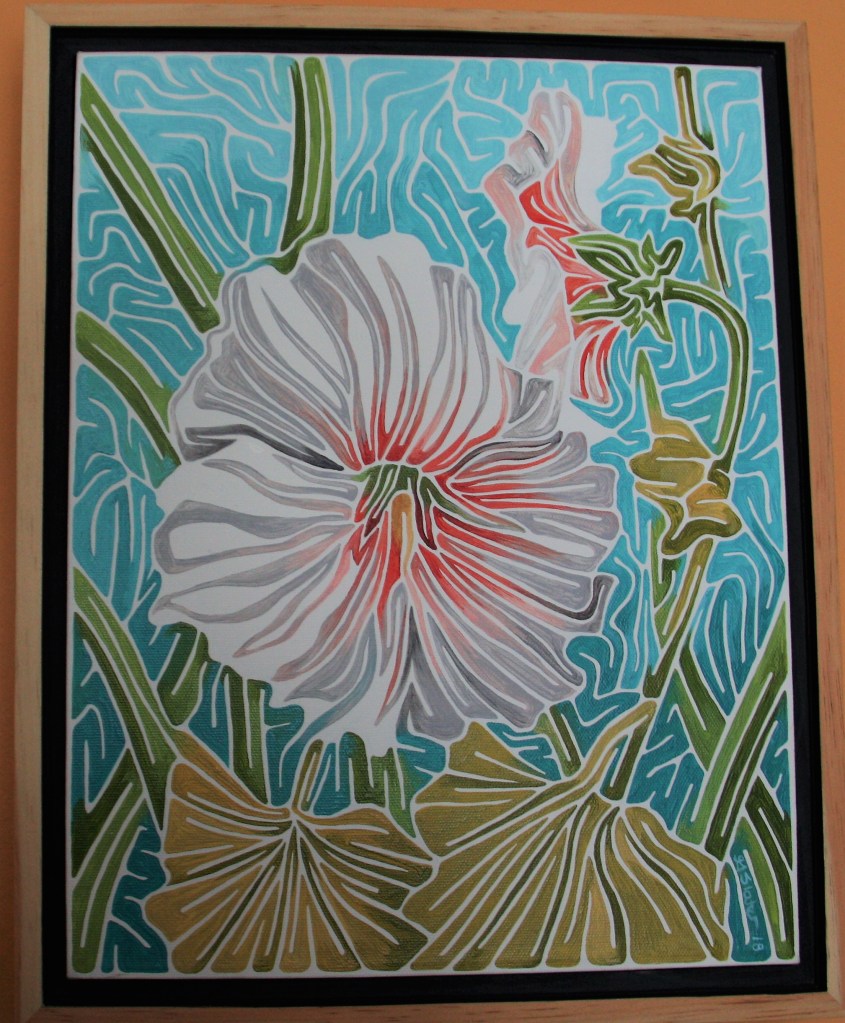
So many questions, so few answers. The hollyhock that blooms in my kitchen is not a real hollyhock. Intertextuality, visible and verbal: this is a poem about a painting of a digital photograph of a hollyhock, a genuine flower that once upon a time flourished in my garden.
A still life, naturaleza muerta in Spanish, a nature morte in French, a dead nature, then, portrayed in paint and hung alive, on display, in this coffin’s wooden frame.
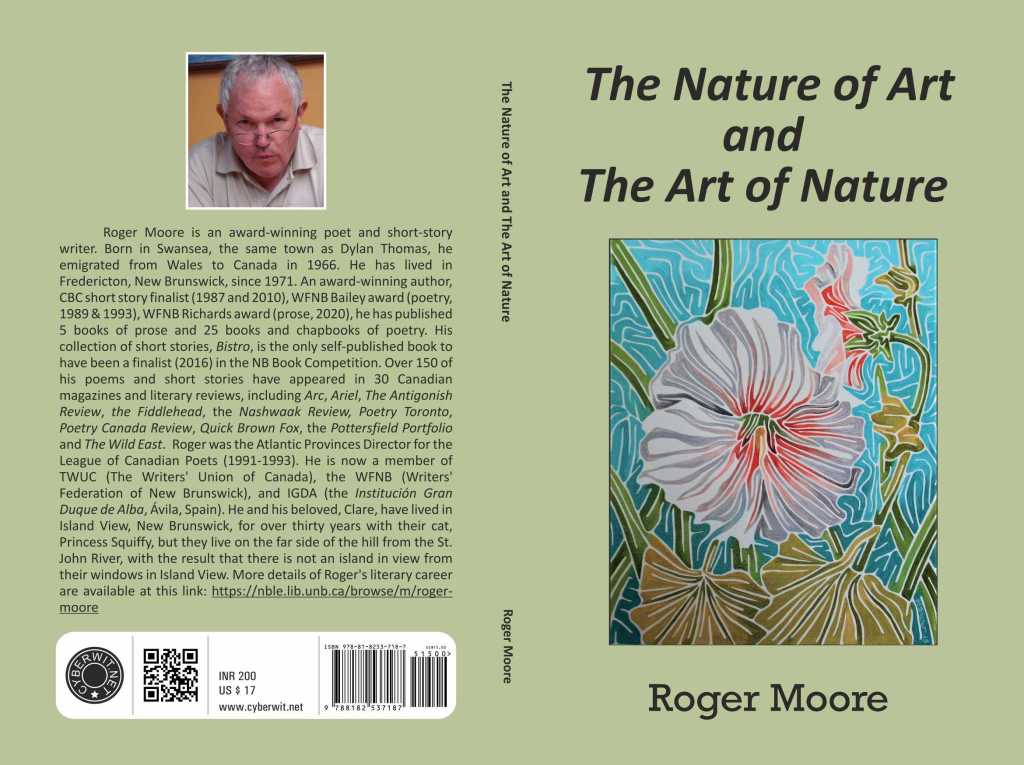
Comment: Back home in Wales, Christmas Day was for family and Boxing Day was for friends. I guess the same traditions still exist here in Island View. And what better friend than Geoff Slater? I met him in 2017 at the first KIRA residency and we have been friends ever since. We have worked on so many projects together: painting, creative workshops, videos, sound recordings, poetry, and short stories. He has illustrated several of my books, McAdam Railway Station, Tales from Tara, Scarecrow, and I have put some of his drawings to poetry, Twelve Days of Cat. Last, but by no means least, his painting of a hollyhock from my garden appears on the front cover of my latest poetry book, The Nature of Art and the Art of Nature (Cyberwit, 2021). The title of the collection, incidentally, came from sundry discussions we had on the nature of art and the Prelude: On Reading and Writing Poetry (pp. 7-31), was written at his suggestion. Poems to Geoff can be found on pp. 43, 44, and 61-62 of The Nature of Art.
So, Boxing Day is for friends. And I dedicate it to Geoff Slater and all the many friends I have made in KIRA, Kingsbrae, and throughout my multiple meanderings through the realms of academia, coaching with the NCCP and the NBRU, researching in communities like the ACH, the AATSP, and the MLA, various editorial positions on academic journals like the IFR, BACH, STLHE Green Guides, STLHE Newsletter, La Perinola, AULA, CJSoTL, Canadian Modern Language Review, Calíope, translating for different associations, including the Discalced Carmelite Nuns in St. Joseph’s Convent, Avila, and volunteering with STLHE and the 3M National Teaching Fellowship. To all those friends out there, including my friends and e-friends in TWUC, the LCP, and the WFNB, and those on Facebook, my blog, and my online Skype and Zoom courses and meetings, plus, of course, those I know via Quick Brown Fox, you are not forgotten. Here, for you, on Boxing Day, is a hug or a wave of the hand and a great, big thank you for being there.
Selection of my books on the sea-shore at Holt’s Point.
Wishing all my followers a wonderful Christmas and let us hope that the New Year brings us some relief from Covid-19 and all the ensuing vicissitudes. Sunny here in Island View and coldish, but not too bad. A tiny sprinkling of snow, so we qualify for a White Christmas – una blanca navidad.
AMGD: The full phrase attributed to St. Ignatius of Loyola, the author of Ejercicios espirituales / Spiritual Exercises and the Founder of the Jesuits, is Ad maiorem Dei gloriam inque hominum salutem or “for the greater glory of God and the salvation of humanity.”
So, to continue with the Latin: Pax Amorque /Peace and Love. My friends: whatever your customs and beliefs, make this Christmas a good one and let us all wish for a Happy New Year.
“Hoy cumple amor en mis ardientes venas veinte y dos años, Lisi, y no parece que pasa día por el.”
Francisco de Quevedo
“For twenty-two years my captive heart has burned.” Christ, what crap that is. The only heart burn I have known came from your cooking: African Nut Pie, as detailed in the cookbook I bought you for Christmas on our first wedding anniversary,
remember? And do you remember the ride to Kincardine on the train? A dozen coaches left Toronto and one by one they were shunted away until only you and I and an elderly man ploughed through the snowstorm in the one remaining carriage. Deeper and deeper piled the snow.
You looked through the window and started to weep: “What have I done?” you cried in shock and grief. Outside: Ontario lake-effect snow. Headlights from two waiting cars lit up the station. We drove to the homes of people you didn’t know, third generation cousins of mine.
You’re the only bride I know who was carried to church in the arms of the total stranger giving her away in place of the father she never knew. The snow lay six foot deep (eighteen inches fell on your wedding day alone) and you, with a white wedding dress and black boots
up to your knees. Cousin Walter carried you to the altar: how they laughed as they chanted that old song to us. Later, when they tapped the glasses and fell silent at the meal, I didn’t know what to do. And you, my love, standing up, kissing me, married after six days in Canada.
Comment: 55 years ago today. Where have they all gone? How quickly they slipped away. So many memories. So much happiness.
White flame, her hair, emerging from shadows, lighting her path downhill toward water’s edge. Wind-driven waves splash lake-side where she will wander. I watch her footsteps, not now as firm as once they were. Burgeoning age
grips hip and joint. Toes and heels no longer lift in the same old way. Component parts break down, arteries clog, arthritis worms, painful, into fingers, wrists, and knees. I recall nursery rhymes: “Jack be nimble, Jack
be quick,” but she isn’t anymore and neither of us could jump over candles. Candlelight, inner light, outer light, her hair, so pure, so white, her voice clear as a bell, soft yet luminous, as she picks her way on a perilous path through wayward
woods, not stumbling yet, nor lumbering, and still she lives, as I still live, in hopes to see each other, until earth stops our eyes and we can see, sense, touch, hear no more …
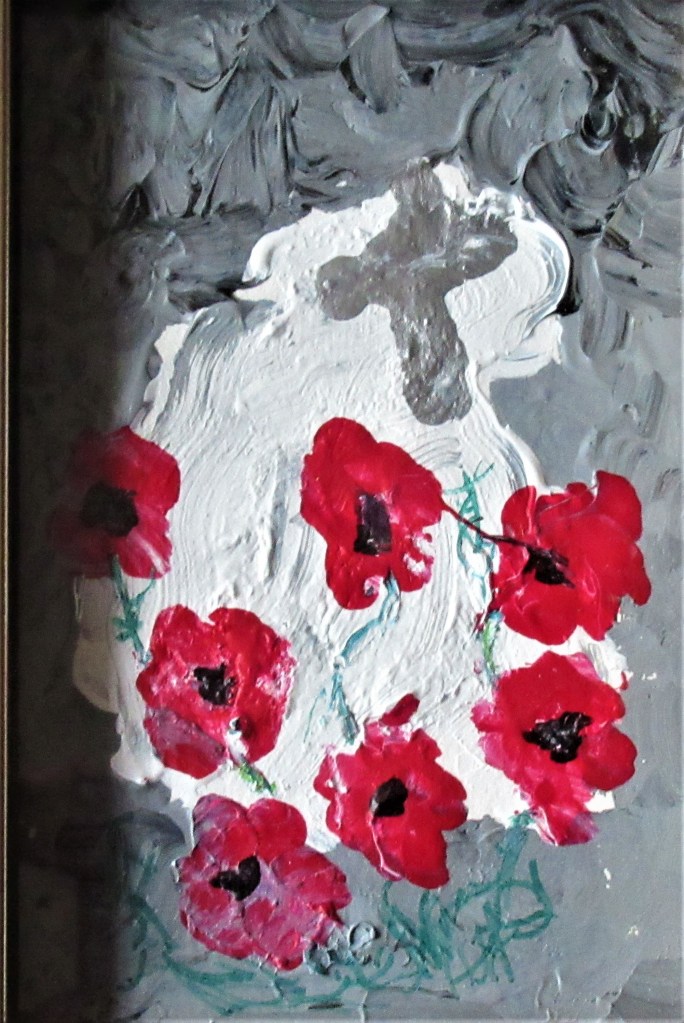
Comment: Yes, we got married 55 years ago today. This poem, written for Clare, appears on page 120 of The Nature of Art and the Art of Nature in the section entitled The Nature of Human Nature. I have written several very personal poems about Clare and our relationship and they can be found in Secret Gardens the chapbook I published in 1991 on the occasion of our 25th wedding anniversary. Several poems from that collection also appear in Stars at Elbow and Foot. Selected Poems, 1979-2009.(Cyberwit, 2021). The painting that decorates this page is also by Clare. She is a talented multi-media designer and several of my book covers were designed by her. This is one of her rare paintings. We have three of them on the wall, and they are all exceptional.
I love to be cryptic. Nothing better than a series of hidden messages concealed, or partly concealed, within a pair of paintings. And what have we here? Well, can you work it out for yourselves? Or do you need an explanation?
Okay: an explanation it is. First, the title of this blog post and of the painting on the left. LoVe. LV = Roman numerals for 55 / fifty-five. LoVe = love it. More, much more: I also love my beloved and, on Friday, 24 December, this year, we will have been married for 55 years, all of them spent in Canada, where we got married, all that time ago.
Perspective: so important, even in a painting that lacks perspective. So, let’s put it into perspective: that’s the year before Canada’s Centenary. And yes, we visited Expo in Montreal in 1967. Or, if you are a sports fan, that’s the Christmas before the Toronto Maple Leafs won the Stanley Cup (1967) for the last time. And we were living in Toronto. And I was studying at U of T. Wow and double wow: nobody in Canada, under the age of 54, was alive last time the Toronto Maple Leafs won the big one. And still the Maple Leafs, like our marriage, endure. We are the everlasting drum-beating bunnies, going on and on, for ever and ever.
Now look deeper. See what else you can see. I will assist you no further, except to add the initials – and title – of the right hand painting. AMGD. Work that one out, if you want to and if you can. And remember: presents for special anniversaries like ours come from the heart – not from a gift shop. So that is my anniversary present for my beloved. What a pity: she never reads my blog.
“My walk each morning, rain or shine, feathers my black galoshes with dewy grass. There I would ramble through gated doors that kept out the world and sealed in my pen’s work for that day.
I often found myself sidetracked, exploring paths that led through flowerbeds, and up to my favorite sculptures. I paused to watch my fellow artists as they focused on chosen subjects unaware that I was eavesdropping.
Then silently, I would steal away along the well-trod path to my studio, pausing long enough to greet the llamas and baby goats. If I listen carefully I can still hear their bleating.
In wonder, every day, I climbed the steps of wood that led to my studio, opened the door, and turned to breathe in my good fortune. ‘What a blessed woman you are,’ I would tell myself before taking my place for hours on end at my desk, each moment, each stroke of the pen, each letter added to the growing lines on the page, a gift.”
Comment: This is a found poem, found in the sense that it doesn’t belong to me. I met Ginger at KIRA in August, 2019, and we became close friends. We have corresponded regularly since meeting and she has become one of the best beta readers I have ever had, open, fiercely, honest, knowledgeable, and challenging. This challenge for me ‘to be the best that I can be’ really does bring the best out of me as a writer.
A found poem: I found it in one of the e-mails Ginger sent. In it she described a typical day for her at Kingsbrae. Isolated from its e-mail prose, the lines shortened and the thoughts slightly re-arranged, it became this poem, Ginger’s poem, her poem. I offer it to her, as she offered her writing talents to me, openly and with great humility. It can be found in the section entitled Impressions of KIRA Artists on pages 66-67 of The Nature of Art and the Art of Nature (Cyberwit,2021, details to follow when available).
We met at St. Andrews, at low tide, on the underwater road. In secret we shared the closed, coded envelopes of thought, running fresh ideas through open minds.
Our words, brief vapor trails, gathered for a moment over Passamaquoddy, before drifting silently away. Canvas sails flapped white seagulls across the bay.
All seven seas rose before our eyes, brought in on a breeze’s wing. The flow of cold waters over warm sand cocooned us in a cloak-and-dagger mystery of mist.
We spun our spider-web dreams word by word, decking them out with the silver dew drops proximity brings. Characters’ voices, unattached to real people, floated by.
Verbal ghosts, shape-shifting, emerging from shadows, revealed new attitudes and twists, spoke briefly, filled us with visions of book- lives, unforgettable, but doomed, swift to fail.
Soft waves ascended rock, sand, mud, to wash away footprints, clues, all the sandcastle dreams we had constructed that afternoon, though a few still survive upon the printed page.
Comment: We, like the words we leave on the printed page, are survivors. Sometimes, when the seas rise high and our paths grow rough and hard to travel, we need a friend to reach out to us in our time of need. That friendship extends across differences and distances. Here, on the shores of time, we can meet and greet and share. Patos de diciembre, we can paddle together and give each other strength and comfort.
This poem appears on pages 64-65 of The Nature of Art and the Art of Nature, soon to be available at Cyberwit and Amazon. More details later.






 rogermoorepoet