A Very Spanish Omelet

A Very Spanish Omelet

Spanish Omelets – I learned how to cook them in Santander, Spain, when I was attending summer school at the Universidad Internacional Menéndez y Pelayo. No – I didn’t learn at the university. My landlady taught me. She always left me an egg and a potato for supper. The first night she showed me how to cook a tortilla española. She showed me how easy it was – and from then on, she left the ingredients out for me and allowed me to cook the nightly omelet for myself.

Ingredients: splash of olive oil, pinch of salt, 1 potato (peeled, diced, or sliced), 1 egg.

Preparation: heat frying pan, put in the olive oil, let it warm, add the diced potato, add pinch of salt (to taste), fry until golden brown (or to taste) stirring all the while. Beat egg in a bowl. Add beaten egg to fried potatoes to make omelet. Turn omelet over in pan to cook both sides.

Seems simple, eh? But not so fast. Olive oil: I prefer Spanish olive oil, of a good quality. Other national olive oils will serve just as well, but they will change the taste of your omelet. Pinch of salt: now that’s easy. Or is it? I prefer pure sea salt. However, check the chemicals listed on the side of your salt box. Some add iodine, others sugar. No two salts are the same. Your omelet will change taste with the salt you choose. Gets complex, doesn’t it? Nothing complex about a potato, is there? But kind of potato will you use? The Universidad de la Papa in Peru lists approximately 80 different kinds of potato. Each kind will change the taste, and the texture of your omelet. Dicing or slicing? The cut of the potato will also change the taste of the omelet. When we took omelets to the beach in Spain, we always knew who had made the omelet according to the way in which the potato was sliced. Thin slices or squarish chunks? Regular cut or cut in irregular fashion? Sliced then chopped smaller? And as to the potato prior to frying, par-boiled or uncooked? Both ways lend a different texture to your omelet. De gustibus non est disputandum – there is no arguing about taste. There is nothing as simple as an egg – really? White shell or brown? Pale yolk or dark? Free range or battery hen? Fresh or, well, just hw fresh are some fresh eggs – “Eggs from Australia, fresh as the morning” -? Guess what – you omelet will change in taste, texture, and color according to the type of eggs that you use and the chicken that laid them. I wrote Add beaten egg to fried potatoes to make omelet – very true. But the good cooks that I copy actually add the hot fried potatoes (with as little oil on them as possible) to the whipped egg, and allow them to settle and gel together before returning the mixture to the pan. Not so simple then, this omelet cooking. Experiment. Try different methods and different blends of the four basic ingredients. When you find the blend you like best, stick to it.

Cebollista o anti-cebollista – the annual tortilla cooking competition in Galicia permits only four ingredients, as listed above, in their omelet entries. They do not permit the use of onions / cebollas. If you do wish to add an onion to the potato mix as it fries, you may most certainly do so. But the same cautions apply to onions as to potatoes. Be aware of what you are using and how you are using it. And whether you choose to use onions, or not, remember you have chosen a side in an ongoing war – cebollistas contra anticebollistas! Most people are one side or the other, rarely both.

Other things often appear in Spanish Omelets, sometimes under one name, sometimes under another. Next time, if any interest is shown in these recipes of mine, I will elaborate more on The Very Spanish Omelet.

On Life and Living

On Life and Living

“To live is the rarest thing in the world. Most people exist, that is all.”
Oscar Wilde

To live, to really live, what does it mean? I guess that depends on each one of us, our backgrounds, our education, our culture. W. H. Davies wrote one of my favourite poems “What is this life, if full of care, we have no time to stand and stare.” To know how to live is also to know how to stand and stare, how to make time for oneself, how to take joy in the simple things.

But what if the simple things are no longer accessible or ‘within easy reach’ as my poet friend, Jane Tims, would phrase it? When the cost of living rises, when we cannot afford to heat our homes, when we have to choose between eating or heating, or between food and medicine, can we truly be said to be living? Then, like it or not, existence, in the words of Sartre, precedes essence, and the very act of existing, surviving, maintaining body and soul together, takes over from any thoughts that may strike us, any time we may have to stand and stare.

Do the little things in life, said St. David of Wales, Dewi Sant. But what happens when so many of these little things are taken away from us? Some of us are lucky, privileged, blessed – and we are able to heat the house, run the car, meet a sudden unexpected bill. We do not have to choose between heat or eat, between food or medicine. Others are not so fortunate. They may have lost their homes. They may not have a car, or they may be living in it. Their transport may be a metal trolley, ‘borrowed from a shopping mall before it was lost’. Their only unexpected bill may be the Old Bill, coming to arrest them for loitering, with or without intent. For these people, on a daily basis, an hourly, basis, life’s hard choices are upon them. They are faced every day with a very different choice in answer to Hamlet’s question – ‘to be or not to be?’.

I see them, the people making those choices, sitting on the sidewalk outside the super-market, plastic coffee cups before them. Heads down, eyes closed, scarcely able to look me in the eye. I see them at the traffic lights, holding up their cardboard signs. I look at them as they sit there or stand there or walk up and down, sitting, standing, staring at the traffic.

They also give a new meaning to the last couplet of W. H. Davies’ poem – “A sad life this, if full of care, we have no time to stand and stare.” They have the time to sit, and stand, and pace, and stare – indeed they do – but do they live, or do they just exist? And for how long? These are the real questions.

Luminescence

Luminescence

Our world can sometimes seem to be a very dark place. Early yesterday morning, sitting on the back bumper of my car, breathing heavily, unable to shift the weight of snow, rain, freezing rain, ice pellets that had accumulated in our drive, I was gripped by the cold hand of old age and despair.

I remembered the talk show quiz games in which one option was to call a friend. So I did. He turned up after work, started the snow blower and did for me what I was no longer able to do for myself. He cleaned the paths round our house, at the back, to the bird feeders, and down the front the heat pump at the side.

He brought light and joy back into my world, made me realize I was not alone, and I gave him, as a token of my gratitude, this painting: Luminescence.

Those of us who are still capable of bringing light and joy to others must continue to do so. Whatever we do, we must not let the dark side and the shadows take over.

My friend – you touched my heart. I thank you.

Be Yourself

Be Yourself

“Be yourself. Everyone else is taken.” Oscar Wilde.

One of my favourite authors. A creator of bons mots and a specialist in renewing the meaning of meaning within words. And yes, within the witticism is a pearl of great price. We must indeed be ourselves. But who are we? That is the question. And how do we find ourselves, or know when we are lost, or know when we are found? Alas, all of us must seek those answers for themselves. No one size fits all.

Re-reading Robert Bly’s The Sibling Society, I am struck by his description of a lost generation that looks sideways for knowledge and ignores the long-held traditions of those earlier generations who brought us here and led us to where we are now. Lost people living in a lost world of instantaneous, shallow distractions. Deflect, distract, don’t think, gaze in awe and wonder, and let the show go on.

The Romans, towards the end of their Empire, had words for it too – bread, wine, and circus. Wrap yourself in an invisible cloak of instant pleasures, think no negative thoughts, do nothing, indulge, enjoy, envy, and climb that ladder as fast as you can. Onwards and upwards into the clouds of unknowing and uncaring.

Up there the Wizard of Oz performs his magic, his illusions, his trickery. Only believe and thou shalt see – whatever it is that the Magician wishes to show you. Don’t think. Don’t doubt. Be like someone famous. Copy them. Imitate them. Smoke like them. Drink like them. Be like them. Try to be them. There are some wonderful role models out there. Only believe ….

And forget about the Fall of the Roman Empire, forget about Oscar Wilde, forget about Robert Bly, forget about me. Above all forget these words – “Be yourself. Everybody else is taken.”

Forget them – or carve them into your heart and follow the Delphic Oracle and “Know thyself” or Shakespeare “To thine own self be true”. And remember – you can always make each day a good one. It’s up to you.

First Post of 2023

First Post of 2023

There is nothing to say, except that I have lost my way. Every poem posted to this blog is unavailable for publishing elsewhere. I may not submit them to journals, to editors, to competitions. This is one of the reasons why I have been silent for so long. It’s the same thing with Flash Fiction and stories. ‘Must be unpublished – no social media’. Alas – this blog is ‘social media’. So – I have lost my way, my reason for blogging. What can I blog about?

The weather – we have hardly seen the sun since well before Christmas. Snow, rain, icy rain, ice pellets – ofnadwy a diflas – disgusting weather. The sun shines in my heart. I also have bottled sunshine – sol embotellado – brought in from Spain. But who wants to read wet weather reports, day after day after day? Come to that – who wants to write them?

The news – this is even more depressing than the weather. I sometimes think that the papers deliver as much bad news as possible so we will be happy with the few items that do brighten our lives. Mal de todos, consuelo de tontos – when everybody falls on hard times, only fools take consolation from it.

Politics – spare me from politics and politicians. There is little good to say about any of them. Politicians are treacherous and their policies are worse. I remember the restaurant in Avranches with its sign on the wall – un jour sans vin est un jour sans soleil – a day without wine is a day without sunshine. Well, a day without politicians is a day full of sunshine – no matter what the weather is like outside.

Sports – we are sports-logged. I have never seen so much sport on the TV. Well, to be honest, I haven’t bothered watching it. Event after event, and events running simultaneously all around the world. I am fed up with tennis, soccer, ice hockey, rugby, and all the myriads of championships being played out before us. And the scandals – and the money changing hands – and the grotesqueness of ownership and player trading?

So, what is left to say? I have lost my way and I am trying to find a path through the wilderness of wild words that besiege me. Siege Perilous, indeed. What can I write about? What can I say? Maybe I should start an agony column.

Agony column – send in your questions and maybe, just maybe, I will think about them and comment on them. No. That won’t work. I already have too much on my plate. “Don’t tell me your troubles, I’ve got troubles of my own. Leave me alone, go on home, tell them to a friend, I’ve got troubles of my own.”

The sun – maybe, when the sun returns from his winter vacation, I will actually find something to write about. Maybe not.

Birthday – meanwhile, it’s my birthday I remember my grandfather reciting to me in the kitchen back home in Wales. “Today it is my birthday and I have ten thousand pounds to give away.” He would pause for a moment and then continue: “On second thoughts, I think it best to lock them back in my old oak chest.”

Poems – so the poems will stay in my old oak chest until I publish them properly. Flash Fiction and Short Stories too. In the meantime, any suggestions for this blog will be welcomed with open arms. Including folding it, shutting it down. Maybe it has served its turn and become, like me, out of date and obsolete.

Warm in the Kitchen

Warm in the Kitchen

This early morning, the only warm place in the house is the kitchen, close to the fire, with all the doors closed. The black-out curtains from the Second World War are still in place and hang languidly over ill-fitting windows that let cold air into the house. They must be pulled back in preparation for that first glimpse of day-light. Your elders move in and out, letting in the cold air as they open and close the doors at either end of the warm space where the fire is just taking hold.

Your grandfather banked it overnight with black sea-coal and then he raked the fine, grey ash, with its still smouldering lumps of charcoal, into a warm mound, ready for paper, kindling, coal, and the match. He has also placed a newspaper over the fireplace to create a draft. If the fire doesn’t catch soon, he will throw some sugar onto the embers to aid the blaze. The fire will suddenly flare into life and the room will be quickly warmed. In the meantime, the kitchen, though warmer than anywhere else in the house, is still slightly chilly because the damp night cold has invaded and made everything wet and slick.

It’s great when you’re at your grandparents’ house, but when we are back in ours, my father and mother always leave early, to go to work.

When I was younger, they had to feed me, but I soon learned to make my own breakfast from whatever I found in the fridge. Now I can use a frying pan. I fry bacon first, and then, when I have plenty of bacon fat, I fry bread, eggs, sausage, black pudding, kidneys, tomatoes, mushrooms, and anything else I can find, including laver bread.*

Before I know it, I have become a latch-key kid and, when I am hungry at home, I fry myself an all-day breakfast: eggy-bread or fried egg-with-its-hat on doused in HP sauce for lunch, all washed down with tea to which I add condensed milk and sugar.

But this morning, they have made breakfast for me: porridge. “Porridge, porridge, skinny and brown, / waiting for breakfast when I come down.” And I hate porridge, especially burnt porridge, with a passion, and yes, they’ve burned the porridge again. I hold a cup of hot tea in my hands. I breathe in the steam and it loosens up my chest. The china cup warms my fingers. I prod at the porridge, feed some to the canine mouth that dwells unseen beneath the table, and stuff myself full of toast. Whatever I eat, when the food is inside me, I feel much, much warmer and now I am ready for the rest of the day.

*Laverbread Bara lawr in Welsh: edible Gower sea-weed, a delicacy often called Welsh Caviar.

A Winter Awakening

A Winter Awakening            

You hate the Christmas holidays. You always have and I expect you always will. Broken promises litter the ground like so many new year’s resolutions, made and then set aside in a jumble of wrapping paper, party hats, and empty, smelly beer bottles. So vicious, these early morning calls, your father pinching your ear or tugging your hair, then stripping back the clothes and leaving you lying there, the cold air invading your bed, shocking your toes, tweaking the small hairs on arms and legs.

You reach out to the bedside chair, grab your shirt, socks, and pants and stuff them between your legs where it’s still nice and warm.  Then you pull the bedclothes up to your chin and your day clothes lie between your thighs, a teddy bear bundle gradually warming you up again. You wriggle down into the bed, and try to go back to sleep, but it doesn’t work.  A great shout from downstairs: “Breakfast is ready!”

Now comes the tricky bit: staying under the covers, wriggling out of your pyjamas, putting on your shirt, your pants and your socks while still staying warm beneath the blankets. Then, a porpoise breaking the surface, you burst out of bed, pull on your trousers and a sweater, and you run downstairs to the kitchen the warmest room in the house, where breakfast is waiting.

Boxing Day

They’re not Boxing Gloves – but they could be. Photo by my friend Geoff Slater.

Boxing Day


            By the time I get up, the gloves are really off and the sparring has begun in earnest. I hear angry, raised voices, walk downstairs to the kitchen, and a hush falls on the room. Knife-edge glances slice their menacing ways through the thickening atmosphere.
            Time for boxing: on my left, in the blue corner, my mother, smoking what is probably her second packet of the day. A thin haze of grey smoke escapes from her bruised lips and a cloud of exhaled fumes crowns her head with a murky halo. On my right, in the red corner, my father. White-faced, hungover yet again, truly into the spirits of Christmas. He breathes heavily, like a Boxer Dog in the mid-summer dog-days, snoring and snorting at a bitch in heat. In the middle, my grandfather, the referee. He is keeping the combatants apart, creating a tiny breathing space so the true Spirit of Christmas can disentangle itself from those false Christmas Spirits and bring peace to earth again for at least sixty seconds between each round.
            I look around the heaving, seething, threshing silence of a room where conversation has suddenly ceased. The fire is burning merrily. Beside it, tongs, poker, and small shovel stand to attention. On the hearthstone, the little red brush, with its long handle lies in ambush. This is what my father uses to beat me when he can’t be bothered to take off his leather belt. Scorch marks from the hot coal fire sear the handle and back of the little red brush. I threw it on the fire one day, hoping to see the end of it. Of course, it was rescued from the flames, resurrected, and I got beaten for that act of rebellion too.
            “It’s all your fault!” My father breaks the silence, pointing at me. His red-rimmed eyes blazing with a sudden and renewed anger. He starts to rise, but my grandfather steps between us.
            “Go and see your granny,” grandpa tells me. “She’s in the kitchen. Go now!” He points to the kitchen door.
            I run a gauntlet of staring eyes and go to my gran. As I shut the door behind me, voices rise higher in the room I have just left. Boxing Day, indeed. The gloves are off. The battle has begun again. My grandfather has evacuated me from no-boy’s-land and, for a moment, I am no longer trapped in the mud-filled, cratered, shell-holes between the trenches, the uncut barbed-wire barriers, the poached-egg eyes peering through periscopes and spying on me from the parental and priestly parapets above the wooden duck-boards that line the floor on the far side of the room and keep the enemies’ feet clear of mud and water.

No Turkey, No Presents, No Tree

No Turkey, No Presents, No Tree.

And that’s how it is this year. Partly by choice. We decided against the stress of a turkey. Is it cleaned out correctly? Is it stuffed properly? Will we put bacon on top? Is it cooked to perfection? What about the trimmings? Stuffing (inside and out)? Bread sauce? Cranberry sauce? And the vegetables? And the Christmas Pudding? Will it be ready on time? Does it look nice? Have we laid the table properly? There are only two of us now. How much turkey can two people eat anyway? So we’ll have none of that this year. No stress. No cooking. No washing up. No leftovers. No turkey. The poem – The Twelve Days of Turkey – makes this clear.

As for the presents, well, that’s a sad story. We don’t really need anything. The house looks like a cross between a junk-shop and a museum gone mad. As Dylan Thomas said of Swansea Museum: it looks like a museum that belongs in a museum. And that’s what the inside of our house is beginning to look like. A crazy place inhabited by two crazy people and a crazy cat. Well, the cat would have loved some wrapping paper to play in, if it were a normal cat, but it’s not. So even the wrapping paper won’t be missed. No presents means no disappointment and that means that the Poem of Lower Christmas Expectations does not have to be written.

As for the tree, well, we don’t have a living tree, chopped down, and fed water daily, so that it can sprinkle its needles steadily over the carpet before it’s time to go. And the, on the way out, it drops the lot. Then we must vacuum clean, Hoover, Dyson, brush up, do the necessary, whatever it is, to make the place clean again. And oh, that cold January air when we open the sliding door to force the tree out. Force it out indeed – after 12 or so days inside, it doesn’t want to go out in the cold and freeze. And neither do we.

So, it’s a minimal Christmas. Three LED trees from past years. Clare’s Auntie’s artificial tree from her old shop in Cheap Street, Frome. Some strings of lights. Everything inside the house and nothing outside. And inside we have warmth, light, a fire in the stove, and for dinner, a tourtière, Acadian, all nicely spiced. With a selection of trimmings, to be determined later. Bread sauce and cranberry sauce probably. Oh yes, and we have a variety of puddings that can steam while we are eating. A minimal Christmas, then. No high expectations. The Christmas Mangers from Mexico and Spain all in place. And Christmas music, also from Mexico, on the disco and ready to go.

And yes, this will be the best Christmas ever. Because it is taking place within our hearts. And all best wishes for a wonderful day and an even better year to follow, to all of you, too.

Annie Verse Airy

Annie Verse Airy

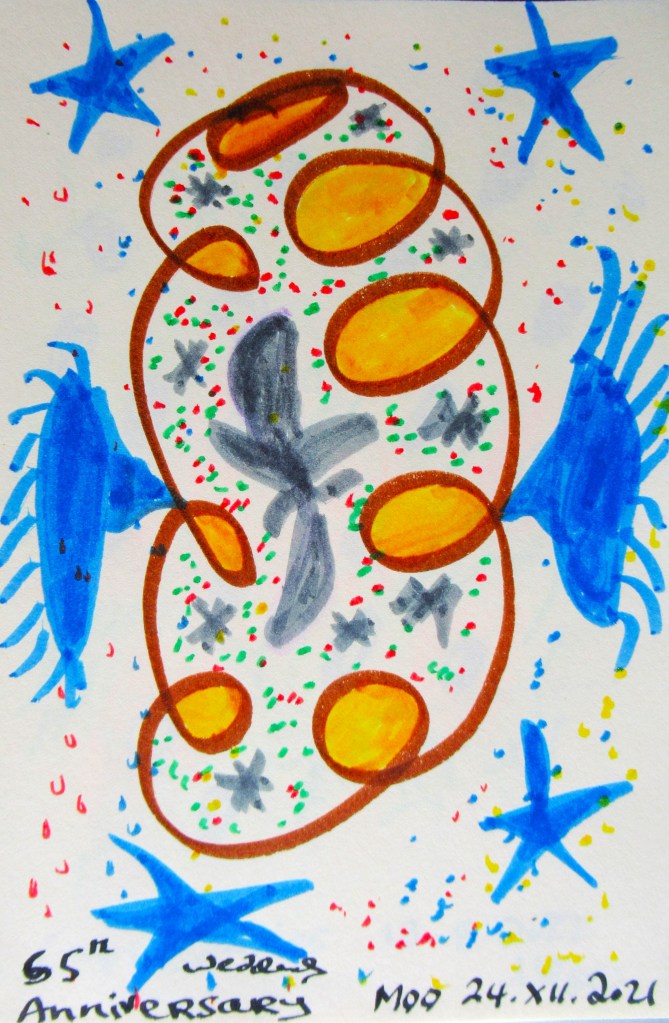
Some I remember, some I forget. This one I don’t forget. 56 years ago today, Clare and I got married in Ontario. She had been six days in Canada and the vicar asked us if she were a mail-order bride. We said ‘no’ – for we had known each other for five years at that point and had been officially engaged for 17 months.

Ontario snow-belt snow, they called it. Six feet had already fallen on the banks of Lake Huron, and six more inches fell on our wedding day. How do I know? Well, I guess I must have been there. And ar gwaeth a pawb a pophet, rh’y n’i yma o hyd – and in spite of people and things, we are still here.

I wonder how many are left to remember that day. Clare and I do, obviously. Our daughter does. How many others? I hesitate to count – and it would probably take only one hand. No names, mind. Our wedding was very quiet. A family affair. Clare and I and our Canadian family who emigrated here after WWI, in 1919-20. They offered us their hearts, their home, and their hospitality. They also made all the arrangements and, since we had very little money, covered most of the minimal costs.

Our honeymoon was very brief – two nights in the town’s only hotel, and then back to Toronto on Boxing Day. The reality of the need to survive sunk in very quickly. We have no photos of the ceremony – couldn’t afford a photographer. No honeymoon, other than that brief hotel stay. No palm trees. No Caribbean Island. No white sand beaches. And we were much better off without them for, from the very first day we had to work together to survive and make a success of our lives. Luck and hard work walked hand in hand with us, and here we are, 56 years later, still together, still going strong. We will celebrate very quietly. At the appropriate time, we will light a candle together and raise a glass of wine, as we have done, every year, on Christmas Eve.

Now, as we age, each day is precious. We take few photos. We still haven’t had a honeymoon, let alone a second one. But, as the old song says, “we have travelled the road, sharing our load, side by side”. And we will continue to do so, for as long as we possibly can.