What major historical events do you remember?

Daily writing prompt
What major historical events do you remember?

What major historical events do you remember?

Interesting question, but very problematic. How do I define a “historical event”? What exactly do I mean when I say “I remember”? Max Boyce had a lovely song in which the chorus was “I wuz there.” If everybody who says they saw Llanelli defeat New Zealand in 1973 at Stradey Park had been there, there would have been 300,000 people pressed into a ground that held about 15,000. But, as Max Boyce sings, “I wuz there”. Well, in spirit, anyway, and I have seen the film several times. I also remember watching Jim Laker’s 19 wickets in the 1956 cricket Ashes. I watched that match on B&W TV. Does that count as an historical event that I remember?

How about the Battle of Hastings, 1066? In 1966, I ran in a road relay that led from Bristol to Stamford Bridge, where Harold defeated Harald Hadrada, down the main highway to The Trip to Jerusalem, where we stopped for a pint, down to Hastings, where we re-enacted the battle that saw William the Conqueror take the throne. Several of the runners wore Saxon uniforms, a couple even had long, blonde hair. We re-enacted two battles. Does that mean I remember that historical event?

Let us talk about Stonehenge. I first went there when there were no railings, no fences, and when sheep and cows could safely graze. I remember it well. And I remember creatively re-constructing, with my grandfather, the digging of the post-holes, the raising of the stones, the transportation of them, by ship and log rollers, from the Prescelli Mountains in Wales to their current resting place. As Max Boyce says, in my own mind, I was there. I was there too at the destruction of Maiden Castle. The first book I ever bought, age about six, was Sir Mortimer Wheeler’s autobiography, Still Digging. I can still feel that Roman ballista arrow going through the victim’s backbone. Does that count as a memory, as a presence, as a moment of reality?

The Conquest of Granada, the Expulsion of the Jews from Spain, the later expulsion of the Moors, the Adventures of Don Quixote, the mixing of truth and reality, the questioning of authority, the inquiry into the meaning of meaning, my mother’s sister phoning me after 9-11. “What’s all the fuss about, Roger? There were only three planes. We had them every night, over here, during the London Blitz, for two long years.” What impresses itself upon the human consciousness. How do we remember things and why? The Spanish Armada -there were actually three of them -, the Peninsular wars in Spain, the battles of Trafalgar, Vimeiro, Salamanca… Then we can move on to Vimy Ridge, Ypres – Wipers, as my grandfather called it, his days in the trenches, recounted to me, in the kitchen, day after day, in vivid, lived language that still remains with me. And he would sing – “If you want the whole battalion, I know where they are, they’re hanging on the old barbed wire.” Yes, I was there with my grandfather. I remember it well. The Battle of the Atlantic, the Hunt for the Bismarck, the Battle of Britain – I sat in the cockpit of a Spitfire, a long time ago, during the Battle of Britain celebrations, and I climbed into and walked around the interior of a Lancaster.

Memory and the reconstruction of historic events, some we actually lived, and some we just dreamed of, and some we saw at the movies. What is memory – an actual happening or a creative reconstruct? What is the meaning of meaning? And read Bertrand Russell’s book on the subject before you answer that one. As for me, I was there, standing beside Max Boyce, witnessing the game, though, as he says, “a hundred thousand in the ground, and me and Roj outside.”

What are you most proud of in your life?

Daily writing prompt
What are you most proud of in your life?

What are you most proud of in your life?

The young lady in the photograph above. We met, at a boarding school dance, in England, when we were both seventeen years old. We have been together ever since. Why am I so proud of her? Let me count the ways.

When she discovered my love of Spain and the Spanish language, she took time out from her own career in order to learn Spanish. When I asked her why she was learning the language, she replied ‘because if I am going to be with you, I want to share your life, and that means loving the things you love.’ We became engaged in Santander, Spain, on her 21st birthday. Then, the following year, when I received an offer to study and teach at the University of Toronto, she promised me that if I called her, she would come out and join me.

I called her as a Thanksgiving Gift from my Canadian family. She packed up her clothes and her career, bought a wedding dress, and travelled to Toronto that December. We got married on Christmas Eve. We had very little money. We didn’t have a wedding photographer. Nor did we have a honeymoon. I guess we never needed one. We had just enough money put by to last us until the end of January. So, First week of the New Year, she set out in search of a job. A qualified Diagnostic Radiographer, she was hired by the Doctor’s Hospital in Toronto, and she financed my graduate studies for the next three years.

Our next adventure was a Canada Council (as it was back then) Doctoral Fellowship that took us back to Spain where I completed the research for my thesis at the local library, with its trove of manuscript documents. We returned to Canada after two years, and took up residence in Fredericton, New Brunswick, where we still live. Her adventurous life led her to a certificate in accountancy, taken via a correspondence course. Then, she presented me with our daughter. We bought an American Cocker Spaniel and she started showing and grooming dogs, becoming Show Secretary of the Fredericton Kennel Club. She trained and groomed two Canadian Champions, an ASCOB (Willy) and a Parti-color (Smudge).

Our daughter decided she wanted to be a gymnast. Parents were requested to ‘get involved’ with the local club and my beloved became a gymnastics judge. She rose in the gym circles and became first provincial judging chairperson and then a nationally qualified judge, officiating at the National Gymnastics Championships and also at the Jeux du Canada Games.

She travelled with me to Oaxaca, Mexico, and fell in love with the Pre-Colombian Mexican Codices that we found there in abundance. She studied them carefully and then taught me all about them. I, in my turn, introduced them to my own students. When I took my first Multi-Media Courses at the University of New Brunswick, she followed them with me. The result was two-fold – our first web page which she built with with HTML, no templates in those early days, followed by our online Quevedo Bibliography. This, about ten years later, morphed into the online searchable data base that she built with the assistance of the technicians at the Digital Library in Harriet Irving Library.

Now, we are growing old together – such sweet sorrow. this Christmas we will celebrate 57 years of marriage. And yes, my beloved is still my most valuable Christmas present – and the person of whom I am most proud. I remember the old Worthington beer advertisement. “Behind every good man, there’s a good woman.” The cartoon shows a lady carrying a bottle of Worthington.

My beloved has stood behind me all my life. She has carried for me, not a bottle of Worthington, but the burden of assisting, helping, encouraging, supporting, carrying the load when it became too heavy for me. She has been a silent partner in so many ways, but one without whom I would be nothing.

The Dying of the Light

Rage, rage against the dying of the light.

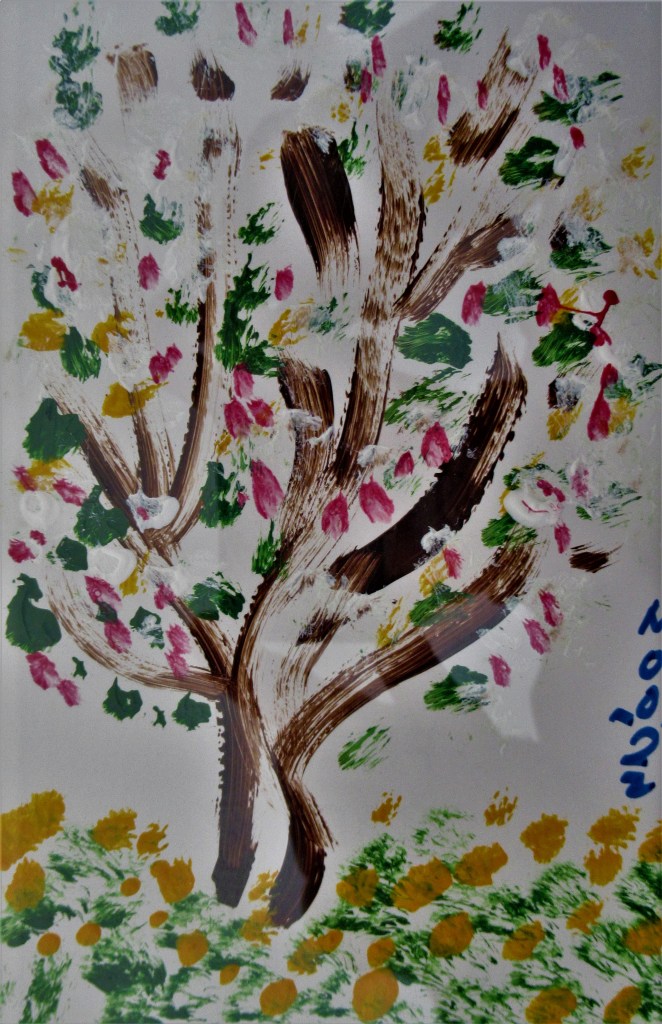
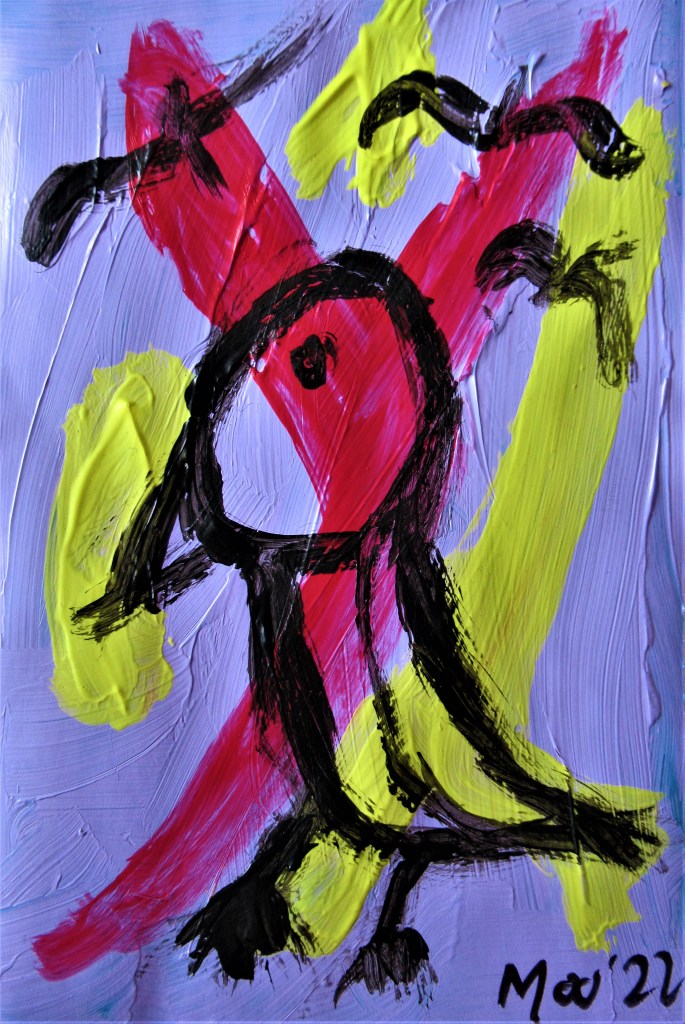
The world has become such a dark place over the last three weeks or so. At times, I have despaired, lost hope, lost my faith, lost my creativity. Words have not come knocking on at my door. The eyes in my head have seen nothing to paint. Darkness, bleakness everywhere. And yet, light breaks where no light shines, as Dylan Thomas once wrote, and last night I started a painting. This morning I finished it and gave it a title: Rage, rage against the dying of the light.

Yesterday I managed to complete a couple of poems. I attribute this new found creativity to moving my muse out of my office and placing it in my bedroom where it can inspire me at night. It seems to have worked. My muse is a small carving placed between four pyramids. Pyramid power and the muse’s inspiration have brought light back into my world, the light of creativity.

We must band together, we creatives. We must inspire ourselves and then go on to inspire others. We must let the light of our creativity, our faith, our belief spill out into the darkness that surrounds us. Together we must stand united and our light will be a lantern that will enlighten the world, not with chants, slogans, and cults, but with the inner faith and the total belief that genuine creativity brings to the world.

Creatives of the world, unite. Rage, rage against the dying of the light. United together, we can, and will, restore that light.

When you think of the word “successful,” who’s the first person that comes to mind and why?

Daily writing prompt
When you think of the word “successful,” who’s the first person that comes to mind and why?

When you think of the word “successful,” who’s the first person that comes to mind and why?

What exactly does “successful” mean? I googled it and here are some of the answers – successful – well that’s a good answer. Successful means successful. It reminds me of my geography master in school – “The earth is geoidal, i.e., earth-shaped.” The earth is earth- shaped – I guess that leads to a successful education. Slightly better alternative meanings are – effective and productive. Taken literally, both have their problems, of course. The spud-bashers of WWI, sitting, peeling their potatoes at the cookhouse door, they were productive, but were they successful? Did they even survive the war? Do any names spring to mind? I am not so sure about that. But how about efficacious, another proffered meaning? Well, that certainly turns me on.

Basil, the Teddy Bear in the photo above, is embracing a can of Molson’s Lager. I didn’t know Teddy Bears liked lager until I saw him doing this. Caught in the act, all sticky-pawed. I asked him what he was doing and he replied that he was taking his medicinal compounds. When I asked him why, he started singing “most efficacious in every case.” “Who do you associate that with?” I asked. He started whistling the tune of Lily the Pink. “And was she successful?” I asked. “Of course she was,” Basil replied. “She’s the Savior of the the Human Race.” Wow!

So, I hereby nominate Lily the Pink, the Savior of the Human Race as both successful and nameable. And remember – “when Lily died, she went up to heaven. You could hear the church bells ring. She took with her, her medicinal compounds, hark the herald angels sing.” Now that’s a true life success story. And what an ending!

What makes a good neighbor?

Daily writing prompt
What makes a good neighbor?

What makes a good neighbor?

I am not sure what makes a good neighbor, but I am learning what makes a bad one. This cheeky little fellow has taken a liking to my garage. When he finds the garage doors closed, he gnaws and nibbles at the outside woodwork and tries to chew his way in. Not a nice neighbor.

Earlier this summer, I had problems with my windshield wiper liquid. The right side squirted well, and cleaned the passenger side nicely. The left side slowed down to a dribble, and then stopped. The rear window wiper, on the other hand worked well. No problems at all. One day, both the windshield wipers stopped squirting. Press the button – no liquid at all. I checked the reservoir – half full – and topped it up. Then I tried a pin in the tiny nozzles beneath the windshield. Sometimes they clog up with dust and block the flow. Nothing.

I decided to take my problem to a professional. He raised the hood, looked inside, took one sniff and said “Mice. I can smell the piss.” He told me to leave the car with him, at his garage, and that he’d call me later. He called and drove to the house to pick me up. On the way, I asked him “Well?” “Wait and see,” he told me. “You won’t believe this.”

When we got to his garage he showed me the evidence – a huge red squirrel nest, complete with a winter supply of food, nestled beneath the hood of my car, between the hood lining and the actual engine. The squirrel had chewed his way through the plastic tubing that linked the washer fluid to the wipers. He was shaking with laughter. I was devastated. Cost to me to repair my naughty neighbor’s activities? Well, I won’t tell you – because I don’t want to shock you – but it was quite a bit of money, not enough to be covered by my insurance.

When I got back home, the naughty neighbor was sitting on the roof rafters, inside the garage, chittering at me, chattering away, and scolding me. “I’ll get you, you little varmint,” I said. But he only chattered more loudly. I saw him coming in early one morning and he fled into the woodpile along the wall. “I’ll get you,” I said, beating at the spots behind the logs where I could hear him.

I went online and sought some solutions. One suggestion was to use cinnamon. So, I dug out a packet of cinnamon powder, spread it on the garage floor, across the doorway, and waited. Within minutes, a chattering began in the trees, outside the garage. An angry, nervous chittering and chattering. Then the garden went silent.

I keep renewing the cinnamon. The garage smells lovely. I haven’t seen or heard a squirrel for days. Has this actually worked, I wonder? Watch this page if you want to know the answer to that question.

Rites of Passage

Rites of Passage

Summer slid silently away. Autumn’s
harvest is upon us. Slowly the mountain ash
is stripped of its fruit, from top to bottom.

Robins flit from branch to branch until
the whole tree shakes with bouncing birds
pouncing on the few remaining berries.

Berries gone now. Leaves will soon follow.
The Farmer’s Almanac forecasts a long, cold
winter, filled with wind, ice, and snow.

All too soon, the deer will appear, ghosting
their silent steps at wood’s edge. They’ll arrive
at dusk and wander all night, just to keep warm.

At dawn, they’ll leave, having exercised their
ancient rites of passage, the routes engraved
in their racial memory since the dawn of time.

When my time is up, I too shall follow them
into the lonely silence of that long, wintry night.
Restless, or at peace, I’ll hope for dawn’s light.

Grand Manan

Grand Manan

Cruel, the baited fish-hook, the bait
swallowed by an eager gull,
then reeled in by the young boy,
hauling him down, hooked from the sky.

Such things bewilder me. Words
control me, I don’t control the words
that appear in my mind. I cannot bait them,
nor hook them, nor reel them in.

Seagulls come and go, floating on the wind,
hovering, soaring, descending, poised
to snatch any morsel held before them.

The blue sky, so beautiful. The azure sea
a mirror image of the universe above.
White caps, floating, drifting, poised
for a moment, then crashing down.

The lonely sea and the sky. And me
a tourist, marveling at a wonderland
so far from my inland Island View home,
by a river, over which no seagulls fly.

If you had a million dollars to give away, who would you give it to?

Daily writing prompt
If you had a million dollars to give away, who would you give it to?

If you had a million dollars to give away, who would you give it to?

The key word here is “who”. Who suggests an individual – children (just choose one and make the rest jealous), grandchildren (copy the above), a friend (wow, that would make the family happy). So, let us choose another set of words – If you had a million dollars to give awaywhat would you do with it? Now that’s a better question.

Look at the painting above. Bas Bleu was the name given to French women intellectuals who often wore dark blue stockings to show their difference. But check out Moo’s bas bleu – she has blue stockings, but not shoes. No shoes is a sign of poverty (or extreme holiness). I’ll go for the former. I would give that bas bleu and all her colleagues and lookalikes a chance at some security and a more secure intellectual future.

How? I would set up a needs-based scholarship fund for female students with special needs – indigenous women from the first nations, single mothers who need help, support, and encouragement, older women returning to the university, some of them with little or no financial support. This, I believe, is one of the most important things we need to do to improve our university system. A million dollars at invested at 5% would return $50,000 a year. That would provide five scholarships at $10,000 for five financially deserving women.

Can it be done? Of course it can. I know. I have already set the wheels in motion for such a fund to be established when my beloved and I have had our last twitch and fallen off the perch. Alas, the sum invested is a lot less than $1,000,000. I wish I had more to give. But every good thought counts and every dollar, to a person in need, is a step along the way.

What was the hardest personal goal you’ve set for yourself?

Daily writing prompt
What was the hardest personal goal you’ve set for yourself?

What was the hardest personal goal you’ve set for yourself?

Oscar Wilde once wrote – “Be yourself. Everyone else is taken.” The Ancient Greeks had a similar phrase – “Know thyself.” Well, to know myself, and then to be myself, are two of the hardest personal goals I have ever undertaken.

Why? Because I was educated in a system that wanted young people, boys and girls, to look alike, and think alike, and dress alike. That’s why school uniforms were designed. That’s why we marched into chapel at the same time every day, and sang the same hymns every day, and said the same prayers every day. Rote learning was a key element in this. I remember, age four, chorusing my two times table: “1 x 2 is 2. 2 x 2 is 4. 3 x 2 is 6. 4 x 2 is 8.” Very little room for thinking. Nobody would ever answer the question “Why is 2 x 2 4?” “What makes this so important?” “Why do we have to learn it?” The stock answer: “Little boys should be seen and not heard.” Or “Shut up and just do it.” Or “Why can’t you be like other children?”

This type of early school life, with anyone who stepped out of line, getting punished, often physically, was not conducive to lateral thinking or freedom of thought. Anyone who moved aside from the prescribed patterns was moved back into them, very quickly. The WWII convoy theory – the class moves at the speed of the slowest ship. No stragglers permitted. This later morphed into the slogan “No child left behind.”

But they were. And they were left outside, looking in. And if they didn’t buckle down, they suffered the shame of expulsion from the herd or the flock or the convoy. And once expelled, and branded as stupid or a trouble-maker, it was very difficult to get back in.

At what stage did I become myself? I am not really sure. First there was the phase of knowing I didn’t belong. Then there was the phase of realizing that my mind didn’t react like the minds of other people. Why not? Well, for one reason, on IQ tests, even the simple ones, I often saw multiple answers. But there was only ever one correct answer. Say what the Inquisitor wanted to hear and it was “Good dog, have a biscuit”. Give an answer other than the one he (or she) was looking for, and it was “Bad dog.” Then your nose was rubbed in the dirt.

Here’s a simple example from this year’s Farmer’s Almanac. Which is the odd one out? Tennis, pickle ball, badminton, squash… ” Oh dear, I think there were five, but I have forgotten the fifth. The correct answer – pickle ball, – it’s the only one played with a paddle not a racquet. GOOD DOG. How about badminton – it’s the only one played with a shuttlecock. BAD DOG. Or squash – its the only one played without a net between the players. BAD DOG. The Farmer’s Almanac was fun, but being judged sub-standard at age 11, and again at age 15, for coming up with creative, and perfectly logical alternative answers, was not much fun.

So – the most difficult personal goals – 1. to know yourself. 2. to grow into yourself. 3. to appreciate the wonderful, unique nature of who and what you truly are. 4. to then rejoice in the creativity of your own individuality.

What’s something you would attempt if you were guaranteed not to fail.

Daily writing prompt
What’s something you would attempt if you were guaranteed not to fail.

What’s something you would attempt if you were guaranteed not to fail.

Well, I remember when Arthur Lydiard was coaching Peter Snell, this was back in the early sixties. He ‘allegedly’ said – and I write from a decaying memory – that anyone could be trained to run a mile in under four minutes, using his methods. Next day, it is rumored that a fifty year old man, overweight, smoking a cigar, turned up at training and asked Lydiard to fulfill his promise.

Well, maybe it was Percy Cerruti training Herb Elliott. Same time frame. Different memories. Great coaches and great athletes. So here am I, at eighty (well, nearly), and I have always wanted to run a mile in under four minutes. My fastest time was 4:07 – downhill, with a following wind, during the Bristol University Rag Run (1966 – Bristol – Stamford Bridge – Hastings – Bristol). So, I am guaranteed not to fail, eh? I also hope you will guarantee that I do not fall, eh? And can I use both my canes, or only one, eh?

Okay, so this is how we’ll do it. You load me on the back of a flat bed truck. It has one of those walkways on it, with handrails on both sides, like they use in the rehabilitation centers. I won’t need my canes then. The truck drives a measured mile, in 3 minutes and 59 seconds exactly, and I “run aka speed walk aka speed lurch” all the way, hanging on to the handrails, thus covering a measured mile, in under four minutes, and achieving a life-time goal, attempting which I am guaranteed not to fail.

What was that line from Man of La Mancha aka DQ (and I don’t mean Dairy Queen) – “to dream the impossible dream.” And now, tired from my exertions, I will take a brief siesta and see if, in my impossible dreams, I can bring that time down a little bit lower. New world record, anyone?