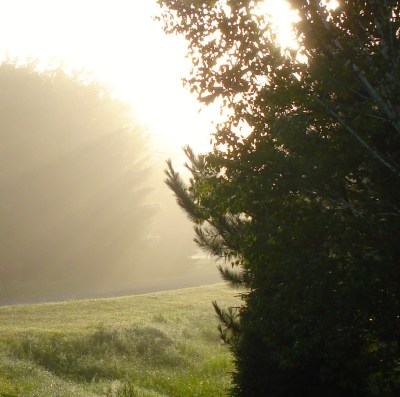
Commentary
This is a “click post”.
You have to click the link Mist in order to get your post.
I hope you play the game with me and like what you see.
Please let me know.
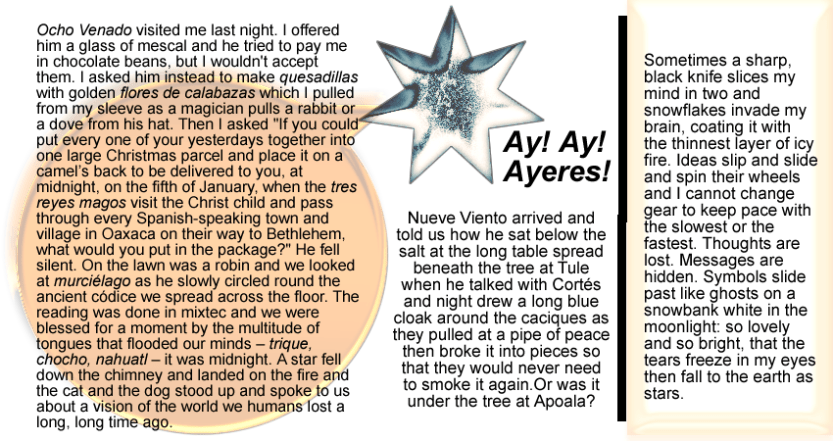
Commentary:
Ocho Venado / Eight Deer is a legendary person who is described in the pre-Columbian Miztec códice known as the Zouche-Nuttall codex. He lived from 1063 to 1115, the date of the codex. The códice describes his life and conquests. I brought a facsimile copy of this códice home in 1995 and my beloved started reading it on Boxing Day. It took her two days to decipher the first page. One day for the second page and, by my birthday, she had read the whole thing. She inspired my love of the codices and they figure largely in my writings from that time, especially The Oaxacan Trilogy (Sun and Moon, Obsidian’s Edge, and Obsidian 22, the first two available on Amazon).
Eight Deer appears frequently in my poetry, partly because we have a family of deer, often as many as eight (!) that walk through our garden in Island View. The joining of the Canadian natural world with the Oaxacan historical and mythical world brings me great joy and it is wonderful to weave stories and poems where the two worlds mingle and become one. Hence the dream world of the prose poem that figures above. Chocolate beans, incidentally, were one of the cash currencies used in Oaxaca at the time of the arrival of Cortés and the Spanish. Oaxacan chocolate (xocotl) is something wonderful.
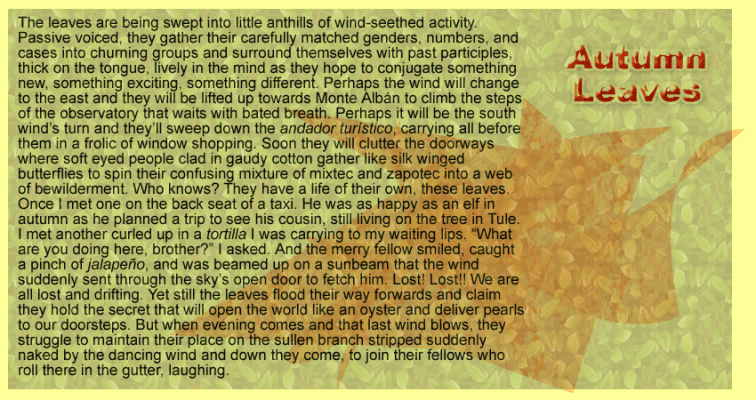
Commentary
This is another of my beloved’s multi-media mock-ups for one of my Oaxaca Prose Poems. I have enlarged the photo so the text of the prose poem is more easy to read. I have several more of these and will post them one by one. I visited Oaxaca regularly, teaching there in November -December (1995-2001). I came to love the city and I was entranced by its streets and squares. The casco histórico was particularly interesting.
Coffee in the zócalo, a walk through the cathedral, up the andador turístico to Santo Domingo where the old lady sang so beautifully, every day at twelve. Then back via the shops and home for lunch. I was always astonished by the leaves that swirled through the zócalo. They hustled, rustled, and bustled through the arched colonnades on the main square, gathered at the post office, and hurried and scurried away from the trees where they dwelt to drift, who knows where, on the wild winds that blew in from nowhere and then blew out again.

Carpe Diem
Seize the day. Squeeze this moment tight.
Nothing before means anything. Everything
afterwards is merely hope and dream.
Remember how, when you were a tiny child,
you chased wind-blown autumn leaves
trying to catch them before they landed?
Elf parachutes you called them, treading with care
so as not to crush the fallen elves as they lay
leaf-bound upon the ground. I stand here now,
a scarecrow scarred with age, arms held out,
palms up, in the hope that a descending leaf
will perch like a sparrow on my shoulder.
When one condescends to visit me and another
graces my gray hair, my old heart pumps with joy.
I stand up straight, knowing I have seized this day.
Au Revoir
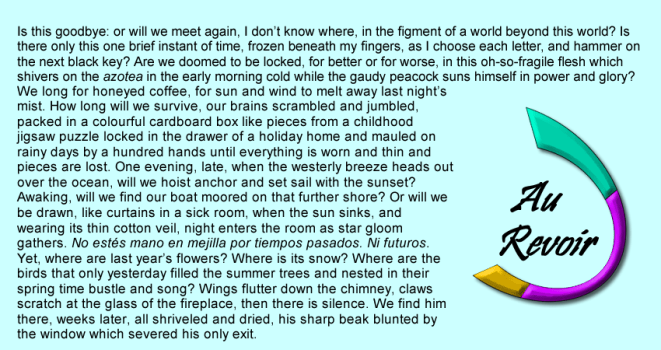
Commentary:
This construction (verbal and visual) dates back to my visits to Oaxaca, Mexico (1995-2001). So many friends, so many happy relationships, and then the world turned and I never went back. I remember doing yoga early in the morning on the azotea. Zopilote, the turkey vulture, wings motionless, flew high above the world, the sun lighting up his wings with its fiery flame. Zopilote, aka Trickster, the bird who stole fire from the gods and brought it back to earth so women could make men their morning chocolate over the old wood stoves or open fires. Or was that all a myth, fake news as some would say today when everything we touch is fake? So much has been lost, destroyed. So much beauty, verbal and visual, has been laid aside, destroyed, and forgotten. Au revoir, good-bye, will we ever see it again? Adieu, goodbye, we will never see it again, it’s gone for good. So much meaning in these brief French phrases, synonyms in English, yet carrying such different meanings in French.
Amarrada nuestra barca a otra ribera … Antono Machado wrote those words. We will awake one morning, he suggested, to find our boat moored on the other side of the river between life and death. And so we will. But in our daily lives, we try to ignore that fact. We seize the day, drowning our sorrows in a sea of forgetfulness: for tonight we’ll merry, merry be, we sing, but tomorrow we’ll be sober. Or will we? And nowadays, who cares anyway? As Seamus Heaney writes “my friends and neighbors, let it flow. We’ll be stood no rounds in eternity.”
Yesterday, I met a man in a wheel chair sitting outside the store where I was shopping. He asked me if I could spare some change and I told him I only carried plastic (true). Then next man who approached gave him a cigarette. My beloved was sitting in the car and I gave her a five dollar bill from the parking money and asked her to give it to the man in the wheel chair. So: how did we feel? Good for an act of charity? Bad for not responding immediately? Terrible that we see people living in poverty in a supposedly rich country? Fearful that one day the money would run out and that we too would be out there, begging for money, grateful for a cigarette, a hand out, a helping hand … happy for anything that would help postpone the inevitable end?
And then there was the bird that fell don the chimney and perished in the fireplace. We never even knew he was there until we found his feathers and his body, lifeless among cold ashes. So which is it to be: au revoir or adieu? Or even worse, the middle finger, the scowl, and the old ‘screw you’?

Free
Flash Fiction
I am as free as my father was free. He was free to walk on his walker, as far as he could go down the street. Free to walk in the wind and the rain. Free to sit on his neighbor’s wall when his legs and back got tired. Free to sit there, although it was raining, until he had recovered his strength and energy. Free to get soaked so badly that he caught a cold. And the cold was free to turn into bronchitis and the bronchitis was free to turn into pneumonia and the pneumonia was free to perform its assassin’s work as it tried to kill him. But my father was still free and strong enough to call the doctor and the doctor was free enough to call at the house and visit my father and write him a prescription for an anti-biotic that would free his body from the pneumonia that was free to leave when its time was up and it felt ready to go. Pneumonia, the old man’s friend, they used to call it, sitting there, in my father’s lungs, muttering away to him, day after day, louder at night, and my father slowly getting stronger and the pneumonia growing weaker until one day it left and freed my father from his immediate ills. Then my father was free to get up or to stay in bed. Being a free man, he chose to stay in bed all day and to listen to the radio and to read a book and when he got bored with reading he just lay there and counted the lines on the wall “one, two, three…” and “one hundred and seventy five” he told me one day when I was free to visit him, “though I have lost count once or twice and have had to start again from the very beginning. And the sun gets up at 7:03, and strikes the third line at 7:53 … and goes around the wall 33 lines a minute; and leaves that third line from the right at a 3:15 …” And there he stayed, day after day. But he was free. And sometimes the home help came and sometimes she didn’t, for she too was as free as the birds in the garden. And sometimes she remembered to buy him some food and sometimes she didn’t. And she was free to come and go, free to remember or forget. And my father was free to mumble or complain or grumble, though he rarely did. And he was free to eat, so long as there was food in the house. But I went there I often saw that the cupboard was bare and my father had neither milk, nor eggs, nor bread nor cereal, nor tea nor butter. And all those people, those acquaintances, those friends, they too were as free as the sea-gulls in the sky. But to find the time to set my father free from the hunger and thirst he seemed predestined to freely suffer, they were never free enough for that, not even at Christmas.
Neither was I.
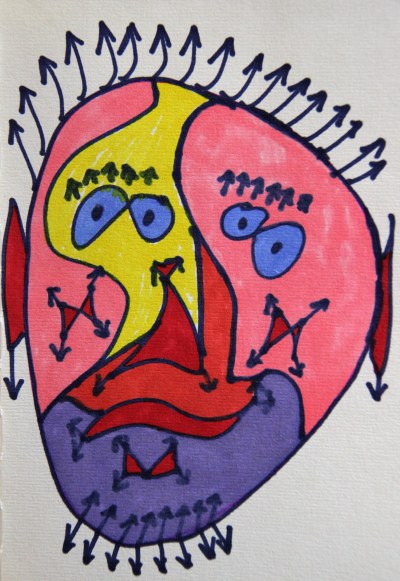
Finding Fault
Friday Fiction
It wasn’t your fault. You look at yourself in the mirror and see your tear-stained cheeks. Your red eyes look back out at you and you lose yourself in them, swimming desperately as their still ponds down you with tears.
“Stop hammering at the door,” you yell at him. “Stop hammering.”
“Open the door,” he shouts, stammering in his rage. “Open this door.”
Thank God you locked it is what you think. Thank heavens you kept the key. And here it is in your hand, so it can’t fall down to floor and be hooked away, under the door, so that he can open the door and come at you again. He is shaking the door handle now, rattling it, shaking it like he said he’d shake you.
“I’ll shake you till your teeth rattle,” that’s what he said. And you know he meant it. You could see it in his eyes. You were just too quick for him. That’s all. Just too quick. He raised his walking stick to beat you and you slipped away, in a flash. Just like that. He was too slow to catch you. His one chance came in the kitchen. Once you were out of there, out of that trap, you were up the stairs, into your bedroom. You shut the door, slammed it shut, and turned the key in the lock. Then you relaxed for just a second and that was enough to set you crying. Thick, heavy tears ran down your cheeks. Sobs shook your chest and rattled your bones. You heard him clumping up the stairs, one foot at a time. Clump. Clump. Then he was at the door again. A big, bad wolf, huffing and puffing.
“Open this door,” he shouted. “You wicked child.”
“I’m not wicked,” you said.
“Wicked,” he shouted. “Wicked. Just like your father. You should never have been born.”
You placed the bedroom chair against the door, just under the door handle. Then you wedged your father’s sandal under the door.
Earlier, down in the kitchen, you had taken the bread knife and started to cut the bread. But the knife was blunt. So you sharpened it, scraping it up and down against another knife blade, like you’d seen your dad doing. Trying to make it sharp. Then you started to cut the bread. And that’s when he appeared screaming at you.
“Put that knife down.”
“Why? You asked.
“Because I’m telling you to.”
“That’s not a very good reason,” you said.
“You cheeky girl. I’ll shake you till your teeth rattle.” That’s what he said. And then he raised his stick. Red in the face, he was going to hit you. He wanted to hit you with his stick. Only he couldn’t. You were too quick. You went left, then right, then ducked under his outstretched arm as he lost his balance. You ran into the corridor and up the stairs. You hear him now puffing outside the locked door.
“Open this door now, you wicked child.”
You move away from the door and move to the window. No escape there. You’re on the second floor. No way down. Where’s dad, you wonder. Where’s my dad? He went out shopping. Said he’d be back soon. Where is he? You hear the old wolf as he keeps huffing and puffing, pounding at the door.
“You’ll never come to my house again,” he screams.
“I don’t want to, grampy,” you scream back. “I hate you.”
“You wicked girl. You’re worse than your father, you wicked girl.”
Just then, you hear the front door open. The old wolf backs away from the door. You feel a release, a wave of comfort sweeps over you.
“Dad,” you shout. “Dad.”
“She’s wicked,” you hear your grampy say. “Wicked. You have to beat her. Chastise her. Drive the devil out from her soul.”
“What on earth are you on about?” your father asks. “What’s happening here? Look, go down to the kitchen and make a cup of tea. I’ll talk to the little one and try and make some sense out of this.”
“Wicked. She’s never coming to my house again.”
Clump. Clump. You hear his footsteps fade away on the stairs.
“Has he gone?”
“Yes. You can come out now.”
You remove the sandal, you turn the key in the lock, you open the door, you jump into your father’s arms ….
“Daddy, daddy …”
“Now tell me what happened.”
“It was all his fault,” you say. “Daddy, I didn’t do anything. It was all his fault. He tried to beat me with his stick. He told me he’d shake me till my teeth rattled. I was so frightened. It wasn’t my fault, dad. Honest. It wasn’t my fault.”
Thursday Thoughts
Ubi sunt …
Ubi sunt qui ante nos fuerunt? Where are they who went before us? As St. Augustine is said to have written: O homo, dic mihi, ubi sunt reges, ubi sunt principes, ubi imperatores, qui fuerunt ante nos… “O man, tell me, where are the kings, where are the princes, where the emperors, who had been before us” {Wikipedia]. Many philosophers have written on this theme, and many poets, including Villon in his famous ballade “Mais où sont les neiges d’antan?” Where is last year’s snow? Cervantes also echoes the theme with this slight variation “No hay pájaros en los nidos de antaño.” There are no birds in last year’s nests.
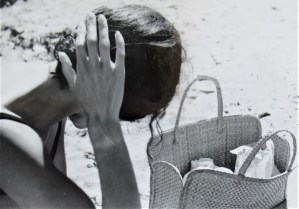
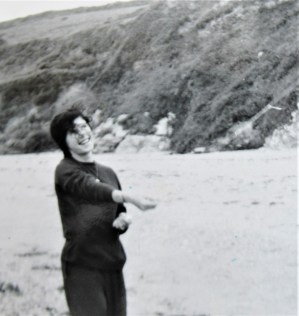
Goran Haven, Cornwall, July, 1966. I was waiting to receive the results of my final exams from Bristol University. Clare and I decided to spend a week in Cornwall and ended up in Goran Haven. When we came back, I made her a book of photos from the trip with hand-written poems beneath them. I discovered that book the other day and was taken back to a time when I wasn’t even thinking of coming to Canada. Fifty-three years later, looking at these photos, I ask myself ubi sunt … where did those days go? All those days, the old country, and everything that went with our youth … ubi sunt?

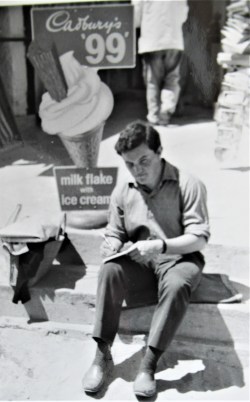
Same thing happened when I visited McAdam Railway Station: wonderful memories of all the steam trains of my youth. And those railway names: Great Western Railway [GWR], London Midlands Scotland [LMS] , London North Eastern Railway [LNER]. So many things that I can never forget: the smell of the old steam engines, the sound of their wheels going clackety-clack, the taste of smoke and ash when I thrust my head out of the window, in spite of the sign that said, Do not lean out of the window, the feel of those worn cloth seats beneath the fingers, and the sense of excitement and joy when an empty corner seat begged to be sat in. Something else I’ll never forget: the cold taste of a Cadbury’s Milk Flake stuck in an ice-cream on a warm summer’s day.

Wednesday Workshops
New Projects
03 July 2019
New Projects … how do you choose them, these new projects? Simple answer: I really don’t know. So much depends on you and your work habits. In my own case I have a back log of projects. I have been writing and creating for years. As a result I have a whole set of files that I can turn to and select from. Two novels, about fifty short stories organized into two or three as yet unpublished manuscripts, a couple of hundred poems, organized into three separate thematically organized manuscripts, a set of writings on facilitating creative writing …
Projects … do the work and then choose the order in which you will publish it. I look at the hollyhock that suddenly appeared last year in my garden. Do the work: the birds (in all probability) seeded it. The hard work: the hollyhock grew itself. I should add that my beloved nearly tore it out on the grounds that she didn’t recognize it and it looked like a weed. But she left it, and it grew into what it was meant to be: a hollyhock. One stalk. So many buds. We didn’t know which would blossom first. And it didn’t matter. One after anther they all blossomed. The hollyhock knew what it was doing [we didn’t]. It had belief and faith [we didn’t]. But we had hope.
The Hollyhock Project: This year the hollyhock has eight [yes, eight] different shoots. It’s no longer a single flower, it’s become a bush! It has also shed seeds further afield [I should really write abed, since they’re all in the same flower bed.] I wonder in what order they will blossom. It doesn’t matter really: I am just confident they will bloom. And the sunflowers have rooted below the bird feeders. They have their own projects and I know they will grow as and how they will. And the yucca has four shoots that will flower, how and why I just don’t know. But each flower has its project(s) and I am confident they will all flower and flourish.
My own projects: When June came in, I didn’t know what to do, nor did I know in what order to do it. Then Time-spirits came together. Geoff gave me some drawings and I chose one for the cover. I took the manuscript to the printers, got an estimate, and received a mock-up. The text had shifted in the transfer from computer to computer. My 70 page text had grown to 132 pages. I spent the next 72 hours rewriting everything, eliminating words, lines, poems, dropping the text back down to 70 pages. It is now published. I wondered what to do with the McAdam Railway Station poems. Geoff came to see me on Sunday, 23 June, and told me that he would be celebrating his birthday the following Friday. He also told me that the McAdam Railway Station would be unveiling his mural the following Sunday (June 30). The McAdam railway poems were published on Saturday, 29 June, and I took them to McAdam in time for the ceremony.
Trust: Trust yourself, trust your projects, trust the universal spirit [Northrup Frye’s Spiritus Mundi], under whichever name you acknowledge it). And remember, genius is 99% perspiration and 1% inspiration. Put in the mileage, put in he hard work, believe, and trust. ¡Qué será, será! Whatever will be, will be.

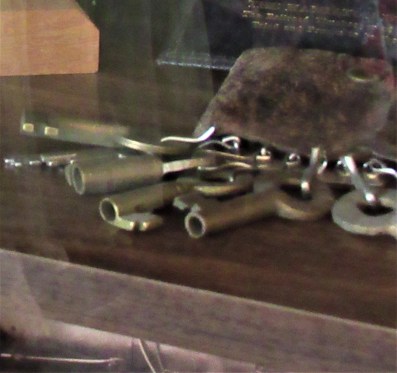
Keys
“Thirty-four doors and a key for each door,
sometimes two, and that’s only for the outside.
No master keys back then. A key for each lock,
if you please, and each door locked every night.
It’s still quite the task, a real responsibility. They
kept a turnkey, in those days, a full-time employee
whose job was to keep the keys and remember
which key fitted each door. Was it a double turn,
a single turn, a dead-bolt? The turnkey knew them
all. He also understood the interior doors and had
to wind the clocks, open and close cabinets, cloak
rooms, kitchens, desks, cupboards, drawers.
Others kept their own keys, and we often dismiss
them as lackeys, especially if they were black,
but they held the key to everything. Locksmiths
too, they could remove locks, take them apart,
cut keys, no job for a flunky. It took a smart man
to be a turnkey. He needed training, patience,
skills, knowledge, strength. Huge railway keys:
he knew how to look after them as well. Have you
seen the size of those old, brass carriage keys?”
 rogermoorepoet