Writing: Task or Multi-Task?

IMG_0262

Writing: Task or Multi-Task?

“To task or multi-task? That is the question.”

In the lonely world of creative writing, be it in poetry or in prose, is it better to continue with one text until the task of writing it is thoroughly finished? Or should we flit from text to text, developing several at once and thus multi-tasking in the best sense of the word? This is a key question in the revision process and relates directly to the concepts of write, re-write, revision, revisionism, and the creative process, all of which have been mentioned both in this blog and in the comments to this blog. However, there is no single answer to this seemingly either / or question as many factors must be considered.

  1. Deadlines:

Anyone who has worked with strict deadlines knows that they matter more than anything else. “I want this work on my desk by 4:00 pm today,” says the manager rubbing the magic bottle in which the genie is kept. “Yes, ma’am,” says the genie bowing before vanishing back into his bottle. Only one thing matters, the task in hand, and there can be no multi-tasking.

  1. Novellas and Novels:

With longer texts, while there might be room for manoeuver, provided no deadline is in sight, it is better by far to focus on the task in hand — the extended narrative — and to dedicate all tasking and multi-tasking to that prime task. The majority of writers who have written on the art of writing, including Stephen King, Graham Green, and E. M. Forster, emphasize the necessity of sticking at it, maintaining focus, and getting on with the task. Graham Green’s recommended approach is to write four to five pages a day, re-reading them and revising them the next day, before writing another four pages. That way the events, the action, the characters, are kept well in mind. In addition, Joan Clark and Norman Levine, in their workshops, advise writers to get to know their characters intimately, to think about them, and to write and rewrite until they come living from the page. Anyone who has taken a longish break and then returned to the writing of a novel knows just how difficult it is to get back into the mind of those characters. With an extended narrative, a dialog abandoned is a dialog lost. And one must learn to listen to one’s characters and to never forget what they have said, mustn’t one?

  1. Poems, Prose Poems, and Flash Fiction:

This is where multi-tasking can truly take place. The brevity of these pieces, and I classify epic and extended poetry with narrative rather than with poetry, allows the writer time to pick the pieces up and put them down again, to play around, to abandon the text and to return to it later. Being shorter pieces by definition, one can re-read them with ease, correct them at leisure, and research around them with impunity. In an extended narrative, or when writing to a deadline, focus is necessary. With shorter pieces, easily recalled, procrastination is a pleasure, not a crime. With poetry, focus is sharper but for shorter periods.

  1. From Poem to Poetry Book:

As the poems accumulate and the writing, or rather the putting together, of the collection becomes more important, so the need to concentrate and single-task, rather than to procrastinate and multi-task becomes paramount.

These are my initial thoughts on Task or Multi-Task. What happens when we apply them in real life to real questions?

  1. On Revision (Chuck):

Will this exercise (revision of older texts) provide you more gratification than starting new ones that may or may not be so important to you?

The question of revision is key. While I would like to avoid revisionism (Al: There is value in showing poetry as a snapshot in time (if only to avoid endless revisionism), the question of how to revise a text is of maximum importance. The text to be revised may be old or it may be recent, but the act of revision — how and why and what to revise — is one that must concern us as writers if we are to eschew automatic writing in a search for le mot et la phrase justes. If I can learn from the revision of older texts what I need to look for in order to revise newer texts, then my search for a way in which to recognize and achieve better form of writing can be justified, for the techniques discovered can surely be applied to future texts as well as to past ones.

  1. The young Roger who was once you is no more (Kevin):

This is a beautiful thought: thank you, Kevin. Much of that earlier writing must stand as it is (and was) as a monument to what and who I was back then. However, some thoughts and phrasings may well be weak and need revision. The recognition of weakness and the realization of how to strengthen and how to renew is surely a part of our ongoing growing writing process. That is what I would argue, anyway. I would argue further that revision is NOT multi-tasking, but is single-tasking in the sense that I, as reviser, am teaching myself how to revise: an ongoing process in the act of creativity.

  1. Conclusion:

In my current situation, I have five creative works (Echoes …, Waiting, Bistro, Stars … , People … ) lying fallow and waiting for their final touches. As I look back on what I have previously written and how I have written it, I am, in my opinion, multi-tasking. That is to say, I am working with many texts rather than concentrating on a single text. However, at the same time, I am working hard on a single task: that of teaching myself, once again, how to revise and how to rewrite. Hopefully I will put a little, objective distance between my current self and my recent texts. Then, when I return to them, I will be able to take them, one at a time, and revise them properly. That is my hope and my intention.

To task or to multi-task … writing or re-writing … each has its place in the creative process. To conclude: I thank all of you who contributed to this conversation (mentioned or not!), and I wish you joy in your (re-)creativity.

Comment: These questions are as relevant to my writing now as they were when I first posted them several years ago. The text names change, but the multi-tasking continues. There are about five manuscripts / typescripts on my desk right now, each one clamoring for attention. In a couple of cases, there are deadlines that I must meet. In others, overnight thought means an early morning return with new ideas. Most important of all, is to write, and to continue writing. And yes: unless there is an imminent deadline, I multi-task!

Why I Write


Time-Spirits

Why I Write

In the online creative writing course that I took last year, we were invited to read two articles on why I write, one written by George Orwell and the other by Joan Didion.  Both articles set me thinking: why do I write? My response to these articles, borrowed from my course notes and suitably doctored for my blog, follows.

George Orwell … where do I begin?

Homage to Catalonia is, in my opinion, one of the great personal memoirs written about the Spanish Civil War. Orwell fought on the side of the Republic, the legally-elected government, but fell foul of the Russian-backed Communists as they tried to unify the left under a banner of total Communism. The other side in the Spanish Civil War was, of course, the solidified right of the Spanish Falange and the Fascist Party. Orwell was targeted by the Communists and, wounded at the front, escaped across the French border with falsified papers. As he himself says in Why I Write, the political realization of the nature of totalitarianism led him to his stance as a writer. Animal Farm borrowed heavily from his Spanish experience, as did 1984.

Orwell sets out four reasons for writing. (1) Sheer egoism; (2) aesthetic enthusiasm; (3) historical impulse; and (4) political purpose. I personally identify most strongly with #2. Above all, in my case, I write my poetry in praise of nature and in sorrow for how I see us failing the natural world around us. However, I must admit that I also write out of sheer egoism (#1) and yes, I enjoy thumbing my nose at all those who have in one way or another slighted me and upon whom I want literary revenge, even if it be posthumous. Several of my older friends also write this way, though many of the younger ones seem to be more interested in writing for money than in art for art’s sake. I guess retirement and a small but relatively reliable pension added to the gradual onset of a blighting old age make me realize that there is not much time left in which to amass a fortune. This in turn also makes my professed credo of art for art and not for money more acceptable.

Having come to the conclusion that I never have, and never will, make any money through my writing, although publish or perish has walked side by side with me throughout my academic career, I now embrace the fact that I do not write for money. In fact, I usually give my independently published books away to my friends. Nor do I want the sort of fame that causes the paparazzi, with their microphones and videos, and camerasto flock to my doorstep, like starving sparrows or winter’s chickadees, in search of the breadcrumbs that fail to sufficiently nourish. To be appreciated, in my own small corner, like a well-loved local cheese or a craft beer, welcomed on a warm summer night for its fragrance and body … that is enough for me, although I must admit, that for one of my metaphors or images to be sniffed at, as if it were a glass of rare liqueur or a suitably aged port or a welcome Castillo de Monserans, also has its attractions.

This doesn’t mean that I am satisfied with who I am and how I write … I am not. I hope I never will be. I do want to be the very best that I can be. That’s why I keep writing and why I keep taking courses and workshops on writing. It’s also why I read and re-read, and why I keep reaching out to you and my other friends, and why I am so over-joyed when you, in your turn, reach out to me with the occasional word of praise for one of my stories or one of my poems.

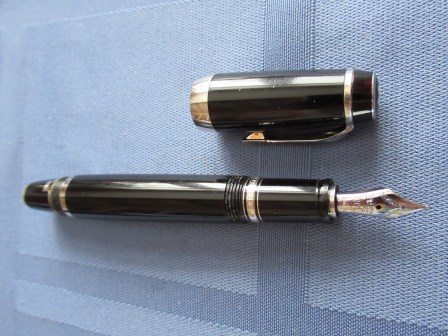
However, warm as is the friendship of the beginning, failed and faltering writers’ support groups to which I belong,  most, if not all, writing is done in isolation: me and my memories, me and my invention, me and my keyboard, me and my blank page, me and my pen, me and a-penny-for-my thoughts as I refill that pen with Royal Blue ink in the hopes that something regal will actually fall from the nib and grace one of my pages, even though I am really wondering yet again whether, like the budding author in Camus’s La Peste,  I should start that first paragraph all over, yet again, just once more.

Alas, me and the cat and the keyboard do not share a healthy working relationship, especially when she walks across the keys, sticks her kitty-littered rear end in my face, scratches her itchy chin against the computer’s sharp edge, and purrs wildly for kibble while adding oft-repeated letters and deleting so many of the wonderful words that I have so carefully accumulated. Last month, incidentally, she also unfriended a dozen of my Facebook friends. Unfortunately, I do not know which ones and none of them have got back to me. Oh dear.

One of the students in my current course asked me when I started to write. The answer is that I do not know. I have always written. I guess I have written from a deep inner urge to understand myself and the world in which I live. Going to a series of boarding schools was also a key part in the relationship between me and my writing. I was six or seven when I first went to boarding school and every Sunday I was plonked down on a wooden bench and ordered to write a Sunday letter home to my parents. Oh the wails and the take-me-aways that issued from my pen only to be deleted by the school censors. As a result, from early on, I shaped letters for the censoring audience. I also wrote other letters and they became a part of my writing style and my need for self-expression.

Mikhail Bakhtin, in his theory of Chronotopos, speaks of ‘man’s dialog with his time and place’ and that is exactly what I do. I hold a dialog with the things happening around me in the particular place I find myself.  Why do I write? To better understand my time, my place, and my own interactions with the world around me. Writing then is a means to an end and that end, for me, is self-understanding, self-betterment, and the better understanding of the world in which we all live.

IMG_0402 (1)

Titles

img_0177


Titles

I am currently thinking and re-thinking the titles to my books.

Clearly, the title is of the utmost importance. The title should draw the reader in while offering some information on the content. Alas, my earlier titles rarely did this.

Monkey Temple, for example, really doesn’t say much about what the book contains. Nor does its subtitle: A narrative fable for modern times. Those who have read poems from the book or who have heard me read excerpts from it, know what it is about. However, deep down the title really says little about the life and times of Monkey, the protagonist who works and suffers in the corporate Monkey Temple.

In similar fashion, Though Lovers Be Lost is a wonderful title, taken from Dylan Thomas, and illustrating his theory that “though lovers be lost, love shall not, and death shall have no dominion.” If readers have these lines on the tip of their tongues, as most people from Wales do, then they will have a fair idea about the contents of the book. However, without that intimate knowledge of one of the great Welsh poets … many readers will be lost and the title will lack meaning, check my post on Intertextuality.

Bistro is a collection of flash fiction. I am not sure that the title suggests that instead of a standard and expected table of contents the book has a menu that refers to the 34 pieces of flash fiction are contained within its pages. The pieces are so varied, rather like a meal of sashimi or sushi, that it is difficult to describe the contents (or menu) in such a short thing as the title. Does the one word, Bistro, draw the reader in? The cover picture might and the combination of title and picture and cover may go further. However, I have my reservations.

Empress of Ireland, on the other hand, is a book of poems about a specific event: the sinking of the Empress of Ireland  in the St. Lawrence River in May, 1914. Here, title and event are closely linked and hopefully the title is rather more indicative of the contents. Even here, as in the cases of the books mentioned previously, a brief description of the book is necessary.

Sun and Moon is a great title, provided you have lived in Oaxaca, Mexico, and know that Sun and Moon are the official symbols of the state of Oaxaca. Without that knowledge, the sub-title, Poems from Oaxaca, Mexico, is essential. The cover photograph with the state symbol of Sun and Moon is intriguing, but it is still necessary to read the description to find out what the book is about. Are title and sub-title enough in themselves? I’m still not sure.

Obsidian’s Edge is a tricky title. I thought everybody knew that obsidian is the shiny black glassy stone produced in volcanic areas. Further, I thought most people knew that the edge of obsidian is used in weapons and knives that cut. By extension, obsidian knives were used by the Aztecs and others in their human sacrifices … so much knowledge that is clear to the writer but unclear to the reader who may not realize that we all live at Obsidian’s Edge with the sacrifice of our own lives hanging by a thin thread on a daily basis. Oh dear, I have been to workshops and readings recently where people knew nothing about obsidian and its properties … my title gives so little information.

Land of Rocks and Saints has yet to be revised and rewritten. Few English readers will associate it with the old Spanish saying, Ávila: tierra de cantos y santos / Avila, Land of Rocks and Saints. The tragedy of living a life in more than one language is that the cultural knowledge so easily understood in one does not necessarily transfer readily into a second or third language. Some of my readers write me to say that they Google all these terms and learn a tremendous amount from the books. Alas, I have to improve my titles. I need to sharpen them and use them to draw my future readers in.

Ávila: cantos y santos y ciudad de la santa, the Spanish translation of Land of Rocks and Saints that I put up on Amazon / Kindle, is a better title. Avila is both the province and the capital city of the province. The rocks and saints are clearly linked to the name and the city itself is the city of the saint, St. Teresa of Avila, of course. Hopefully, this title, in Spanish, will attract some Spanish readers. I can only hope.

The book on which I am currently working was originally called Iberian Interludes and had no sub-title. In my revision, I am selecting poems about Spain from various earlier collections and placing them together in one large compendium. I have selected poems from two collections Iberian Interludes and In the Art Gallery (oh dear, I never mentioned that it was the Prado and that all the paintings could be found there). To these I have added a selection of individual poems either published in reviews and literary magazines or taken from other collections.

I am still working on a title for this collection, hence today’s post. I have rejected Iberian Interludes as too vague (how many of my potential readers know that Spain is Iberia) and I am now looking at a bold assertion: Spain. If I do this, I will need a sub-title. The evolution of the subtitle looks like this: Bull’s Blood and Bottled Sunshine, ¡Olé!  >  Bull’s Blood and Bottled SunBottled Sun and Bull’s Blood. I wonder if Spain: Bottled Sun and Bull’s Blood will be catchy enough. Will it draw readers in and attract them?

Post Script: By the way, I thought long and carefully, and went with Iberian Interludes anyway. The cover picture shows a modern stone sculpture of a traditional bull. Lovely!

Intertextuality

Zeitgeist 1-10

Intertextuality

Intertextuality is the dialog that takes place between texts or as Merriam-Webster explains it: “the complex interrelationship between a text and other texts taken as a basic to the creation or interpretation of the text.”

Often we write from an intertextual perspective when we respond to other writers and their thoughts and imagery. This is why, in the creative process, reading can be as important as writing. Reading expands our vocabulary. It reinforces some of our own opinions and challenges others. Without reading, we are lonely rocks in sunless seas.

To be creative, we need to be aware of what others are writing and how they view the world we inhabit. When we read creatively we read with an eye to improving our creativity and our structures. We look for new ideas, new images, new words, new ways of expressing our thoughts.

Often we think we are being original when in fact we are re-processing, just as I am now, the ideas of other people. Given the nature of modern media, we are not always aware of all the multiple sources of our material: telephone, twitter, blogs, radio, television, newspapers (less and less), books, chapbooks, magazines, e-sources, lectures, chat groups, Facebook, and general conversations with other people who are also unaware of their sources. Thus ideas abound, float in the air, circulate and recirculate, submerge and resurface, shift their shapes and colors.

As writers we dip into that enormous moving mass of current and past culture and creativity and we choose our narrative lines, our characters, our structures, our images, our metaphors. As Jean-Baptiste Poquelin, better known as Molière, once wrote, “Mes idées? Je les prends où je les trouve.” My ideas? I take them from wherever I find them.

Imitation is the best form of flattery. Indeed it is. We cannot, however, borrow wholesale and just copy. Miguel de Cervantes borrowed the first five chapters of Don Quixote (the first sortie) from an earlier entremés entitled El Entremés de los romances. For a very long time, critics thought that Cervantes was the author of both pieces: they are very similar. However, even a quick analysis also shows that they are very different. The language of the entremés is much older while the conversion of theatre into narrative distinguishes them at a very basic level. Cervantes borrowed: but in borrowing, he adapted, he changed, he took the old form and converted it into something new and completely original. Nevertheless, we are still aware of the origins of the great novel that has many other borrowings woven into its fabric.

So, we indulge in intertextuality when we engage in a dialog with other texts and ‘borrow’ from other authors. To be original, we have to take that borrowing and turn it into something entirely different, something that becomes a part of ourselves and no longer exists as a part of that other text. Intertextuality is not copying. If we take a text in its entirety, if we ‘copy’, then we must acknowledge the source. However, when we indulge in a dialog with a text, when we transform a text, when we are ourselves transformed by a text, then that is a totally different situation. Think of the links between Akira Kurosawa’s 1954 film, The Seven Samurai, and its offspring, the 1960 western entitled The Magnificent Seven. They are very similar in so many ways … and yet they are so very different.

While intertextuality refers more to the larger elements of character and narrative structure, it also exists at the level of metaphor and image. Sometimes, without thinking, we use metaphors that we have heard before. Often we like the sound of a group of words, shuffle them around, and come up with a new meaning for them, a new metaphoric reality. This too is intertextuality.

At its best it is a very valuable addition to our creative tool kit.

While on the topic of creativity, let us spare a thought for our needs for creative time and space. We cannot create when we lack the blessings of time and space. Creativity is greatly hindered when we go hungry and need to complete back-breaking work just to sustain our lives and feed our families. Our relative wealth and leisure is a blessing: without them, we would be floundering in the pre-industrial world of subsistence farming, working at manual labor from dawn to dusk.

Let us spare a thought too for those oral societies that existed when people could not write. Or those early societies in which only the few, the happy few, were educated to the level at which they could actually read and write.

Intertextuality is a blessing, not a curse. Use it wisely, use it well.

Comment: I would like to thank Meg Sorick who suggested that I expand an earlier conversation that we had on the topic of Intertextuality.

Codification

IMG_0068 (2)

Codification

For me, it is vital to see how others read and interpret my work … what comes across, what doesn’t, how things are understood and read, sometimes in the same way, sometimes in different ways. It is always easy to pick out some favorite phrases. However, deciphering, interpreting, and then reacting to, a poem’s inner code, is a very different matter.

I love the cut and thrust of dialog … I was at our Tuesday night writing group meeting last night from 7-9:30 pm and we had a great time, back and forth across the table pecking, like wild birds perched on a literary feeder, at each others’ texts. My own texts are thickly layered and highly codified and I have become very interested in the theory of literary codification.

My own ideas are a development of those of Northrop Frye as he expressed them in The Great Code. When we lose our common code, to what extent do we need to explain a private one? This is of great import to Frye’s studies on William Blake, perhaps (in spite of his seeming simplicity in certain poems) one of the most difficult of English poets.

Perhaps the answer lies in Karl Jung’s theories on the racial subconscious: that we all share deep, (human) racial symbols that transcend words and often appear as symbols and images. If this is true, then we communicate, at a non-speech level, through metaphor and symbol, and that is more powerful and outreaching than linear language, however well and clearly codified it may be.

This emphasis on symbol, image, and metaphor leads us, of course, into surrealism, free writing, concrete poetry, sound poetry, and all those efforts to abandon the linear and reach into the subconscious roots of ‘that which binds us together as human beings’ … in my humanistic theories, to find the links that behind is more productive than the reinforce the fears and misbeliefs that separate. Alas, not everyone thinks that way in the literary world, and private codes can easily be used as wedges to force people apart.

We need codes, preferably codes that we can share. The question is, how explicit would we be, as writers, in explaining those codes? How closely should we imitate the writing codes of other people?

The eternal mystery of Aladdin’s Lamp: “New codes for old.” And don’t forget the magic words “Open Sesame.”

Ah, the joys of codification.

Commentary
This is a golden oldie, a repeat of an earlier post.  I am creating furiously at present and cannot always spend the time to create for the blog. Hence the repetitions and the golden oldies. Codification is something that has interested me for some time: the Biblical Code, The Western Tradition, Courtly Love, the Icy Fires of Petrarchism, Romanticism,  Impressionism, Expressionsim, Surrealism, Existentialism, Modernism, Post-Modernism … the -isms, once started, are apparently endless. All of these -isms spiral round the ideas of verbal codes. In codification, I would like to start a discussion on what these codes are, how they affect us, what do they mean, especially when they can be so totally personal. By all means, join the discussion: what do you mean by codes? How do you use them? How do you interpret the codes of other people? By all means post here, but better by far, rech out and discuss these things with your friends and your writing or art groups.

New Projects

IMG_0026

New Projects

 … how do you choose them, these new projects? Simple answer: I really don’t know. So much depends on you and your work habits. In my own case I have a back log of projects. I have been writing and creating for years. As a result I have a whole set of files that I can turn to and select from. Two novels, about fifty short stories organized into two or three as yet unpublished manuscripts, a couple of hundred poems, organized into three separate thematically organized manuscripts, a set of writings on facilitating creative writing …

Projects … do the work and then choose the order in which you will publish it. I look at the hollyhock that suddenly appeared last year in my garden. Do the work: the birds (in all probability) seeded it. The hard work: the hollyhock grew itself. I should add that my beloved nearly tore it out on the grounds that she didn’t recognize it and it looked like a weed. But she left it, and it grew into what it was meant to be: a hollyhock. One stalk. So many buds. We didn’t know which would blossom first. And it didn’t matter. One after anther they all blossomed. The hollyhock knew what it was doing [we didn’t]. It had belief and faith [we didn’t]. But we had hope.

The Hollyhock Project: This year the hollyhock has eight [yes, eight] different shoots. It’s no longer a single flower, it’s become a bush! It has also shed seeds further afield [I should really write abed, since they’re all in the same flower bed.] I wonder in what order they will blossom. It doesn’t matter really: I am just confident they will bloom. And the sunflowers have rooted below the bird feeders. They have their own projects and I know they will grow as and how they will. And the yucca has four shoots that will flower, how and why I just don’t know. But each flower has its project(s) and I am confident they will all flower and flourish.

My own projects: When June came in, I didn’t know what to do, nor did I know in what order to do it. Then Time-spirits came together. Geoff gave me some drawings and I chose one for the cover. I took the manuscript to the printers, got an estimate, and received a mock-up. The text had shifted in the transfer from computer to computer. My 70 page text had grown to 132 pages. I spent the next 72 hours rewriting everything, eliminating words, lines, poems, dropping the text back down to 70 pages. It is now published. I wondered what to do with the McAdam Railway Station poems. Geoff came to see me on Sunday, 23 June, and told me that he would be celebrating his birthday the following Friday. He also told me that the McAdam Railway Station would be unveiling his mural the following Sunday (June 30). The McAdam railway poems were published on Saturday, 29 June, and I took them to McAdam in time for the ceremony.

Trust: Trust yourself, trust your projects, trust the universal spirit [Northrup Frye’s Spiritus Mundi], under whichever name you acknowledge it). And remember, genius is 99% perspiration and 1% inspiration. Put in the mileage, put in he hard work, believe, and trust. ¡Qué será, será! Whatever will be, will be.

IMG_0206

Comment: another golden oldie. I am trying to choose what new projects to start and which old projects to finish. A pleasant problem. Meanwhile, I am enjoying the prospect of a nice, snowy Canadian winter day. Best wishes and happy writing to all.

Revisions

img_0128

Revision
“We are not writers, we are re-writers.” I do not remember who said this, but it is extremely well said. We write, yes. But then we rewrite, sometimes obsessively, again and again. But how does that rewriting process take shape? Why do we rewrite? How do we rewrite? And what do we do when we re-write? These are all vital questions.

Mechanical revisions and rewrites
This, for me, is the search for typos, punctuation errors, mis-spellings, grammar corrections, that sort of thing. Yes, we can rely on a (reliable?) editor and a not so reliable spell-check, but the editor usually costs money. Or we can learn to do it ourselves, which is what I recommend very strongly.

Grammatical revisions and expression checks
These are usually a little more difficult to deal with. Do the verb tenses check out? Are subject and verb clearly delineated? Does the wording make sense, not just to us, but to the outside reader? A second pair of eyes is always useful at this point. Also, a sense of distance from the text is useful. Leave it a day (or two) and come back to it later when he creative rush has fled the system.

Structural revisions 1
Whenever we do a structural revision, it is essential to check that the revision ties in with the rest of the piece and that we maintain consistency throughout. A simple example: I decide, on page 77 of my novel, to change my main character’s name from Suzie to Winnie. Clearly, her name has to be consistent, both backwards (1-77) and forwards (77 onwards). While this is obvious, other changes, taste, color of hair, color of eyes, height, weight, tv program preference, may not be so easy to check and double-check. But it must be done.

Structural Revisions 2
This is where we must pay attention to the vision in the re-vision. We must ask the question, what does the poem / story / chapter / text want to say? What is it actually about? Often, in the flush of creation, we write words (actions, thoughts, emotions) on the page and they flow like water from a fountain. It’s a wonderful feeling. Later, during the re-vision process, we must ask ourselves, again, deep down, what do these words mean, what are they trying to say? This is actually a slightly different question from what am “I” trying to say?
The speaking / writing voice may want to say something, but the words (and characters and actions) themselves may want to say something else. Now we are faced with a dilemma: do we write what we want to say or do we follow the intricate word-path growing from what we have written? As a beginning writer, I did the former. As a more mature (and I hope, a slightly better writer) I now do the latter.
The result is often a piece that is radically different from it’s starting point. When you listen to what the story / poem / text / characters etc are telling you and when you follow words and characters, then structure changes, paragraphs switch places, thoughts move around, expressions change. We are no longer forcing words into our meanings, we let the meanings grow out of the words. This is particularly important in short story telling and the writing of poetry. It is vitally important to the novel where any inconsistency must have a relevance to the development of action, plot and character. It is also a totally different approach to the meaning of re-vision.

Summary
I realize many writers may have difficulty accepting these points. Those trained originally in the academic world, in particular, will respond negatively to the idea of the words ‘not being forced into the correct academic shape by the quasi-omnipotent academic mind’ aka Constable Thesis Editor. However, the more creative a writer is, the more that writer will respond to the creativity that lies within both the creator and the creation that has appeared on the page and, as writers, we must never lose sight of that creative act, for it is one of the most truly wonderful things that we can do.

Comment

This is a golden oldie. However, it is still worthy of being reconsidered. Why do we revise? How do we revise? I hope this article is of use to the many out there who are looking for help and encouragement.

KIRA Boutique Writing Retreat


IMG_0124

KIRA Boutique Writing Retreat

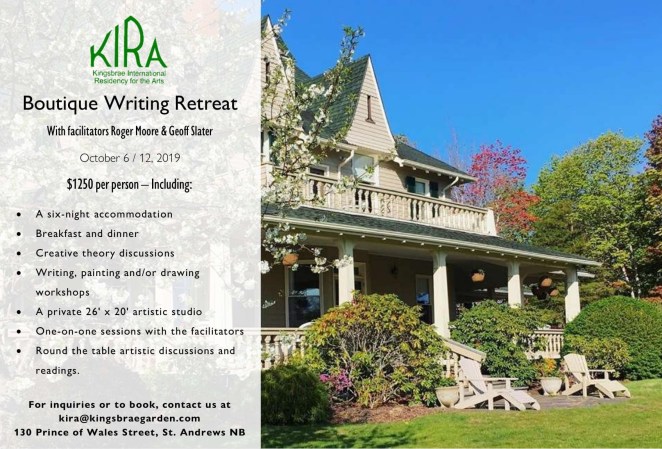
The 2019 KIRA Boutique Writing Retreat will take place from October 6-12 at KIRA (picture and details below) just outside Kingsbrae Gardens in the beautiful New Brunswick town of St. Andrews. More information is available from kira@kingsbraegarden.com 

IMG_0126 (2)

The KIRA Boutique Writing Retreat, aka The Art of Writing, is unique in that it concentrates on Creativity: how we channel it, how we express it, and how it changes us. Geoff Slater (artist and line painter) and Roger Moore (award winning teacher, poet, and short story writer) concentrate on different forms of creativity with, in addition to the free time at the retreat, workshops on drawing and painting (Geoff) and poetry and prose (Roger). The morning talks and the evening readings allow each individual to explore themselves and their creativity in a unique setting.

KIRA Boutique Writing Retreat Advertisement

Attendance is limited to five residents. This allows us to offer one on one time with each of the instructors if and when it is needed.

IMG_0068 (2)

KIRA

KIRA Boutique Writing Retreat Advertisement.jpg

Commentary:

This is the new advertisement for the KIRA (Kingsbrae International Resdencies for Artists) Fall Session (October 6/12, 2019). Geoff Slater and I will be again facilitating a week of creative workshops, including drawing and painting (Geoff) and writing (Roger, both poetry and prose). These will take place in the KIRA Residence, just beside Kingsbrae Gardens. Residential enrollment is limited to five people. Just send us an e-mail if you are interested in attending this workshop. If you click on the KIRA link in the first line (above), be sure to watch the opening video. Pictures speak louder than words and the video will help you to understand what Creativity at KIRA is all about.


Wednesday Workshop: New Projects

IMG_0026

Wednesday Workshops
New Projects
03 July 2019

New Projects … how do you choose them, these new projects? Simple answer: I really don’t know. So much depends on you and your work habits. In my own case I have a back log of projects. I have been writing and creating for years. As a result I have a whole set of files that I can turn to and select from. Two novels, about fifty short stories organized into two or three as yet unpublished manuscripts, a couple of hundred poems, organized into three separate thematically organized manuscripts, a set of writings on facilitating creative writing …

Projects … do the work and then choose the order in which you will publish it. I look at the hollyhock that suddenly appeared last year in my garden. Do the work: the birds (in all probability) seeded it. The hard work: the hollyhock grew itself. I should add that my beloved nearly tore it out on the grounds that she didn’t recognize it and it looked like a weed. But she left it, and it grew into what it was meant to be: a hollyhock. One stalk. So many buds. We didn’t know which would blossom first. And it didn’t matter. One after anther they all blossomed. The hollyhock knew what it was doing [we didn’t]. It had belief and faith [we didn’t]. But we had hope.

The Hollyhock Project: This year the hollyhock has eight [yes, eight] different shoots. It’s no longer a single flower, it’s become a bush! It has also shed seeds further afield [I should really write abed, since they’re all in the same flower bed.] I wonder in what order they will blossom. It doesn’t matter really: I am just confident they will bloom. And the sunflowers have rooted below the bird feeders. They have their own projects and I know they will grow as and how they will. And the yucca has four shoots that will flower, how and why I just don’t know. But each flower has its project(s) and I am confident they will all flower and flourish.

My own projects: When June came in, I didn’t know what to do, nor did I know in what order to do it. Then Time-spirits came together. Geoff gave me some drawings and I chose one for the cover. I took the manuscript to the printers, got an estimate, and received a mock-up. The text had shifted in the transfer from computer to computer. My 70 page text had grown to 132 pages. I spent the next 72 hours rewriting everything, eliminating words, lines, poems, dropping the text back down to 70 pages. It is now published. I wondered what to do with the McAdam Railway Station poems. Geoff came to see me on Sunday, 23 June, and told me that he would be celebrating his birthday the following Friday. He also told me that the McAdam Railway Station would be unveiling his mural the following Sunday (June 30). The McAdam railway poems were published on Saturday, 29 June, and I took them to McAdam in time for the ceremony.

Trust: Trust yourself, trust your projects, trust the universal spirit [Northrup Frye’s Spiritus Mundi], under whichever name you acknowledge it). And remember, genius is 99% perspiration and 1% inspiration. Put in the mileage, put in he hard work, believe, and trust. ¡Qué será, será! Whatever will be, will be.

IMG_0206