On The Outside Looking In


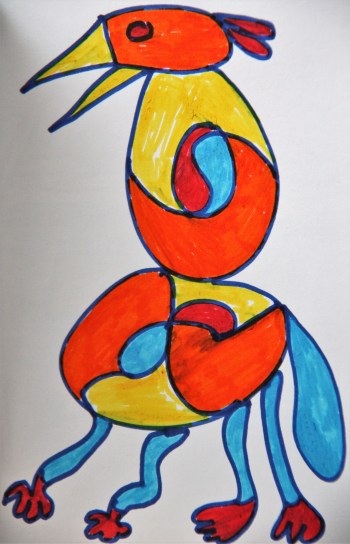
IMG_0192.JPG


Billy was walking home on his own. As usual. The church party was awful. As usual. Lots of trumped up noise and artificial gaiety.

The priest had made the boys sit in a circle on the floor, legs crossed. Then he put a bar of chocolate in the middle of the circle. He walked around the group and whispered the name of an animal secretly, he loved secrets, to each one.  Then he explained the game to them.

“I cannot remember what animal name I bequeathed to each boy,” he said, staring at them, his eyes golden, like a fierce eagle’s, beneath bushy black eye-brows. “I will say the name of an animal until one of you, whoever it happens to be, hears his own secret animal name. When you hear that secret name, you must grab the chocolate bar before anyone else can get it. Understood?”

The boys all nodded and the mums and dads who had brought them to the party smiled in anticipation.

“Are you ready?” He watched the boys as they nodded and shouted “Alligator!”

Nobody moved.

“Elephant!” The boys shuffled forward, like inch worms, hands twitching, fingers flexing and grasping.

“Tiger!” A sigh from the boys, some of whom were already licking their lips.

“Lion!” One boy moved, but the priest shooed him away. “Sit down. I didn’t give the name lion to anyone.”

“M-m-mouse!” The boys heaved, a sea-wave about to crest and break.

“I do love this game,” said the priest to the parents. “And so do the boys, don’t you boys?”

“Yes father …”

“Monkey!” All the boys moved as one. Some crawled, some dived, some leaped to their feet and ran. A surging heap of boys writhed on the floor as the chocolate bar was torn apart and the long awaited fights ensued.

All the boys moved, except one. Billy just sat there.

“I said ‘Monkey’, Billy,” the priest frowned at the boy.

Billy nodded.

“When I say ‘Monkey’, you join in with the other boys and fight for the chocolate bar.”

Billy nodded again.

“Go now and have some fun. Join in the game.”

Billy shook his head.

“Why not, Billy?”

“It’s a stupid game. I won’t play it. I want to go home.” Billy stood up and walked out of the church. He turned at the door and saw the priest glaring at him while a mound of boys continued to scrummage on the floor.

As Billy walked, it started to snow. Not the pure white fluffy snow of a Merry Christmas, but the dodgy, slippery mixture of rain, snow, and ice pellets. Billy turned up the collar of his coat and, bowing his head, stuffed his hands into his pockets. He turned the corner onto the last street before his own and stopped.

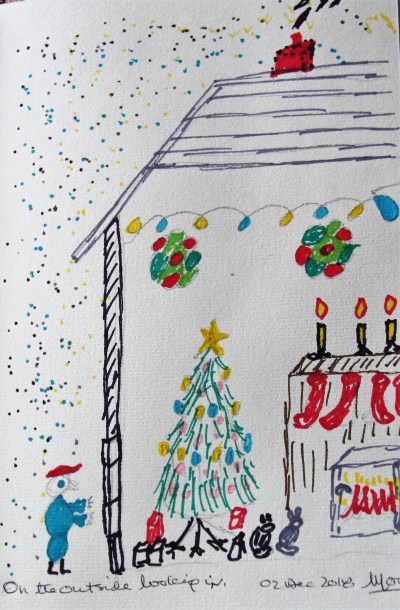
A house. With a window lit up in the gathering dark. He drew closer, pressed his nose against the window and looked in. A Christmas tree, decorated with lights, candles, more decorations, a fire burning on the hearth, two cats before the fire, presents beneath the tree, stockings hanging from the mantelpiece. For a moment, Billy’s heart warmed up. Then he thought of his own house. Cold and drafty. No lights, no decorations. No fire. A snowflake settled on Billy’s heart and refused to melt.

When he got home, the house stood cold and empty. His parents were at work and the fire had gone out. Nothing was ready for Christmas. Billy sat at the table, took out his colouring book and began to draw the cartoon you see at the top of this page.

When his mother came home, he showed her his drawing.

“Very nice,” she said, barely glancing at it.

“But mum, you haven’t really looked.”

Billy’s mother stared at the picture again. This time, she saw the Christmas tree and the lights, the cats and the candles, the decorations and the presents. But she never noticed the little boy standing outside in the snow,  peering in through the window.


Happy Hours

IMG_0126 (2).JPG


As the inscription on the old Roman sundial announced: Horas non numero nisi serenas / I count only the happy hours. And, of course, the sundial is right. When the skies are cloudy and the rain and snow are falling, the sundial sleeps and refrains from marking the passage of time. But when the sun prances brightly through those heavenly meadows and casts shadows across the numbers on the clock, then the sundial counts the hours, precisely because they are happy.

I try to do the same. I try to avoid the shadows that are cast across our planet and I try not to count them. Alas, like the grains of sand on the beach and the countless stars in the sky, they are innumerable, though the latter are being named, numbered, and counted, much to their chagrin.  Who wants to be called Welsh by foreigners, with all the negative connotations they associate with the epithet, when our real name is Cymraeg? And no, we don’t live in Wales, we live in Cymru, or better still, in Canada when we (e)migrate. Canada: I wonder what the real name is for this huge and wonderful land? And what about the local indigenous peoples? I can accept that they are First Nations. No problem. But who are our hosts and neighbors when they call themselves Wolastoqiyik (or Maliseet) and we call them Aboriginals (or worse)?

What’s in a name? North, South, East, West … simple, eh? How about Upstream, Downstream, Away from the River, Towards the river? Think names of the months, names of the days of the week. Now think guidance, think signposts, think culture, think separate cultures, think different ways of living, think different ways of life. Think possessive pronouns: my book, my house, my cat, my dog, my son, my daughter, my Wifi, my wife.  Or as le grand Charles de Gaulle expressed it, in Le Canard enchaîné: “Ma France, mon coup de frappe, mon Europe … mon Dieu.” Maybe we would be better off without possessive adjectives. But then …

“Taffy was a Welshman,
Taffy was a thief,
Taffy came to our house
and stole a leg of beef.”

Taffy: a generic name for the Welsh. Any male person from Wales is automatically a Taffy from the moment he opens his mouth and speaks with anything like a Welsh accent. Taffy, from the River Taff that flows through Cardiff,  aka Caer Dydd, the fort on the Dydd. There are many rivers in Wales, many regions. Men from the Isle of Mona, Llanberis, Caernarfon, Brecon, Abertawe, Aberavon, Castell Nedd, Caerfryddin, Pen-y-pont, Caer Isca, Usk, Cas Newydd, Pen-y-Bryn, Sgetti, Uplands, Trebanog, Llanelli, Llanfairpwllgwyngilldrawbwllchllantiisilioggogogoch, Cwm Parc, Trebanoc Cwmbwrla, Cwmrhyddiceirw  … Taffies one and all, even if they were born miles away from the River Taff and rarely visited Cardiff, the very name of the river and the city anathema to them.

I once had a friend, a very good friend, or so I thought, educated in Harrow, Oxford, secret member of the ultra-secretive, fabulously expensive, well-endowed and super-privileged, ultra-elite Bullingdon Club. He had a triple barreled name of course: Somerset-Trilby-Frisbee or something like that, I forget now. Whenever I arrived at a reunion or a meeting, he would greet me with a bullhorn, bullfrog chorus that reached into the far corners of the room: “Lock up the silver spoons, the Welsh have arrived.”

Humor? His laughter would rock the rafters and shake the room once more. Racism? What racism is there in mocking the Welsh when you are English? Bigotry? No man with a three part surname, an English public school background, and a list of ancestors longer than your arm could possible be a bigot.  Idiot? He was very intelligent, slightly unbalanced, and totally oblivious to any social norm or indignity, unless he was the threatened person, and watch out for vicious mousetraps if you made him the butt of your own humor and he took umbrage at the slight. Criminal? No way: the Welsh were always the criminals, for back in the legendary mists of time they had stolen a leg of beef and now they were here to steal the precious plastic spoons and knives and forks that masqueraded as silver …

… what’s really in a name? What’s in a grey day or a blue day? What’s in a cloudy day or a sunny day? What’s in our hearts when we denigrate our friends and doubly degrade our enemies and those we declare to be our enemies, sometimes on a gut feeling or a whim? Horas non numero nisi serenas … Time to look on the bright side, to walk on the sunny side of the street, to reject the shadow and live in the sunshine. Time, in fact, to turn the whole day into a succession of Happy Hours. Study the cartoon above. Now that is a portrait of someone who really enjoys a Happy Hour. And not a glass or a bottle in sight.

Turds

IMG_0188


I love the sales shows on the telly. The sales lady comes and and starts talking and you can’t stop her once she gets going. My golly, once they start talking they’d sell you anything from snake oil to …. well, I heard a good sales pitch today. It went like this.

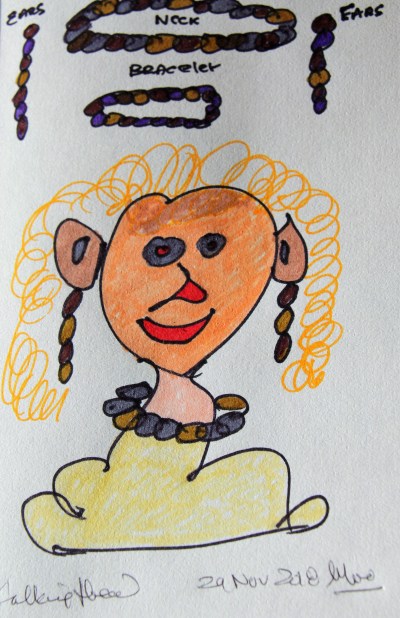
“See how delicately the necklace is carved? Then it is highly polished in a new process that leaves it bright and shiny, like a brown diamond.”

The model whirls and twirls, showing off her best points,  not to mention what she is encouraging viewers to buy, the bracelet, the ear-rings, the shiny necklace. Television and online sales. No sense across the screen of touch, of taste, of smell. Just a temptation to enter a vision that the sales girl is selling. The model whirls, the music rings out, the camera focuses on the band in the background. The lead singer wears exactly the same jewelry as does the model: identical necklace, ear-rings, bracelet.

I struggle to catch the words, but you know how modern music distorts the lyrics, twists the sounds. Later, I put the words of the song back together. I recognize snippets, portions, and then the whole verse clicks. Intertextuality, I think, verse responding to verse across cultures and the ages. No wonder that I recognize it and can put the words back together with the help of the original.

“Only twenty left,” the sales lady says. The model smirks, wiggles, shows off her multiple gems, and smiles. “Call this number now,” the sales lady points to a number in the corner of the screen. “Nineteen, eighteen left, be quick. You don’t want to miss out on one of these.”

“Remember,” the sales lady says. “these are original dog turds. They say you can’t polish a turd, but you can. In fact, with today’s new freeze dry technology you can collect dog turds, freeze dry them, and then carve, shape and polish them. No more doggy bags and doggy waste. It’s one of the best forms of recycling.” The sales lady smiles at the camera and the show band breaks once again into that snappy song and chorus. While the lead singer sings, the camera focuses in on her necklace, her ear-rings, and then her bracelet. And I piece together the words:

“Gather ye dog turds while ye may,
for time it is a’flying,
and that fresh dog turd, dropped today
tomorrow you’ll  be drying.”

“Looks like a dog turd.
Smells like a dog turd.
Feels like a dog turd.
Tastes like a dog turd.
Thank Dog we didn’t step in it.”


Snowman

IMG_0176.JPG

“Settle down, children, and be quiet. I am going to read you a story about the snowman who didn’t believe in global warming. You, at the back, Elizabeth … yes, you. Sit down and shut up and stop biting your fingernails. And no, it’s not recycling when you chew them afterwards. Stephen, stop blowing raspberries. Now, children, shall we begin?”

“Yes, miss.”

“Once upon a time, a long time ago, after a big snow storm in November, Little Justin built a snowman in his garden. It was a lovely snowman. You can see how lovely it was if you look at the picture at the top of this page. There. Isn’t he lovely?”

“Yes, miss,”

“Justin was a very clever boy and he could do magic tricks. So, he made his snowman mobile and the snowman walked all over the garden. He was a very happy snowman and he threw snowballs at Justin who caught them and threw them back. Stephen, will you stop blowing raspberries.”

“Sorry, miss.”

“Justin’s snowman could speak and understand long words and sentences. He was very clever, but not as clever as Justin. David, will you stop picking your nose and don’t put that finger anywhere near your mouth.  And Stephen, one more raspberry and I’ll make you stand in the corner. Do you understand me?”

“Yes, miss.”

“One day, Justin told the snowman all about global warming and how the spring would come and the sun would shine and all the snow would melt. ‘Phooey,’ said the snowman. ‘I don’t believe you. And anyway, I don’t care.’ ‘You just wait until April or May,’ said Justin. ‘Then you’ll believe in global warming.’ ‘Right,’ said the snowman. ‘I won’t believe in global warming until April or May. Then I’ll believe in global warming. Maybe. We’ll see.’ Justin was very upset that the snowman didn’t believe him. Stephen: that’s enough. No more raspberries, I said. Now go stand in the corner. With your face to the wall. Any more noise from you and I’ll put you in detention. Do you understand?”

“Yes, miss.”

“Well Christmas came and the snowman danced on the snowbanks and thumbed his nose at Justin. ‘Global warming sucks,’ he sniggered. Justin shivered through the cold winds of January and February. Then March came in like a lion and the cross-country skiing was wonderful and Crabbe Mountain was full of young people all having fun. Meanwhile the snowman danced away and sang under the moonlight. Some nights Justin would wake up to find the snowman’s face, like a great full moon, leering in at his window. And … what was that noise? Stephen, was that you?”

“Please, miss. I couldn’t help it. It wasn’t a raspberry, miss.”

“I know it wasn’t a raspberry. And I know what it was. You’re coming with me to see the principal. Class, you can take out your pencils and notebooks and write your own ending to the snowman story. Stephen, what you did was disgusting. You’re coming with me to the principal’s office. Right now.”

“But, miss,” Elizabeth an David raised their her hand.s and spoke in chorus” “What happened to the snowman?”

IMG_0185.JPG


P.I.S.S.

IMG_0170.JPG

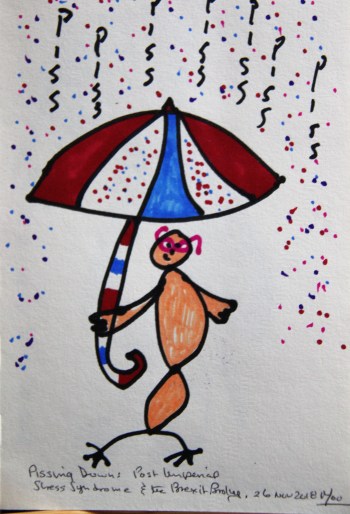
I found the acronym PISS in the below the line comments section in the Guardian. I love it: apparently it stands for Post Imperialist Stress Syndrome, another lesser buzz-word from the referendum and its aftermath. It refers to the idea that a whole (and elderly) generation of Brits cannot get over the fact that they no longer have an Empire and yes, they want their Empire back. How that is going to happen is anybody’s guess.

So, here’s the weather forecast: heavy rain over Britain during Brexit. In fact, to use a local saying the rain will indeed be “pissing down”. For a while, everybody can wear rose-tinted glasses (you can see them in the cartoon), but soon enough reality will return and then the reconstruction of British Empire 2.0 can begin. The rich won’t suffer: they never do. But what will happen to those who are currently staggering under the current burdens of austerity? Nobody knows and the only ones who really care are the sufferers themselves.

Eau Canada: it’s great to live in a bilingual country where such fractures can be faced and overcome. Yet who knows what fractures face us in the future as we predict fires, floods, high winds, ice storms, power losses, and a host of climate change adaptations that will be as difficult to surmount as the political changes voluntarily sought by a small majority of 2% in a referendum where only 60% of the people voted.

As the Chinese curse would have it: “May you live in interesting times.” Whatever your beliefs, your faith, your vote, your IQ factor … interesting times are indeed upon us. But keep them at a safe distance from me, s’il vous plaît … And let’s watch it all unfold in virtual reality on the telly … I prefer to live my life that way.

Three Deer

img_0351


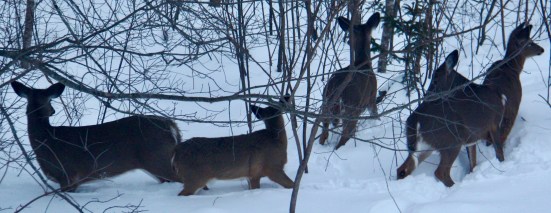
We spotted them very late and by the time I had found my camera they had walked past the kitchen window and my only shot of them was through the bars of the back porch. Not a great photo, but better than nothing. We see them regularly in the winter, but usually at dawn of dusk. We have never before seen them at mid-day, not that we are looking for them ‘out of hours’ so to speak.

We speculated on why they were there, what they were looking for, but we could come up with no answers. Hungry? But this was an early snowfall and there would be plenty of food out there. Confused, perhaps, as were were, by the early snow? That is a possibility, but we’ll never know for sure. What I do know is that they haven’t been back. With the snow down they would leave tracks, but we have seen no tracks in the snow.

Maybe, without the photo, I would have forgotten about the and thought that maybe I was mistaken. But I have photographic evidence and no, it isn’t photo-shopped or forged. In spite of all my doubts and misgivings, they were there, in the early snow of Snovember. They passed through the garden last night for their first nocturnal visit. I heard a cough and a snuffle at the feeders, but didn’t get out of my warm bed to take a peek. This morning, they had snaffled all the seeds in the bird feeders and they left tracks leading up from the trees, then back into the woods again. The chickadees had a rough time of it as there was very little breakfast for them, early this morning. We have re-filled the feeders now, and life goes on.

img_0344

Here is a link to an earlier blog post that contains more pictures of deer in the yard.
Five Deer.

img_0436

Pork Pies

IMG_0146.JPG


This is the climate change monster wearing rose-tinted glasses and peering out of the woodwork to say ‘Boo’! And Boo to you too, because, guess what, while California is burning, and Carolina and Florida are drowning, and the Island of Puerto Rico, all surrounded by sea, because it’s an island in the ocean, is being blown away by hurricane force winds, the only people who can really and truly do anything about it have buried their collective heads in the sand, checked their profits [why do they never listen to their prophets?], and declared that it isn’t happening.

And a great many people believe them. I lived through Hurricane Arthur, going twelve days without power in 2014. I saw the devastation on the Acadian Peninsula, where I have so many friends, especially in Paquetville. I witnessed the flooding downriver in the Quispamsis area this spring. I visited the tragic remains thrown out from flooded homes in Maugerville and Sheffield and abandoned by the roadside for the garbage men to pick up and drive to the dump. I also visited the growing mound of electronics and scrap metal flourishing by the Burton Bridge over the St. John river here in New Brunswick.

I saw what was happening and I thought to myself ‘This isn’t right. Those men who could do something about it are absolutely telling the truth. This isn’t happening.’ So I put on my dark glasses and my blinkers and then I couldn’t see what was happening around me. I was happy and immediately knew that there was no problem and that everything was fine.

Fracking? I am voting for it. I don’t  care if the ground water that fills my well is polluted, I’ll just go to the Superstore and buy bottled water in plastic bottles and throw the plastic away afterwards, because I can’t see anything bad happening. The Bad News Bears are out there, bringing Fake News of terrible potential disasters, just to scare me, and I know they are wrong. Those wind storms last month that left 100,000 people in New Brunswick without any power, well, they were greatly exaggerated and didn’t really happen. Anyway, I guess it was less than a thousand people. Not as many as they said. The Bad News Bears always fake the photos of the misery and the cold and the unhappiness and wow, did they do some convincing videos, except they didn’t convince me, because I know better than any of them, and I know they are faking it.

And, guess what? When I wrote twelve days without power after Hurricane Arthur, I was not telling the truth: it was really less than twelve hours, or maybe it was only twelve minutes, and no, we didn’t have to take buckets out and fill them in the ditch in order to get water with which to flush the toilets because it was only twelve minutes, yes, really it was. and we could hang on that long with no problem. And those linesmen from Quebec and from Ontario, well, they were there in minutes, not after twelve days days, and we didn’t really need them, because the fallen trees weren’t really fallen and the power lines weren’t really down, and dear, dear, dear: what pork pies people do tell, and all to make them feel important and get attention for themselves.

“Pork Pies, for sale or rent!”
“Liar, liar, pants on fire!”
“True: I’m not selling pork pies,
I am giving them away for free.”


Snovember

IMG_0133.JPG

The snow came early this year, hence the above cartoon: Snovember. The deer came early too, and we saw three of them wading through the bottom of our garden, about fifty feet from this tree, where the now-bare trees separate our lot from our neighbor’s. It was just after lunch, and quite the surprise, as the deer usually arrive just before dawn or just after dusk, and much, much later in the year.

So it’s clearly a season of firsts and readjustments. Yesterday, we went wild and invested in an early Christmas tree. It’s a six foot tall white birch (plastic and ever-lasting) with 120 led lights and we will plug it in the corner of the dining room by the computers.

In the short dark days of winter, we are affected by Sun Absence Depression (so SAD) and keep a set of lights burning in the corner of the dining room by the computers. These lights are particularly effective in the early winter mornings, before sunrise, when the world is dark and we need warmth and comfort. Turn the computer on, and on come the lights shedding joy to welcome us as we read the enormous amount of bad news that seems to be circulating through our world right now.

Light in the dark: I think of it as a pair of rose-tinted glasses that allow us to reject the bad news and to look for the bright side, the silver lining that blesses every seeming cloud. That’s why the snow falls in bright flakes in my cartoon. The tree appears to be bare, but a couple of birds and some scrag ends of leaves adorn the branches.  The days may appear to be dark, but the bright lights on the tree are a silver lining to the cloud of unknowing that hangs in the air like a black umbrella.

The cloud of unknowing, the dark night of the soul … so much mystery, so much joy and despair, in life around us, yet it is a mystery to be grasped and savored, to be tested and tasted … and what is life without uncertainty, challenge, faith, belief, and lights, colored lights, a festival of lights, and humor, even in this darkest of all seasons?


Ghosts

IMG_0125.JPG

How many ghosts loom out of our past and stand over our beds at night ready, willing, and waiting to enter our dreams and haunt us? I guess we all have them. But, like the animals in Animal Farm, where some are more equal than others, I guess some of us are more haunted by our childhood past than other people are.

What haunts me most from my childhood? Loneliness, rejection, and abandonment, I think. An only surviving child, I was sent to boarding school at a very early age. This initiated the sense of rejection. In my own mind, I was clearly being thrown out and equally obviously, nobody wanted me around. This reinforced my sense of abandonment. Rejection and abandonment were complicated by loneliness. When I came home for the holidays and talked about ‘school’, nobody in the family knew what I was talking about, because nobody in my family had ever been to a boarding school. My school experiences were foreign to the rest of the family.

We lived in a working class area of Wales. It didn’t take long for my ‘posh accent’ to further single me out and this led to even more torment inside and outside the family. I will not repeat some of the things that were said, but I have never forgotten them. Only recently have I begun to understand what many of those words and snide comments actually meant.

“Sticks and stones can break my bones,
but words will never hurt me.”

The old Welsh proverb seems to ring true. I certainly got the sticks and stones, above all the sticks, daily beatings and canings in school. Back home, the words swarmed like black-fly and yes, they stung, hurt, and did a great deal of damage, much of which still clings around me.

Loneliness: how important was that? Both my parents worked, so when I was home from school for the holidays, I was either at home all day during the working week, alone from early morning until late afternoon when my parents came home, or fostered out to family members, not all of whom wanted me around. Many, many days I spent at home, on my own, face pressed against window panes, waiting, watching the eternal rain.

There were some blessings: I learned very early how to cook and I have carried the love of cooking with me always and everywhere. For me, cooking is a joy, a filler of space and time, a beloved occupation that dispels loneliness, and abandonment, and fear. Cooking: the thinking, the planning, the creativity, the activity … I hated cleaning up afterwards, always have. But, it’s amazing how many people love you, and love to hang around you, when you know how to cook, and how to cook differently and well.

Why do I write about this now? Well, I read this article on trauma and addiction a few minutes ago and it moved me greatly. Clearly it’s time for me to face some of those past ghosts and to banish them from my life. Can I do this? I don’t know. But I’ll give it a WIGAN, a jolly good try.

Rain / Il pleut

IMG_0144.JPG


I remain fascinated by Guillaume Apollinaire’s Calligrammes. I first met them when, as a  teenage flâneur in Paris, I wandered the quays along the banks of the Seine, entranced by the literary treasures of the bouquinistes. Eighteen years old, I had just been released from a twelve year sentence to a boarding school education (6-18 years of age). I loved the freedom of Paris and the joys of choosing my own poets and my own poetry books will always stay with me. Apollinaire was not a set text. He was a personal discovery and a true  joy. I remember the light blue cover and the worded rain drops inscribed upon it when I bought my first Livre de Poche, the poems of Apollinaire.

Caligrammes are out of fashion now, their virtues taken over by the joys of concrete poetry. I still write some, drawing them out by hand. I find this much easier than planning them on typewriter or computer, though I have done both. The cartoon – poem hybrid, printed above, is my intertextual reflection on Apollinaire’s original Rain / Il pleut which can be found on page 62 of the above link from Le Mercure de France.

I look at the snow steadily mounting outside my window and I hope that we will not see rain for a long, long time. Not until Easter and the welcome warmth of spring. That said, I miss the rain. It was a constant part of my childhood and I remember spending day after day, head pressed to the window pane (yes, I do know how to spell it), watching the raindrops sliding down while behind me, the old coal fire threw out enough heat to warm me in my daily loneliness.