Ghost Train

IMG_0251

Ghost Train

Old fair grounds, I remember them well, the coconut shy, the dodgems, the swing boats, what the butler saw, the bearded lady, the tunnel of love, the ghost train … with its skeleton that loomed out of the darkness, the spider webs that draped themselves over your face unless you ducked, the witch on her broomstick, cackling, the flashing lights, the eerie voices,  the laughter, the screams …

… I arrived early so I could sit in my usual place. I watched the men enter, tapping hesitant, unsteady, slow, leaning heavily on sticks. I saw the women bald and beautiful , naked skulls hidden beneath hats and head scarves. Haunted looks lurked behind staring, wide-open eyes as the outpatients waited for something to leap out and frighten them, not spider webs and skeletons,  but the ghastly visions of tubes, pills, chemo, needles, all the paraphernalia that tortured them first time round.

The annual check-up seems so much easier. Blood tests, screenings, fervent hopes that the devil in the detail, horned, fork-tongued, cloven hoofed, red tailed, hasn’t been hiding, like a wayward ghost, in the small print of blood tests, scans, urine samples, all too ready to break free, leap out and beat us once again into submission.

The ghost train: has that cancer really gone or could it come back, condemning us once more to hospice or ward, to chemo and radiation, to the knife, or to other things more radical?

I sniff the double hospital smells of despair and ill-health, of hope and cures for all those ills, and I am there again, arms folded across my chest, lying motionless on that moving bed of bleached white sheets, heading slowly into that tunnel that smells of polished steel, where machinery coughs and starts and stops as flashing lights whirl their cadences of kill or cure above my troubled head.

Tunnel of love or ghost train? I guess I’ll soon find out.

IMG_0265

F-F-F-Forgetting

IMG_0486

F-F-F-Forgetting

    The apps and programs that no longer work. The computer files you can no longer access. The photos that vanish leaving a blank space in the album.
Now your memory goes on the blink and you forget faces and voices, friends, phone numbers, addresses, street names, the houses where people live, when to turn, where the best parking spots are, how far you can walk, where you were really going, and what you were sent out to buy.
Snow banks don’t help: that banked-up whiteness, that sticking out of the car’s snout into traffic, that stretch of your neck peering round corners. How many number plates have vanished into those white mists? How many cars? How many phone numbers have you forgotten?
You have forgotten the birthdays of your closest family and friends. When was your father born? When did he die? When and where did you bury him? Did you actually scatter his ashes or did someone else do it for you? When was your cousin born? When did he die? How close were you at the beginning, in the middle, and at the end? What color were his eyes, his hair? Did he even have any, hair, I mean of course?
What happened to that carton of eggs you abandoned in the store? Do you remember buying it, let alone leaving it there? How about your brothers, their faces, the sound of their voices? Did your own voice change when you emigrated?
Have those who live in Australia forgotten that they are Welsh? Do they speak like Australians, now, or do they still have those rich Welsh voices and rhythms that nobody in Wales ever wanted because they made us stand out when we moved, unwanted, to England? How many times have we, the Welsh, heard those threatening words: why don’t you go back home to Wales. Countless times, no doubt. In fact you have forgotten how many and you have forgotten so much.
Do you remember the parking spot in which you left your car? Do you recall your number plate or what model your car is, or what color?
“What day is it today,” you ask, for the second or third time. “I’m sure I know you,” you say to a friend who stops to talk to you in the shopping mall, “but I’m sorry, I can’t remember where we met and I can’t remember your name.”

IMG_0452

Butterfingers

IMG_0730 (2)

Butterfingers

My fingers turn to butter, but they taste of nicotine, garlic, and soap when I bite my nails. These butterfingers encourage cups to slip, saucers to fly off, run out of energy, stall, and crash to the kitchen floor where they lie in broken pieces, resting in peace, waiting to be picked up, one by one, and buried in the waste bin.

Arthritic fingers, grown clumsy now, struggle with bottle tops and glass containers screwed up so tight they refuse to open, even when soaked under the hot tap. I stick those jars in door jambs, lid first, closing the door with one hand, and twisting the jar with the other. Sometimes it slips and crashes to the floor, often with a portion of the contents spilling out.

I hate layer after layer of plastic wrapping. Flagrant in its defiance, it wages its guerrilla war against these ageing, uncoordinated fingers. I am often forced to use a knife, but a knife can slip or twist so easily. Occasionally, blunt, it will not even penetrate indomitable, multi-folded Saran wrap. So many slips between plate, teeth, and lips. Multiple precious items drop to the floor.

I cannot always bend to pick them up, and I cannot easily grasp them, not even with my new mechanical claw.

Crow’s Feet


img_0146

Crow’s Feet

So many meanings, so many possibilities. I remember them round my grandmother’s eyes, wrinkles, laughter lines, crow’s feet. And then there are the real crows, sauntering, swaggering, two roadside hops, and take off. So bold, that sometimes they will stand there and defy you and your car, refusing to fly, but always leaving their footprints, crows’ feet in the snow.

We have a family of seven. They own our garden. Visit us every day. Check us out. Nothing like the whistle of the wind in their pinions as they sweep low over our roof, summer and winter, all year round. We belong to them, not them to us.

IMG_0147

Crows: such shadows, hovering  in our minds, casting their shadows over our lives and our deaths, for ‘the coward dies a thousand deaths, the hero dies but one’ and down, deep down, we are all cowards, in one way or another, and the crows await each one of our thousand deaths.

Bullfight

f1000018.jpg

Bullfight

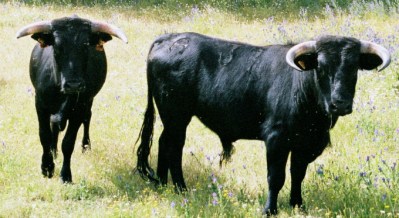
The above photo shows novillos, young bulls, on a bull farm in Salamanca, Spain, bred for the bull ring. They are tested in the farm’s private bull ring and the best and bravest are saved for the bull ring. A series of computer programs tests them at six month intervals to see if they are bull ring material.

Spain is divided on bull fighting with Catalonia banning the bullfight while Castilla and Andalusia are ardently in favor of the three, thousand year old tradition. The Spanish flag, in Castille, comes with a fighting bull, in the centre, replacing the coat of arms.

Many opinions exist abut bullfighting, bull running, and the whole tradition of blood sports. I will not state my position. But I will leave you with a piece of flash fiction, perhaps a short story. Each of you, if you wish, may play the game, click on the Bullfighting link, and decide for yourselves where you, and I, stand. Warning: not for the faint of heart … go on, be brave, remember the toros bravos who have perished in the ring.

F1040014.jpg

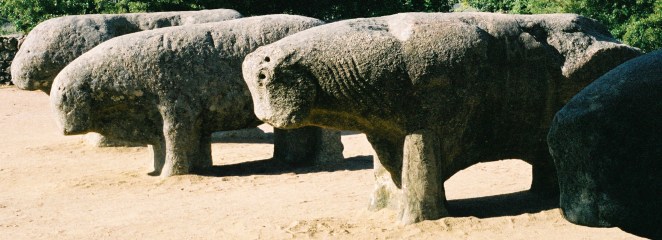
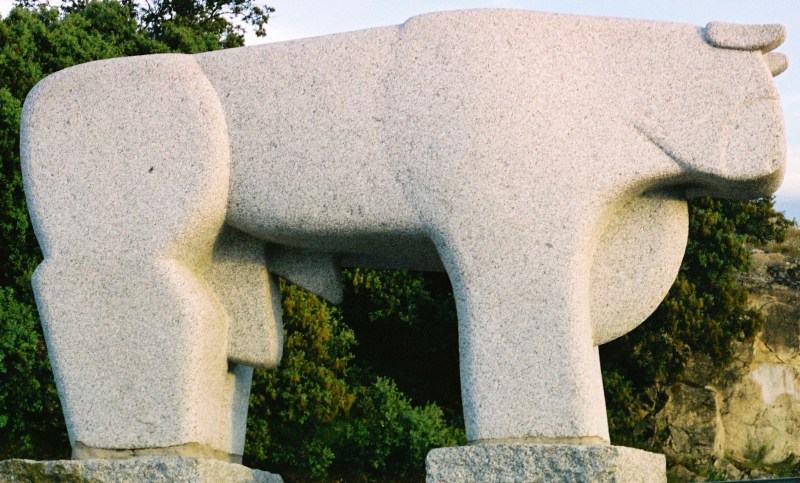
Los Toros de Guisando, mentioned in the Quixote, prehistoric stone bulls, verracos, Celtic carvings from the Province of Avila, Spain. The Roman legions carved their names into these stone bulls. Below, a modern bull, also from the province of Avila. I must, at this point, mention my friend Juanra, who took me to see these monuments and encouraged my interest in his wonderful province. Juanra, te lo agradezco, no sabes cuanto.

F1040010.jpg


Friday Fiction: Finding Fault

IMG_0169

Finding Fault
Friday Fiction

It wasn’t your fault. You look at yourself in the mirror and see your tear-stained cheeks. Your red eyes look back out at you and you lose yourself in them, swimming desperately as their still ponds down you with tears.

“Stop hammering at the door,” you yell at him. “Stop hammering.”

“Open the door,” he shouts, stammering in his rage. “Open this door.”

Thank God you locked it is what you think. Thank heavens you kept the key. And here it is in your hand, so it can’t fall down to floor and be hooked away, under the door, so that he can open the door and come at you again. He is shaking the door handle now, rattling it, shaking it like he said he’d shake you.

“I’ll shake you till your teeth rattle,” that’s what he said. And you know he meant it. You could see it in his eyes. You were just too quick for him. That’s all. Just too quick. He raised his walking stick to beat you and you slipped away, in a flash. Just like that. He was too slow to catch you. His one chance came in the kitchen. Once you were out of there, out of that trap, you were up the stairs, into your bedroom. You shut the door, slammed it shut, and turned the key in the lock. Then you relaxed for just a second and that was enough to set you crying. Thick, heavy tears ran down your cheeks. Sobs shook your chest and rattled your bones. You heard him clumping up the stairs, one foot at a time. Clump. Clump. Then he was at the door again. A big, bad wolf, huffing and puffing.

“Open this door,” he shouted. “You wicked child.”

“I’m not wicked,” you said.

“Wicked,” he shouted. “Wicked. Just like your father. You should never have been born.”

You placed the bedroom chair against the door, just under the door handle. Then you wedged your father’s sandal under the door.

Earlier, down in the kitchen, you had taken the bread knife and started to cut the bread. But the knife was blunt. So you sharpened it, scraping it up and down against another knife blade, like you’d seen your dad doing. Trying to make it sharp. Then you started to cut the bread. And that’s when he appeared screaming at you.

“Put that knife down.”

“Why? You asked.

“Because I’m telling you to.”

“That’s not a very good reason,” you said.

“You cheeky girl. I’ll shake you till your teeth rattle.” That’s what he said. And then he raised his stick. Red in the face, he was going to hit you. He wanted to hit you with his stick. Only he couldn’t. You were too quick. You went left, then right, then ducked under his outstretched arm as he lost his balance. You ran into the corridor and up the stairs.  You hear him now puffing outside the locked door.

“Open this door now, you wicked child.”

You move away from the door and move to the window. No escape there. You’re on the second floor. No way down. Where’s dad, you wonder. Where’s my dad? He went out shopping. Said he’d be back soon. Where is he? You hear the old wolf as he keeps huffing and puffing, pounding at the door.

“You’ll never come to my house again,” he screams.

“I don’t want to, grampy,” you scream back. “I hate you.”

“You wicked girl. You’re worse than your father, you wicked girl.”

Just then, you hear the front door open. The old wolf backs away from the door. You feel a release, a wave of comfort sweeps over you.

“Dad,” you shout. “Dad.”

“She’s wicked,” you hear your grampy say. “Wicked. You have to beat her. Chastise her. Drive the devil out from her soul.”

“What on earth are you on about?” your father asks. “What’s happening here? Look, go down to the kitchen and make a cup of tea. I’ll talk to the little one and try and make some sense out of this.”

“Wicked. She’s never coming to my house again.”

Clump. Clump. You hear his footsteps fade away on the stairs.

“Has he gone?”

“Yes. You can come out now.”

You remove the sandal, you turn the key in the lock, you open the door, you jump into your father’s arms ….
“Daddy, daddy …”

“Now tell me what happened.”

“It was all his fault,” you say. “Daddy, I didn’t do anything. It was all his fault. He tried to beat me with his stick. He told me he’d shake me till my teeth rattled. I was so frightened. It wasn’t my fault, dad. Honest. It wasn’t my fault.”

Growing Up

IMG_0817 (4).JPG

Growing Up
in Brynmill

They drag the kids kicking and squealing
from childhood’s universe into an older
world of smoking and drinking, forbidden
fruits stolen after Christmas dinner when
drowsy grown-ups’ eyes are turned away.

Why do bigger boys follow smaller ones,
buying their sisters’ kisses then thrusting
their fingers into little girls’ knickers, or
invading Woolworth’s and tucking stolen
goods in shirts with their buttons undone?

The games they play: offering a little girl
a cigarette  or a sweet while two boys
wait behind the garden gate with a sharp
knife to  press against the victim’s throat.

Time-Spirits

IMG_0868.JPG

Time-Spirits

Zeitgeist

Zeitgeist is a concept from 18th- to 19th-century German philosophy, translated as “spirit of the age” or “spirit of the times”. It refers to an invisible agent or force dominating the characteristics of a given epoch.
Wikipedia

Those who cannot learn from history are doomed to repeat it.

“Plus ça change, plus c’est la même chose.”

Poems for troubled times.

Introduction

Our world finds itself in an incredible mess right now. Somehow, we have to sort it out. Images and metaphors tie past, present, and future together. We must pick our ways through the difficulties of these troubled times, as you must pick your way through the intricacies of these poems. Many of you will give up. Some of you, the chosen few, will make your way to the heart of each poem.

These poems are deliberately cryptic. Each one is a mind game I am playing with you. I do not underestimate you. I have placed clues throughout each poem and if you follow the clues you will arrive at many of the poem’s hidden meanings. Some poems are more difficult than others, their meaning more recondite. Others seem very straightforward, yet still contain secrets.

            This style of poetry has a long history going back to Anglo-Saxon riddles and way beyond, back into the mists of time. Luis de Góngora (1561-1627) and Francisco de Quevedo (1580-1645) specialized in similar forms of recondite poetry, often based on metaphor and the juego alusivo-elusivo, the game of alluding to something while eluding the act of saying what it is. Jorge Guillén (1893-1984) and Federico García Lorca (1898-1936) also played this game, as did Octavio Paz (1914-1998). In the works of all of these poets, the clues may rest in the poem or they may be found in a generic knowledge of the mythology of the poem’s exterior world.

             Always remember that “those who cannot learn from history are doomed to repeat it” (George Santayana). Otherwise expressed, in the words of T. S. Eliot: “Time present and time past / are both perhaps present in time future / and time future contained in time past” (Burnt Norton). The seeming anachronisms in these poems suggest that all time is ever-present and that each new day presents us with events that have already occurred on many occasions.

Commentary: The idea for Time-Spirits aka Zeitgeist was born around the kitchen table in Island View on Saturday, 22 December 2018, during a literary conversation between Gwen, Victor, and Roger. A poem at a time, one after another, grew from that table top chat. The result: 70 poems, not easy to read, deliberately difficult, that reflect our troubled times. My thanks to Geoff Slater, line-painter, who drew the cover picture: Robin Red in Claw and Breast, a symbol of nature ‘red in tooth and claw’. So are we in the words of Albert Camus who writes ‘nous sommes ou les meurtriers ou les victimes’ . Is it the early bird that catches the worm? Or is it the late worm that gets caught by the bird? Whichever: it’s the worm that gets eaten, until the robin bites the dust, when he is eaten in his turn. Just think of it as nature doing its regular recycling …


IMG_0865 (2).JPG


Tracks

IMG_0777

Tracks
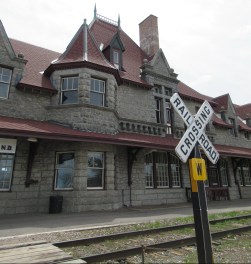
McAdam Railway Station #12

“Put your fingertips on the rail,
see if you can feel its pulsing beat.

No heart rail rhythm now. No tremble.
Put your ear on cold metal:

nothing but silence. No murmur,
however distant. Black fly whine.

No-see-ums flit. The train track’s
buzz of harmony is lost and gone,

replaced by careless nature. Listen
to the wind whistling in the woods,

hark to spring sounds, so subtle,
grass growing, rust accumulating,

sleepers turning over in their graves,
silent, rotting beneath forgotten rails.”

Comment: Nothing so lonely as an abandoned railway track, rusting beneath snow and rain, the wooden sleepers rotting into oblivion. That said, the Southern New Brunswick Railway still carries freight trains through McAdam, and it is the railway station that suffered, with the loss of passenger traffic, rather than the rails themselves. What a pleasure, incidentally, to hear the hoot of the approaching diesel, to count the wagons as the train came to a halt outside the station. Then came the joy of watching the engine separate wagons from the main train, shunt them into sidings, return, and take the freight train, slow at first, but rapidly gathering speed, out of the station and away into the distance. Such memories. So many ghost trains riding those rails. So many ghosts bewitching the windmills of the child’s mind that still inhabits the ageing brain.

IMG_0780


Hospital

IMG_0811 (2).JPG

Hospital
McAdam Railway Station #9

“I was here the day they
took the hospital away.
I gave some writing workshops.
Teachers upset, students in tears,

everywhere, fear and despair.
‘I was born in that hospital.’
‘My grandfather died there.’
‘Where will my child be born?’

I helped them write down
their memories and fears,
their hopes and dreams.
My lesson plans vanished.

How could they survive
when life’s rising tide
broke all bulwarks,
flooded open hearts.

A wounded community,
diminished by its loss,
they took me into their hearts.
Their loneliness wrapped me.

They wrote down memories.
Tears stained every page.”

Comment: This is one of my memories of being in McAdam. I was invited to run a series of writing workshops there, under the Writers’ Federation of New Brunswick  (WFNB) WiSP (Writers in Schools Program). I arrived there the week the announcement was made that the local hospital would close. I remember all too well the effect that this announcement had on the local community and I have tried to express that anger, sorrow, despair, fear, resentment in the above poem. More than anything, I felt the sorrow and despair of students and teachers. It is so easy to make an executive decision, at a distance, to rip the beating heart out of a living community on financial grounds. It is so difficult to revive the patient after the act of removal. What amazes me about McAdam is the effort hat volunteers are making to rebuild their town. Their words and deeds are truly impressive: as impressive as their magnificent railway station, now declared a national heritage site.