Two Spiders

Two Spiders

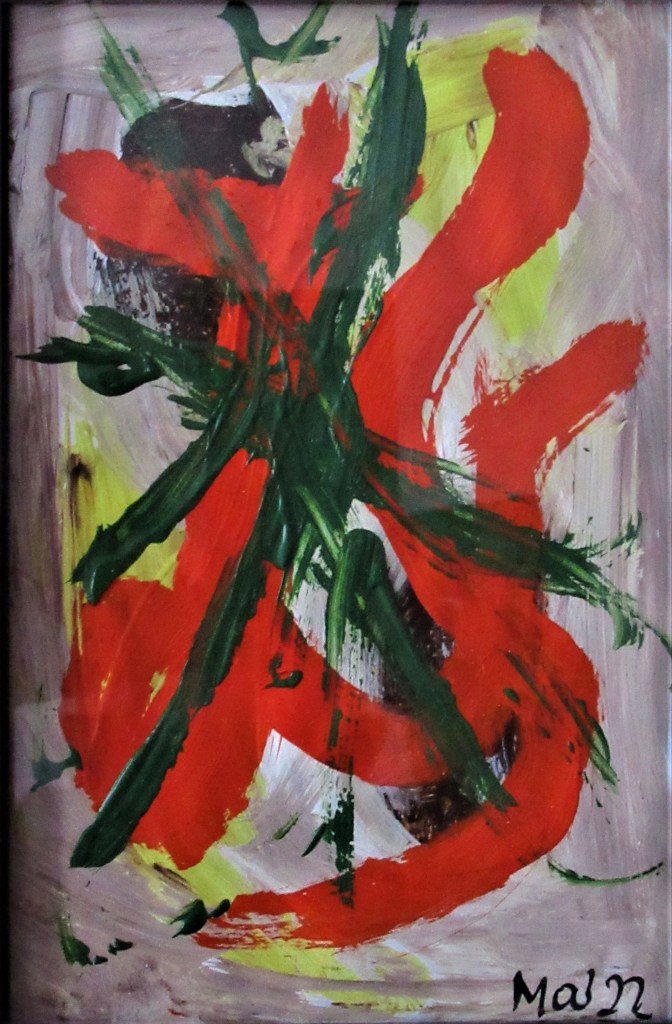
A spider dangles from its web by a fine, thin thread
that glistens in the sunlight. She hangs there, refusing
to think about the father she never knew, the aunties,
uncles, grand-parents, sisters and step-sisters, and all
those unknown relatives that abandoned her and fled.

What can she do? What can we do? Nothing.
We think ‘ancestry’ but we know, more or less,
who we are and what we are. We are just a son
and a daughter of troubled marriages where one set
got divorced and the other stayed together through
hell and high water, and all that those things mean.

But we are a son and a daughter, brought together
by chance, circumstance, happenstance, or some
thing beyond our control, and happy together,
the outside world shut out, and us in our little web,
as we have been for more than sixty years.

We have learned that, when the strong winds blow,
we must weave our web beneath fine grasses, that
do not stand strong like the oak tree, then stubbornly
break and fall, but bend like reeds or willows, before
the life’s storms, then straightening up, to raise
their heads, and surviving, after the winds pass.

A Darker Mist

A Darker Mist

Sometimes a dark mist marches over
the sea-salt marsh flats and, a sea-bird
come to land, nests in my heart. This lone
bird brings others and soon a colony sings
its chorus in time with the incoming tide
that threatens to overwhelm me.

My body’s weak clay responds to this
darkness and slips into the chaotic
cacophony of multiple voices
raised to shut me off from the light.

My soul, a seagull seeking the sun,
rises upwards, ever upwards,
in search of the sunshine, that silver
lining that redeems every cloud, belying
the darkness of this gathering gloom.

“You will find sorrow moving through you, like a dark mist over landscape.” John O’Donohue, Anam Cara, p. 94.

Black Paintings

Black Paintings
pinturas negras
Goya

Wrapped in his blanket of silence, the painter paints.
He pays no attention to the shrieks, screams, prayers,
curses, doesn’t even hear them. He sees their staring eyes
as the bull’s eyes at which anonymous soldiers, heads down,
backs to his easel, fire. He sees their mouths as black holes,
slashed across their faces. He sees the priest with his rosary,
but never hears the rattle of the beads or the firing squad’s guns
going off, filling the canvas with smoke, the square with blood.

Back home, in the Quinta del Sordo, his deaf man’s house,
he sits at the supper table, dwarfed by his painting of Saturn,
devouring one of his children. Beside him, old women,
hags themselves, suck soup silently from wooden spoons,
or fly soundless, black bats in the starless sky,
 on the back of goats or on their witches’ brooms.

The great, open wounds of his paintings speak to us
of his hushed suffering, of the calamitous world that spawned
such violence, plague, famine, and fear. Plundering armies,
guerrilla warfare in back street and alley, torture, pillage,
rape, and suffering, pits filled with the dead and dying,
famine walking the streets, and all of it inaudible,
the nightmares of a little child, seen, but never heard.
His paintings speak to us, and they allow us to reconstruct
in our imagination, the many things that the painter, deaf,
but never dumb, could never hear, yet reproduced
using his paintbrush and his taciturn palette as a tongue.

Click here for Roger’s reading.

“It is said that deafness is worse than blindness because you are isolated in an inner world of terrible silence.” John O’Donohue, Anam Cara, p. 71.

The Appointment

The Appointment

“We have room tomorrow,” she said.
“But only between 7 and 9 am.
Shall I book you in for 8:15?”
“Sure,” I replied, not realizing
that I had forgotten to remember
the joys of rush hour traffic,
and the crush of crossing
the only bridge downtown.

I left home early only to find
chaos at the end of my road.
School busses, cars nose to tail,
trucks, cyclists, you name it,
it was all there, flowing, slow
but steady, with scarcely room
to insert a razor blade between
bumper and bumper. But that
was only the beginning.

The bridge downtown: it was
like threading a four wheeled camel
through the eye of a very small needle.
Crawlers, creepers, slugs and snails,
racing demons, speedsters, all of them
hustling, impatient, bustling, yielding
not an inch of space. My car became
a shuttle, weaving a thread of progress,
inch by inch, through the maze
that confronted and confounded.

I got to my journey’s end at last.
“You’re late,” said the girl at reception.
“You’ve missed your appointment.
Shall I book you in again?
Tomorrow at the same time?”

Click here for Roger’s reading.

Black Saturday

Black Saturday

Doubt and Despair

1

This is the day we go into ourselves
to work out who we really are.

It is the teeter-totter day
when the world balances on a knife-edge:
Yesterday, the dark deed was done.
Today the body is in the morgue,
far from the crime scene
where black and yellow ticker-tapes,
keep sight-seers seeking thrills at bay.

Today, there is no centre to hold.
Things gyre and gimble in the wake
of troubling scenes misinterpreted,
called fake, and deliberately misunderstood.

The unfortunate lie chained so they can’t
escape. Take these chains from our hearts,
the watchers say. Take these irons from
our wrists, your knees from our necks.
Forsake your vicious choke holds.
Go away and leave us alone.

2

A birch tree lies on my power lines,
and I am powerless.

No phone, no radio, no tv,
and all because of a snow-laden tree.
Why did this happen to me?

“It’s a day, man, a day.
It’s nothing but a day.”
“Imagine,” says my wife, “being
without power all your life.”

I clench my fist and pump the air.
Nobody sees me. No one seems to care.

A ghost’s voice echoes in my head:
“Stop moaning, bro,
at least you ain’t dead.”

Sun, wind, melting snow.
The lame tree rising, slow.
Then, at last, the lines are free.
Power is back again.
I breathe more easily.

3

For forty days
I have wandered in this wilderness,
walking from room to room,
climbing stairs,
descending to the basement,
sitting at the computer,
sitting at the table,
writing in my journal.

I have watched the minutes
as they turn into hours,
the hours turning into days,
days into weeks, then months.

How long, I ask, oh lord, how long
before peace and love, friendship and joy,
return to this world
where they used to belong?

4

A turkey-vulture flew
over the house this afternoon,
hungering for who knows what,
as I too hunger for things
I have forgotten
and no longer know.

Freedom to walk
in now forbidden places,
freedom to shop for groceries,
to stop at the liquor store,
to buy wine and beer,
other things that I adore.

For forty days
I have sailed in this Noah’s
Ark of a house.
Like John the Baptist
I have lingered here for forty days.

Strange and wonderful are thy ways,
oh lord, in heaven, where souls and angels
admire your beauty and sing your praise.

Good Friday

Good Friday

Crucifixion and Death

1

Now is the hour of his parting,
such sweet sorrow, they say,
but not on this day.
Yet we’ll meet again, sang Vera Lynn,
don’t know where, don’t know when.

There he lies, helpless, on the street.
Why is that man in blue
kneeling on his neck?
“I can’t breathe.”
Can’t anyone hear his cries?
Is there anybody out there listening?

Watchers stand round and watch.
Someone makes a video on a cell phone.

Who gifted him this gift,
this parting gift he never chose.
Everyone who follows him
and tries to walk in his shoes
knows he had no choice.
They know he didn’t choose.

2

Do you feel the baton stab into the guts?
The plastic shield’s edge slash into the face?
The knee come up, no ifs, no buts?

Eyes water from tear gas and pepper spray.
Thunder flashes crack and roll, deafening
ears, taking years from marchers’ lives.

Did you follow him through Jerusalem?
Did you walk in his footsteps, step by step?
There is a green hill far away, or so they say.

The cameras rolled as they cuffed him
to his pavement cross, men in blue smiled,
winked at each other, watched him fade.

His loss was not their family’s loss.
Just another loser tossed beneath the bus.
The watchers watched and nobody made a fuss.

They stood and stared and nobody cared
until cell phone videos hit the tv screens.
 Now it’s fake news, whatever that means.

The believers will believe what they’re told.
You can’t put a price on what he was losing,
on the many things that others have already lost.

3

Leg-irons and chains:
that’s what remains from his journey here.

Iron, cold iron, splintered, burning wood.
A death bed on the sidewalk
his last will and testament.

A flaming cross lifted him to the skies,
that cross burning before his eyes.

Before he goes, we must double-check:
whose is that knee upon his neck?

“Let me breathe, let me breathe.
Take away your knee.
Justice, why hast thou forsaken me?”

Commissioner, forgive them.
They didn’t know what they did,
when all around the dying man
men closed their eyes and ears,
buried their heads, and hid.

4

Good Friday in Island View:
a foot of snow fills the streets,
empties the churches.
The Easter Weekend lurches
towards its predestined end.

But how do you end
two thousand years of hurt,
four hundred years of persecution,
of cruelty and neglect?

How do you end
eight minutes and forty-six seconds,
with that black man lying there,
choking, a white man’s knee on his neck.

He died in the shade
of orders that were given and obeyed,
orders that should never have been made.
Anonymity

Anonymity

Multiple masks stripped away, old wall paper
shed in strips, layer by layer, until you reveal
the bedrock foundations of your delicate face.

Your visage dissolves before my eyes until you
become what you were when I first met you:
sweet, young, fresh, a delight to catch the eye.

As you still are, to these old, fragile eyes of mine,
cataracts removed and lenses still capable of
seeing you in your spring, although it is your winter.

The snowfall of your hair cannot deny the sparkle
in your eyes, the summer freckles that will soon return,
the sunlight and joy you bring when you enter the room.

Ageing, yes, but you are as young and as sweet
as you always were. How could you not be?
Anonymity peels itself away until no barriers exist

between what you are to me now, and what you were.
It is a lie, that only the young write poetry in praise
of their beloved’s eyebrow, her lips, her gaze.

For how many days have we stood together, as one,
breathing the same air, walking together, facing
the same difficulties, and overcoming them hand in hand?

Yes, we have both slowed down – the way of all flesh –
and we are no different. We wither and perish, but
we haven’t perished yet, although we are withering.

The magic of our love, our gifts, molded into our DNA,
will not perish with us, and never will, not while
our spirits live on and our love creates others in our shape.

Click here for Roger’s reading.

“In the human face, the anonymity of the universe becomes intimate.” John O’Donohue, Cara Anam, p. 37.

Spider Web

Spider Web

for
Ginger and Michael Marcinkowski

I do love long and complicated sentences,
stuffed with clauses and dependent clauses,
 and all strung together like a spider’s web,
an enormous web with silvery threads that glisten
 with dew drops in the early morning sun that
blanches them, turning them white, and look,
there’s a little fly caught in this one, trapped
by his own struggles, and struggling even more
as the spider emerges, advances towards his prey,
soon to be his breakfast, or lunch, if he lets his victim
stew in the poisons soon to be injected, and look,
dew drops are falling as web shakes, and threads
tremble, and the dark and seamier side of life
emerges with its stark, black lines, from beneath
the advertising mask of glorious beauty that distorts
reality, as the spider turns into an assassin and the fly
into his victim, and yes, each of us must choose whether
to be an assassin or a victim, meurtrier ou victime,
as Camus phrases it in one of his books, L’Étranger,
though I read it so long ago, when I was a teenager,
studying French in school, and that was one of the books
I chose to read, but I was never labelled, meurtrier or
victime, just trouble-maker, first class, because I didn’t,
wouldn’t, couldn’t tow the official line and kow-tow
to a rigid authority, that walked set lines, like this spider,
the meurtrier, who turned that fly into his victime, and I,
I who could so easily become either, became neither,
but merely the observer, who stands on the outside,
looking in, and watching as the show goes on and on,
year after year, seculae seculorum, world without end,
and yes, the English Master told me never to mix
metaphors, nor to add foreign languages to my poems,
but what if they are not foreign to me, but a part of my being,
as part of the spider’s being is to be a meurtrier, and as for
that fly, well, he is the victime, in whichever language you use,
and yes, this poem is only one sentence, and I love it, amen.

Click here for Roger’s reading.

The Rover’s Return

The Rover’s Return

The eternal return to The Rover’s Return,
renovated, again and again, but filled
with the ghosts of Ena Sharples and others
who walked this cobbled street before,
and every episode more or less the same,
though décor, characters, accents change
and life becomes ever more complicated
from episode to episode, the street slang
changing slightly, and ageing characters
ageing more and more as time goes by,
and yet the trumpet’s martial sound,
the rhythms of the northern brass bands,
the first of those accents to break the plum
in the mouth snobbery of Oxford English
and the BBC’s domination of the language,
and ‘hey, Mr. Oxford Don, me no graduate,
me immigrate,’ echoing round the abandoned
buildings where the working class once worked,
and the elderly were cared for by their friends
and neighbors, not tossed into care homes,
and abandoned to their fate, as they have been
so often of late, and all things change, in time
with the clocks that tick-tock forward, their clock
work everlasting, and the pigeons still there,
and those crazy chimney pots, and that cat,
slithering down the roof, and the rovers still roving,
then returning, once again to the Rover’s Return.

Click here for Roger’s reading.

Comment: For more than sixty years I have listened to Coronation Street and some things have never changed, the trumpeter from the Brass Band, the rain on the cobbles, the memories and ghosts that linger among brickwork and paint. It takes me back to my childhood, when ITV was the upstart channel that dared to challenge the might of the mighty, one might almost say, the almighty BBC. And now, here in Island View, I turn away from the color and recall the old black and white sets, with their selection of two channels, one of them advert free, and their scheduled times of programs, not the TV blaring twenty four hours a day and two hundred channels available at the touch of a button.

It’s all one sentence, though I had to stop and take a couple of breaths while reading it. My good friend and fellow poet, Jane Tims, has called me ‘the master of the long sentence,” and I do love long sentences, especially when I am in rant mode, like now. But I am also very much aware of other friends that warn me that “your sentences are too long. They are too complicated. I don’t understand them. Write shorter sentences.” OMG, FFS. LMA* – 4 – UAW** – IMHO.

Translation of unusual terms: LMA* = Leave Me Alone. UAW** = You aRe Wrong.

Acknowledgements: My quote from the poem, inaccurate, and from memory, is from John Agard, whose poetry I love. I acknowledge now his poem and its influence upon me. I too am no Oxford don, and I too am an immigrant. His wonderful reading of the full poem can be found here. John Agard, Oxford Don.

Ides of March

Ides of March

Sometimes, as the sun goes down, the shadows close in.
You can sense real people, half-hidden in the mists
rising up from the ground. You shiver in their presence.

They fought a battle here, according to legend.
Legends never lie, though they hide away the facts,
as these mists hide those fallen warriors, brought
back to life, in the half-light, and thirsting for warm blood.

In the distance, blood flows staining the evening sky.
When the hairs on your neck rise up as wraiths, you take
to your heels and run to the place where you left your car.

Westbury White Horse, Badbury Rings, Maiden Castle –
such places are haunted with those whose spirits never left,
never moved on. They stayed here, defending the defenseless,
spirited warriors, never saying die, not even when dead.

Close by, at the hill’s foot, someone has built an altar
crowned by a small, carved cross. Who put those flowers on it?
Who came to bless the peace of those who dream and wait?

The Ides of March have come once more. Now they have gone.
Like all those other Ides before them, like all those years,
those seasons, those warriors. Come and gone. Or not gone,
as you stand there, sensing their spirits, living on and on.

Click here for Roger’s reading.

Comment: The Ides of March – March 15 this year, two days before St. Patrick’s Day. “The Ides of March are come.” “Ay, Caesar. Come but not gone.” William Shakespeare. Julius Caesar. The Ides always seem such a precious time. Sandwiched between St. David (Wales) on March 1 and St. Patrick (Ireland) on March 17, and all so close to the Equinox and the start of spring. It is snowing outside my window as I type. About four inches / ten centimeters down and more to come. But, with the lengthening of the daylight hours and the arrival of spring, we hope the snow won’t last too long.