What’s something you believe everyone should know.

Daily writing prompt
What’s something you believe everyone should know.

What’s something you believe everyone should know.

I think everyone should know that the world, as we see it right now, is a very troubled and troubling place. Everyone should also know that there is no so-called “silver bullet”, no single answer that will solve everything with the wave of a magic wand.

These two points are tied in to a third – that the world is filled with smoke and smoke screens. Misinformation, disinformation, manipulation, lies, downright lies, and AI statistics now rule. There is no longer a clear pathway to follow and there is so much downright tribalism and hatred that there are few safe places, save in the middle of a person’s own little tribe that protects while allowing no challenges to whatever truths their authorities present as being true.

Voltaire once persuaded Candide to say that “everything is for the best in the best of all worlds.” Personally, I wish those words were true. It is equally false to say that “everything is for the worst in the worst of all worlds.”

As I type these words, the first snow of winter is falling outside my window. It covers my garden with a thin, white blanket, soft, and fluffy, and wet. All the flaws of my late fall lawn are covered up, tucked away, lie buried beneath that blank sheet on which neither animal, nor beast, nor bird has yet set foot.

I imagine it as a clean page, a fresh beginning, a new start, a moment when the world can change and a new future history can be written starting now. I do not smoke, so pipe dreams are something I have not experienced. Alas, I fear that such a dream is nothing but a pipe-dream, a castle in the clouds, a chateau in Spain, as some say.

“Those who ignore history are doomed to repeat it, over and over, and over again. Then the snow settles. The winners write their stories on blank pages. The losers all disappear into the mists of time. But those mists contain the ghosts, and the myths, and the fairy-tales, that turn themselves into truths reborn, and the same merciless battles begin again.

Then the snow of memory loss starts to fall and the world is presented with another blank page on which to write. Alas, instead of a new future history, the old stories, the old myths, the old falsehoods emerge once more from the miasma and the world again becomes a very troubled and troubling place, and so it goes on, secula seculorum, for ever and ever, amen.

Bronze Ribbon

Bronze Ribbon

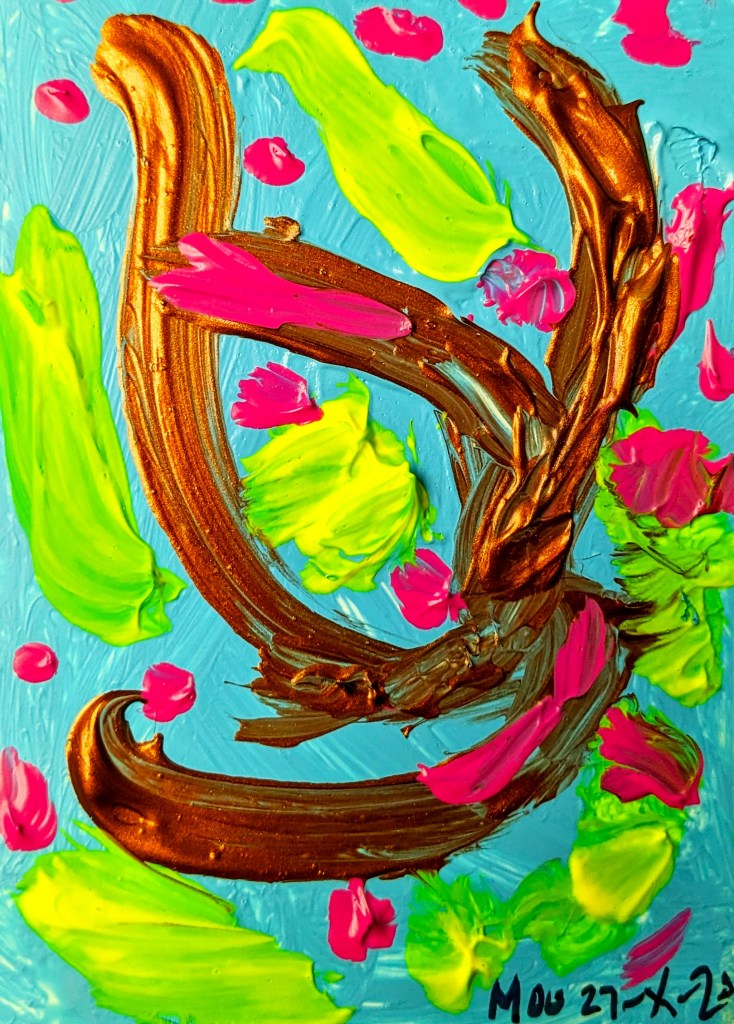
And time has ticked a ribbon round the stars.” Dylan Thomas, sort of, but a perfect title for this painting that I completed this morning. The acrylic paint is still wet! I brought it downstairs, looked at it in the light from the kitchen window, and the colors had all changed. I angled the painting, then re-angled – it was a chameleon changing color in the shifting light. Then I turned the large ceiling lights on – and this is what I saw.

Exactly the same painting – or is it? When I was studying in Madrid, a long time ago, I visited the Prado every afternoon. Each day I would visit a different room and stay there for the duration of my visit. The tourists who flitted in and out amazed me with the brevity of their visits. A minute or two to see all the paintings by Hieronymous Bosch, for example. I sat in front of just one of them for half an hour – and I could have stayed longer.

When I visited Las Meninas, it stood in a room by itself. It had a full size mirror opposite it, on the far wall. I should add that this was long before it was cleaned and renovated. I looked at it from every possible angle. I drew close and squinted at the lace and wondered at the quality of the brush-strokes. I lay on the ground in front of it. Stood at the side. Watched it change as I changed my position. I discovered art as a living being, not a static moment in time. Imagine me, for a moment, kneeling on the ground, watching the young prince’s horse soar over the top of me, as it would have done, if it had occupied its original spot, angled above a doorway. Change the angle, change the perspective, change the painting, and watch it come alive.

I will never forget my days with Goya. His Disasters of War – wow – such an incredible sequence – took up several afternoons. And the Pinturas Negras – the Black Paintings – they still haunt me, as do the Disasters. Man’s inhumanity to man – not a dead set of etchings but living portraits of an evil that goes on and on. “This I have seen!” “And this!” Indescribable scenes. Words cannot do justice to the depth’s of the feelings generated by such works of art. When will we ever learn? I taught a great variety of students for most of my life and I know all too well that some lessons can never be learned. Like an endless loop on a news tape, people are doomed to repeat them, again and again, and again.

As the BBC Lion said as he finished his supper – “That is the end of the gnus.”
TWTWTW.

How much would you pay to go to the moon?

Daily writing prompt
How much would you pay to go to the moon?

How much would you pay to go to the moon?

Exactly the same amount that I would pay to visit the Titanic in a Titan – zilch, nada, rien, nothing. Too risky. Not worth it. Too much carbon emission to damage the world around me. It’s only a thin envelope of air up there – pointless damaging it further. We have problems enough anyway.

And how much would it cost to fund a rescue mission if something went wrong? How much did it cost to search for the Titan for five days? I haven’t forgotten Apollo XIII, even if other people have.

No way, my friends, no way. No common or garden human being in his or her right mind would ever get into something like that. I notice you say ‘to go to the moon’. Is it a two way, return ticket, then? Does the lucky traveler also get to come back? Or is it a one way only trip and a journey of no return?

Don’t bother answering those questions. I am quite happy viewing the moon through my bedroom window. I wouldn’t go, even if you offered me a free ticket. Thanks, but no thanks. Not on my watch! I am not moonstruck!

What major historical events do you remember?

Daily writing prompt
What major historical events do you remember?

What major historical events do you remember?

Interesting question, but very problematic. How do I define a “historical event”? What exactly do I mean when I say “I remember”? Max Boyce had a lovely song in which the chorus was “I wuz there.” If everybody who says they saw Llanelli defeat New Zealand in 1973 at Stradey Park had been there, there would have been 300,000 people pressed into a ground that held about 15,000. But, as Max Boyce sings, “I wuz there”. Well, in spirit, anyway, and I have seen the film several times. I also remember watching Jim Laker’s 19 wickets in the 1956 cricket Ashes. I watched that match on B&W TV. Does that count as an historical event that I remember?

How about the Battle of Hastings, 1066? In 1966, I ran in a road relay that led from Bristol to Stamford Bridge, where Harold defeated Harald Hadrada, down the main highway to The Trip to Jerusalem, where we stopped for a pint, down to Hastings, where we re-enacted the battle that saw William the Conqueror take the throne. Several of the runners wore Saxon uniforms, a couple even had long, blonde hair. We re-enacted two battles. Does that mean I remember that historical event?

Let us talk about Stonehenge. I first went there when there were no railings, no fences, and when sheep and cows could safely graze. I remember it well. And I remember creatively re-constructing, with my grandfather, the digging of the post-holes, the raising of the stones, the transportation of them, by ship and log rollers, from the Prescelli Mountains in Wales to their current resting place. As Max Boyce says, in my own mind, I was there. I was there too at the destruction of Maiden Castle. The first book I ever bought, age about six, was Sir Mortimer Wheeler’s autobiography, Still Digging. I can still feel that Roman ballista arrow going through the victim’s backbone. Does that count as a memory, as a presence, as a moment of reality?

The Conquest of Granada, the Expulsion of the Jews from Spain, the later expulsion of the Moors, the Adventures of Don Quixote, the mixing of truth and reality, the questioning of authority, the inquiry into the meaning of meaning, my mother’s sister phoning me after 9-11. “What’s all the fuss about, Roger? There were only three planes. We had them every night, over here, during the London Blitz, for two long years.” What impresses itself upon the human consciousness. How do we remember things and why? The Spanish Armada -there were actually three of them -, the Peninsular wars in Spain, the battles of Trafalgar, Vimeiro, Salamanca… Then we can move on to Vimy Ridge, Ypres – Wipers, as my grandfather called it, his days in the trenches, recounted to me, in the kitchen, day after day, in vivid, lived language that still remains with me. And he would sing – “If you want the whole battalion, I know where they are, they’re hanging on the old barbed wire.” Yes, I was there with my grandfather. I remember it well. The Battle of the Atlantic, the Hunt for the Bismarck, the Battle of Britain – I sat in the cockpit of a Spitfire, a long time ago, during the Battle of Britain celebrations, and I climbed into and walked around the interior of a Lancaster.

Memory and the reconstruction of historic events, some we actually lived, and some we just dreamed of, and some we saw at the movies. What is memory – an actual happening or a creative reconstruct? What is the meaning of meaning? And read Bertrand Russell’s book on the subject before you answer that one. As for me, I was there, standing beside Max Boyce, witnessing the game, though, as he says, “a hundred thousand in the ground, and me and Roj outside.”

The Dying of the Light

Rage, rage against the dying of the light.

The world has become such a dark place over the last three weeks or so. At times, I have despaired, lost hope, lost my faith, lost my creativity. Words have not come knocking on at my door. The eyes in my head have seen nothing to paint. Darkness, bleakness everywhere. And yet, light breaks where no light shines, as Dylan Thomas once wrote, and last night I started a painting. This morning I finished it and gave it a title: Rage, rage against the dying of the light.

Yesterday I managed to complete a couple of poems. I attribute this new found creativity to moving my muse out of my office and placing it in my bedroom where it can inspire me at night. It seems to have worked. My muse is a small carving placed between four pyramids. Pyramid power and the muse’s inspiration have brought light back into my world, the light of creativity.

We must band together, we creatives. We must inspire ourselves and then go on to inspire others. We must let the light of our creativity, our faith, our belief spill out into the darkness that surrounds us. Together we must stand united and our light will be a lantern that will enlighten the world, not with chants, slogans, and cults, but with the inner faith and the total belief that genuine creativity brings to the world.

Creatives of the world, unite. Rage, rage against the dying of the light. United together, we can, and will, restore that light.

When you think of the word “successful,” who’s the first person that comes to mind and why?

Daily writing prompt
When you think of the word “successful,” who’s the first person that comes to mind and why?

When you think of the word “successful,” who’s the first person that comes to mind and why?

What exactly does “successful” mean? I googled it and here are some of the answers – successful – well that’s a good answer. Successful means successful. It reminds me of my geography master in school – “The earth is geoidal, i.e., earth-shaped.” The earth is earth- shaped – I guess that leads to a successful education. Slightly better alternative meanings are – effective and productive. Taken literally, both have their problems, of course. The spud-bashers of WWI, sitting, peeling their potatoes at the cookhouse door, they were productive, but were they successful? Did they even survive the war? Do any names spring to mind? I am not so sure about that. But how about efficacious, another proffered meaning? Well, that certainly turns me on.

Basil, the Teddy Bear in the photo above, is embracing a can of Molson’s Lager. I didn’t know Teddy Bears liked lager until I saw him doing this. Caught in the act, all sticky-pawed. I asked him what he was doing and he replied that he was taking his medicinal compounds. When I asked him why, he started singing “most efficacious in every case.” “Who do you associate that with?” I asked. He started whistling the tune of Lily the Pink. “And was she successful?” I asked. “Of course she was,” Basil replied. “She’s the Savior of the the Human Race.” Wow!

So, I hereby nominate Lily the Pink, the Savior of the Human Race as both successful and nameable. And remember – “when Lily died, she went up to heaven. You could hear the church bells ring. She took with her, her medicinal compounds, hark the herald angels sing.” Now that’s a true life success story. And what an ending!

¡Qué será, será!

¡Qué será, será!

“Those who the gods would destroy,
            they first make happy.”

Twenty-four hours
            after our power came back,
it had been gone for 52 hours,
            we lost it again.

And happy we were,
            cleaning out the freezer,
            draining the water from the bath,
            packing up the pots and pans.

We sat down for happy hour,
            a drink before supper,
            and zap – the power went.

Promises, they made,
            estimates of when the power
            would return – 4:30 pm –
            5:30 pm – 6:30 pm –

Now we don’t know
            when it will return.
            The power site says
            “No estimate available.”

I write these words by candlelight.
            The battery on the radio
            just failed and now our cell phones
            are rapidly draining.

“¿Quién sabe?” Some are saying.
            “¡Qué será, será!” say I.
            Whatever will be, will be.

Share a story about the furthest you’ve ever traveled from home.

Daily writing prompt
Share a story about the furthest you’ve ever traveled from home.

Share a story about the furthest you’ve ever traveled from home.

Once upon a time, I lay in the sea, at midnight, in Brandy Cove, and I watched the moonlight lap over the waves as I lay there. I began to relax and felt the moon rise. Then I rose up with it, just like Cyrano de Bergerac, and I rose, rose, rose, up into the sky until I was level with the moon.

Was this the furthest I have traveled from home? No.

Once upon a time I climbed with Don Quixote and Sancho Panza upon the back of Clavileño and I rose up, up, up into the skies until I danced among the seven sisters, the Pleiades, and counted them, one by one. Sancho told me they were little goats, all colored differently. “And look,” he said. “That’s the earth, down there, as small as an orange pip.”

Was this the furthest I have traveled from home? No.

A long time ago, I visited Stonehenge and marveled at the temple my ancestors had created there to tell the time and worship the sun. Seven thousand years ago, they told me. I closed my eyes and dreamed I was back there with them, digging the post holes and raising the stones.

Was this the furthest I have traveled from home? No.

I also visited Hengistbury Head in Dorset. There I discovered the scrapes the Reindeer People had scratched in the chalky soil nearly ten thousand years ago. Older than Stonehenge, I lay down in the rocky soil high above what is now the English Channel. My mind went back in time. The waters slowly receded and I saw green grass where herds of reindeer crossed the meadows that still attached Albion to the mainland of Europe.

Was this the furthest I have traveled from home? No.

Once upon a time, I truly traveled and visited Avila. I wandered among the ancient ruins of the pre-Christian monuments. There I stroked the granite of the Toros of Guisando, and watched the ever-lasting storks as they nested in the towers of all the churches. I also walked the Roman Road at the Puerto del Pico. When I ran my hands over the bodies of the verracos, I marveled upon how far away from home I found myself, and how small the world really was.

Was this the furthest I have traveled from home? No.

Once upon another time, I really traveled, this time by plane. I flew to Oaxaca, Mexico, and went back a thousand years or more in time. I read the Pre-Columbian Mixtec Codices, climbed the temples, visited the tombs, consulted a witch doctor, drank mescal, ate chapulines, and entered a world beyond my world.

Was this the furthest I have traveled from home? I no longer know. But I do know that el mundo es un pañuelo – the world is a handkerchief, as the Spanish say. Yes indeed. It is a small, small world. Alas, too many people are blowing their noses into it right now and I see and grieve for this, even when I am at home.

Write about a random act of kindness you’ve done for someone.

Daily writing prompt
Write about a random act of kindness you’ve done for someone.

Write about a random act of kindness you’ve done for someone.

Sir Alex Ferguson, one of soccer’s greatest managers, once said that it wasn’t the victories he remembered, but the defeats. So it is with my own coaching career – it’s the losses I recall. Same thing with random acts of kindness. There have been many, too many to count. I will not paper my e-walls with glowing memories of past kindnesses. But what about those random acts of kindness I failed to do? Here’s one of them.

            Crave More: I hate those words. I always choose a cart with the shop’s name on the handle. I can handle that. I can’t handle a shopping cart that screams Crave More at me every time I stoop down and place another item in the wire grid. If stores were honest, they would inscribe their shopping carts with a sign that said Think More, Crave Less, and Save Your Money. I bet that would quickly cut into profits.

            Anyway, there I was, in La-La-Land, leaning on my cart, still half asleep, when this ghost drifted towards me. “Help me,” it said. “I’m hungry. I need food.” I woke up from my dream, looked at the ghost, tall, skeletal thin, cavernous eyes and cheekbones protruding, gaps in the teeth, grey face drawn and lined. The single word “Sorry” came automatically to my lips. Then I felt shame. I looked at him again. “I only carry plastic.” The excuse limped heavily across the air between us. I saw something in his eyes, I knew not what, and I turned away.

            Then, as I walked away, I added 100 lb of muscle to the scarecrow frame. Took forty years away. Filled his body with joy and pride, and remembered how he played when I used to coach him, hard and fast, but true. I ran my hand through the card index of former players that I had coached. I knew their moves, and attributes, the way they played the game, their stronger / weaker side, their playing strengths, their weaknesses. I remembered him holding up the Champion’s Cup. But I couldn’t remember his name.

            I pushed the cart all over the store in a frantic search for him. I went to the ATM and took out cash. I could hand it to him. I could tell him he had dropped it. I went through a thousand scenes. I could invite him to the snack bar. I could tell him to buy what he needed and follow me to the check out lane where I would add his purchases to my cart. I looked everywhere. He was nowhere to be seen.

            A single opportunity. One chance. That’s all we get. Miss it, and we blow the game. Take it, and we win the Championship and hold up the Cup.

How would you describe yourself to someone who can’t see you?

Daily writing prompt
How would you describe yourself to someone who can’t see you?

How would you describe yourself to someone who can’t see you?

Well, that would depend on why they couldn’t see me. “Those who have eyes, but cannot see.” Many have stood beside or before me, looked into my eyes, as I looked into theirs, and never saw me. “The most difficult role in the play is that of the fool,” said Don Quixote, “for he who would play the fool must never be one. So many people saw me deliberately playing the role of the fool and forgot the above quote. They also forgot what Antonio Machado wrote: “The eye you see is not an eye because you see it, it is an eye because it sees you.” And there you have it: why would I bother describing myself to people of that ilk, so stupid and blind with their own limited wisdom, that they couldn’t see me anyway.

Keenan’s Well, by Seamus Heaney, is a wonderful poem. It tells us about Rosie Keenan, his blind from birth neighbor, who played the piano and sang all day. She let them touch her books, like books of wallpaper, and feel the letters of braille by means of which she was able to read. They allowed her to touch their faces with her oh-so-sensitive fingers, and she said she saw them, as well as knowing them by their voices. When he read her a poem about Keenan’s well, she told him that she, blind from birth, ‘could see the sun shining at the bottom of it now.”

How would you describe yourself to someone who can’t see you? I wouldn’t waste my time and energy trying to do so.