Share a lesson you wish you had learned earlier in life.

Daily writing prompt
Share a lesson you wish you had learned earlier in life.

Share a lesson you wish you had learned earlier in life.

I wish I had learned earlier how hard it is to grow old and how difficult it is to prepare for it. My first serious rugby injury, age 16, torn cartilage in left knee. Doctor’s advice: give the game up now. Later, you’ll regret it if you don’t. My response: I’m tough. 60+ years later, my left knee still creaks and I rub ointment in every morning. My second serious rugby injury, age 20, damaged lower back. Doctor’s advice: give the game up now. You’ll regret it later if you don’t. My response: I’m tough. 60 years later, my back really hurts. I rub ointment in every morning, take pain killers, and stretch. Same with hips, from kicking! One of my rugby friends, about the same age as me, has two knee replacements, one shoulder replacement, and one hip replacement. If he’s not the $6,000,000 man, he must be pretty close.

But there is a story beyond that story. I was sent to a series of boarding schools and no, I didn’t go there willingly. In the summers, I travelled abroad to learn foreign languages that were foreign to others but became familiar to me. I never saw my grandparents as they aged. Often, when they died, I was in school, or away on the continent. I never understood the ageing process. I never witnessed the natural decay of those whom I loved. I never learned that lesson. When I left university, I emigrated, and the same sequence happened with my parents. I was never there when it mattered. I was always somewhere else. And when I was there, I heard the usual litanies: “This never happens when you are not here. It’s your fault.” Or else, “this wouldn’t have happened if you had been here.” Told to me by a close relation at my mother’s funeral. I flew back home, though it was never really my home, to be present for that.

But what is the lesson that I wish I had learned earlier? Alas, there is not just one lesson, but a series of lessons. How to deal with the ageing process. How to face sickness and ill health in age. How to face diminishment with grace and humor. How to accept the natural process that occurs whether we want it to or not. How to face the gradual decline in someone, close to you, your life companion whom you really love. How to face the fear of passing (FOGO to some) and how to pass that lesson on to our own young ones. How to face my own end and how to die with as much dignity as possible.

How often do you walk or run?

Daily writing prompt
How often do you walk or run?

How often do you walk or run?

The painting above tells the whole story (thank you, Moo). On the left, the deer head (or is it a sheep’s head? Moo didn’t tell me) represents my hip and knee joints. On the right, the wolf’s head (or is it a bear’s head, look at those teeth) represents the osteo-arthritis that is sinking its own teeth into me and removing much of my movement. So, how often do I walk or run?

Walking, every day. I use two sticks in the outside world, or one stick and the furniture at home. The sticks are fun. I use them like chop-sticks to pick up fallen objects. And I have discovered that if I drop one of the sticks, I can stand on its rubber tip and raise the handle enough either to grasp it, or to secure it with the other stick. Wow!

Some days it is a positive circus act. Yesterday, the very thoughtful grocery store had placed the 1% milk on the top shelf, where I couldn’t reach it. I held on to my trusty shopping cart with one hand, reversed my stick and, with the handle, pulled a carton of milk to the edge of the shelf. I let go of the cart, flicked the stick, and sent the milk carton tumbling into my other hand. It took some concentration and I was surprised by the applause that came from several watchers, none of whom offered to help me. I do the same with out of reach beer cans, too. Bags of sugar on the lower shelf are much more difficult. my chopsticks aren’t designed to pick up a 3lb bulky bag of sugar.

As for running, well, my nose runs, my eyes water and run, my tummy rumbles and runs, and I move at a slowly increasing four-legged plod to the bath room, hoping against hope to get there in time. I usually do. My premonitions have become very accurate over the last few months. However, do nose, eyes, and tummy runs count? If not, well then, running rarely happens nowadays.

With the walking, though, in spite of everything, I aim for 2000 steps a day. I usually make it to 3,000, especially when I go shopping, and occasionally make it to 4,000. And that, ladies and gentlemen, is the best I can do.

What’s your all-time favorite album?

Daily writing prompt
What’s your all-time favorite album?

What’s your all-time favorite album?

My stamp album, of course. I am old enough to remember the joy of receiving letters from friends and pen-pals in far-away places with strange sounding names and oh, the joy of those colored squares of paper stuck in the top, right hand corner of the envelopes.

Then there were stamp dates, and stamp parties, where we gathered and swapped stamps, each trying to improve his or her collection. Not that I remember many young ladies saving stamps in those days, it seemed to be a boys only sport, like Conkers. I guess that was because those games were all dependent on one-up-man-ship. And yes, we have boycotts (some of them even open the batting for England), but I have never heard of girlcotts or one-up-woman-ship. I guess there are flaws in the language, all languages. Ceilings as well, probably – the height of linguistic folly.

Then there were stamp competitions when we could take our collections, more or less specialist, and show them off to our friends, admirers, and bitter rivals, hoping to gain fame and fortune. I for one never did. But I learned so much about the world, the rapidly changing world, as maps changed, borders changed, kings and queens changed, countries changed their names, divided their borders and morphed into something else.

Don’t forget those FDCs – First Day Covers – with their postal histories, not to mention the little booklets with the tear-out pages telling us all about Peter Rabbit, Flopsy Bunny, Mrs. Tiggy Winkle. and a dozen other tales. And then there were the special stamps – the penny blacks with their multiple Maltese Crosses, the Queen Victoria 9d green (mint), the Sea Horses, the French Painting Series, the Spanish Civil War stamps, issued on, and by, both sides of the conflict, and you mustn’t forget my own face as it appears on a Mexican do-it-yourself stamp, photo taken in Oaxaca, and the stamp sent back to Fredericton, NB, Canada, just for the fun of it.

My own stamp collection now sits in a cupboard, all covered in dust. I guess it is worthless. Nobody sends or receives letters anymore. Nobody collects stamps. Used stamps are now so much rarer. And those pristine new issues, so bright and cheerful, have never felt the lick of a lover’s tongue. And those envelopes have never borne the imprint of our secret messages – SWALK – PHTR – ICWTSY – and so many other little joys of a life that is long past, but never forgotten.

Do you see yourself as a leader?

Daily writing prompt
Do you see yourself as a leader?

Do you see yourself as a leader?

First, I want a definition of leadership. Here’s one – Leadership is the ability of an individual to influence and guide followers or members of an organization, society, or team. Leadership often is an attribute tied to a person’s title, seniority or ranking in a hierarchy.

Let us begin with the last sentence. Leadership often is an attribute tied to a person’s title, seniority or ranking in a hierarchy. I am without a title, I have no seniority and, furthermore, I do not belong in any hierarchy. So, having nothing onto which to hitch my leadership, I am clearly not a leader. In addition, I can say, in all honesty, that I have no followers. Where on earth would they follow me? I have no wish to go anywhere, let alone to lead other people into the wilderness that so often surrounds us.

So, what am I, if I am not a leader under that definition. Am I a follower? I doubt it. I cannot remember following anyone in thought, word, or deed. A maverick, then? Possibly. All in all, I have always felt that, rather than ‘belonging’, I was outside the hierarchical cultures in which I found myself and was merely an outsider, looking in through the window and watching and observing others as they boldly led, or meekly followed.

So being neither a leader nor a follower, what might I be? Well, I am a creative person. I see the world in a very different light. I also encourage others to see things differently and to present different points of view while embracing their own authenticity. I see myself as an innovator. I see myself as a problem solver. But my solutions have all too often come up against the red taped inhibitions that bind those hierarchical cultures into their unbending, iron strangleholds that limit or deny fresh visions of truth and beauty.

I always remember a story my grandfather told me about one of his experiences during WWI. “See that pile of sand over there?” “Yes, Sarge.” “Well, move it over here.” “Yes, Sarge.” “Right. Well done. Now move it back again.” “Yes, Sarge.”

Ah yes, leadership. And in those days to disobey a direct order was to volunteer yourself for ‘forty days in prison’ or ‘back to bread and water’ or, even worse, to qualify you for a blindfold and a firing squad.

Are you holding a grudge? About?

Daily writing prompt
Are you holding a grudge? About?

Are you holding a grudge? About?

I have reached the stage in life when grudges belong to a distant past. Some of that past I still regret, but I have come to accept most of it as the normal rites of passage through which human beings must pass, if they are to grow and develop. This acceptance also comes from the understanding that the steps that led me to my current life and situation, were beneficial, even when I didn’t think they were at the time.

Garcilaso de la Vega once wrote: Cuando me paro a contemplar mi estado / y a ver los pasos por do me ha traído, hallo, según por do anduve perdido, que a mayor mal pudiera haber llegado. The Wikipedia translation offers us this – When I stop to contemplate my state and see the steps through which they have brought me, I find, according to where I was lost, that it could have come to a greater evil.

That said, I have learned to see the lesser evil in things that actually happened and the greater evils into which I might have fallen. I remember bearing grudges, but I feel that I have now set them aside. Reading John O’Donohue’s book Anam Cara, for the fourth or fifth time, has helped me to achieve that state of mind.

Some things do annoy me though. Speed reading is one of them. Well, not speed reading but the application of speed reading to any and all situations. In today’s Guardian, for example, I read that – “A lot of people, myself included, complain that they don’t have time to read but everyone has time to read a poem. You can read Ozymandias, for example, in just 17 seconds.”

One of the first things that I did in Grad School at U of T was to take a speed reading course. I found it absolutely essential in order to read and process the quantity of new material that was thrown at me by my profs. In my undergraduate education (Bristol University) I was told that “It is better to read one poem a hundred times than to read a hundred poems once.” As a poet, and a student of poetry, I prefer to dwell on a poem, to absorb its essence, its meaning, its subtleties, its associative fields, rather than to gulp it down in 17 seconds, for example, and then move on to something else. The poet and dreamer who live within me need that time to re-create, poeticize, and dream.

“What is this life if, full of care, we have no time to stand and stare, no time to stand beneath the boughs and stare as long as sheep or cows,” wrote W. H. Davies, author of Autobiography of a Super Tramp.

I realize just how much our lives have speeded up, how we are inundated by information, how we drown in sound-bytes, memes, and mini-clips. I also know that, however fast we read, we will never take it all in, not in one lifetime. Sometimes, less is more, slower is faster, we need to take time, to make time, to stand and stare. Seamus Heaney expresses it well – “Some time, take the time…” I don’t hold a grudge against those who can’t, or won’t, make and take that time. But I truly believe that many, many people would benefit by doing so. I also believe that a benevolent society would allow many more people to do just that.

Meanwhile, I will agree with the Guardian columnist that reading a poem in 17 seconds is much better than reading no poetry at all. So, some time, take the time….

Why do you blog?

Daily writing prompt
Why do you blog?

Why do you blog?

I blog to make the world a brighter, healthier, happier place. I also blog to keep my readers aware of the existence of poetry, beauty, truth, love, and creativity. If I didn’t blog, those readers might never see the painting that I have attached above, painted by my friend Moo, of course – wrth gwrs. In fact, if I didn’t blog, you might never know that Moo is my friend, as is Sparkle. And if I didn’t blog you would never read the interview I had with Sparkle.

Who are you?
I am Sparkle.

What are you?
I am a fairy.

What???
I am a fairy. More important, I am your house fairy.

What on earth is a house fairy?
Well, when your granddaughter built a little fairy house and placed it where I could find it, and when I saw it and entered it, at her invitation, I became your house fairy.

Why did you choose that particular house?
Because it was built by a kind, loving young lady who didn’t want you to be alone. She built the house and outside the door she wrote Welcome Fairies. So I knew I’d be welcome. More important, perhaps, she built another fairy house in her own home and my friend Crystal lives there. Crystal told me there was a fairy home vacant, and she also told me where to find it. And she said that her human had told her that you might need a fairy friend to keep you company and stop you from being lonely. So, here I am.

I didn’t know that fairies could talk to humans.
They can’t, normally. But you are not a normal human being.

What do you mean by that?
You are a poet and a dreamer. Both poets and dreamers already have one foot in fairy land. Sometimes we call it la-la-land. It is a very special place and the people who can go into it are, in many ways, almost fairies. These are the ones we can talk to.

How do you know I am part-fairy?
Because I can see your wings.

But I don’t have any wings, not that I can see.
Quite. “Ah would some power the giftie gie us to see ourselves as the fairies see us.” That poem was written by a friend of mine, a long time ago. He was a poet and I could talk to him too. When the time comes for poets and dreamers to cross the rainbow bridge, their wings become visible and their spirits can fly again. That’s when they are able to return to fairy land.
Socrates was another friend of mine. He too was a poet and a dreamer. He dreamed that humans originally had one wing in the middle of their backs. When they found their soul-mates, they could join together and then, with two joined wings, they could fly to the heights of the spirit world.

Socrates? What did he know? He thought the world was flat.
He didn’t know everything, of course. But he was right about some people having a single wing and needing a partner to fly. You are very special – you have found one of those. Socrates just didn’t know that other people could have two wings, although they couldn’t be seen here, on earth, in this dream world where they dreamed they were wingless people.

So, am I dreaming that I am a wingless person?
Of course you are. But you will wake up to the truth one day. My task here, as your house fairy, in this house built for me by that cute young lady, is to help you realize your dreams. I will help you release the poet within and I will help you to reach out and make the world a brighter, kinder, more loving space, for other people who lack what you have – the power to dream and to create.

Oh dear. This is a little bit too much for me, Sparkle. I’ll have to sit down and think about it. It’s too much to take in all at once.
I know. But I have been chosen and I have been given the power to choose you. I have done so and I am here. And remember – I will never leave you nor forsake you.

Thank you so much, Sparkle. And thank Crystal and that little girl for me.
I will. Now I must go. It’s September and I have some fall sparkling to do. But don’t worry – I am here. I’ll be back. We’ll talk again.

What does your ideal home look like?

Daily writing prompt
What does your ideal home look like?

What does your ideal home look like?

My ideal home looks exactly like the one I am living in right now. In the country, surrounded by trees, with blossoming crab apples in the front garden and a mountain ash in full view from the kitchen window, what more could I ask for? Blossoms in the spring, a gradual flowering throughout the summer, and now, as fall approaches, the fruit ripening.

Verde, que te quiero verde. – Green, for I love you green. But what exactly is green? I sit on the front porch in the cool of summer, and look out on a sea of greens – green grass, green leaves, light green, medium green, dark green, and all kinds of shades and hues as the sunlight filters a subtle dance of colors through the leaves. The eye distinguishes so many different shades of green. Alas, I do not have the vocabulary to distinguish verbally what I see visually. Ah, poor poet, linguistically damaged, and writing with one hand tied behind my back, I suffer from an ability to feel and an inability to express. Terminological inexactitudes, Winston Churchill called them. But in my case, they are the lies I must create when the truth overwhelms me with its beauty.

And in winter, when the cold winds blow, and the leaves lose the safety of their trees to be blown hither and thither at the wind’s will, what then? A blanket of whiteness, shadows shifting beneath the moon by night, and a million brilliant sparkles beneath the sun by day. And the visitors, every night the deer come, stay awhile, then vanish, only to reappear the next day. At midnight, in the moonlight, I watch them from my window as they dance on their hind legs and nibble the hanging fruit that the mountain ash reserves, just for them, so that they will survive, as they have done for millennia, in this paradise that surrounds my ideal home.

What TV shows did you watch as a kid?

Daily writing prompt
What TV shows did you watch as a kid?

What TV shows did you watch as a kid?

Well, first of all I want to define the age group that outlines the meaning of ‘kid’. Here’s one definition: What age range is a kid? Children (1 year through 12 years) Adolescents (13 years through 17 years. They may also be referred to as teenagers depending on the context.) If we start with the 1-12 year old age group, then I can safely say I had no favorite TV shows as a kid, quite simply because during those years, we didn’t have a TV. Ipso facto, not having a TV, I couldn’t watch one.

That said, our first family TV was bought by my maternal grandfather in June, 1953. It was very small, black and white, very grainy, and was the only one on the street where he lived. I remember all of us crowing into the sacred room where the TV stood and watching the Coronation of Queen Elizabeth II. I was 9 years old at the time. I don’t remember much about the Coronation, but it was my first TV show.

Early TV. In the beginning, there were black and white sets. The BBC had only one channel. It came on from 12 noon until 1:30 or 2:00 pm, then shut off until 5:00 pm when it opened for evening programming until 9:30 pm or 10. I was safely tucked into my bed by then. And since I visited my grandparents at odd times, I rarely saw any TV shows. I do remember Sooty, a hand puppet, hitting Harry Corbett, the puppet-master, with a hammer (!), and I have vague visions of Muffin the Mule, a string puppet, dancing on a piano.

By the age of nine, I had been removed from my first boarding school and was attending my second. There were no television sets in boarding schools in those days. So, guess what? There were no favorite programs. In the holidays, with both parents working, to make enough money to send me to boarding school, as they so frequently told me, I often spent time with aunts and uncles (no TV) or with my paternal grandmother (no TV). The bungalow was our favorite summer residence, and that didn’t even have running water or electricity, let alone a TV set. It had one radio, an item of religious importance, that ran off a battery, and was for the sole use of my uncle. It sat on a high shelf and was untouchable. One bungalow in the bungalow field actually had a telephone, and that was only used for emergencies.
So, in the age group I am writing about, age 1-12, I rarely, if ever, saw a TV set and I certainly had no favorite programs. Radio programs, yes. But that is a different story, one that tells of a single radio in the dormitory, to the sound of which, eight or ten or twelve boys, in rows of beds, fell asleep to the sound of music. It also tells of prowling masters who would enter the dorms and switch the radios off. I will not go into the horrors of boarding school life during those formative years. I have done that elsewhere. But the shows that I remember were all true life horror shows where real flesh and blood, in the 6-12 age group, suffered appallingly, at the hands of older boys and brutal masters. But those shows, and I remember them well, were never seen on TV and were denied vehemently by the perpetrators, boys who had been bullied in their turn, and masters who claimed they were only doing their duty and making men of us. Men, indeed, and an adulthood that I, among many others, never wanted to enter.

What do you enjoy most about writing?

Daily writing prompt
What do you enjoy most about writing?

What do you enjoy most about writing?

I love it when a special friend reads one of my books and then takes it to the place where it was composed, and sends me a wonderful photograph of the book cover and the exact spot, at Hopewell Cape, where the cover was drawn. Wow! That is so special. Thank you, Sara, my friend and accomplice, for making even more art out of art and involving nature in the process.

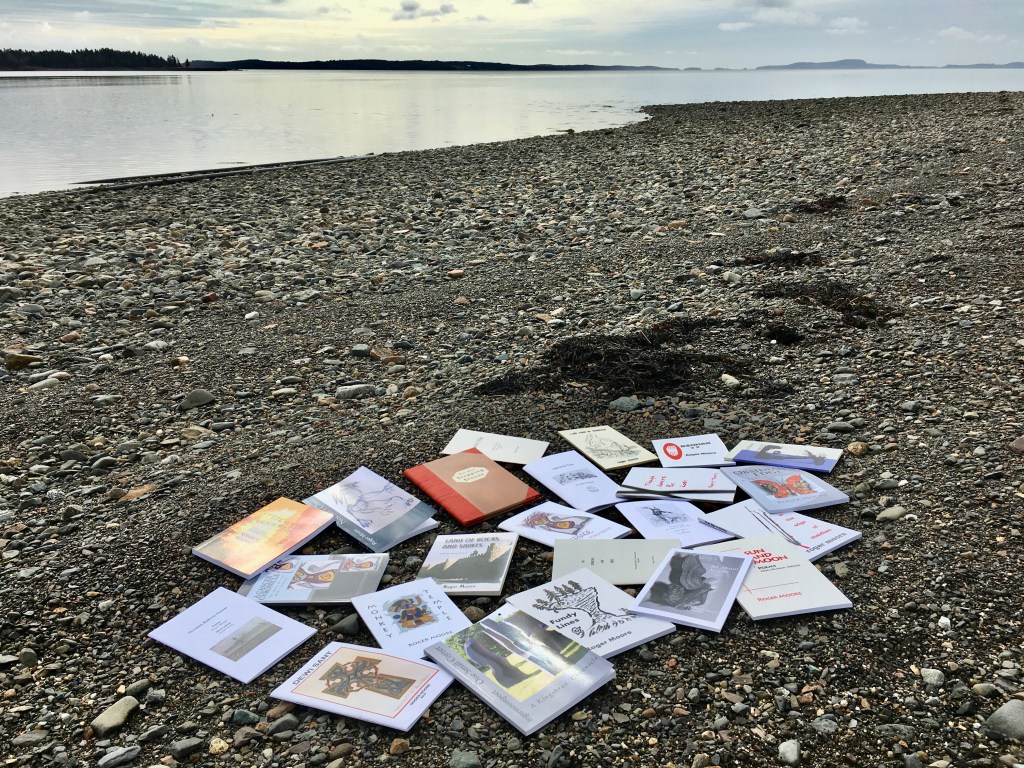
Other friends have done similar things. Here is a collection of my books on the sea shore at Holt’s Point. And yes, Fundy Lines is in there as well. Can you spot it? Another very good friend, Geoff, contributed this very meaningful photo. So much of my life, there, upon the sea shore, waiting for the tide to come in.

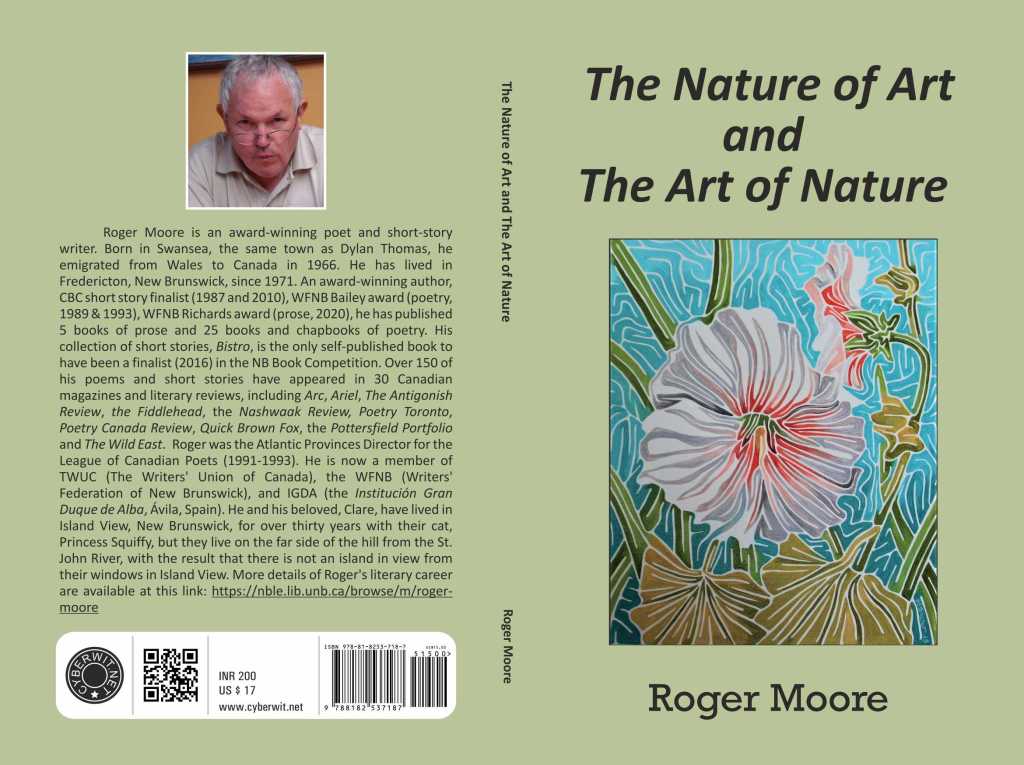
This book, and its cover, are also very special indeed. And here’s why.

Still Life with Hollyhock
Geoff Slater

How do you frame this beaver pond,
those paths, those woods? How do you
know what to leave, what to choose?
Where does light begin and darkness end?

Up and down: two dimensions. Easy.
But where does depth come from?
Or the tactility, the energy, water’s
flow, that rush of breathless movement
that transcends the painting’s stillness?

So many questions, so few answers.
The hollyhock that blooms in my kitchen
is not a real hollyhock. Intertextuality,
visible and verbal: this is a poem about
a painting of a digital photograph of a
hollyhock, a genuine flower that once
upon a time flourished in my garden.

A still life, naturaleza muerta in Spanish,
a nature morte in French, a dead nature,
then, portrayed in paint and hung alive,
on display, in this coffin’s wooden frame.

So, what do I enjoy most about writing? Everything – for whenever creative people create they draw in others into a web of intertextuality that spins its way from mind to mind and, especially in Canada, links shore to shore to shore.