The End of Time

Meditations on Messiaen.
Quartet for the End of Time.

3

The End of Time

A thin violin crying
its cat-gut heart out
in tears of sound, falling,
rhythmic raindrops,
down a grey-streaked face
tight with stress and pain.

Such concentration,
such soulfulness packed
into each mindful note.

An audience of one,
I sit, head bowed,
meditating on the meaning
of meaning and nothingness,
the nothingness of being condemned
to oblivion yet oblivious
of the how and when.

Each note a hammer-blow,
then, the piano hammering nail
after nail into this coffin body
I drag through the motions
of extracting meaning
from this meaningless life.

Click on the link below for Roger’s reading.

The End of Time

Dark Angel

Meditations on Messiaen.
Quartet for the End of Time.

2

Dark Angel

He will come, the dark angel,
and will meet me face to face.

He will take all that I own,
for it is only temporary
and all my possessions are on loan.

My house, my wife, my car,
my daughter, my grand-child,
 my garden, my trees, my flowers,
They are not mine.
I do not possess them.

I only own this aching heart,
these ageing bones,
this death that has walked beside me,
step by step, every day
since the day I was born.

That indeed is mine,
and nobody else’s.
That is my sole possession.
That is the only thing I own.

Click here for Roger’s reading.
Scroll down to appropriate episode.
Dark Angel

Carpe Diem

Carpe Diem

Seize the day. Squeeze this moment tight.
Nothing before means anything. Everything
afterwards is merely hope and dream. 

A tiny child, you chased wind-blown leaves
trying to catch them before they hit the ground.
Elf parachutes you called them and trod with care

so as not to crush the fallen elves as they lay leaf-bound.
I stand here now, a scarecrow scarred with age,
arms held out, palms up, in the hope that a leaf

will descend, a fallen sparrow, and rest in my hand.
When one perches on my shoulder and another
graces my gray hair, my old heart pumps with joy.


Comment:
Coming soon to a garden near you!

Listen to the podcast
Carpe Diem

Blood and White Wash

Blood and Whitewash
A Thursday Thought

2-September-2021

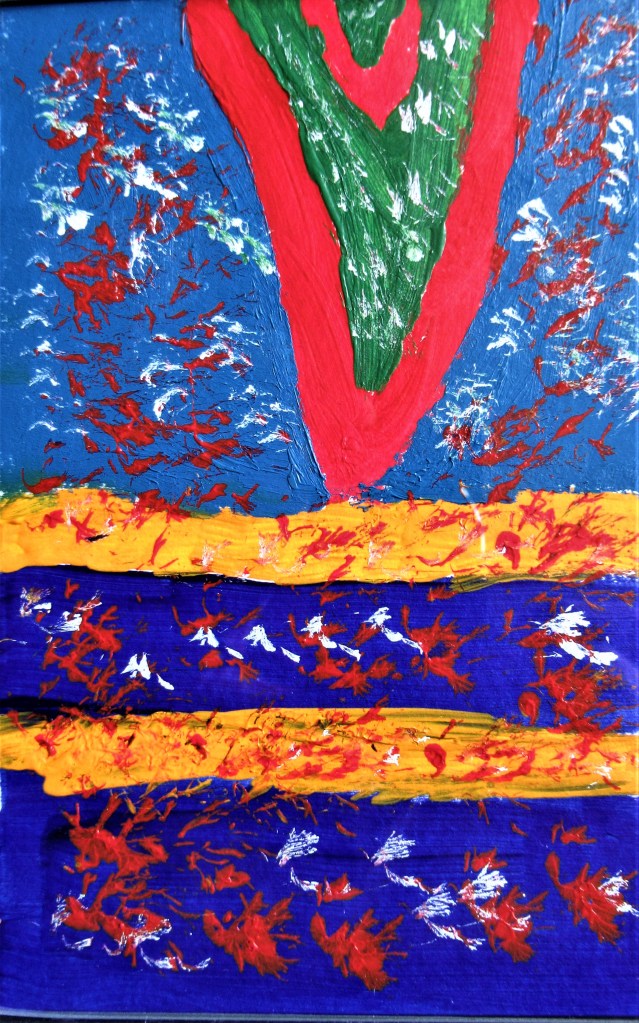
Blood and Whitewash is the title of this painting. It has a subtitle: My Plan of Attack.

The origins of the title, and hence of the painting, go back to the Goon Show, with Spike Milligan, Peter Sellers, and of course / wrth gwrs, Harry Secombe, the Swansea Comedian and Master Singer. Away in boarding school back in the late fifties, one of my greatest pleasures was listening to the Goon Show on one of the dormitory’s transistor radios. As a teenager, I found the jokes and the accents incredibly funny. Still do. That’s why I painted this painting. Alas, it is silent, and you cannot hear the accents.

The following snippet of dialog occurred on one such Goon Show, I cannot remember which.

“What are we going to do?”
“Well, this is my plan of attack.”
“That’s not a tack, it’s a nail.”
“No it’s not. It’s a tack.”

So above you have my painting of My Plan of Attack, resurrected after all those years. I throw my mind back to the First World War.

The General:
“He’s a cheerful Cove,” said Jimmy to Jack,
as he walked to Arras with his pack on his back.
But he did for them both, with his plan of attack.

And there in essence is the history of the painting. First, the plan of attack, then the failure and the blood-letting, and then the white-washing of the whole history, a white-washing that turns failure into success, defeat into victory, and loss into gain. But in WWI, it was the poor Tommies who bore the burden, and all the other front line troops who obeyed orders, went blindly over the top, and charged unbroken wire with fixed bayonets.

“If you want to find the sargent,
I know where he is, I know where he is,
If you want to find the sargent,
I know where he is.
He’s hanging on the old barbed wire.”

“If you want to find the chaplain,
I know where he is, I know where he is,
If you want to find the chaplain,
I know where he is.
He’s hanging on the old barbed wire.”

“If you want the whole battalion,
I know where they are, I know where they are,
If you want the whole battalion,
I know where they are.
They’re hanging on the old barbed wire.”

Singing as they marched to their deaths, obeying orders, like sheep, and nipped on by the eternal sheep dogs. Things were so bad at Verdun that instead of singing, the men marched, bleating, like sheep. “Sheep unto the slaughter.” There was so much ill-feeling and rebellion in the face of orders and certain slaughter, that French regiments were decimated, one man in ten shot for mutiny, as they marched bleating, instead of singing, to their deaths.

“Oh, we’ll hang out our washing on the Siegfried Line,
have you any dirty washing, Mother dear?”

“Those who do not learn from history are condemned to repeat it.” So, tell me, “where have all the young men gone, gone to graveyards everyone, when will they ever learn, when will they ever learn?”

And that, dear friends, is my thought for today: The History of My Plan of Attack. When, indeed, will we ever learn?
Calling It a Day

Calling it a Day

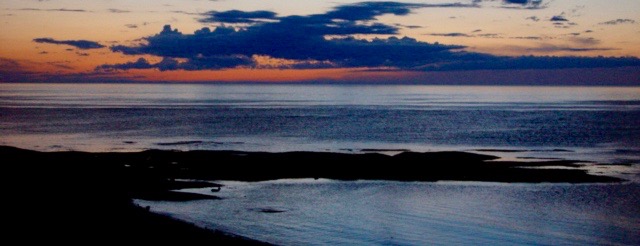
This auriferous sky, sewn with sharp sequins.
Is there a warp, a leaning towards meaning,
a lurch maybe towards the moon’s dark side?
Questions: knights-errant questing for answers.

Who planted our DNA into that first Garden?
Or did the garden fill us with its own seeds?
Why did those little plants take root and grow?
Why do they now wander everywhere, restless?

This auriferous sky, sewn with sharp sequins.
Is there a warp, a leaning towards meaning,
a lurch maybe towards the moon’s dark side?
Questions: knights-errant questing for answers.

Rampant feet patrol our castle’s heights
while we seek instant gratification, swift
possession, our fingers probe each passing
cloud, reaching for all, but grasping none.

A satellite glides its razor edge, slices
the night’s eye into pin pricks of light.
The moon balances her orange unicycle
on thin black lines, hills edged with trees.

Lesser incandescence of a departed sun,
that low, lone moon slowly climbs the sky.
Released from their earthbound burdens,
who knocks this night at heaven’s gate?

Here on the back porch, midnight slowly
covers me with its dark gray cape of grief.
My grief is your grief, your grief is mine, all
grief is one, why do we all then grieve in vain?

A Theory of the Absurd

A Theory of the Absurd

I wonder what I’m doing here, so far from home, sitting
at the bar, with my beer before me, my face distorted
in half a dozen fairground mirrors, surrounded by
people half my age, or less, all smoking, cursing, using
foreign forms of meta-language, gestures I no longer recall:
the single finger on the nose, two fingers on the forehead,
the back of the hand rammed against the chin with a sort
of snort of disapproval. It’s way beyond my bedtime, yet
I am held here, captured, body and soul, by foreign rhythms,
unreal expectations of a daily ritual that runs on unbroken
cycles of time: morning brandy, pre-lunch wine and tapas,
home for the mid-day meal, a brief siesta, back to the café
for a post-prandial raising of spirits, more blanco, then back
to work at four and struggle on until seven or eight when
the bar routine begins again with pre-supper tapas and tinto.
Who am I? What am I? Where am I going? I wander, restless,
 streets and squares, enter other bars and restaurants, consume
verdejo, manzanilla, tinto de verano, the original and many
 falsifications, in corner bars, on patios, sampling liqueurs,
cognacs and coñac, Fundador, Carlos Quinto, Torres Diez,
sol y sombra, Cuarenta y Tres, pasteles con café quemado.
Time, comprehended in this new life-cycle, lacks meaning.
Time, in a cycle I have long abandoned, is meaningless too.

Survivors

Survivors

Last night’s rainstorm shrank the house.
We closed down rooms
and now the walls are closing in.
There’s so much we no longer use, nor visit,
so many rooms we no longer enter.

Almost all our friends downsized long ago.
We are the holdouts. We love it here
in this big house with its lawns and trees
and flowerbeds with bees’ balm, butterflies, birds,
and the yard abuzz with sunshine and bees.

But now we are starting to throw things out.
Maybe we’ll move, next summer perhaps,
or maybe not. For now is the time of indecision.

Like friends of the same age,
we travel the lesser road of memory loss,
a name and a face here,
a date or phone number there.

Perhaps, when the time comes,
we will have forgotten how to move.
Meanwhile, the mandatory old man’s question:
‘where did I put my glasses?’

Pepe’s Bar

Pepe’s Bar

Friday Fiction

Pepe’s bar was at the top of a steep, cobbled street, on the left-hand side. When we got there, it was crowded with men, mostly fishermen off the North Atlantic ships that cross the sea to the Grand Banks of Newfoundland. The men stay away for weeks at a time, and when they get back home, they too have a huge thirst, large and curious appetites, and money with which to indulge them. We all pushed our way into Pepe’s bar to join the crowd.
            “Phew! Let’s get out of here. The place stinks of fish!”
            “We can’t go without drinking something. You know what Pepe’s like.”
            “Let’s share a porrón.”
            And a porrón of red wine duly appeared. The porrón is designed for a small boat in the open sea. It is a glass flask of variable size, holding half a litre or a litre of bright red wine, depending upon the number of people drinking from it. It has a wide funnel at one end through which the wine enters and a thin spout at the other through which the wine exits in a fine ruby jet which the experts shoot directly into their mouths; done with skill, no lips ever touch the flask which circulates from hand to hand amidst cries of appreciation for the skilled and jeers for the careless (and the educational tourists, like me, here to learn about the language and the culture) who suddenly choke and cough as they squirt a red stream of wine up their noses and onto face, shirt, and tie. By dint of hard work, some of it done in the bath tub at home while nobody is watching, I can manage a porrón in the quiet confines of the bar; but I still don’t know how I would fare, out at sea, in an open, wind-swept boat.
I was soon going to find out.

After the Floods

After the Floods
(2004 BC & 2018-2019)

as the crow flies
so the pigeon
holding straws
within its beak
time to rebuild

who now knows
the unknown
perceives the abyss
beneath egg-frail
cockle-shell hull

waters recede
islands re-emerge
bald skulls of hillocks
stripped of grass and trees
water-logged fields
old bones dug up
displayed in the ditch

mud walls fallen flat
warped wooden planks
water-swollen
so much stolen
by water wind and wave

Patience

Thursday Thoughts
Patience

Patients must be patient.
The waiting-room
is where the doctor
makes them wait.

My father waited, patiently,
to see the specialist.
At the stroke of noon,
nurse told the waiting patients
not to wait patiently
and to all go home.

“Come back next week,” nurse said.
“What’s up?” I asked.
“The doctor,” she said,
“has a very important meeting.”

I hurried for a taxi.
My father on his Zimmer
followed slowly behind.
On the hospital steps
I met the doctor.

“Damnation!” he said,
into his cell phone.
“I’m going to be late
for that appointment.
I’ve left my golf clubs behind.”

Thursday Thoughts: I remember that day well. My father was due to visit the hospital for his appointment with the stroke specialist. I wanted to drive him there, but he insisted on waiting for the old folks’ ambulance. It was due at 9:00 am and his appointment was for 10:30 am. We waited patiently, watching the hands on the clock moving slowly round. 9:00 > 9:15 > 9:30 > 9:45. “I can drive you,” I said. My father shook his head: “If I don’t take the ambulance, they won’t come to pick me up again. They’ll say I have other means of transport.”

The ambulance / ambwlans (in Welsh) arrived just before 10:00 and dad was sure they’d make his appointment time. Except there were still empty seats and that meant more passengers to pick up. Used to the system, my father waited patiently while I got more and more frustrated. Finally, the ambulance was full and we made our way to the hospital, getting there about 10:45. “Run,” my father said, thrusting his appointment papers at me, “tell the nurse I’m on my way.” Run I did. When I got to the waiting room, I found it full of people with never a chair for my father to sit on. When he arrived, a younger patient offered him his seat and he flopped down into it.

Names rang out. Patients disappeared. Some returned to the waiting room, then walked out. Some didn’t return. At 11:15 my father demanded tea. I got him a cup. At 11:30, a man stood up and started to preach to his captive audience. “Does that every week,” dad muttered in my ear. “He’s mad.” “You can’t take it with you,” the preacher thundered. “There aren’t any pockets in shrouds.” People fiddled and looked uncomfortable. Most had teacups perched precariously on saucers, and some rattled them, whether in applause or anguish, I still don’t know.

Then at noon the nurse appeared and announced what you have read above. “Dr. XXX’s patients: you can all go now. Dr. XXX has an important appointment. Come back next week.” My dad pushed me. “Run,” he said. “Get a taxi. They’ll all be wanting one and by the time I get there there’ll be none left.” That was the only visit I made with my father to that particular hospital. I had so many questions to ask that specialist, but, alas, I never met him.

What I did learn was that patients must learn patience. Hospitals, like airlines, run to their own schedules. A sign should be placed above every hospital door. “Abandon hope, all ye who enter here.” Just a thought, nothing more. The delays in all our medical systems, caused by the Covid-19 pandemic, have been disastrous for many people, especially the old. Missed appointments. Delayed and cancelled treatment. Long waits and delays. The medical staff have been placed in such stressful conditions. Many are finding it difficult to cope with their inability to fulfill their desires to help their patients. Many are so stressed out. Two of my own doctors have cried when talking to me. I think of it as Covid Collateral Damage, CCD, just like the Colony Collapse Disorder that wiped out our bee population a few years back. Now we are the bees and hospitals and nursing homes are the hives.

Looking back, that morning spent waiting with my father, was a lesson in what old age has in store for us Golden Oldies as we age. Patience: as patients, we must learn patience. And remember, as Bette Davis once said “Old age is not for cissies.” And those are my thoughts for today!