Impact

IMG_0017.JPG

Impact

This photo comes up from nowhere, springs into your half-awake mind, diminishes your reality. W5: who, what, why, when where? But there is no who, save the person bearing witness to this moment in time, and you, the double witness who also contemplates and is therefore complicit.

Do you recognize this scene? Is this a moment in your life? Are you the one who struck the match and lit the flames in the lower corners? And are they even flames? Or are they moments of glory, flashes of fireworks, the world coming alive in a moment of combustion when light and dark are mingled until, fiat lux / let there be light, and the world is reborn, light and form, drawn from darkness, and earth and sea divided into separate realms. In principium erat verbum / in the beginning was the word and the world was born / reborn in this verbal-visual instant between sleeping and awakening, when dreams gain substance and ideas take on form and shape and grow in the observer’s mind until creation sparks into life.

Who now knows what will be, what might be? We see. We bear witness. We paint, draw verbal pictures, take snapshots, unfold our souls, placing them on paper and canvas capturing them by camera in snapshots … but What’s it all about, Alfie? Do you remember the film? The suspension in space, the knowledge that all is absurd, that this is a jigsaw puzzle of the worst kind, with no solution, no answer, and every path bifurcating before us, and each of us wandering in a maze, a labyrinth, with an entrance, but no exit.

Do you think up or down, when you’re floating in a space without gravity, where nothing is substantial and all the rules you ever learned no longer hold? The roller-coaster rolls on and you hang on, and sometimes the sun comes up and sometimes the sun goes down, and is that the first light of morning or is it the last light of day, and how can you be sure?

And where is it anyway? Have you ever been there? And if I told you where it was , what time of day it was, or what time of night, would you believe me? And if not, why not? And who and what am I? And why do you trust what I say? And why would you trust me, when you have never met me, and you do not even know who I am, or where I am, or what I am, and even I do not really know who I am or why I am, and why does any of this matter?

It matters because we need faith, we need substance, we need hope, we need to believe in something other than ourselves and beyond ourselves. We still want to wake in the morning and see the dawn. We want to grasp it in our hands, not just in our minds, and know that there is light beyond this darkness, there is hope beyond this gloom, there are better things ahead. See that forgotten candle? Pick it up. Take that match. Strike it against the box. Now light that candle. Take it out. Show it to other people. Encourage them to light their own candles.

Sometimes we need to enlighten the world, to turn it round, to reject it as it seems to be and to recreate it in our own image.  But take care: the image of the candle is not that of the laser beam or the searchlight. One by one, the small people, we must join together, and like tiny stars and light up the firmament. I cannot do it alone. But together, you, and you, and you, and you, if you walk with me, we can do our best. And that is the best we can do, in this, as Voltaire’s Candide once called it, the best of all worlds and the only one we have.


Friends

IMG_0136.JPG

Friends

When good friends get together they can talk and walk and hug and hold and discuss so many awkward and difficult things, like how the body fills with spirit and the reader can be swept away in the magic of voice and how time and space can be suspended in the majestic act of creation that spins a web of forgetfulness around us and makes us forget who and what we are as we forge new worlds and the duende (Lorca’s dark earth spirit of love, want, and creation) holds us captive and drives us onward and inwards until we give birth to that which was waiting to be born, even though we never knew that the seed had even been planted, and “What is this?” we ask as we survey the new born entity fresh on the page, held in the hands, suddenly full of life and breathing on its own, a thing of beauty in its own right, that made complete sense as we struggled to hold it as it grew and transformed and transitioned from internally ours to externally and eternally theirs, a product of mind and body now belonging no longer to us but to the world beyond us, and we long to know its fate, to watch it as it walks along its path, its destiny now in its own hands, and “What is it?” people ask as we stand still and know not what to tell them, or else they say “Nice”, sigh, and go back to their two-thumbed clicking and their imaged devices, bereft of the imagination to see and explore that which has just been placed before them, this babe in swaddling clothes, this new creation, “Here, have some,” they say, thrusting our way the chips on which they are munching, or the curly French Fries they are crunching, or the pistachios, or whatever, and their coffee cools on the table, and their eyes are locked on the text that moves between their fingers across the electronic page, and this is life, as they know it, this shifting screen of shadows, this black and white stage that moves across the wall of the man-cave, woman-cave, in which they have immersed themselves, their noses close to that shifting screen, their minds elsewhere, trapped in the instantaneous insanity of the hyper-cyber-space that inhabits the void behind their eyes and between their ears, as they try to judge the price of everything never understanding the value of anything, let alone what we have created, and “Take away his grant,” “Let her wither on the vine,” “They’ll soon forget to be creative when we chain them up face to face with harsh reality,” and was that what they said to Goya, to El Greco, to Leonardo, and what exactly did they say to Lorca, before they shot him dead and rolled him into that common grave along with all the other murdered men and women, teachers and artists, poets and thinkers, and we, poor parents, holding our precious precocities in their swaddling clothes and wondering why we ever set out on this adventure, and why we are creators in the first place and “Watch out, here it comes again!” the tsunami, the tidal wave that sweeps us away and drives us into the black holes of our inner lives where a dark sun shines and shadows dance and lead us on and on until we have caught our dreams, squeezed them dry of their nothingness, and turned them into the weavings of an actuality stuffed full with new life, a new reality, a new creation, something that is truly ours, yet outside ourselves, and we gaze at it for a moment then position it in its cradle of reeds, place it in the river, push it out into midstream and eyes fill with tears and heart with hope as we watch it float away to make its own life, sink or swim, on this sea of sorrows, where someone, downstream, may bend to the waters and say “Holy Moses: what on earth is this?” or “How are we going to judge and assess it?”

Twits, Tweets, and Twitter

img_0281


Twits, Tweets, and Twitter
aka
Bits and Bytes

After a very cold and snowy December, with low temperatures, way below average and dropping at times to -24C, with snow on the ground almost all month, and all this in the fall, aka autumn, since winter didn’t officially begin until 6 pm yesterday, December 21, it was a real shock and surprise to listen to the rain fall and high winds batter the windows all night as the overnight temperature rose to +14C and we received 40 mms of rain. As a result, we awoke to warnings of flash floods from melting snow and an influx of rain as winter has begun with a more of a whimper and a watery splash rather than with a flash freeze and a bang as your bottom hits the ice. I wonder what the deer think as they paddle through the puddles on their way to and fro from the water-logged feeders. I know what I’m thinking: ‘thank heavens we don’t have to shovel it’, but it will be a totally different story when it all freezes over, the road are like bottles, and we descend the hill in first gear with an ever-present fear of a much too welcoming ditch.

I have just read an interesting article on how, accustomed as we are to Twits and Tweets, many of us are no longer capable of unravelling a long interesting sentence that rambles on and on and refuses to make an immediate Twitter Point, usually underlined by the use of CAPITAL letters for KEY WORDS and all of this for a sound byte audience that is becoming less and less literate as social media proliferates and news is telescoped into tiny jam jars of meaning that are spread around with an illiterate spoon and many exclamation marks. There: you have just read a 96 word sentence. I wonder how you did with it? Did you persevere? Did you give up half way through?

In my former life, when I encouraged young people to read Miguel de Cervantes’s Don Quixote from cover to cover (and they did), I was surprised to discover the difficulties they had with his long sentences, some so long that they continued for a whole paragraph or a full page. I was also surprised to discover that many Spanish speaking people are now incapable of reading Don Quixote in the original Spanish as it is too complicated for them and too difficult in meaning and structure. I have cartoon versions of Cervantes’s master-piece, but have always found them to be simplistic and undignified. I have read the original, in Spanish, twenty-seven times, usually in the Martin de Riquer edition, and have never found the language to be a problem. Indeed, it is refreshing to enter the labyrinth of a long sentence and to struggle for a little while with the exact meaning of a complicated structure that offers so many multiple readings that no single meaning can easily be extricated, if at all, and so the mind wanders on and on in the Cervantine maze spun by a spider-web pen and a brilliant mind, now no longer accessible to the multitudes: a paradise now closed to so many, a garden open to a only a select few / Paraíso cerrado para muchos, jardines abiertos para pocos.

The spirit of Cervantes, the creator, appeared to me last night in a dream. ‘Rogelio,’ the master said. ‘Spare me and spare my creation.’ ‘Don Miguel,’ I mumbled sleepily, ‘here sit beside me on my bed. Welcome to my humble home.’ ‘I am not don Miguel,’ Cervantes replied. ‘I never was a don and I never will be one. I am humble Miguel, writer, poet, and son of a vagabond surgeon who, like father, like son, often entered the debtor’s prison’. ‘That same debtor’s prison where the history of your hero was engendered,’ I replied. ‘So they say, but I am not here for that. I have come for you to save me.’ ‘How, my Lord, how can I save you?’ ‘Rogelio, I am not a Lord, but a rumor has reached me in my after-life, that they have modernized my knight, given him a car, not a horse, set the Civil Guard against him, ridiculed him with condoms that he blows up like balloons, sent him to Salamanca, and Galicia, where he never went, continued his adventures, reborn, in a foreign language that I loathed …’ ‘That is bad, my Lord, I mean don Miguel, I mean Miguel …’ ‘Worse is to come.’ ‘Worse? How can it get worse?’ ‘Indeed, it arrived at my ears, you might say a little bird told me, that they are releasing my book in a series of 240 word tweets on a thing called Twitter that speaks like a Jesuit with false flickering words.’ ‘But you were brought up by the Jesuits …’ ‘That’s how I know of what I speak. This cannot be, the history of my knight reduced to episodes of 240 words, the whole 124 chapters, 1000 pus pages of finely scrawled ink, reduced to tweets on twitter by some poor twit … you must stop this nonsense. I and my knight depend upon you.’ ‘How can I stop it, don Miguel?’ ‘Charge the windmills of Twitter. Attack the falsehoods of Tweets. Stand up for the long, soulful sentence that will withstand the winds of time …’ ‘As your book has withstood, until now, the literary storm that is about to engulf it in an Alfred Hitchcock swarm of wild birds that is poised to twitter and tweet you to your doom?’

The ghost of Miguel de Cervantes vanished with a howl, only to be replaced by that of Pierre Menard, Borgian author of the renewed Quixotic page. ‘To tweet,” the ghost whispered in a thin, shrill voice, ‘or not to tweet, that is the question, and therein lies the Cervantine rub.’

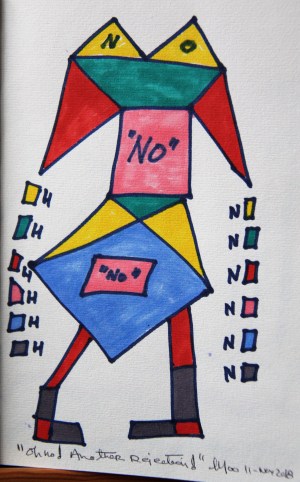
Rejection

IMG_0023.JPG


“Oh no, another rejection!”

“And rejection equals dejection, or doesn’t it?”

“Only if you let it get you down. I wait until I am in a foul mood and ready to tear things to pieces because my mean streak is surfacing. Then I go to my rejections pile, re-read the rejection letters, then read again the pieces that have been rejected.”

“Why on earth would you do that?”

“Above all to work out why the work was rejected. What did the editors see that I didn’t? When I write, I wear rose-tinted glasses and all my little babies are the prettiest, the strongest, the fairest in the land, especially when I give them the ‘mirror, mirror on the wall’ test.”

“I’ve never heard of that.”

“It’s simple: you look in the mirror and ask ‘Who’s the fairest writer of all?’ and the mirror answers ‘Why, you are, of course.’ If you believe that, and as writers, we often do, then rejection becomes a hard realistic rock, shattering both Ego and Id. The immediate response is to deny the editor’s taste and judgement. It is amazing how many stupid, dumb, and uncultured editors there are out there. They hate us and don’t understand us.”

“That’s true.”

“No it isn’t. The fault, dear Brutus, lies in ourselves, not in our editors, that we are not great writers. Understand that, and you have a chance to succeed and to improve. Re-reading allows me to try and understand what went wrong, why the mirror lied, how the rose-tinted glasses distorted the actuality of the written page. Understand the other and how the other perceives what and how you write and maybe, just maybe, you can condition yourself to improve. Many budding writers are dropped on stony ground and fall by the wayside. Others land in the desert and their things of beauty bloom where nobody sees them. Some fall on seemingly fertile ground and earn an immediate immortality that fades in a season when the fad wears off. A few writers, an occasional few, go back to the drawing board and water their flowers with the sweat of their brow. Eventually, if they are lucky, their work may be accepted.”

“You always preach the bus story, Julius.”

“Of course I do. Get off the bus early, and you’ll never finish your journey. Remember Sir Walter Raleigh: ‘it’s not the beginning, but the continuing of the same until it be thoroughly finished that yieldeth the true glory.’ He didn’t sail the Golden Hind around the word by setting up house in Cadiz and living in luxury on a beach in the south of Spain. He continued on and on, always forward, until he arrived back in his home port.”

“So we must just keep going, then?”

“Of course. But never blindly. Take criticism to heart, remembering that it comes from another’s heart. Learn from your mistakes. Correct them when you find them. Never give up.”

“You’re always happy, Julius. I bet you never get rejected.”

“Oh I do, Brutus, I do. And each rejection is a dagger to the heart. But I keep going. For example, last week I received my fifteenth consecutive rejection. So much work, so much genius, and all denied.”

“But you’re still smiling.”

“Indeed I am. I have just received my second acceptance in two days. I no longer feel betrayed by my editors.”

“I’ll never betray you, Julius.”

“You will, Brutus, you will. Never fear, et tu, Brute.”

Siege Perilous

IMG_0168.JPG

Siege Perilous

           My second name begins with G … G for Galahad.

         Siege Perilous: the chair calls me, sings out my name, craves my body warmth and blood. I move towards it, hear it groan to me in greeting. I feel it sink beneath my weight, feel its heat and comfort, sense the heart-sound of its old, carved, polished wood. My father sat here before me and his father before him, and his father … and so on down the ringing halls of time.

           Siege Perilous welcomes me as it welcomed them. It cherishes me, nourishes my flesh and blood, my sense of belonging within a great chain of being whose links vanish backwards into forgotten, far-off mists. The chair understands that we are weaklings. It accepts us are we are, strengthening our strong points, filling in for our gaffes, gifting us with the ability that allows us to see ourselves as we truly are, willing spirits in an all too flimsy flesh. Impervious its wood to words or tears, it strips away our masks, dismantles our disguises, meets our inner being face to face, seat of wisdom carved from the tree of knowledge of good and evil.

           The chair rarely rejects us, though sometimes it senses the rot within and moves us on. More often than not, it brings light to our darkness, pierces our clouds of unknowing with its beam of sunshine, illuminates our darkest nights. It cares for us, wraps us in the warm wings of its radiance, carries us onward when we are alone, shapes our own heart-wood with its hand-carved arms that cling and clutch and cleanse of impurities. Blood warms its veins, the blood of the generations that have climbed here as children, sat on the elders’ laps, listened to their tales, then shared their inheritance, before sitting here themselves.

           A sense of entitlement wraps its veil around Siege Perilous and the Forgotten Table. It shuts out doubt and fear. We feel its power transmitted through us, fear, fire, foes all defeated. Power: the power of good to defeat evil, of truth to conquer lies, of my people to survive. They may seem to be crushed, and yet they will rise; defeated, they will overcome; victorious, they will be magnanimous in their victory.

           King Arthur: the Once and Future King … King Arthur and his Knights of the Round Table … Siege Perilous … the Vacant Chair … the Holy Grail … Excalibur: the Sword in the Stone … Arthur himself … Galahad, Geraint, Percival, Gawain, Lancelot … all equal … all pure, honest, innocent, celibate … Camelot …

Merlin the Magician and Wondrous Wizard, conjurer of truth and falsehoods … the historian-poet adjusts his rose-tinted spectacles, smiles, clacks the false white teeth that spin-doctored so much verbal magic, so many mystical myths, fabulous fables, phenomenal falsehoods … and started, pen on paper, to create yet again another set of nonsensical, downright gut-jarring lies.

Thinking Outside the Box

IMG_0026


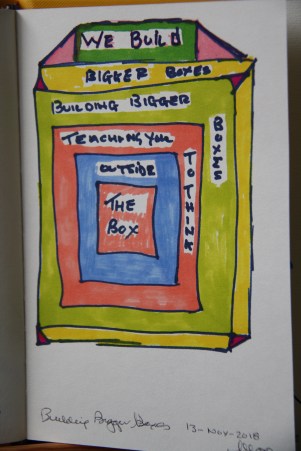
Clichés, I love them.  Take one of our current Canadian educational clichés, for example: “We teach you to think outside the box.” I have met many teachers at various levels of education who tell this to me, and to their students.  Yet most of these teachers cannot themselves ‘think outside the box’. What they usually do, when teaching, is shut off the student’s original box by teach them to build a slightly larger one around it. They must now learn to think inside this new box in the way the teacher wants. Hence the cartoon above: We build bigger boxes and Building bigger boxes.

The central motif is, of course, the original ‘tiny’ box outside which the student must be ‘taught‘ to think. For ‘taught‘ substitute one of the following: persuaded, bullied, pressured, beaten, shamed, starved, embarrassed, … depending on the time and place, all of these words are sadly suitable and yes, in my learning career, I suffered at one time or another at the hands of teachers who used each of these methods, and others equally (or more) brutal, sometimes more than one at once.

What was inside that original box? Of course the contents vary with each individual, but creativity is in there, challenging authority is in there, self-belief is in there, a desire to ask endless questions, a childish wisdom to see the world as it is, not as the grown-ups say it is. I ask you, have they really ever grown up, have they ever escaped from their own hand-built boxes? Education: locking down the walls of that original box. Do away with creativity [not that way, this way!], free thinking [you mustn’t say things like that!], challenging  authority [cheeky, disobedient child!], asking questions [little children should be seen and not heard …. silence! … silence in class!] and finally, do away with self-belief and make the child dependent on the teacher [please, Sister Mary … please, Mother Theresa … please Father Maguire …] …

As the walls of the bigger boxes grow thicker and stronger, so it becomes more difficult to once again think as a child. Questions are answered by authority figures or on the internet with answers to FAQs and pre-packaged concepts. How do we regain our creativity? I assure you, we have never lost it. Where is it? Where is it hidden? In this world of folly and rush, of hustle, muscle, and busy bustle, so few of us have the time or can afford to take the time to sit and think, to undo those false walls that surround us, to find again the child-loving pleasure of thinking for ourselves, of discovering for ourselves, of being creative in the ways that we were so very, very long ago. Remember what Picasso said of his later paintings: ‘it took me a long time to relearn how to see the world as a child.’

Creativity: it is always with us. We must rediscover it. We must unwrap it from the tarpaulins that the system placed around it. We must dig it out from under the walls, the ruinous walls, with which the system surrounded us. It is still there, waiting for us to rediscover it. Believe. Roll up your sleeves. Dig deep inside yourself. And think for yourself. Then, when you have found that original box, open it, find exactly what is in it (the universal gifts to the new born), and become creative yet again. Only then will you have taught yourself (yourself, because others won’t teach you) to truly think outside the box, the multiple boxes, that the system and society designed to trap your creative spirit. Open the cage door: , release your creative spirit and let it soar to the skies.

KIRA 1

IMG_0170


KIRA 1

Our first full day at KIRA, and it’s not over yet.

Last night we had our first dinner together, courtesy of Kingsbrae Garden Café. Wonderful food and a dessert to live for. All of the participants gathered around the table and we were graced with the presence of Mrs. Lucinda Flemer. Conversation was lively, with each of us defining our position and interests in various art forms ranging through painting, print-making, poetry, photography, short stories, and memoirs.

After dinner, we discussed the nature of the retreat itself. This centered on several areas: Establishing Goals, Towards a Shared Experience, Building a Creative Community, and Managing Expectations. We discussed an agenda for this morning (Monday) and agreed upon an action plan for our first day. We also agreed that we would achieve what we could during the first day and then change, as necessary, if change were needed. The main things: be flexible, be creative, talk together, work together, support each other, and cater, small group, to each individual.

This morning we discussed the creation of a personal time and space for writing. Each one spoke of where and when they wrote. We made some suggestions as to how time and place might be achieved, even during a busy working day. We then spoke about journals, pocket notebooks, hard work versus inspiration, and the need to recognize gems when we created them. Genius is 99% perspiration and 1% inspiration. The hard yards must be put in at the beginning. Before long they will no longer be hard. The idea of the artist as a traveler was discussed. We are all making similar journeys, but we are all on different points along the way. Many of us were helped in our beginning days, and we in our turn must now help others.

We then worked on specific goals for each person, facilitators and participants. This was very person-specific. We agreed upon a schedule for Blue Pencil Cafés and gave the first ones later in the afternoon. We finished with a ten word exercise, courtesy of Jeremy Gilmer. Write a ten word story. We took time off to write and then ended the session by reading our efforts to each other. Great fun and a good time was had by all.

My own BPC went very well. More about that later, perhaps. It went on much longer than I expected and we both had great fun looking at a poem in all it’s different shapes, meanings, and possibilities. Tonight, we have our first set of readings and we will see how they go. The BPC material, reworked, should be ready for later. Again: it will be fun and words, thoughts, and ideas, will creatively take wing and fly.


Butterflies

img_0189

Butterflies

Butterflies, as large as elephants, stamp through my gut, just when I thought I was too old for butterflies. As my old Holly-Hock told me this morning: “You’re never too old for butterflies.”

So, what’s it all about, Holly? I am packed and almost ready for the trip to St. Andrews to participate in the inaugural KIRA Boutique Retreat. And yes, I am happy, excited, and very nervous. Hence all those butterflies, walking the tight-rope of my tum.

IMG_0068 (2)

One of the elements of creativity that we will talk about next week is the importance of attention to small details. I attach an article on how small words, lapidiary (carved in stone) phrases, can light up our lives, in the best sense of the word. We should all work on them, for such phrases glow in the dark, unlike those cutting and damning words, so hurtful, that cut people down and cause so much harm. Hope, my friends, hope in the breaking of day. We can leave the dark night of the soul to the cynicism of our current politicians. Hope: for all is not doom and gloom and, with our best words, our best works, we can write through the gloom and bring light to lighten the darkness.

How poetry can bring light to darkness


KIRA Writing Retreat #2

KIRA Writing Retreat #2

IMG_0084

A second KIRA Writing Retreat will be held from Sunday, October 14, 2018 to Saturday, October 20, 2018. A maximum of five participants will be selected to work with the Kingsbrae  Artistic Director, Geoff Slater, Professor Emeritus and Award-Winning Poet, Dr. Roger Moore, and Award Winning Short Story Writer, Jeremy Gilmer. Full details are available from the Program Director, Mary Jones, at kira@kingsbraegarden.com or by telephone at 506-529-8281.

Click on the attached link for A Brief Overview of Life and Art at KIRA.

 KIRA Promotional Video


Sentence

SENTENCE

IMG_0279

Never underestimate the importance of the sentence, the power and placement of each word, the dynamism of the parts, the wisdom of the whole. I could write about this at length but, much more important, others have done so. My thanks to my friend and fellow artist, Jan Stoneist, for choosing the above sentence from my book, Stepping Stones, and carving it in Old Red Sandstone, from Wales. Cymru am Byth.

This article, attached below, illustrates the theory much better than I can.

THE SENTENCE