A Sacrifice to Mithras

F1040022

A Sacrifice to Mithras

“What is this sound?”
“It is your own death sighing,
groaning, growing
while you wait for it
to devour you.”

“What is this feeling”
“It is the itch of your own skin
wrinkling and shrinking,
preparing to wrap you
in the last clothes you’ll wear.”

“What is this taste?”
“It is the taste of your life,
bottled like summer wine
once sweet tasting,
now turning to vinegar.”

“What is this smell?”
“It is waste and decay,
the loss of all you knew
and of all that knew you.

“That carriage outside?”
It is the dark hearse
come to carry you
to your everlasting home.”

“Look on us in our darkness,
help us to seek and see the light.
Keep us strong, keep us brave.
Mithras, always a soldier,
help us to die aright.”
F1010019

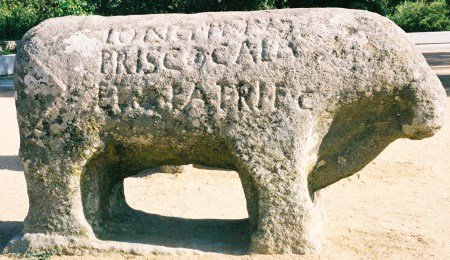
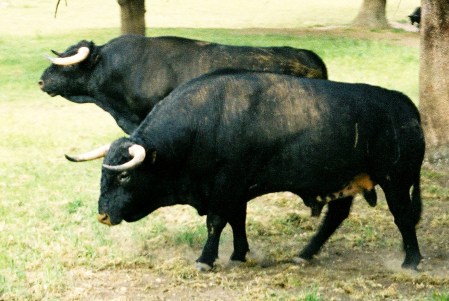
Comment: I am re-reading Puck of Pook’s Hill (Rudyard Kipling). It was given to me for a Christmas present (1955) by my father’s younger brother, my Uncle Frank. His signature is there, on the fly leaf, and his hand writing is as I always remember it. As I write these words, I can still hear his voice. The Song to Mithras, on which this poem is based, can be found on page 191, my edition (MacMillan, 1955), as a prelude to The Winged Hats. Without these clues, the poem operates in another space, more personal and more morbid, perhaps. The rites to Mithras were associated with the sacrifice, at midnight, of the black bull. The upper photograph shows one of the Bulls of Guisando (Los Toros de Guisando), which have stood in the province of Avila, in Spain, since time immemorial. So old are they, that the Roman legions left their mark on them in Latin, as you can see from the photo, when they conquered Spain after the Carthaginian wars.  The lower photo shows fighting bulls on a bull farm in Salamanca, Spain. Born from generations of fighting stock, these animals have been bred for thousands of years to die in the bull ring, as the bulls dedicated to Mithras were bred to die in the Roman temples. This is not a defense of the cruelty of bullfighting or the sacrifice of animals. It is rather a statement regarding the longevity of cruelty, of sacrifice, of the natural flow that leads men and women from birth, through childhood, to maturity, and on to old age, and death. My father is long gone now, as is his younger brother. Who will have access to these memories of mine when I go? Who will remember my family when I am gone?
Fire and Flame

IMG_1571 (2)

Fire and Flame

1

The world is on fire.
Someone, somewhere
lit a match.
The world exploded.

A match in the lungs.
the whole world burning.

Someone, somewhere
sneezed into their sleeve.
the world collapsed
in a fit of coughing.

“It isn’t the cough
that carries you off,
it’s the coffin
they carry you off in,”
said the talking head,
scientific boffin.

2

Intelligence, give me
the exact name of things:
corona virus, vaccine,
air that’s pure,
drinkable water,
a new, fresh world
for my daughter
and her daughter.

I wish I could spare them
from all this slaughter.

Comment: The echoes in here are obvious to me, but to how many others? Octavio Paz strolls through the first stanza while Juan Ramón Jiménez patrols the second one. How many people read their poems now? Polvo seco de tesis doctoral / dry dust of a doctoral thesis, as my friend José María Valverde once wrote. He, too, passed and will all too soon be forgotten like the rest. And time: what is it? How does it function? Is it linear or circular and repetitive? It twists and turns, like we did last summer, but not like we’ll do this one. My old arthritic bones will allow me to twist no more. Vingt-et-un, quatre-vingt- et-un: twist and bust. Yet time flows by, like water under Le Pont Mirabeau and days blend into days. 79 days of lock down now, all voluntary, or is it 80? El tiempo aquí no tiene sentido / time is meaningless in here, as my friend and mentor, José Hierro wrote, so long ago. And yes, these memories linger on, as time lingers on, as life lies heavy around us, and time limps by with its lame, old feet, yet looking back, it has raced passed like a spring river in spate. And the leaves are back, and the flowers are coming up, and the spring birds and bees and butterflies are arriving … and, in spite of everything, perhaps even because of it, life is as lovely as it ever was. Keep safe, keep well!

IMG_1264

Ego

cropped-39948917_706398923049634_3046174897211441152_o.jpg

Ego

I am not worthy
to be called her sun,
and yet her world
revolves around me.

She spins in my space
and short-circuits
her own life to make
mine more livable.

I’d like to say ‘joyous,’
but tears are in all things
(sunt lacrimae rerum)
and
death touches mortal minds
( et
mentem mortalia tangunt
).

The best I can offer:
a salt water world,
filled with inadequacies,
drowning us in tears.

Comment: Several things of note in this poem and the voice recording. Should we mix languages in a poem? Why ever not, so long as we explain them. This Latin tag goes back over 2,000 years and links my poem (Intertextuality, remember?) into a long Western tradition. Am I worthy of that tradition? Is my poem? Well, that is a totally different question. However, I am linked in, as you might phrase it. A second question: does my reading of the poem affect your understanding of the poem? If so, how and in what way? Does the phonic word play sun / son affect your understanding of the poem? If so, how? And how does the double meaning of ego work on your mind? Does the Freudian Ego / Id stand out? Or does the schoolboy “Quiz?” “Ego!” spring to mind. Or do you immediately think of the first person singular (Latin) ego as in ego sum lux, via veritas? More important: are you aware of any of this or does the poem disappear into a desert landscape of nothingness with no apparent strings attached? Good questions all: I invite you to think about them all. Blessings and best wishes. Keep safe.

An Angel at Jarea

IMG_0258

An Angel at Jarea

An angel moves through the room
in the silences between our chatter.
He fills the interstices of speech
with the wonder of feathers
enlightened by rainbows.

Tranquil his footsteps
as we sense his presence.
He places his hand on an arm,
his arm around our shoulders,
and now, commanding silence,
a finger on his lips.

We sit here
scared by our intimate inadequacies,
scarred by the fierceness of our thoughts
as we sense the vacuum
of his soon-to-be absence.

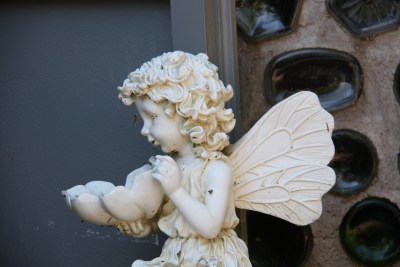
Comment: The video reading of my poem follows. Ruby Allan, one of the five artists invited to participate in the first cohort at KIRA (2017) would always say, when a silence fell on the group, that ‘an angel is moving through the room’. This poem is dedicated to her, and to my friend, Geoff Slater, whose house and gallery we were visiting when the happenings depicted in this poem took place in June, 2017. Several years ago now, but I remember it like yesterday: a magic moment that I have tried to preserve in words. I could never have captured these moments in my verbal snapshots without the assistance of my friends. Thank you all so much.


Mist at Jarea

fundy-05-mistwolfepipers-081

Mist at Jarea

Moving in with the tide,
drawing gauze curtains
over the islands,
climbing, so silent,
pebbles and rocks
to arrive at our windows
and block out the sun.

The mist’s grey face
presses against the panes.
Long lost friends,
come back to haunt us,
loom out of our past.

They bear memories
born beyond the mist,
living now in, and for, this mist.

They come stalking us and tap
with long, cold wisps of fingers
at locked windows and doors,
bolted so they can’t get in.


Empty Nest

fundy 05 mist+wolfepipers 153

Emptiness
is an
Empty Nest

The wind at the window
scratches tiny notes.
I can no longer hear the tune
nor read the words.

Who walks beside me
as I pace my lonely path,
abandoned
in this empty house.

My self-portrait
stares back at me:
a splintered selfie,
framed in a sliver
of silvery glass.

Above me,
the monkey-faced moon,
that itinerant tinker,
walks a fractured way
over broken glass.

The knapsack on his back
is cobbled together
from a finery of cobwebs
and clumsy clouds.

IMG_0039

Limbo Dancing

IMG_0724 (2)

Limbo Dancing

Yesterday I went limbo dancing
in the bedroom mirror.
Lower and lower I danced
until I fell into the mirror
and became my reflection.

Rough were the waters.
I know how to swim, but
I thought I would drown,
except the light was too shallow
and my feet touched bottom
when I let down my wheels.

I swam on and in
looking for a deserted island
on which to build
my idle, sandcastle dreams.

Two people said they saw
my reflection swimming,
a goldfish in a silver space.

They said I stared back at them
with circles of longing
ringing my eyes, but I laughed
when they said they had seen me,
for when I looked in the mirror
that reflected the mirror,
I saw myself limbo dancing,
stranded between
heaven and hell
in a dance hall called Virus
where I drank Corona.

Whose eyes watch me now
as my video goes viral
and I twist and I dance
in a fantasy land
filled with sweet nothings.

Finisterre

fundy 05 mist+wolfepipers 081

Finisterre

Nothing left now but this pain in my heart.
It makes me think about ageing, growing old,
that unstoppable process of the body’s slow,
inevitable breaking down from all to nothing.

I should probably go to the doctor, but what
can she, will she do? She can’t stop the hands
on my body clock and lop ten or twenty years
from my life. Nor can her pills, lotions, potions

gift me with the long-sought magic of the Fountain
of Youth. The truth, unwelcome as it is, is that
the day I was born I took my first steps on the path
to death, my own death, an inescapable law

that tells me that body and spirit will be forced
apart, that the flesh will wither and perish,
and that the person the world and I know as
me will no longer be able to hold together.

Comment: Finisterre, the Pillars of Hercules, the Nec Plus Ultra beyond which there is nothing, Terra Incognita … that spot in Newfoundland where my friend, Dr. Leo Ferrari, who founded the Flat Earth Society, stood at the edge of the world and looked at the horrible void below him which ended in nothingness.

Nihilism is the point of view that suspends belief in any or all general aspects of human life, which are culturally accepted. Most commonly, nihilism is presented in the form of existential nihilism, which argues that life is without objective meaning, purpose, or intrinsic value. Moral nihilists assert that morality does not exist at all. Nihilism may also take epistemological, ontological, or metaphysical forms, meaning respectively that, in some aspect, knowledge is not possible, or reality does not actually exist.

The term is sometimes used in association with anomie  to explain the general mood of  despair at a perceived pointlessness of existence that one may develop upon realizing there are no necessary norms, rules, or laws.

Nihilism has also been described as conspicuous in or constitutive of certain historical periods. Many have called post-modernity  a nihilistic epoch and some religious theologians and figures of religious authority have asserted that post-modernity and many aspects of modernity, represent a rejection of theism, and that such rejection of theistic doctrine entails nihilism. All the above is borrowed shamelessly from this Wikipedia article on nihilism.

What this leads to is the danger of losing our faith in these troubled times. G. K. Chesterton wrote, a long time ago, in the century before last, that people who lost their faith were inclined to believe anything. Please, do not believe everything and anything you hear. For example, no, Leo, my friend, the world is not flat. And no, my beloved readers, drinking Chlorox or Drano will do you much more harm than good. In fact it may well turn you into the nihil [Latin for nothing] from which nihil-ism is formed.

More important: believe in life, in positivity, in the light that will shine through this darkness. Believe, as Our Lord Don Quixote [thank you, don Miguel de Unamuno, for that wonderful book, and thank you also for gifting us with your philosophy in The Tragic Sense of Life] believed that yes, we can see all of this through and that yes, we are the children of our deeds, and that yes, as my friend Pedro Calderón de la Barca told me a long time ago, obrar bien, to do only good, be the best that we can be, that’s what really matters in this vale of tears and shadows, this tv reality show that we call life.

Time Flies

mistec4

Time Flies

… bends like a boomerang,
flies too rapidly away,
limps back to the hand.

Endless this shuffle of unmarked
days dropping off the calendar,
extinct so many animals
that exited Noah’s Ark.

Hands stop on the clock.
The pendulum swings:
time and tide stand still,
do not move.

‘As idle as a painted ship
upon a painted ocean.’

The print in my grandma’s house:
seemingly moving seas,
sails swelled out,
the ship stays firm in its frame.

Our garden fills with birds
and squirrels, light and dark.
Morning ablutions: each day
a twin of the day before.

The TV screen fills up its washbasin:
tired, shadow faces boring us
with endless wit and wisdom.

Time flies:
an albatross around the neck,
an emu, an ostrich, a dodo,
all flightless,
an overweight bumble bee,
too clumsy, too heavy to fly.

Avila 2007a 102

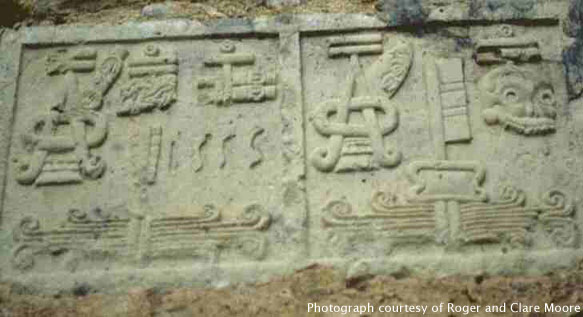
Comment: The top photograph shows the year 1555 marked in standard figures and in glyphs from the Mixtec calendar (Oaxaca, Mexico). … time flies you can’t they fly too fast … This is a conundrum from the General Knowledge Paper in the school leaving exams (1961). Punctuate this sentence: time flies you can’t they fly too fast … Proposed answer: Time flies? You can’t. They fly too fast!”  I seem to believe there were about ten of these on that paper. However, never trust your memory.

The second photograph shows fledgling storks in Avila, Spain, trying to fledge, to fly, to leave their nests. Some will succeed earlier than others. Those who do not manage to fly, who are not brave enough to leave their nests, will sit there. After a while, their parents will not feed them. And then they must fly or starve. Sometimes, time flies. Sometimes, time sits on its hands and the clock hands refuse to move. Think: time enjoying yourself (it just flows by). Think: time in the dentist’s chair with a root canal, time lying prone having an anal biopsy for prostrate cancer, time spent, those everlasting ten minutes, while a cataract is being removed and a new lens is inserted.

Oh yes, time is flexible. Not only is it flexible, it is insistent, inexorable, unstoppable. Those clocks tick on, whether we are awake or asleep. The seconds lull us with their security, the minutes lull us with their monotony, hours lull us with their harmony, days faze us, daze us … hours: each one wounds, the last one kills. Time marches on. We can rewrite the past (revisionism), but we cannot relive it, except in our dreams.

Avila 2007a 150

 Doors close.
We can never go back.

The Journey

IMG_0681 (3)

The Journey

I sense the rust in her mind’s clockwork
clogging her brain, slowing down thought.

I watch her search for words, stumbling through
sentences.  “Wind up the flowers,” she says
handing me the key for the grandfather clock.

When she says “water the clock” I receive
the plastic watering-can meant for the flowers.

Fellow travelers, we journey side by side on life’s
train. I watch her as she looks out of the window
at the passing countryside with its tiny stations.

She frets as she clasps her weak hand in her strong
one and I realize she’s worried because she no longer
knows when, where, or how the journey will end.

Comment: I wrote this originally in memory of my grandmother. However, as I have been involved in the rediscovering / revision / rewriting of older poems, I have come to realize that, as our visions change,  our poems become more accessible to a wider audience. In other words, given what is happening right now with the pandemic, none of us know when, where, or how the journey will end. This leads directly into the twin themes of the fragility of life and the nature of memory. What do we remember? Why do we remember a particular incident? Did it happen just as we remember it or have we already doctored our memories, re-creating them, so to speak.

I have a clear memory of seeing Sir Frank Worral batting at St. Helen’s in Swansea, when I was about 11 years old. A close friend of mine, an outstanding cricketing historian, checked the details in Wisden and told me that Frank Worral wasn’t playing in that match, so I couldn’t have seen him batting. And then there was Sir Everton de Courcy Weekes: I swear a saw him score a century at Bristol, yet, again according to my friend who checked the records, he only got fifty in that game! Games: what mind games the mind plays with us as we age. So, do I go with the fantasy land of my memories in which much has been (re)-invented? Or do I go with the world of truth and checkable reality? As an academic, I lived in the latter world: research, check, double check, avoid expressing personal opinions, facts, facts, facts, and exact dates. As an ageing poet, I would much rather live in that former world where truth and reality march hand in hand with fairy-tale and fiction, a little bit of one and a smattering of both.

How far is from fairy-tale and fiction to the dream world we inhabit at night? Just a short step, I reckon. Sometimes I remember my dreams and write them down when I wake up. Sometimes they vanish and I can only recall some vague feelings of joy and anguish. And what is life, that fragile, dream-like reality? Is it really a dream, as Segismundo tells us in Calderón’s La Vida es Sueño? Or is it a real world? And if it is real, do we create that reality or do we dream it? And if we dream it, do we sleep walk, sleep talk, sweet talk our way through it? Or do we portray it just like it really is, with no creativity, just a factual repeat of reality as we know it?

¿Qué es la vida? Un frenesí.
¿Qué es la vida? Una ilusión,
una sombra, una ficción,
y el mayor bien es pequeño,
porque toda la vida es un sueño,
y los sueños, sueños son.

What is life? A frenzy.
What is life? An illusion,
a shadow, a fiction,
and the greatest good is small,
because life is a dream,
and dreams are nothing
but dreams, after all.