On days like these, the center must hold, but not just hold, it must writhe and strive to live longer, be stronger, to hold together so that the periphery understands that it too is at the center of an extended web of life that contains us all, you and me, past and future generations, in a great chain of being alive and knowing that yes, we are here, we are, at heart, really only one, and totally unique, is spite of the sameness that sometimes surrounds us as time’s spider-web unravels, oh so fast, so slow, and yet still we are here, and still the center holds.
Some days the clouds roll in. Your world turns from gray into fifty shades of black.
These are the days when the sun seems as lost as you. But the sun isn’t lost. It hides behind clouds, maybe, but it’s there.
That’s where the sun storm comes in. Clouds have silver linings and the sun, once seen, will never, ever be forgotten.
Hold its image in your mind. Breathe in the sunshine. Let it flood through your body and shine out through your heart.
Now, you will never be alone, and the sun will walk with you, all your days, and be remembered even in the darkest night when paths disappear and all seems lost.
And this has been a dialog with my time and my place. But what is time? A river flowing? A long line leading from my beginning to my end? Alpha and Omega? An instant held between finger and thumb and so swiftly forgotten? A dream I dream when I am awake or asleep? And which is my real dream, waking or sleeping, sleeping or lying awake?
And what is my place? This house in which I now live? The garden I watch from my kitchen window? My town? This forested area where I think I belong? My county? My province? My region? And how do I relate to my “time” or my “place” to this being called “Roger”, this dream-Roger who dreams this post-amniotic ocean of life in which he now drifts? I dream I am male yet when I read Carl Jung I learn that a large part of me is female. I always thought I was masculine / macho / male, yet when a large part of me is feminine / hembra / female, I am no longer sure what I am. And how much does it matter?
I have ten fingers yet I use only two to type. Two fingers manipulate twenty-six letters, selecting some, rejecting others, making careless mistakes, organizing and reorganizing, shuffling all those verbal cards. I turn this black-and-white keyboard world upside down when I think my subversive thoughts and type them onto the computer screen and then print them out on what starts as a snow-white page that slowly fills with ant-size letters. Time and place, male and female: I lay on my side in hospital and the young urologist shot me full of female hormones so my prostrate cancer would not take over my inner organs and destroy my life. Place and time: I lie awake at night and shape disturbing dreams, dreams I have never before dreamed of dreaming.
Some nights I sense the end is drawing near. I fear it. In my beginning is my end. Beginning and end: both belong to me as do time and space, so central to the story of my life. For life will continue with or without me even if I am not there to bear witness. But I have been here, and parts of my story will remain embedded in the mind of each and every one of those who knew me and heard me speak.
Beethoven took the Fifth and rewrote it in his own image. I want to rewrite my life. I want my youth to return. I want to be young and athletic and lithe … I do not want to be this old man with a stick who bends double when he walks and sticks a blue sticker in the windscreen of his car.
I want to refuse to open the door when the postman knocks to deliver my mail. I know that soon he will bring me that registered letter, for which I must sign, with that last fatal message, the subpoena from which there is no appeal. I guess that like the snow and the wild geese, he’ll be back tomorrow, or the next day, in spite of those voices telling me that tomorrow never comes. And so, on an unusually Odd Sunday in a bar they once called Corked, or at another table in another wine bar with a different name, raise a glass to me when I am gone and leave an empty glass on the table for me. If you do, I promise I’ll be there.
Comments: This, as promised, is the final chapter from On Being Welsh. Chronotopos is Bakhtin’s theory that all our writing is a dialog with our time (chronos) and our place (topos). “Know me, know my time and place.” When we discover and explore our time and place we begin to understand ourselves and our roles in life. Then we can start rethinking who and what we are, what we have been, what we want to be, what we need to do in order to change. But first, we must know ourselves, for without self-knowledge, we are ships adrift, floating rudderless on a rising sea, or driven by the forceful wind of others into places where we may not wish to go. My friends, I raise a glass to you, filled, alas, with orange juice, because it is breakfast time, here in Island View, on the first Sunday, damp and cold and wet of 2022.
Only the winners write the history of their conquests, only the winners. Am I a winner, then? Of course I am. I’m writing this aren’t I? Therefore, ipso facto, I am a winner. This means that although they trashed and thrashed me, they never broke me nor was I a loser. I survived. And in that world in which I lived, surviving without surrendering was a victory in itself. But this is no tale of a hero, of bloody deeds, of a great victory. It is a survivor’s tale. So, if I won, then they lost, and who knows now how the losers felt, history’s non-winners, their slates wiped clean now, their names anonymous, erased from my story, not carved in stone nor impressed into steel. What’s in a name? The Red Wings, the Black Hawks, the Braves, the Algonquins? Whose heart lies broken and buried at Wounded Knee? Why does the Wolastoq rise in the Notre Dame mountains and flow down through unceded land to the City of Fredericton that noble daughter of the woods, and on to the city of Saint John on Fundy Bay? Why Wolastoq, Notre Dame, Fredericton, Saint John? “Sticks and stones will break my bones, yet names will never hurt me.” But what if I am called Nemo and have no other name? No-name man, no-name woman, no-name child, no language to call my own, no culture, no history, except the one that others wrote and forced me to believe or the innocent who causes me to rebel
“Grandpa,” she says, climbing on my knee. “Tell me a story. Please.” “Once upon a time,” I begin. “There was this little girl …” She wriggles and giggles. “What was her name?” “I don’t know.” “Yes, you do.” “Don’t.” “Do.” “Was it me? Am I that little girl?” “You can be if you want.” “I want. How does my story end?” “I don’t know. You’ve only just started it.”
So, write your poems, write your stories, write your childhood, write your memories, write what you know, invent what you don’t know. You can’t remember your name? Give yourself a new one. You have forgotten your myths? Create new ones. You have forgotten your language? Seek and you will find, and when you have found, learn your language again, a word at a time, phrase by phrase, word-picture by word-picture, until you have renewed your world and your place in it. Let your ancestors stride through your veins again and again to stand in the spotlight that you shine upon them. Restriction, extinction, suppression of the weakest and poorest, survival of the fittest … You, you who are reading this, you who have survived, you can count yourself among the strongest and the bravest. Now name yourself for who and what you are. Pick up your pen and write. Lazarus I name you: step out from your living tomb, step out from your kennel-cave. Pick up your bed and walk and talk, and write your own story. And remember the words of Oscar Wilde, “Tell your own tale, and be yourself, my friend, because everyone else is taken.”
I walk past the Jesuit Church where the shoe-shine boys store polish, brushes, and chairs overnight. I walk past the wrought-iron bench where the gay guys sit, caressing, asking the unsuspecting to join them.
Nobody bothers to ask me for a match, for a drink, for charity, for a walk down the alley to a cheap hotel.
The witch doctor is the one who throws the hands of all the clocks into the air at midnight, in despair. He’s the one who leaves this place, and returns to this place, all places being one.
The witch doctor sees little things that other men don’t see. He reaches out and flicks a fly away from my nose. “It too has lost its way,” he sighs.
I think I know who I am, but I often have doubts when I shave, rasping the razor across my chin’s dry husks. The witch doctor, my lookalike, my twin, stares back at me from my bathroom mirror.
Three witches dance on the waning soap dish. One spins the yarn, one measures the cloth, one wields the knife, that will one day sever the thread of I, who the same as all poor creatures, was born only to die.
You too must one day look in that mirror, oh hypocrite lecteur, mon semblable, mon frère.
Comment: My thanks to all those who click on earlier poems and express their liking for them. I am particularly pleased when an earlier poem lacks a voice reading. Then I can revisit it, rethink it, rewrite it, record it, and speak it aloud. Here’s the link to the earlier version of the poem Charles Baudelaire. Fast away the old year passes, and we must renew ourselves, our thoughts, and our poetry for the new year soon to be upon us. To all my readers, old and new, welcome to that world.
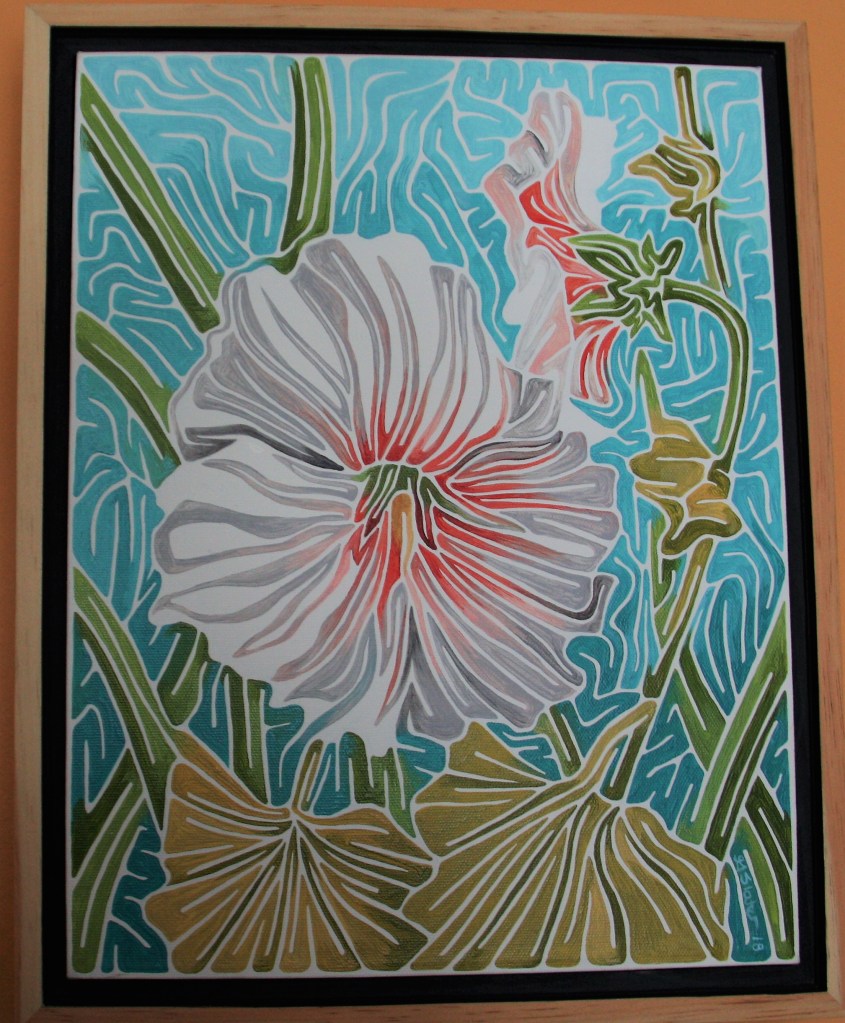
How do you frame this beaver pond, those paths, those woods? How do you know what to leave, what to choose? Where does light begin and darkness end?
Up and down: two dimensions. Easy. But where does depth come from? Or the tactility, the energy, water’s flow, that rush of breathless movement that transcends the painting’s stillness?
So many questions, so few answers. The hollyhock that blooms in my kitchen is not a real hollyhock. Intertextuality, visible and verbal: this is a poem about a painting of a digital photograph of a hollyhock, a genuine flower that once upon a time flourished in my garden.
A still life, naturaleza muerta in Spanish, a nature morte in French, a dead nature, then, portrayed in paint and hung alive, on display, in this coffin’s wooden frame.
Comment: Back home in Wales, Christmas Day was for family and Boxing Day was for friends. I guess the same traditions still exist here in Island View. And what better friend than Geoff Slater? I met him in 2017 at the first KIRA residency and we have been friends ever since. We have worked on so many projects together: painting, creative workshops, videos, sound recordings, poetry, and short stories. He has illustrated several of my books, McAdam Railway Station, Tales from Tara, Scarecrow, and I have put some of his drawings to poetry, Twelve Days of Cat. Last, but by no means least, his painting of a hollyhock from my garden appears on the front cover of my latest poetry book, The Nature of Art and the Art of Nature (Cyberwit, 2021). The title of the collection, incidentally, came from sundry discussions we had on the nature of art and the Prelude: On Reading and Writing Poetry (pp. 7-31), was written at his suggestion. Poems to Geoff can be found on pp. 43, 44, and 61-62 of The Nature of Art.
So, Boxing Day is for friends. And I dedicate it to Geoff Slater and all the many friends I have made in KIRA, Kingsbrae, and throughout my multiple meanderings through the realms of academia, coaching with the NCCP and the NBRU, researching in communities like the ACH, the AATSP, and the MLA, various editorial positions on academic journals like the IFR, BACH, STLHE Green Guides, STLHE Newsletter, La Perinola, AULA, CJSoTL, Canadian Modern Language Review, Calíope, translating for different associations, including the Discalced Carmelite Nuns in St. Joseph’s Convent, Avila, and volunteering with STLHE and the 3M National Teaching Fellowship. To all those friends out there, including my friends and e-friends in TWUC, the LCP, and the WFNB, and those on Facebook, my blog, and my online Skype and Zoom courses and meetings, plus, of course, those I know via Quick Brown Fox, you are not forgotten. Here, for you, on Boxing Day, is a hug or a wave of the hand and a great, big thank you for being there.
Selection of my books on the sea-shore at Holt’s Point.
Who has seen the early spring wind drifting its thought-clouds across the grass, moving shadows over the lawn’s green, thrusting spikes.
Sometimes, I speak my thoughts aloud, hoping that nobody can hear or see them as they leave migratory footsteps across my mind.
Autumn now and I watch the wind twist leaves from the tree. Yellow and red, they flee from me. I do not understand their reluctance to stay, their urge to tear away and leave. The birds must leave for they cannot bear the cold, cannot stay without food.
At night, when I close the garage door, I sing hymns to the trees and to him who always hears. Each note forms like a pea in the pod of my throat and launches itself skywards, migrating upwards, in a feathered flock that celebrates in songs.
Words, migrant birds, their flight unplanned, will not stay still, will neither perch, nor gather, nor feed from the outstretched hand.
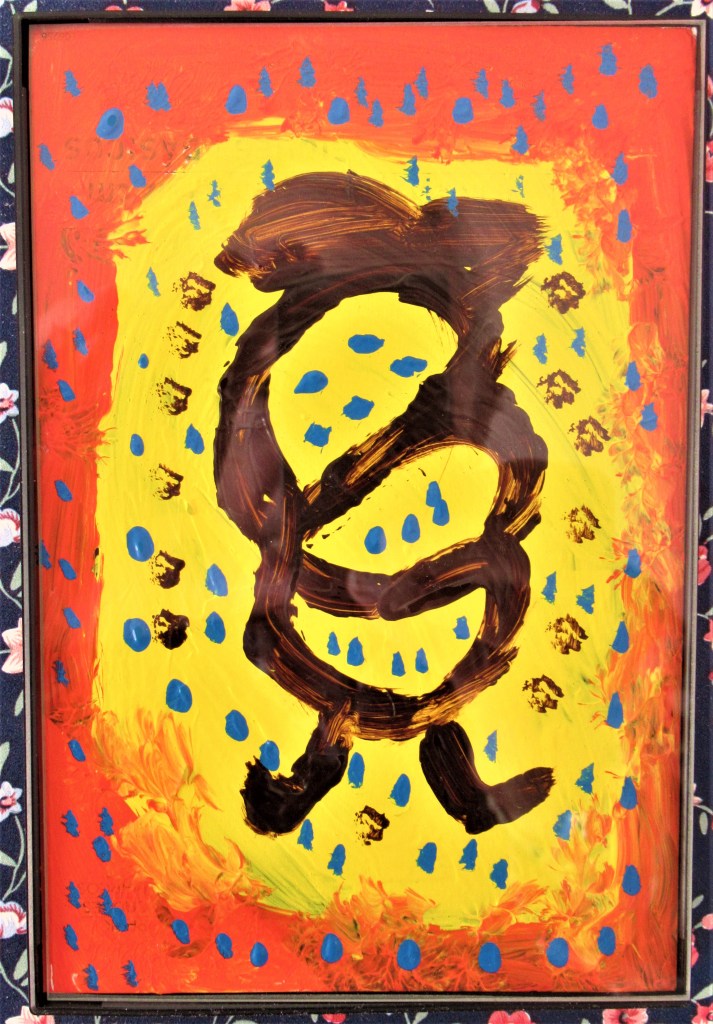
This from the days when I was a wannabe artist who thought he could actually be an artist. But no, it was not to be and the masks fell off and dropped to the ground. There was no Covid back then, so I didn’t have to pick them up and put them back on again. And I didn’t have to stay two metres – six -feet – away from the painting. If you paint with the Devil, you need a long brush. Also known s a Devil’s Paint Brush.
To paint or not to paint, that is the question. So, I chose the path of mindfulness, la escondida senda por donde han ido los pocos sabios que en el mundo han sido / the hidden path along which have walked the few wise men who have lived in the world. And yes, art, in all its forms, is mindfulness, being in yourself, being aware of the moment, being taken up by that split second when paint hits paper, canvas, or whatever, and being absorbed totally in that.
Gardening will do that for you. Also what I call hyperspace, that wonderful world between fingertips, and screen where the great ideas flow naturally, like paint, and words come tumbling out onto the page. Today’s theme: The Great Pretender. Not all the words are wonderful, nor all the ideas great. The greatest skill is to be able to differentiate between gems and dross. This comes with patience and practice. But when the words flow, and the paint settles, there are few joys like it.
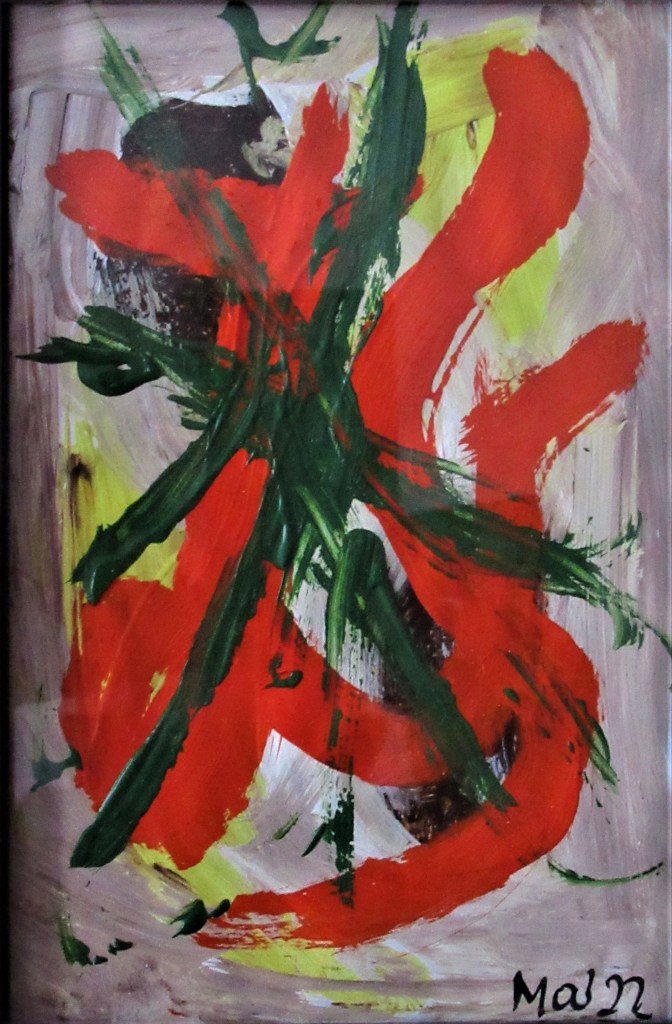
One of my first cartoons. It always reminded me of Jerry Lee Lewis: “Goodness, gracious, great balls of fire.” What fun it was to paint and what a joy to rediscover it. I guess that’s the name of the game for a little while: rediscovery. Dig down into the dirt and the memoirs and the flashbacks and reproduce what’s in there. It reminds me too of the conjunction of Mars and Venus, a couple of years back. I would look out of the window, to the southern sky, and there they were, drawing closer together until, suddenly, one night, there they were. “Goodness, gracious, great balls of fire.”
I have never been able to draw or paint with any skill. Then, one day, I read Matisse and his commentaries on his own work: “Making meaning out of colour and shape.” So, there you are. I don’t know what it means, but, as Salvador Dali said “I don’t know what it means, but I know it means something.” And the moment means something: staying in the moment of creativity creates great joy. That joy, the joy in joie de vivre, is there to be rediscovered. So: share the joy. Laugh at the innocence. And, following Picasso, “paint the world as a child might see it.”
So, the writing is back. I have reformatted The Nature of Art and the Art of Nature and am now checking it through one last time before I send it to the publishers. This feels good. I haven’t stopped painting though. Luckily the original, hanging on the wall, looks better than the photo. My angles are all wrong and the colours are definitely not as sharp as in the original. As I always said, when introducing Spanish Art via slides and photos: “Do not trust the imitations. Go back to the original.” Easier said than done, especially when the original may be tucked away in a foreign museum hidden in a small town. As Dylan Thomas once said of Swansea Museum: “it’s the sort of museum that ought to be in a museum.”
As for the Introduction of Art, and please note I do not write ‘the teaching of art’, here’s my article on my career as an art facilitator! ‘In the beginning was the picture and the picture was in the book.’ I guess my art career ran parallel to my career as a facilitator of Spanish literature, prose, theatre, and poetry. Some things you can present and introduce. But no, you cannot teach them, not unless you are completely without humility and understanding.




 rogermoorepoet