Clepsydra 25 & 26

25

… how will it all end
     does it not need closure
          something to bring
               the water-wheel full circle
                    a golden key to open
                         what

the museum’s door
     memory’s door
          the archives where
               so many memories lie
                    gathering dust

though some may tell the truth
     whatever that is

or does the story go on and on
     never pausing
          never ending
               wrinkle after wrinkle
                    threaded through time
                         after time
                              the candle
                                    burning

the clepsydra
     dripping all life away
          the pendulum
               swaying
                    back and forth …

26

… Westminster Chimes
     chiming the quarters
          church bells
               ringing out a warning

the hills alive
     alight
          with burning beacons

what new armadas
     sailing now off our coast
          what fireflies flicker
               their thunderous roar
                    frightening birds in trees
                         driving deer
                              into the woods

how many people
     cast forth like bread
          upon the waters
               to return ten-fold

hark to the bells
     ringing out again
          St. Clement’s
               St. Martin’s
                    the Old Bailey
hark to the children singing
     dancing in a circle
          never-ending
               until the music ends

and the last child
     is caught by
          the lowering arms
               trapped
                    a fish flapping
                         in the osprey’s grasp …

Commentary:

I wonder how many people still sing the children’s song about the bells of London? Images from it – intertextuality – occur throughout Clepsydra.

“Oranges and lemons,”
ring the bells of St. Clement’s.

“You owe me five farthings,”
say the bells of St. Martin’s.

“When will you pay me,”
ask the bells of Old Bailey.

“When I grow rich,”
sing the bells of Shoreditch.

“And when will that be,”
sing the silver bells of Battersea.

“I do not know,”
booms the great bell at Bow.

“Here comes a candle
to light you to bed.
And here comes a chopper
to chop off your head.”

The song appeared at children’s parties. Two of them joined hands, held their hands high, like London’s Tower Bridge, and the children, in a long chain passed beneath the ‘bridge’ as the song was sung. At the end, the children speeded up and they tried to avoid the last verse when the bridge’s arms descended and two children were caught. These then had to replace the original two gate-keepers and the game started again. At least, that was how I remember it being played.

It is worth remembering how violent in their imagery children’s songs can be. The games seem sweet, but they often have dark undertones, some going back to the Black Death – “Ring a ring a rosies, a pocket full of posies, atishoo, atishoo, we all fall down.” If you don’t know what that all signifies, go down the rabbit hole with Alice and the white rabbit and look it all up! And find out what a farthing is, and a penny farthing – go on – I double-dog dare you!

And remember – poetry carries its own meaning – or multiple meanings – and they are not always easy to find. Dig, my friends, dig. There’s gold in them there hills.

Silence

Silence

Pain stops at the edge of silence
and silence is the sound of sunlight
breaking against the walls of the room
in which I sit and listen, in silence,
waiting for the notes to begin again.

Silence, yes, yet my silence lies broken
by the renewed intrusion of the clock,
by the electric hum from lights and heating.

Ghostly noises break into my thoughts:
cheers from a distant tennis court,
those eternal advertisements
that invade my innermost being.

What triviality now shatters
the Messiaenic mood that wrapped me
for a moment in a many-colored cloak
woven from musical oblivion.

Time’s teeth start to gnaw again
and the grandfather clock
nibbles at my soul, extracting
its essence in a surge of sound,
tick-tock, tick-tock.

Westminster Chimes choke
life from the hour and ring
the tick-tock knell that files
my life away, second by second,
minute by minute, day by day.

Comment:

Silence is the fifth poem in the first sequence (Crystal Liturgy) of my poetry book Septets for the End of Time.

“So,” said Moo, “today I offer this painting where the title, Sound of Silence, fits well with the title of your poem. That said, I am not sure that the painting itself, qua painting, is as suitable as earlier pairings. De gustibus non est disputandum / there is no arguing about taste. I guess you either like something or you don’t.”

“It certainly isn’t in your usual style. In fact, it looks more like a colored pencil sketch than a painting. Where did you draw the title from?”

“Actually, it’s from one of your poems about Avila, in Spain, the city where, or so they say, you can hear the silence. You complained about all the noise that you found, especially the church bells, in that otherwise silent city.”

“Ah yes. I remember that poem. And I’ll never forget the sound of the bells echoing from wall to wall in those narrow, medieval streets. Bells from all the churches inside the walls of the city, tolling at exactly the same time, calling the faithful to prayer.”

“And that is one of the differences between us that I mentioned yesterday. My paintings, whatever they depict, are always silent. I have heard you read your poems out loud on Spotify and I have also heard other people reading them on your behalf, not always successfully. Poetry is designed not only to be read silently, but also to be read out loud, before an audience. Painting, on the other hand, is always silent. It does not speak, nor can it be heard. A painting is just there, in two dimensions, powerful, if you are lucky, weak and wobbly if the artist does not fulfill his task.”

“Interesting, dear Moo. And the images that I draw from Messiaen’s music are interesting too. For musical notes, without words, change into images within the listener’s mind, and then, when heard by the poet in me, become verbal images upon the page. Fascinating.”

“It is. Some time soo we must talk about intertextuality, the ways in which one artistic form or text can influence another. Hopefully, you’ll find a poem and I’ll find a painting that illustrate just that.”

30 things that make me happy!

Daily writing prompt
List 30 things that make you happy.

List 30 things that make you happy.

The first thirty dots I add to a dotty painting. As we all know, pointillisme drives one dotty. So, start counting each little dotty – when you get to thirty you can stoppy – and you’ll be as happy as a poppy. I do hope poppies are happy. I know poo-pees are. They wag their tales when they are hippy, happy, hoppy.

Oh yes, counting the ten toes on my feet when I have a double-trouble bubble bath. Then counting the ten toes on my grandson’s feet – that makes twenty. Then counting the toes on my other grandson’s feet. That makes thirty. Bubble, bubble, toil and trouble, hard to see those toes when the bubble baths bubble. Pinch each bubble, make them pop. When you get to thirty you can stop. Okay, okay, I hear you laugh – and that’s the joy of a bubble bath.

One Small Corner

One Small Corner

 And this is the good thing,
to find your one small corner
and to have your one small candle,
then to light it, and leave it burning
its sharp bright hole in the night.

 Around you, the walls you constructed;
inside, the reduced space, the secret garden,
the Holy of Holies where roses grow
and no cold wind disturbs you.

 “Is it over here?” you ask: “Or over here?”
If you do not know, I cannot tell you.

But I will say this: turning a corner one day
you will suddenly know
that you have found a perfection
that you will seek again, in vain,
for the rest of your life.

Comment: This is the title poem of the book One Small Corner – A Kingsbrae Chronicle, written at the first Kingsbrae International Residences for Artists (July, 2017), and published on Amazon – Kindle that same year. This is the video that accompanies the poem. https://www.kingsbraeartscentre.com/ – turn up your sound. My thanks to all those involved in that first residency and especially to Mrs. Lucinda Flemer, Geoff Slater, and my fellow resident artists, Ruby Allan, Carlos Carty, Elise Muller, and Ann Wright. One Small Corner, along with some other publications, can be found by clicking here. Special thanks for the making of the video itself go out to Geoff Slater, Jeff Lively, and Cameron Lively.

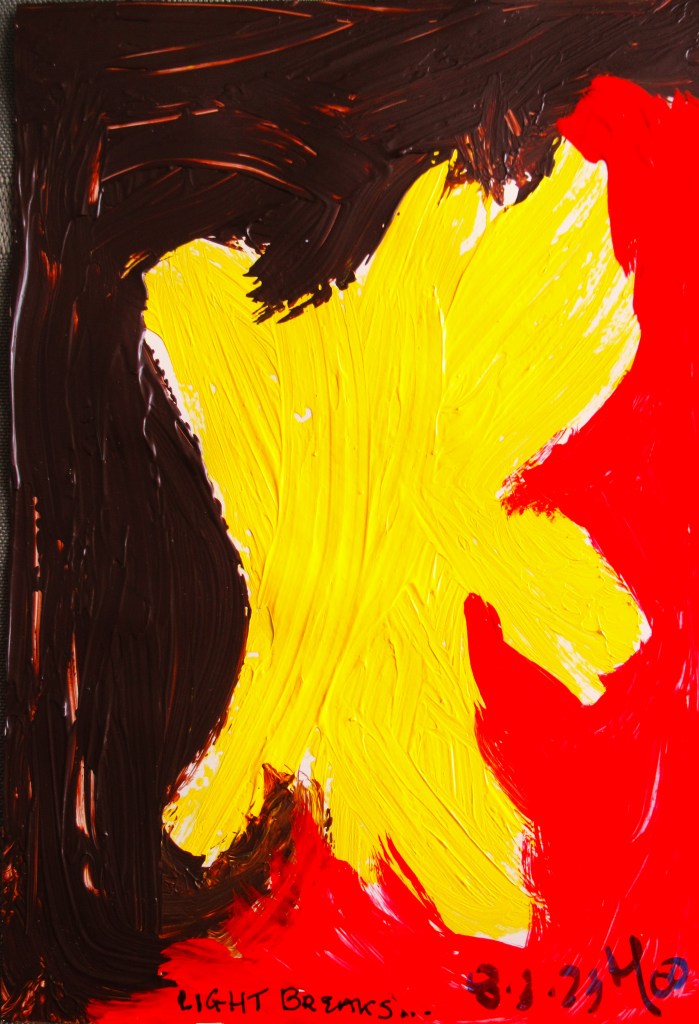
Light Breaks

Bandits

Two shadows,
at three in the morning,
their faces masked,
shifty in the moonlight,
slip soundless over snow,
as they move towards
the bird feeders.

They huddle together,
forming a darker patch.
I watch the feeders move,
but cannot see the seed
nor hear it as it falls.

The feeders empty,
they move again
towards the back porch,
climb the steps,
and settle once more.

I know that by morning,
all traces of seed will be gone,
devoured by Dyson and Hoover,
scavengers and professional
seed removers.

Comment: Light Breaks

“Light breaks where no sun shines…” but sometimes it takes a long time to happen. The name of my blog is rogermoorepoet and it’s main function is to showcase my poetry, above all, to my friends and followers. In my efforts to publish in print form, I have neglected to pay attention to the main function of this blog – poetry. Why? Because when I submit poems I always find the phrase – ‘must be unpublished – including on social media’! So I stopped publishing poetry on my poetry blog and on other social media. Okay, okay. I know. I am an idiot. BUT – light has now broken where no sun shone – Dylan Thomas, of course, another Swansea Boy, and as of today poetry is back. A big thank you to any and all who have been waiting for its return. Give me some encouragement – let me know if you like what I am doing – paintings and poetry!

Click here for Roger’s reading.

On Being Welsh – Dydd Dewi Sant

On Being WelshDydd Dewi Sant

On being Welsh
in a land ruled by the English

 I am the all-seeing eyes at the tip of Worm’s Head.
I am the teeth of the rocks at Rhossili.

I am the blackness in Pwll Ddu pool
when the sea-swells suck the stranger
in and out, sanding his bones.

Song pulled taut from a dark Welsh lung,
I am the memories of Silure and beast
mingled in a Gower Cave.

Tamer of aurox, hunter of deer, caretaker of coracle,
fisher of salmon on the Abertawe tide,
I am the weaver of rhinoceros wool.

I am the minority, persecuted for my faith,
for my language, for my sex,
for the coal-dark of my thoughts.

I am the bard whose harp, strung like a bow,
will sing your death with music of arrows
from the wet Welsh woods.

I am the barb that sticks in your throat
from the dark worded ambush of my song.

On Being Welsh – short stories – Amazon and Cyberwit

On Being Welsh – poems included in my selected poems (1979-2009)

Cherry always listened to my readings

Click here to here Roger’s reading on Anchor
– On Being Welsh

The Dying of the Light

The Dying of the Light
Rage, Rage

Sometimes you wake up in the morning
and you realize that you can do no more.
What is it about family split-ups, the ugliness
of a disputed divorce, the glue coming
unstuck in an already unstable marriage,
a financial settlement that satisfies nobody
and impoverishes both sides of a divide?

And how do you bridge that divide
when you are friends with father, mother, children
and the wounds are so deep that everyone wants out,
whatever the costs and whatever it takes?
And what is it about the deliberate wounding
of each by the others, leaving permanent scars
that will never heal over, no matter how hard one tries?

And what is it about lawyers, when too many guests
gather around the Thanksgiving turkey and knives
are out for everyone to take the choicest cuts
leaving nothing but a skeletal carcass,
no flesh on the bones, and the guests all hungry
and their empty bellies rumbling for more, more, more.

My thanks to Brian Henry for publishing this on Quick Brown Fox.

Click here for Roger’s reading on Anchor.
Rage, rage against the dying of the light

Fake News

 Fake News

Sometimes at night I hear deer walking across the lawn outside my bedroom window. Intruders in the garden, they rattle the feeders then walk darkly into the woods. Sometimes a coyote howls at the fingernail moon and my heart pumps sudden blood, rapid, through my veins.

            Below me, in the hall, the grandfather clock ticks the night away. I stitch myself up in my dreams, count the black sheep in the family, and iron old ghosts upon the ironing board until they are as flat as the white shirts we wore in boarding school on Sundays.

            If I close my eyes, they rise up before me, those Sunday shirts, flapping their arms, and mouthing their apologies for the sorry life they made me lead. No, I didn’t need to spend those days praying on my knees before the stations of the cross. Nor did I need to ask forgiveness for all the transgressions pulled from me, like teeth, in the Friday confessional.

            Marooned in a catholic cul-de-sac, I walked round and around in rigid circles. An academic puppet, I was trapped in the squared circle of an endless syllogism. Who locked me into this labyrinth of shifting rooms where sticky cobwebs bound windows, doors, and lips? Why did the razor blade whisper a love song to the scars crisscrossing my treacherous wrist? Who sealed my lips and swore me to secrecy?

            A tramp with a three-legged dog, I slept beneath a pier at midnight and woke to the sound of the waves rolling up the summer beach. Once, I stole a deckchair, placed it at the edge of the sea, and told the tide to cease its climbing. The moon winked a knowing eye and the waves continued to rise. Toes and ankles grew wet with wonderment and I shivered at the thought of that rising tide that would sweep me away to what unknown end?

            Last night I wrapped myself in a coward’s coat of many-colored dreams. My senses deceived me and I fell asleep in a sticky web spider-spun by that self-same moon that hid among the clouds and showed her face from time to time. My fragile fingers failed to unravel all those knots and lashings and I was a child again walking the balance beam that led from knowledge to doubt.

            A thin line divides the shark from the whale and who knows what swims beneath the keel when the night is dark and the coracle slides sightless across the sea? I gather the loose ends of my life, weave them into a subtle thread, and make myself a life-line that will bind my bones and lash my soul to my body’s fragile craft.

Click here for Roger’s reading on Anchor.
Fake News


Teeth WFNB 5 March 2022

Teeth WFNB
5 March 2022
This is the story I was reading last night when Island View suffered its brief power outage and I was cut off from the WFNB Zoom reading. My apologies for the break in communications. First the text and then the live reading.

Lunchtime.
            I open a can of tom8to soup and heat it on the stove. I slice the remains of yesterday’s loaf of bread into one-inch cubes and fry them in olive oil and garlic. Tom8to soup with croutons. Then I put two slices of bread in the toaster. My father will only eat toast soaked in butter and layered with Marmite when he eats tomahto soup.
            “Lunch is ready,” I call out.
            The black American Cocker Spaniel, bought by my mother in a moment of madness, by telephone, unseen, camps in the kitchen. It nests at the far end of the table, by the stove, and defends its territory with warning growls and a snapping of yellowed teeth. I do my best to avoid the dog.
            “Dad, your lunch is ready,” I call out, a little bit louder. Dog, as my father calls it, growls and clatters its teeth. It has hidden a treasure in the folds of its old, gray comfort blanket, and guards it with the fierce, loving worry of a dragon protecting its golden hoard.
            My father enters the kitchen just as I place the soup on the table.
            “I’m not ready to eat,” my father growls. Put it back in the pot.”
            “What’s wrong, dad? I thought you were hungry.”
            “My teeth,” my father mumbles through a mouthful of pink gums. “I can’t find my teeth.”
            “Where on earth did you put them?”
            “I don’t know. If I knew where I’d put them, I wouldn’t have lost them.”
            My father circulates round the kitchen opening drawers, lifting saucepan lids, and shaking empty yogurt pots to see if they’ll offer up the rattling sound of lost teeth.
            “I can’t find them anywhere. I can’t eat lunch without my teeth.”
            “But it’s only soup, dad, tom8to soup.”
            “I don’t like tom8to soup. Your mother always made tomahto soup. Why can’t you be more like your mother?”
            “Sorry, dad. I’ll call it tomahto soup, if that will make you feel better. But it’s still made out of tom8toes.”
            “Don’t be so sarcastic. Help me find my teeth,” my father stomps towards the stove and Dog growls fiercely from its blanket as it guards its treasure.
            “Take that, you dirty dog,” my father pokes Dog in the ribs with his stick and Dog howls and spits out what it is chewing.
            “There they are,” my father’s voice trembles with excitement. He bends down, picks up his teeth, still hairy from the blanket and bubbly from Dog’s saliva, and pops them into his mouth. “That’s better,” he says, sitting down at the table. “Now I can enjoy my lunch.”

Click on this link for a ‘live’ reading of the story,
complete with Welsh accent.

Last Year’s Snow

Last Year’s Snow
Mais ou sont les neiges d’antan?
Villon.

Meditations on Messiaen
Inner Migrants

4

Last Year’s Snow

Last year’s snow: where did it go? The snow-blower
blew it around while my daughter made snow angels,
but that snow melted, so long ago. We made a snowman.

I remember rolling snowballs around the yard. They grew
so big we could hardly lift them, one large lump onto
another, and then we planted stick-arms, a hat, a nose.

Our dog visited him. Sniffed. Drilled yellow holes into his feet.
Crows sat on his arms, cawed and cawed, totally unafraid,
no scarecrow this, this fake man made entirely of snow.

The crows saw worse in the roadside snowbanks. Dead deer,
snow plowed into the banks and abandoned at roadside,
their bodies waiting for spring sun to resurrect them.

Our annual question: where did the snowman go?
And its sequels: last year’s snow, the birds that nested
in last year’s nests, what happened? Where did they go?

I have searched near and far, but I haven’t found them,
not a trace, not a song, not a feather floating down.
Where did they go?

No hay pajaros en los nidos de antano.
Miguel de Cervantes.

Click on this link for Roger’s reading.
Last Year’s Snow.

Click on this link for Georges Brassens
Ballade de temps du temps jadis