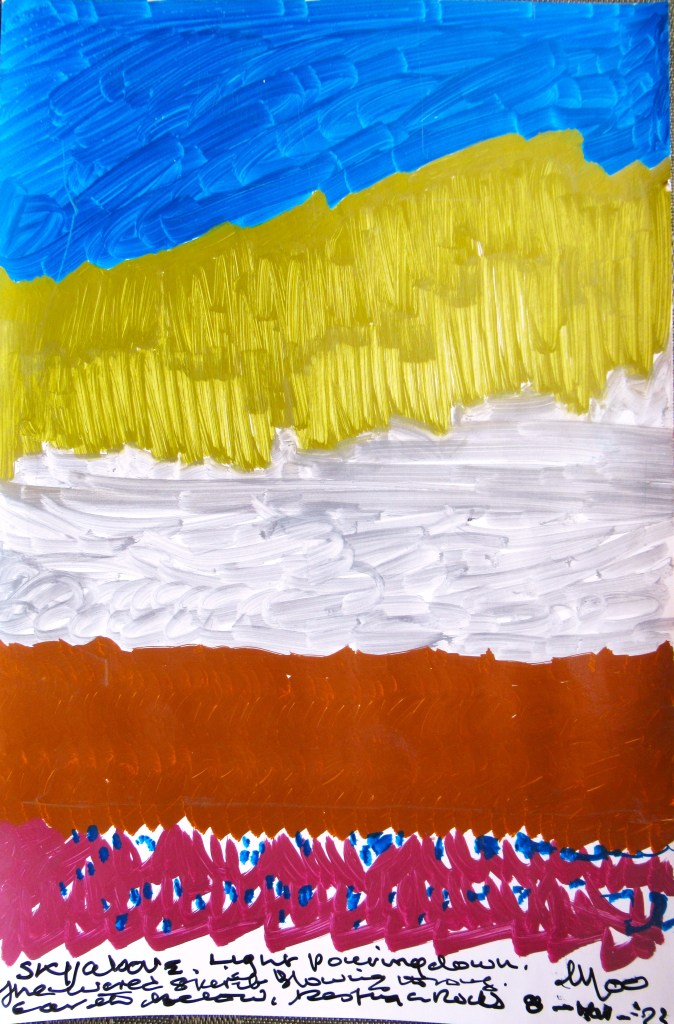
Grand Manan

Grand Manan

Cruel, the baited fish-hook, the bait
swallowed by an eager gull,
then reeled in by the young boy,
hauling him down, hooked from the sky.

Such things bewilder me. Words
control me, I don’t control the words
that appear in my mind. I cannot bait them,
nor hook them, nor reel them in.

Seagulls come and go, floating on the wind,
hovering, soaring, descending, poised
to snatch any morsel held before them.

The blue sky, so beautiful. The azure sea
a mirror image of the universe above.
White caps, floating, drifting, poised
for a moment, then crashing down.

The lonely sea and the sky. And me
a tourist, marveling at a wonderland
so far from my inland Island View home,
by a river, over which no seagulls fly.

Bird

Bird

The bird came to me
   on the wings of Hurricane Lee.

Carried along by stronger wings
   he perched in my tree.

A new species, he was unknown to me.
   Our own power lost, the usual ways
               of searching were denied me.

He moved from the tree
   to the window feeder and gazed at me,
               eye to eye, as the hurricane’s eye
                           passed overhead.

Free. To come and go at his will,
   but there is little free will
               when the hurricane blows.

A sudden, strong gust
   whisked him away.

Unknown, and a stranger still,
   he soon was lost to me.

Comment:

All my good will and new resolutions went down the proverbial plughole when Hurricane Lee swept in, washed away one of the roads near to me, and left us without power for 52 hours. We lit candles, as much for warmth as for light, and, when dark descended outside, gathered in their flickering glow. The time has come, the Walrus said, to indulge in simpler things. Water saved in the bath upstairs and in an assortment of pots, pans, and buckets, served for the washing of hands, the flushing of toilets, washing the dishes. Food was served cold – but we indulged ourselves with perishables that needed to be finished quickly. The morning face wash and shave, in cold water, no shower, was a throwback to old times. The experience brought us closer together. Neighbors with generators dropped round with hot food and drinks, and all went well. After two days of picnics, we got a bit bored. I managed to write lots of poems though. The creativity of that experience will live on in words.

What does your ideal home look like?

Daily writing prompt
What does your ideal home look like?

What does your ideal home look like?

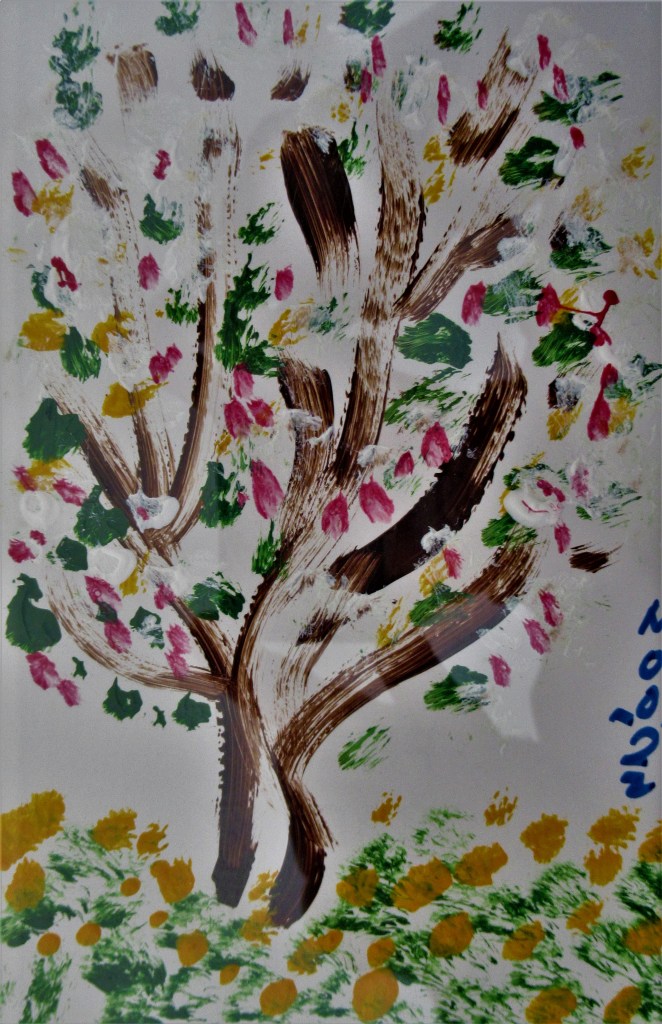
My ideal home looks exactly like the one I am living in right now. In the country, surrounded by trees, with blossoming crab apples in the front garden and a mountain ash in full view from the kitchen window, what more could I ask for? Blossoms in the spring, a gradual flowering throughout the summer, and now, as fall approaches, the fruit ripening.

Verde, que te quiero verde. – Green, for I love you green. But what exactly is green? I sit on the front porch in the cool of summer, and look out on a sea of greens – green grass, green leaves, light green, medium green, dark green, and all kinds of shades and hues as the sunlight filters a subtle dance of colors through the leaves. The eye distinguishes so many different shades of green. Alas, I do not have the vocabulary to distinguish verbally what I see visually. Ah, poor poet, linguistically damaged, and writing with one hand tied behind my back, I suffer from an ability to feel and an inability to express. Terminological inexactitudes, Winston Churchill called them. But in my case, they are the lies I must create when the truth overwhelms me with its beauty.

And in winter, when the cold winds blow, and the leaves lose the safety of their trees to be blown hither and thither at the wind’s will, what then? A blanket of whiteness, shadows shifting beneath the moon by night, and a million brilliant sparkles beneath the sun by day. And the visitors, every night the deer come, stay awhile, then vanish, only to reappear the next day. At midnight, in the moonlight, I watch them from my window as they dance on their hind legs and nibble the hanging fruit that the mountain ash reserves, just for them, so that they will survive, as they have done for millennia, in this paradise that surrounds my ideal home.

Modern Society

Daily writing prompt
What would you change about modern society?

What would you change about modern society?

Good question – what indeed? First, define society. It’s not as if a single society dominated the world. Do we then distinguish between the world, this geoidal planet on which we live, and the multiple societies that inhabit this world? If we do, then what right do you, or I, or any other individual have to change any or all of the world’s cultures and societies? And how do we change them?

Many ways have been tried in the past, very few successfully. The Spanish Inquisition burned many books and censored others. Other book burnings and spurnings have taken place, and in some places, they are still happening. But are they effective in the long term? Good question. Short term, maybe. Long term, I am not so sure.

Do we limit education, and by extension, knowledge, to a few , limited people, who believe what we believe, and do what we want them to do? That has been tried as well. Short-term successes, but long term disasters. As well as depriving people of education and books, we can also enslave them. This is still happening in many places.

So, another definition: what do we mean by change? Change for the better? Change for the worse? Change for change’s sake? Change for the betterment of our own selves and the devil take the hindmost? And what do we mean by modern? So many questions – so few answers.

Albert Camus once wrote that he was ‘optimiste, quant au monde, pessimiste quant a l’homme‘ – an optimist where the world is concerned, a pessimist where humankind is concerned. Personally, I am not sure that this particular thought stands up any longer. Is it still possible to be optimistic about a planet that we are capable of blowing to smithereens, a planet, moreover, that is currently suffering from wind and rain, fire and flood, famine and war, pandemic and a pollution like none we have ever seen before?

How can I change the world? I am just a single human being. Well, I am a married one, actually. But I only have one vote. I rather fear that single vote (votes don’t marry and produce offspring) will have little effect on my ability to make any change at all to modern society.

Pass the soap and a towel, please, as a certain person said a long time ago. I want to cleanse my hands and purge my soul. I am too old a dog to try and learn new tricks.
Hanwell

Hanwell

Here, in Hanwell Woods,
a seemingly abandoned chapel,
paint peeling, and two stark crosses
marked on barred doors.

The new copper spire gleams
as sunlight casts leaf shadows,
sending them dancing under trees.

Neither sight nor sound of bells
this sunny afternoon,
just the mosquitoes’ whine,
the black flies’ zip and buzz.

Across intervals of silence,
a far-off chain saw rips wood.
Trees and branches topple then fall.
Trails set free from winter’s debris.

The wind herds clouds instead of sheep.
Giant footprints drift shallow
across the shadowed land.

A Darker Mist

A Darker Mist

Sometimes a dark mist marches over
the sea-salt marsh flats and, a sea-bird
come to land, nests in my heart. This lone
bird brings others and soon a colony sings
its chorus in time with the incoming tide
that threatens to overwhelm me.

My body’s weak clay responds to this
darkness and slips into the chaotic
cacophony of multiple voices
raised to shut me off from the light.

My soul, a seagull seeking the sun,
rises upwards, ever upwards,
in search of the sunshine, that silver
lining that redeems every cloud, belying
the darkness of this gathering gloom.

“You will find sorrow moving through you, like a dark mist over landscape.” John O’Donohue, Anam Cara, p. 94.

Poems for the End of Time

Poems for the End of Time

Here it is, and it is up and waiting for you! I already have my first copy. More on the way. The same artist who did the cover for People of the Mist did this one as well. He’s such a nice person – doesn’t charge me a penny.

Introduction

         Poems for the End of Time is composed of two linked collections, Meditations on Messiaen and Lamentations for Holy Week. They both have separate introductions in the body of the text.

         My graduate work at the University of Toronto (MA, 1967, and PhD, 1975) included studies on Golden Age / Early Modern Spanish Poetry (16th -17th Centuries). It enabled me to read and enjoy both the Renaissance and the Baroque poetry of Spain. My own interests lay within nature poetry, as expressed by the Spanish Mystics (St. John of the Cross and St. Teresa of Avila), the Neo-Platonic Poets (in particular, Fray Luis de León), and the Metaphysical poets (Luis de Góngora and Francisco de Quevedo). Echoes of their writings and thoughts are frequent within these two poetic sequences.

         I will write further on both sequences later in the book. Briefly, both sets of poems were written while listening to the music of Olivier Messiaen. Three of his compositions, Quatuor pour la fin du temps / Quartet for the End of Time, Éclairs sur l’au-delà / Lightning over the Beyond, and Petites esquisses d’oiseaux / Little Sketches of Birds, influenced me enormously. I listened to them every day while I was writing and revising these poems.

         These poems are not for the simple-minded. They form a contrasting tapestry of point and counter-point, filled with allusions, word-plays, internal rhymes, repetitions, and alliterations. They have a music all of their own.

Do not expect simplistic escapism. If you are serious in your efforts to read, listen to the magic of Messiaen as you turn the pages, much as I did while I was writing.

Movement

Movement

Not just the ups and downs, but the small things,
moving, that catch your eye – that butterfly
on the bees’ balm, wings folding, unfolding –
that deer at the wood’s edge, invisible when still,
then suddenly surging into empty space, tail raised,
up and away – that crow, blending into tree black,
then one quick flap, and launched into clear air –
that falcon, perched on the pole, frozen at first,
then taking a step forward, wings folded, dropping,
like a stone then a fast strike on an unsuspecting
robin – silence , pierced by the robin’s shrill shriek,
then silence and peace returned after violence.

Slow movement – the autumn leaves turning color,
a day at a time, almost invisible the change, until one day,
an autumn leaf becomes a whole forest, blushing into
its autumn finery – even slower, the fall’s stealthy approach,
and then, one day, the blue skies turn grey, rain falls,
the wind rises up, and the leaves go tumbling, here, there,
playing strip-jack-naked with limbs and branches.

Looking at my inner world, I feel, but do not see,
winter drawing near – its frosty footprints grip my bones,
snow and frost lie white upon my head, blood flows
thin and slow, seeps life and warmth away, day by day,
inexorable, yes, but also invisible, their still, small steps.

Click here for Roger’s reading.

Alien Nation

Alien Nation

I used to love the trees, the way
they stood there, patiently,
through all four seasons,
bending to the will
of weather and wind.

I planted many of them,
cultivated them,
watched them flourish,
treated them as siblings,
stood beneath their branches,
my back against a trunk,
their life force flowing
through me, renewing me,
as leaf-filtered sunlight
freckled hands and face
and danced in my heart.

Now, I fear them.
People have treated them
so badly, polluting water and air.
I fear their darkness,
their slow-burning anger,
their dryness, the ways
in which they gather,
shutting out the sunlight,
whispering dark secrets,
plotting to destroy us.

I fear the fire they have stored
in root and branch, a fire
that may one day come
to burn us out and leave
the land for their offspring.

Click here for Roger’s reading.

Sound of Silence

Sound of Silence
Cara Anam, p. xv

Where do the deer go
when they leave their tracks
behind them and pass out of our sight?

We lose them when, like school children,
they scale the snow bank,
stop at the roadside, and look left,
right, and left again, then walk sedately,
one by one, across the road, and blend
into the dark woods opposite our house.

Too many friends have walked a similar way,
crossed the great divide, and lost themselves
in the unknown that lies there, out of sight.

All too soon, we will be faced by that same
decision, whether or not to cross.
Our paths already tell us where we’ll go,
but the hands of our body clocks don’t yet
point to how, or when.

Click here to listen to Roger’s reading.