Monkey Meets Pontius Parrot

Monkey Meets Pontius Parrot
(With glorious  memories of Macarronic Latin)

Pontius Parrot is very clever
and very pontifical.
“Pretty Polly!”
He pontificates from his pulpit.

His name isn’t Polly
and he doesn’t have a pulpit
but he parrots words
in Macaronic Latin:
“Caesar adsum jam forte.”

Pontius Parrot is perky at the podium
and bounces up and down,
preening himself self-consciously,
rattling his chains,
shaking his bars,  and speaking Latin:
“Brutus aderat.”

He is marked with shame and scandal.
A dysfunctional family of feathered friends
 has henpecked him until he is black and blue
and he has thrown up copiously:
 “Caesar sic in omnibus.”

He dips his wings in holy water,
calls for some soft soap, 
and washes his feathers and claws.

Poor Pontius Parrot,
he can only say “Repent!”
“Brutus sic in at.”

Commentary:

I asked Moo if he had ever painted a parrot, but he told me that he hadn’t. However, one of his favorite viewers, had once called this painting a pile of spaghetti wriggling in tomato sauce and he thought that spaghetti was close enough to macaroni for it to serve as a painting for Bony Macaroni Latin.

I had to explain to him what we mean when we say Macaronic Latin. Back to that boarding school and we used to invent all sorts of Macaronic Latin phrases. They used to cane us with bamboo canes. So here’s the verb paradigm in Latin for ‘to cane a student’. Bendo – whackere- ouchi – sorebum. Of course, it helps if you know what Latin verb paradigms look like. They are easy to remember and are aide memoires for the four main parts of the verb. Bendo – I bend over – first person singular, present tense – whackere – to whack or cane – infinitive – ouchi – I said ‘ouch’ – past tense – sorbum – the inevitable result – past participle.

Now, if we look at the italics in the poem we see a poem within a poem, and that smaller poem is written in Macaronic Latin.

“Caesar adsum jam forte.
Brutus aderat.
 Caesar sic in omnibus.
Brutus sic in at.

Translation

Caesar had some jam for tea.
Brutus had a rat.
Caesar sick in omnibus.
Brutus sick in hat.

Oh never underestimate the ingenuity – linguistic and / or otherwise (and we won’t go into that one right now) – of the bored-to-tears Public Schoolboy. Especially if he is not destined to be a Perfect Prefect like Perfect Prefect Plod – who was never any good at Latin, if I remember well. Neither was I come to think of it. Horrible language, dead and reeks like the dead rat that Brutus ate.

As for the ‘repent’, well, usually, just before he beat you, the master doing the beating would enquire as to your health and ask you if you repented of your sins, crimes, bad language, being cheeky to Perfect Prefect Plod, or whatever else you had done (like smoking or holding a girl’s hand in public instead of a boy’s). You always said ‘yes, of course I do, sir,’ in the vain hope of avoiding a beating. But, bad luck, the cane descended anyway, ouchi was heard, and the victim retired to the bath room to examine his past participle, also known as his sorbum.

I bet you never imagined any of that. Wow! What a great lesson I have taught you today. Think about it all and think about it carefully. Now you know why Pink Floyd sang “We don’t need no education.” But what an education it was. And remember, the Duke of Wellington, Old Nosey, once said ‘my battles were won on the playing fields of the pubic schools of England.’ Oh dear – I hope I got that right. I fear there’s a letter missing somewhere.

Monkey Visitsthe Chimpanzees’ Tea Party

Monkey Visits
the Chimpanzees’ Tea Party

Dressed to the nines in their gala outfits,
they have come here for the tea party.
Hairy penguins, they waddle back
and forth across the temple,
then lunge for a table with its jumbo shrimp,
smoked salmon, scallops, baked oysters.

Faces slashed from ear to ear
by enormous grins,
“Food’s free!” they say
and stuff themselves
regardless of the consequences.

Serviettes tucked into collars,
they scoff lobster and crab.
Birds of Paradise, subtle delicacies
flown in from half a world away,
decorate the tables.

There is something about them, though,
these chimpanzees,
gripping cup handles
between finger and thumb,
enormously pleased to be the centre of attention,
however clumsily they walk,
in their hired-for-the-occasion,
ill-fitting, black and white penguin suits.

Commentary:

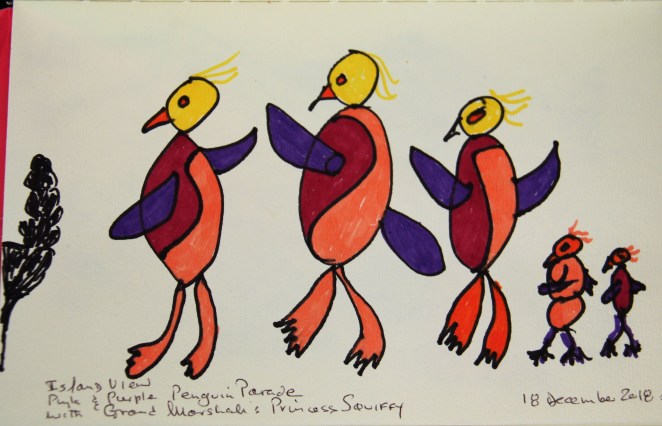
Moo apologizes. He hasn’t painted any chimpanzees, but a long time ago (2018) he drew and colored this cartoon. Pink and Purple Penguin Parade with Grand Marshall, Princess Squiffy. You can just see the end of Princess Squiffy’s tail as she vanishes out of the cartoon, encouraging the Pink and Purple Penguins to follow behind her behind. Oh the joys of leading the parade. Not everybody wants to do it though, many are content not to lead, but just to follow. Perhaps we should have called our cat MacNamara. After all, he was the leader of the band. But I don’t think Princess Squiffy would rather be anything other than what she is – a princess.

This poem, from Monkey Temple (of course / wrth gwrs) reminds me of Parents’ Day at my Boarding School. After several weeks of scarcely edible food, the tide would suddenly turn. Thursday, prime rib roast beef for supper. Friday, roast chicken with all the trimmings. When our parents arrived on the Saturday, all we could talk about was the wonderful food we had been eating for the last two days. Cunning, eh? We all had to dress up for Parents’ Day. Sunday starched collars, collar studs and all, and nice clean Sunday School ties.

Tea on the lawns in summer – unforgettable. A marquee, in case it rained, but otherwise tables laden down with a variety of skillfully cut sandwiches, little triangles, with no crusts, followed by endless helpings of strawberries and cream. The boys served their parents, fleeting back and forth to full the rapidly emptying plates. One boys father, I won’t say whose, devoured 12 bowls of strawberries and cream before the headmaster call the son over and begged him to beg his father not to eat all the strawberries and cream as some other parents’ would like some also.

Griffin Hunting – not a typical public school sport but one in which my school most certainly indulged. Our school symbol – a griffin – woven with gold thread on a dark blue background symbolized for the younger boys the perfection of the Prefects. To Hunt a Griffin was to behave in such a way as to attract the attention of older boys (already Perfect Prefects) and the school masters so that one became a candidate to climb the ladder and become a candidate for Griffin-hood. Some of us, myself included, preferred the anonymity of Robin Hood and were happy in our chosen roles of outlaws in Sherwood Forest and agents provocateurs and anarchists. Not for us the gentle counting of innumerable sheep. We chose rather the perils of after-dark transistor radios and the joys of Radio Luxemburg.

I remember being caught out of bed one night, on my knees, in a corner of the dormitory. All the dorm occupants were squealing and making a terrible noise. This attracted the attention of Perfect Prefect Plod – and in he came, threw the door open, and switched on the light. “You!” he pointed at me. “What do you think you are doing, out of bed?” “I am catching a mouse, Prefect Plod,” I replied. “You are a nasty little liar,” said Prefect Plod. “There are no mice in our nice clean house.” “Oh yes there are,” I replied, and I showed him the little mouse that I had cradled in my hands. “Give that to me,” ordered Prefect Plod. So I did. And the mouse took an instant dislike to him and immediately sunk its sharp little teeth into his thumb. I remember Prefect Plod running out of the dorm screaming “Matron! Matron!” and the little rodent swinging back and forth and hanging grimly on.

Those boarding school days ended 63 years ago. Hard to believe, really, but I still have such vivid memories of them. And of the Perfect Prefects, gripping cup handles between finger and thumb, enormously pleased to be the centre of attention on Parents’ Day, however clumsily they walked, in their spruced up for the occasion, Sunday Suits and Shirts, with their Golden Griffin ties. I always think of the Chimpanzees’ Tea Party when I think of the special performances of that little lot ‘for a Prefect’s lot is not a nappy one, nappy one.’

Monkey Meets An Anarchist Ant

Monkey Meets An Anarchist Ant
(Memories of El Camino de Santiago)

The anarchist ant is dressed in black.
He has a little red base-ball cap
worn backwards on his head.
His eyes are fiery coals.

“Phooey!” He says.
“It’s folly to go with the flow.”
So he turns his back
on his companions
and marches in the other direction.

Some ants call him a fool.
The Ant Police try to turn him.
The Thought Police try
to make him change his mind.

Others, in blind obedience
to a thwarted, intolerant authority,
first bully him, then beat him,
then bite him till he’s dead.

Commentary:

I wrote this last century, no – last millennium – in the 1990’s, after walking the Camino de Santiago in Northern Spain. I travelled alone, on my own. An incredible journey. One of the sayings along the road is that if you do not make the pilgrimage to Santiago while you are alive, you will have to walk it in ant form, when you are dead. I often saw ants on the lonely, dusty roads, especially off the beaten track, and they were all headed for Santiago, except for one or two, who headed in the wrong direction, and were cut off by their companions. From these humble roots was this poem born.

Looking back nearly thirty years, I am surprised – and rather shocked – by the ‘little red base-ball cap worn backwards on his head’. I aways associated red hats with cardinals and bona fide llamas from Tibet (Kim – Rudyard Kipling). It obviously has a totally different meaning today, but I was definitely not aware of that thirty years ago when I first wrote this poem.

I was aware, however, of that in human nature, that made some people rebel and some conform. The conformists were rarely able to tolerate the rebels. This was particularly true in the Monkey Temple where the animals are bound by rules to which they must conform – or else. Thus, our poor anarchist ant broke away from the norm, refused to go with the flow, and suffered an awful fate as a result. Moo and I have always loved the rhythm and alliteration of that final brutal line ‘first bully him, then beat him, then bite him till he’s dead.’ But Moo definitely didn’t want to paint that picture. He encouraged me to use the photo of the ants in the honey pot instead. And guess what – there were fifteen ants floundering in that pot of honey. The luckiest ones were the anarchist ants who adjusted their baseball caps and fled!

How many anarchist ants, I wonder, baseball caps of any color askew on their heads, have suffered a similar fate? Some things, my friends, we’ll never know. And sometimes, my friends, I think we are better off not knowing.

Gorilla Drives the Zoo Bus

Gorilla Drives the Zoo Bus

Gorilla drives the same zoo bus
all day, every day;
same starting time, same finishing time,
same route, same stops,
different passengers,
but every passenger the same:
faceless.
Gorilla doesn’t want to know their names.

“Please tender the exact fare!”
Not a penny less, not a penny more,
and he polices every penny.
Bus conductor and master
of every passenger’s destiny,
he opens and shuts the door,
letting passengers on and off the bus,
but only at official stops.

Every passenger has a ticket,
and he punches every ticket
with a neat, round hole.

He never makes mistakes.
He grinds, like God’s own mills,
exceedingly small.

He has spent all his life in uniform.
He has a belt and braces to hold his trousers up.
He’s always prepared for the worst.  

Ten, fifteen, twenty years:
an anonymous wife;
anonymous little babies;
at shift’s end, a pension,
and another bus.

St. Peter’s at the wheel.
He doesn’t want to know
where gorilla wants to go:
he wants to know where he’s been.

Commentary:

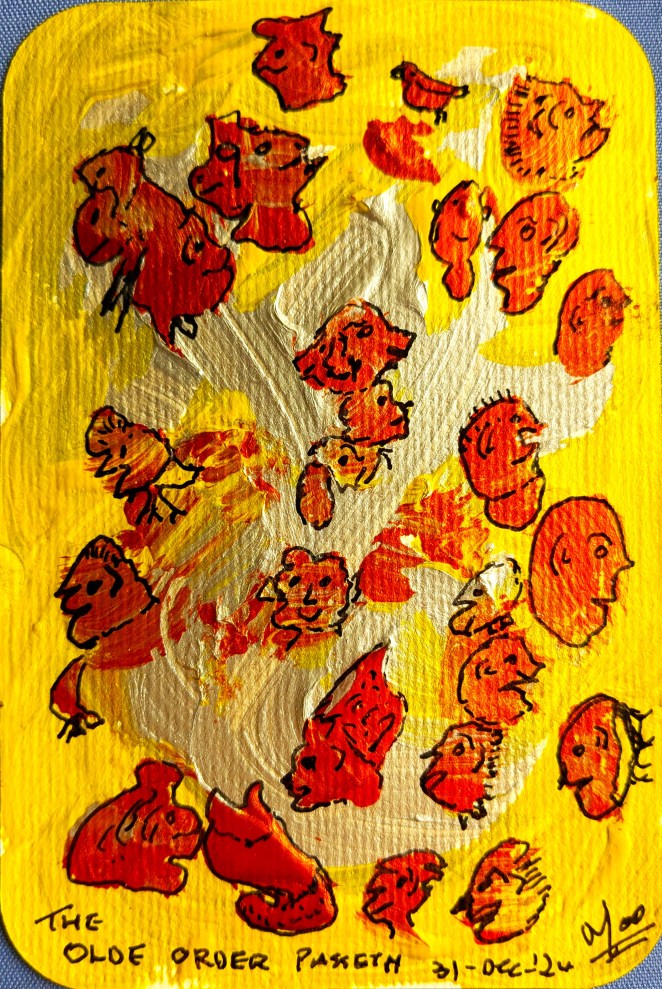
Moo didn’t have a painting of a gorilla driving a bus, so he offered me a painting of the passengers instead. Look carefully – you might even find a portrait of me or you in there. Who knows where Moo goes and who he sees? I certainly don’t. Remember Picasso – he used to run downstairs, out into the street, see a face he liked, and run back upstairs and paint it from memory. I wonder if Moo does the same thing. I’d ask him, but if he doesn’t want to answer the question, he just grunts. And I can imagine him grunting at that one.

Anyway, we all know and recognize the gorillas when we meet them. They are totally unimportant, have a miniscule job to do, but do it with absolute authority and the utmost perfection. Like Gorilla – “Not a penny less, not a penny more, and he polices every penny.” – “he opens and shuts the door, letting passengers on and off the bus, but only at official stops.” – “he punches every ticket with a neat, round hole.” – and probably in the exact same spot of every ticket! – “He never makes mistakes.” – and if he does, it’s the passenger who suffers, because ‘Get on, get off, who ever you may be, I am the lord of the bus,’ says he.

What will happen to us at the end of our shift? I really don’t know. And I don’t think anyone else does, either. Will St. Peter be there to greet us? (I don’t know.) Has the Zoo bus replaced the ferry over the River Styx? (I don’t know.) What will we be asked when we get there? (I don’t know.) How will we answer? (I don’t know.) Is there a little book in which all our deeds, good and bad, are written down? (I don’t know.) Are we to be divided into sheep and goats? (I don’t know.) What will poor monkey do when he is turned into a sheep or a goat? (I don’t know.)

So many questions, deep questions, packed into one small poem. Most of those questions unanswerable. But that’s one of the joys of poetry – to open a poem is to open a tin of calamares – there’s always another something or other left in the corner. Look, over there, bottom left, right at the bottom of the can, I spy with my little eye another question. ‘What is that question?’ you ask. Sorry, mate, I’m afraid I don’t know.

Monkey’s Clockwork Universe

Monkey’s Clockwork Universe


Some days, monkey winds himself up
like a clockwork mouse.
Other days he rolls over and over
with a key in his back like a clockwork cat.

Monkey is growing old and forgetful.
He forgets where he has hidden the key,
pats his pockets, and slows right down
before he eventually finds it
and winds himself up again.

One day, monkey leaves the key
between his shoulder blades
in the middle of his back.

All day long,
the temple monkeys play with the key,
turning it round and round,
and winding monkey’s clockwork,
tighter and tighter,
until suddenly the mainspring breaks
and monkey slumps at the table –
no energy, no strength,
no stars, no planets, no moon at night,
the sun broken fatally down,
the clockwork of his universe
sapped, and snapped.

Commentary:

I guess we normal human beings, not the monkeys who live in the Monkey Temple, think of this as a sort of mental and physical burn out. It can happen to anyone really. You don’t have to be a monkey. But if you live in a clockwork universe where you clock in at nine and clock out at five, and regulate everything – your eating, your breathing, your visits to the loo – by the tick of the tick-tock work clock, then I guess this can happen to you.

Escarmentar en cabeza ajena – a lovely Spanish proverb that means ‘to learn from the blows delivered to another’s head’. Much better to let this poor monkey teach you that yes, you have to take breaks or, like monkey, you will break down. You must learn to pace yourself, not to be put upon by others, and to look after yourself. Because, if you don’t, others will take advantage of you and push you to, and beyond, your limits. Don’t learn that lesson the hard way, by ending up broken, run down, and in hospital. Learn from monkey’s experience. Keep the key hidden. Don’t let other people see it, or steal it, or wind you up with it.

Life is hard enough anyway. Look after yourself first. And then you will be much better able to look after other people – especially your family and friends – when they need your help. A difficult lesson to learn, especially in this world of multi-tasking where too many people hold too many low-paying jobs and work long, long hours, day after day, just to make ends meet.

There is no escape from the clockwork labyrinth, you think. Alas, that too is true, all too often. But escape you must. Somewhere, Ariadne’s thread will lead you out. You must seek it, even in the darkness and the gloom. Once found, it will lead you out from the darkness and back into the light. And that is what we must all hope for and work for. Pax amorque – and blessings.

Monkey Turns Down Promotion

Monkey Turns Down Promotion

“I hereby appoint you head of the asylum.”

The young office monkey with the plastic stethoscope
was dressed neatly in a white sheet.

“Dr. Freud, I presume?”
Monkey held out his hand
but his witticism was lost in a flood of water
flowing from the flush and over the floor.

Monkey stood there, paddling in piddle.
Inmates with crowded heads and vacant faces,
fools grinning at a universe of folly,
paddled beside him. He wiped
a sick one’s drool from his sleeve.

The office boy spat on his hands,
slicked down his hair, and placed
his stethoscope on monkey’s heaving chest.

“You have no pulse.”
“How do you know I have no pulse?
Surely, you cannot hear my heart
for you have a banana stuck in your ear.”

“Speak up!” said the doctor,
“I cannot hear you:
I have a banana stuck in my ear.”

Then monkey felt fear.

Daylight diminished
and waters closed over his head.
He spurned the proffered paw,
the life belt thrown
by the offer of a new position.

Exit monkey left,
pursued by a chorus:
“Run, monkey, run!”

Commentary:

A Golden Oldie from Monkey Temple (2010). I came across it by accident as I thumbed through some older books – wow, fifteen years ago that came out. A Golden Oldie indeed. I had forgotten all about Monkey Temple. However, the last couple of days I have watched New Zealand vs Canada and England vs France (Women’s Rugby World Cup). Both semi-finals took place at Ashton gate, Bristol. That’s when I started thinking about Bristol and Bristol Zoo.

We had family in Bristol (Westbury-on-Trym) and from an early age we visited Bristol Zoo. One of my favorite places was the old ruined Monkey Temple, full of monkeys that impressed me with their antics. A small, walled zoo, it was full of innovations and I remember well Alfred the Gorilla and Rosie the Elephant. I loved the rides on Rosie’s back. The camels too offered lifts to young children and the elephants took apples from my hand with their long trunks. I also remember the bear pit, and loved watching the brown bear climb to the top of his pole and catch food thrown to him by the visitors.

I think everybody’s greatest thrill came with feeding time for the seals. What a racket when the attendant appeared with his / her pail of fish and he/she threw them to the waiting seals. Almost as thrilling was the penguin house with its aquarium and glass windows. Animals that seemed so clumsy, waddling on land, turn into sea-angels when they dived and we could meet them, face to face, so to speak, almost in their own environment.

My love of zoos reached out and I recall the zoo in Madrid, established when Columbus returned from his voyages with species of animals hitherto unknown. And who could forget Copo de Nieve, the albino gorilla in Barcelona zoo.

Alas, my zoo day’s are over. But the world is wonderful. Today, two deer entered our front yard, lunched on the fallen crab apples, and went to sleep underneath the trees outside our window. Joy to the world and the world brings me joy -sunrise and sunset, colored clouds, the deer in my yard, a fox passing through. However, I must admit I am not impressed by the little red squirrel that nests under the hood of my car and gnaws my cables. Nor by the porcupine who loves the salt in my garage doors and nibbles at the door frame every chance it gets. The love of nature – red in tooth and claw – I guess we have to enjoy the good and put up with the bad. Life’s like that. “Ask the animals, they will teach you.” Bristol Zoo motto.

Monkey Presses Delete

Monkey Presses Delete

Monkey loves walking behind the gorillas.
The gorillas break and enter:
and when they do, monkey simply points
and gorillas do their thing:
it’s that simple …

Monkey has a code word
that he took from his computer course.
“Delete!” he says with delight
and the gorillas delete whatever he points to.

Monkey loves burning other people’s books.
He also loves deleting parents
especially in front of their children,
and deleting children in front of their parents
can be just as exciting.

The delete button excites monkey:
maneuvering the mouse
tightens his scrotum
and he feels a kick like a baby’s
at the bottom of his belly
as he carefully selects his victim and
“Delete!”

The gorillas go into action:
ten, twenty, thirty, fifty, seventy years of existence
deleted
with a gesture and the click of an index finger
pointed like a gun.  

Monkey’s Clockwork Universe

Monkey’s Clockwork Universe

Some days, monkey winds himself up
like a clockwork mouse.
Other days he rolls over and over
with a key in his back
like a clockwork cat.

Monkey is growing old and forgetful.
He forgets where he has hidden the key,
pats his pockets, and slows right down
before he eventually finds it
and winds himself up again.

One day, monkey leaves the key
between his shoulder blades
in the middle of his back.

All day long, the temple monkeys
play with the key, turning it round and round,
and winding monkey’s clockwork,
tighter and tighter, until suddenly
the mainspring breaks

and monkey slumps at the table
no energy, no strength,
no stars, no planets, no moon at night,
the sun broken fatally down,
the clockwork of his universe
sapped, and snapped.

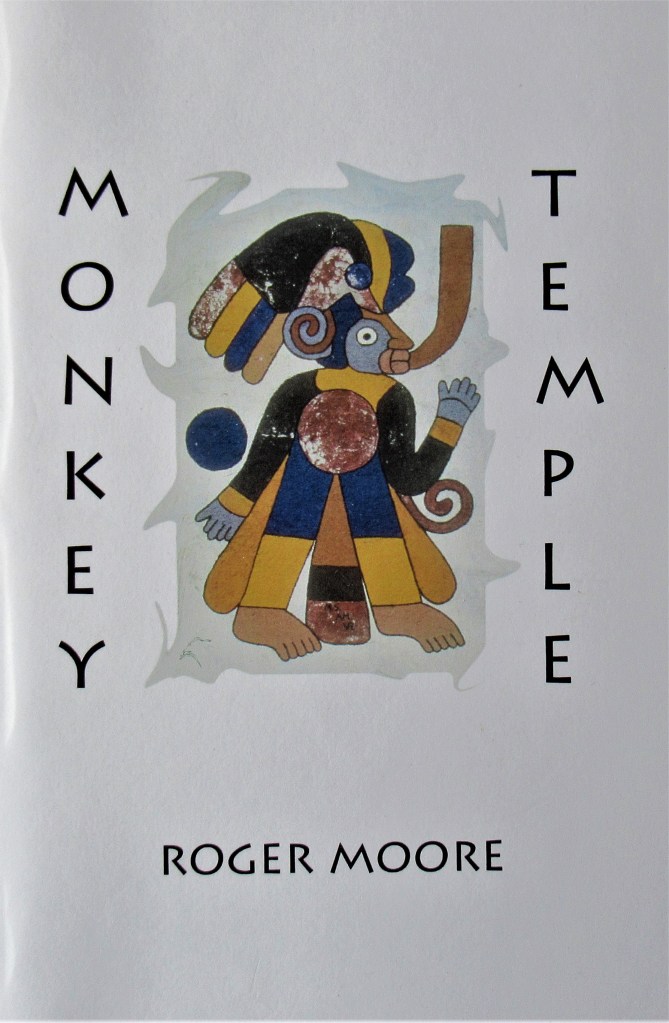
Comment: Monkey Temple is A Narrative Fable for Modern Times written in verse. The poems show strong links to Surrealism and Existential Philosophy. They portray the upside-down world of Carnival and out line Monkey’s Theory of the Absurd in a dystopian world that mirrors that of George Orwell’s Animal Farm, LaFontaine’s Fables, the esperpento of Valle-Inclan, and the witty conceptismo of Francisco de Quevedo. This is a walk through the jungle of the Jungian innermost mind. But watch out for those monkeys: they bite.

Online Edition
First Edition

Click below to purchase Monkey Temple online.

Monkey Temple
paperback

Monkey Temple
Kindle

Monkey and the Bean Counter

IMG_0026

Monkey and the Bean Counter

An acolyte in a charcoal suit runs by.
He neither stops nor speaks
but slips on slippery words
dripping from another monkey’s tongue.

This other monkey has eyes of asphalt,
a patented pewter soul,
ice water flowing in his veins.
“Hear no evil! See no evil! Speak no evil!”

The hatch of his mind is battened tightly down.
Nothing gets out nor in.
The acolyte’s fingers grasp at a khaki folder,
his manifesto for success.

Senior monkey stalks to his office
and turns on the radio.
His favorite music:
the clink of mounting money.

Disturb him at your peril:
this monkey is very important,
and very, very busy.
He’s also clever:
a real smarty.

First, he empties all the chocolate candies from the box
then he sorts them into little piles:
green with green, brown with brown,
blue with blue, red with red.

Then, like the Good Shepherd checking His flock,
he counts them again and again,
to ensure that none have been stolen
and not one has gone astray.

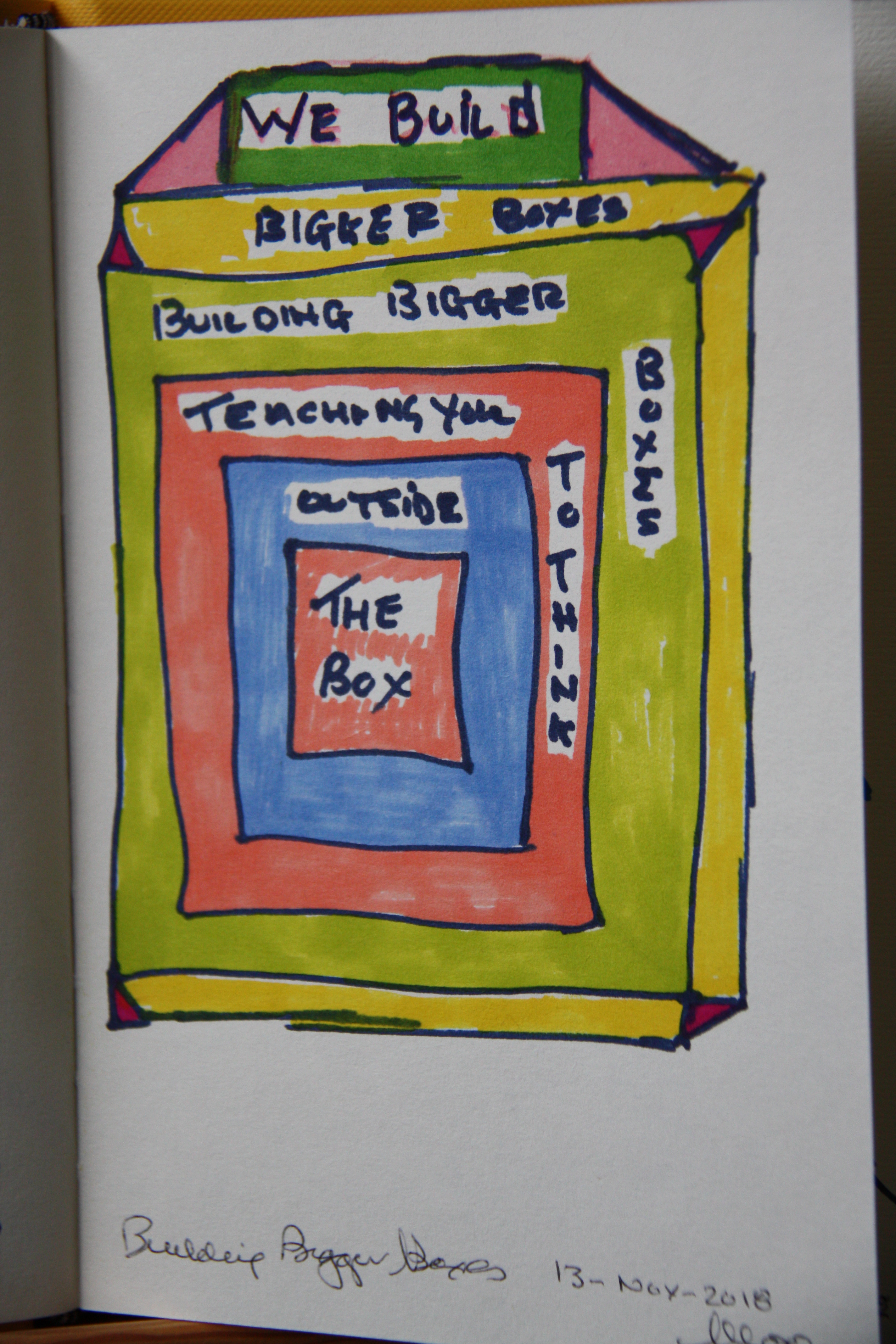
Comment: Another Golden Oldie, this time from Monkey Temple. I have updated it slightly so it won’t be exactly the same as it is in the printed text. Senior Monkey has, of course, built a bigger box into which he can place all his chocolate candies and tuck them away for ever and ever. I guess if he were a bull and not a monkey, he would have tucked them away for heifer and heifer. Such is the sad state of reality in the Monkey Temple. But if monkey were a bull, he would be living in the cow shed, not the Monkey Temple. Oh dear, oh dear: and oh what a tangled web we weave when first we practice to deceive with fiction, flash fiction, creative non-fiction, and all the other sugar and spice which goes into the spinning of spider-webs and fairy tales. Speaking of which, did I ever tell you the story of the… well, maybe next time. So tune in again tomorrow. Same thyme, same plaice, and I’ll sing you a song of the fish in the sea… and a fishy tail that will be.

Monkey Throws Away the Keys

Monkey Throws Away the Keys

Monkey is tired of writing reports
that are never read.
He is fed up with frequently asked
questions and their unread answers.
To every lock, there is a key.
Monkey looks at the red and gold
locks of the last orang-utangs
and wonders how to unpick their DNA.

Monkey would give his kingdom
for a key, a key, a little silver key:
the key to a situation, the key to a heart,
the office key, the key to the door,
at twenty-one, the keys of fate,
the Florida keys, the key to San
Francisco’s Golden Gate,
a passe-partout, a skeleton key,
the key to Mother Hubbard’s cupboard,
where she hides dry bones …

On the last day, when monkey leaves work
he takes a lifetime of keys
and throws them down a deep dark well.

As they halve the distance to the water,
he listens to the sound of silence and wonders
if they’ll ever hit the bottom.

Monkey Temple:
the complete book, is available on KDP and Amazon.