Empty Nest

IMG_1258 (2)

Empty Nest

The wind at the window
scratches tiny notes.
I can no longer hear the tune
nor read the words.

Who walks beside me
as I pace my lonely path,
abandoned in this empty house.

My self-portrait
stares back at me:
a splintered selfie,
framed in a sliver
of silvery glass.

Above me,
a monkey moon,
that itinerant tinker,
walks a fractured way
over broken glass.

The knapsack on his back
is cobbled together
from cobwebs and clumsy
veils of drifting clouds.

Comment: Another Golden Oldie from that same throw-away manuscript that I discovered a couple of days ago. I wrote this one the year after my mother’s death. My father was in hospital and I had flown back to Wales to visit him. When I was not with him, I wandered alone in a large house, empty of people, but filled with memories. The whole experience was rather surreal, just like the imagery I conjured up to describe it. Early spring, but a cold one. After hospital visiting hours, I wandered an untidy house and an unkempt garden. My mother had departed. My father was on the way out. I was alone with a life-time of memories. “No hay pájaros en los nidos de antaño” wrote Cervantes in the Quixote. “There are no birds in last year’s nests.” With no brothers, no sisters, no close family, and no friends left in Wales, I found that out the hard way. Those days of wandering, ‘upstairs, downstairs, in my lady’s chamber,’ taught me that most difficult of lessons in the hardest of ways.
IMG_0456 (2)

Bleeding Heart

IMG_1338 (2)

Bleeding Heart

White moths
wing their snowstorm,
pale stars through the night.

A candle flickers in the darkness.
Hands reach out to grasp me.
A feathered shadow flies
frail fingers across my face.

Butterflies
stutter their eye-lash kisses
against closed cheeks.

Awake,
I lie anchored by what pale visions
fluttering on the horizon?

Eye of the peacock,
can you touch what I see
when my eyelids close?

Black rock of the midnight sun,
blocking this day’s dark cave,
when will I be released
from my daily bondage?

Last night, the planet
quivered beneath my body
as I felt each footfall of a transient god
who mapped in runes
the ruins of my bleeding heart.


IMG_0811 (2)

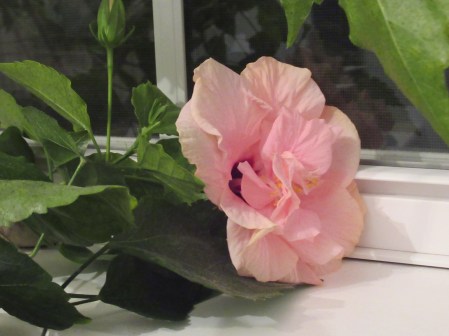
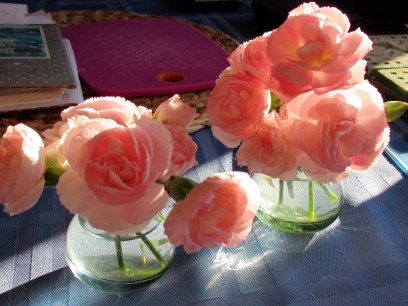
Comment: Another Golden Oldie, also dug out from the rejection / dejection of striations. I tinkered with it this morning. Funny what a shift in structure and a twitching of the metaphors will do. New lamps for old: indeed, and why not? We are not just writers, we are re-writers and some thoughts can be reworked to rise again in the shadows of the adopted children that are our poems. This bleeding heart plant vanished a couple of years ago. We dug up the flowerbed, inserted a rockery, and watched and waited. After two years, the bleeding heart plant resurrected itself from within the stones. Survival, renewal, faith, hope: key words nowadays. Who locked that plant down? Who let it rise up again? When we have gone, how will our gardens get on without us? Very well, in all probability, but they may be more of a tangled garden than a cultivated one. And what’s wrong with a tangled garden? Why, nothing at all, my friends, absolutely nothing at all.

image5

Striations

IMG_0299

Striations

There are striations in my heart,
so deep,
a lizard could lie there,
unseen,
and wait for tomorrow’s sun.

Timeless:
this worm at the apple’s core
waiting for its world to end.

 Seculae seculorum:
the centuries rushing headlong.

Matins:
wide-eyed this owl
hooting in the face of day.

Somewhere,
I remember
a table spread for two.
Breakfast:
an open door,
a window that overlooks
a balcony and a garden.

“Where are you going, dear?”

  Something bright has fled the world.
The sun unfurls shadows.
The blood whirls stars around the body.

“It has gone,” she said.
“The magic.
I no longer tremble
at your touch.”

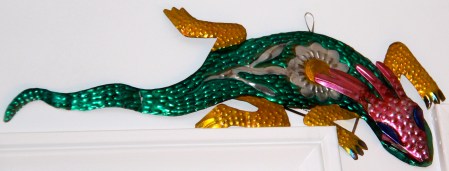
Comment: A real Golden Oldie. The lizard, it’s probably an iguana, came originally from Oaxaca, Mexico, and now sits over the door on the front porch. I had to bend his tail to get him into my carrying bag, poor thing. I found this poem in my poetry discards file, though what it was doing in there is a mystery to me. I think I discarded the longer manuscript in which it was included. Never mind, I have re-found, rediscovered it and it merits a place here, on my blog, along with the iguana. Byddwch lawen: rejoice and be glad.

Lost

IMG_1058 (2)

Lost

My body’s house has many rooms and you, my love,
rule over them all. Your shadow dances on walls.
in mirrors, and your breath brushes my cheek

every time I open doors or windows. That silly cat
looks for you and hisses when I bring her kibble.
I walk from room to room, but when I seek you,

you are no longer here. I knock, nothing opens.
Afraid, sometimes, to enter a room, I know
you are in there. I hear your footsteps on the stair.

Sometimes your voice’s echo breaks the silence.
You whisper my name in the same old way.
How can it be true, my love, that you have gone,

that you have left me here alone? I count the hours,
the days, embracing dust motes to find no solace
in salacious sunbeams and my occasional dreams.

IMG_1774

Comment: A Golden Oldie. I wrote this some time ago while my beloved was in Ottawa visiting our daughter. Separation is such a strange thing: an absence, yes, but also a presence in the tiniest details and the most unsuspected moments. And then there is the dream world where things join together, and then fall apart. This poem has so much more meaning in a time like this when so many people are separated and can no longer be together. Time … I have written about it before … passes. Hopefully, families and friends will be reunited once more, the sooner the better. In the meantime, we’ll meet again, don’t know where, don’t know when. Chadwch eich fydd / Keep your faith, as St. David, the patron saint of Wales is said to have said circa 500, byddwch lawen / be joyful, and gwnewch y pethau bychain mewn bwywd / do the little things in life.

With my angel

IMG_0258

… with my angel …

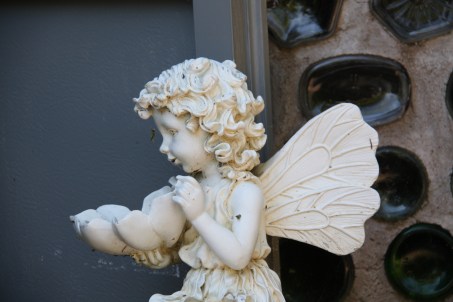
            … with my angel … face to face … the one I have carried within me since the day I was born … the black-one … winged like a crow … the one that hovers over me as I lie asleep … the one who wraps me in his feathered wings when I am alone and chilled by the world around me … the one who flaps with me on his back when I can walk no further … the one who creates the single set of footprints that plod their path through the badlands when I can walk no more …

img_0122

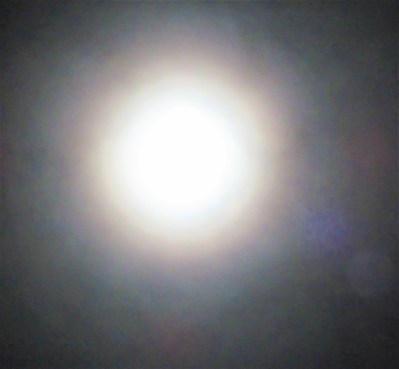
… ‘the truth’ my black angel says to me … I say ‘he’ but he is a powerful spirit, not sexed in anyway I know it … and yet I think of him as ‘he’ …awesome in the tiny reflection he sometimes allows me to glimpse of his power and glory … for, like Rilke, I could not bear meeting his whole angelic being face to face … as I cannot bear the sun, not by day, and not in eclipse … not even with smoked glass … when earthly values turn upside down and earth takes on a new reality … wild birds and bank swallows roosting at three in the afternoon … and that fierce heat draining from the summer sky … I remember it well … and the dog whimpering as a portion of the angel’s wing erased the sun until an umber midnight ruled … a simple phenomenon, the papers said … the moon coming between the earth and the sun …but magic … pure magic … to we who stood on the shore at Skinner’s Pond and sensed the majesty of the universe … more powerful than anything we could imagine … and the dog … taking no comfort from its human gods … whimpering at our feet …
… I saw a single feather floating down and knew my angel had placed himself between me and all that glory … to protect me … to save me from myself … and I saw that snowflake of an angel feather bleached from black to white by some small trick of the sunlight … and knowledge filled me … and for a moment I felt the glory … the magnificence … and there are no words for that slow filling up with want and desire as light filters from the sky and the body fills with darkness … and I was so afraid … afraid of myself … of where I had been … of where I was … of what I might return to … of my lost shadow … snipped from my heels …
… I don’t know how I heard my angel’s words … ‘the time of truth is upon you’ … ‘all you have ever been is behind you now’ … ‘naked you stand here on this shore … like the grains of sand on this beach … your days are numbered by the only one who counts’ … I heard the sound of roosting wings … but I heard and saw nothing more … I felt only midnight’s cold when the chill enters the body and the soul is sore afraid …
… ‘it is the law’ my angel said … I saw a second feather fall … ‘and the law says man must fail … his spirit must leave its mortal shell and fly back to the light’ … ‘blood will cease to flow … the heart will no longer beat … the spirit must accept and go’ … ‘do not assume… nobody knows what lies in wait’ … ‘blind acceptance … the only way … now …  in this twilight hour …  now when you are blind … only the blind shall receive the gift of sight’ … ‘all you have … your wife … your house … your car … your child … everything you think of as yours … I own … and on that day … I will claim it from you and take it for my own … now I can say no more’ …
… the sea-wind rose with a sigh and one by one night’s shadows fled … the moon’s brief circle sped from the sun … light returned, a drop at a time, sunshine flowing from a heavenly clepsydra filled with light …
… birds ceased to circle … a stray dog saw a sea-gull and chased it back to sea … and the sun … source of all goodness … was once again a golden coin floating in the sky …
… on my shoulder a feather perched … a whisper of warmth wrapped its protective cloak around my shoulders … for a moment, just a moment, I knew I was the apple of my angel’s eye … and I hoped and still hope that one day I might meet him again and understand …

Comment: An article on Marcus Aurelius in this morning’s paper made me think of this piece that I wrote, way back when, in the days when I was studying Francisco de Quevedo and the Neo-Stoic movement, courtesy of my good friend and colleague Henry Ettinghausen. “The day we were born we took our first steps on the road to death,” Quevedo wrote in one of his poems. With my angel is my own Neo-Neo-Stoic attempt to come face to face with that very personal reality, one which we all face, and to stare it down, eyeball to eyeball. Alas, in these troubled times, we must confront the knowledge that troubled times have been here before, that other generations have suffered them, and luckily, other generations have survived. We wouldn’t be here if they hadn’t. As another good friend, of mine Victor Hendricken, wrote on this blog just yesterday: “We continue to live on between inhale and exhale; we continue to live on between intake and exhaust, food and faeces. And in this time of self-isolation, we still abide by many of the same personal rules, including morning ablutions, setting and shutting off the alarm. Chin up, old boy. This too shall pass.” I found these words from Victor very comforting. With friendship, solid advice, and the ability to learn from those who have gone before us how to confront difficult times, this too shall pass.

Garbage Day

image1 (17) - Copy.jpeg

Garbage Day
(1789 AD)

all the dustbins
dancing down the street
trying no doubt to achieve
a spring time copulation
so they can give birth
to even more dustbins

you can’t have a revolution
without dustbins
dusty … dusty … filthy
dusty dustbins
a sadistic way to look at
dustbins full of sawdust
heading off down the street
between potholes
and blowing bins
a right Danse Macabre
conducted by
St. Vitus

me sitting there knitting
Montreal Canadians
this Red Cap
I keep flying high

even though I stand
upon Gibraltar’s Rock so fair
not to mention Paris
the Place de la Bastille
with tumbrils rattling

Old Moll in a Moll’s Cap
toothless fairy
at a Goblin Party
watch out
for toad s’tools
[sick this poem
this joke

and all that’s in it]

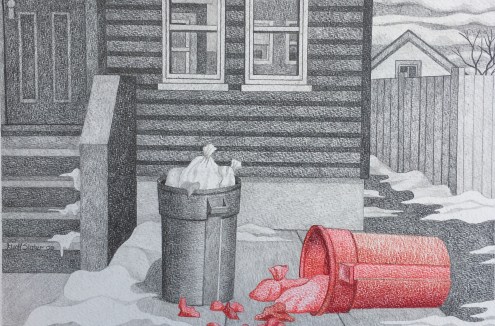
Comment: A wonderful drawing by my friend, line painter Geoff Slater. The poem, of course, represents the garbage in (and out of) the garbage can. 1789 is the date of the French Revolution. I found this poem in my discard file, so it was one of those that didn’t make it anywhere. Maybe it shouldn’t have made it here either. But it takes all sorts to make a world and Geoff’s red dustbin reminds me of the red caps knitted by the old women beneath the scaffold and the guillotine. Funny things, guillotines: invent them and they drop on you when you fall out of favor. There are so many allusions in this poem that I am ashamed to say I remember them all, and not all of them are pleasant. Mind you, few things are pleasant nowadays and remember: it is better to leave your dustbins out to roam the streets and be plundered by the crows and swept away by the high winds than to leave them festering and smelling bad and all cooped up in the locked down garage.

Daffodils

IMG_0617

Daffodils

My daffodil day-dreams carry me back to Wales, that Land of Song where every valley conducts choirs of daffodils and their pale, brass voices are raised in an annual springtime hymn of hope. Beneath the trees, in Bishopston Valley, between Pyle Corner and Pwll Ddu, sheltered bluebells tinkle sweet tunes, lilies-of-the-valley bloom, and primroses raise their faces to the sky while hearkening to those springtime airs that sound where’er you walk. In Blackweir Gardens, the Feeder Brook flows into the castle moat and the castle’s central keep stands on the mound the Normans dug when they converted into a motte and bailey the old Roman camp that was built on an earthworks constructed by the Silures long before that countenance divine shone forth upon these clouded hills and long before the Roman came to Rye or out to Severn strode. Generation after generation, all those who witnessed the birth of these flowers and strove to be the first to hear the cuckoo’s call, come alive again in this floral tribute. Oh, Land of Song: the bluebells may have gone, the larks may sing no more, cuckoo and cowslip may have fled the valleys, but all is not lost, not while the daffodils still toss their heads in sprightly dance and spring breaks out its freckled sunshine.

Comment: Win some, lose some. Survival is all. At the same time as I mourn everything  that is lost, I also celebrate all that survive. The grosbeaks have left us, moving further north as the weather warms. They have left more room for cardinals and hummingbirds have moved in to replace them, as have turkey vultures. Turkey Vultures, Zopilote, The Trickster, in Oaxaca, the bird that flew high up into heaven, stole the fire of the gods, and brought it back on his wings, now flies over the St. John River Valley, having moved up here with the warmer air from the south.

“The olde order changeth lest one good custom should corrupt the world” … indeed it does. And we must mourn and celebrate the olde order while preparing for, and celebrating, the arrival of the new. For the world has changed and is changing as I sit here and type these words and it will have twitched and changed again by the time you read them. Who knows exactly what is coming? How do we prepare for the unknown? How do we open our arms and embrace an uncertain future? Good questions all. I cannot answer them for anyone but myself, but I must ask them. Many of them were discussed today by Suzanne Moore in an article entitled: The way we once lived is now redundant. We must reinvent ourselves. Read it and start thinking about how we can be strong, daring, caring, and best prepare ourselves, not for our own extinction, but for our own reinvention.


Lamplighter


img_0218

Lamplighter

When I was very young, many of our streets still had gas lamps.  The lamp-lighter would appear in winter around three or three-thirty to light those lamps. I remember him walking up the street with his long pole over his shoulder, moving from lamp to lamp. We had one outside our front door. He would turn on the gas, then light the lamp from the lighted wick at the end of his pole.  Sometimes he carried a ladder with him. Then, every so often, when the lamp needed tending, he would climb the ladder and adjust the wick. These gas lights were not very bright but they stood out like light houses between stretches of darkness and we would walk from pool to glowing pool, as if they were stepping stones leading us up the hill to home. We all knew the lamplighter and he would often wave to us as we sat in the front room window to watch him walk by. We rarely saw him in the mornings when he came back to turn off the lamps. We were all tucked safely into our beds. I remember that I wanted to be lamplighter. Later I realized that there are many ways to light a lamp and spread brightness through the world. When I qualified as an academic and a teacher, I became a lighter of a very different set of lamps.

IMG_0262

Comment: I discovered this prose poem in an old and dusty manuscript. I can’t even remember when I wrote it. Prose poems: I discovered Charles Baudelaire’s Petits Poèmes en Prose in a small bouquiniste along the banks of the Seine when I studied French in Paris during the school year I spent in France, 1962-63. I have always loved his prose poems and I have always wanted to write some of my own. That I did, and then promptly forgot about them, is one of the wonders of my creative life. How could I forget these creations? Funny: reading what I wrote back then takes me straight into the front room in my grandmother’s house in Brynmill. She would sit in the bay window playing eternal games of patience and together we would eat grapes, peep at the cards, wait, we didn’t know for what, and watch the light slowly fade. Nobody ever told me my grandmother had cancer. She died from it one day when I was away at school and when I came home for the holidays, she just wasn’t there. Her chair and her table were still there, but her warm presence, her loving kindness, had all gone. I never had a chance to properly say good-bye to her. Maybe these belated words will serve that purpose.


Limpet

fundy 05 mist+wolfepipers 081

Limpet

… like a limpet at the sea side
she clings to her inner rock
as the incoming tide
causes waters to rise,
threatening
to sweep her away.

A wind charges
over the bay,
brings a wave-surge,
white water urgent,
crashing against rocks.

Rock-face showered
and shocked,
the little limpet
clinging on,
knowing that this
is the way
limpets survive,
day after day,
generation
after generation.

Comment: We must also survive and we do so by hanging on as long as possible. The tides may rise, the mists come in, storms may send waves to come breaking over us … but they will not break us because we are limpets. So, imitate those limpets, cling to your rocks and hang on. However grim the situation might seem, the night will end, day will come, and we will survive. And remember that old Irish drinking song: “If Moonshine don’t kill me, I’ll live till I die.” And so will we all. And until then, enjoy the sunshine and the moonshine. This is your life, your planet, your set of circumstances. Hang in there and hang on, for as long as possible. Look for the good things in your life and when you find them, celebrate them and make the most of them. Remember the sundial: I count only the happy hours. Seek and you will find: for there is goodness all around you, even when the night seems to be at its darkest.

Why?

IMG_0446

Why?

“Where are you going?” I ask again. “To see a man about a dog,” my father replies.  “Why?” I ask. “Hair of the dog,” his voice ghosts through the rapidly closing crack as the front door shuts behind him. “Why?” I cry out.

I recall the mud nest jammed tight against our garage roof. Tiny yellow beaks flap ceaselessly open. Parent birds sit on a vantage point of electric cable, their beaks moving in silent encouragement. A sudden rush, a clamour of wing and claw, a small body thudding down a ladder of air to crash beak first on the concrete.

“Why?” I ask.

The age-old answer comes back to me. “Wye is a river. It flows through Ross-on-Wye and marks the boundary between England and Wales.” The swallows perch on the rafters watching their fledgling as it struggles on the floor, the weakening wing flaps, the last slow kicks of the twitching legs.

“Why?” I ask.”

Y is a crooked letter invented by the Green Man of Wye,” my grandfather says.

“Why?” I repeat. “I want to know why.” Silence hangs a question mark over the unsatisfied spaces of my questing mind.

Comment: A golden oldie. We would all like to know why. But there are no answers. Just riddles cast, like two trunk-less legs of stone, on the sands of time. Nothing beside remains. Yet still we ask the age old question? Why? And still we get the age old answer from the ageing masters who rule our childhood lives and teach us everything they know: “Because.”