Exactly the same amount that I would pay to visit the Titanic in a Titan – zilch, nada, rien, nothing. Too risky. Not worth it. Too much carbon emission to damage the world around me. It’s only a thin envelope of air up there – pointless damaging it further. We have problems enough anyway.
And how much would it cost to fund a rescue mission if something went wrong? How much did it cost to search for the Titan for five days? I haven’t forgotten Apollo XIII, even if other people have.
No way, my friends, no way. No common or garden human being in his or her right mind would ever get into something like that. I notice you say ‘to go to the moon’. Is it a two way, return ticket, then? Does the lucky traveler also get to come back? Or is it a one way only trip and a journey of no return?
Don’t bother answering those questions. I am quite happy viewing the moon through my bedroom window. I wouldn’t go, even if you offered me a free ticket. Thanks, but no thanks. Not on my watch! I am not moonstruck!
Interesting question, but very problematic. How do I define a “historical event”? What exactly do I mean when I say “I remember”? Max Boyce had a lovely song in which the chorus was “I wuz there.” If everybody who says they saw Llanelli defeat New Zealand in 1973 at Stradey Park had been there, there would have been 300,000 people pressed into a ground that held about 15,000. But, as Max Boyce sings, “I wuz there”. Well, in spirit, anyway, and I have seen the film several times. I also remember watching Jim Laker’s 19 wickets in the 1956 cricket Ashes. I watched that match on B&W TV. Does that count as an historical event that I remember?
How about the Battle of Hastings, 1066? In 1966, I ran in a road relay that led from Bristol to Stamford Bridge, where Harold defeated Harald Hadrada, down the main highway to The Trip to Jerusalem, where we stopped for a pint, down to Hastings, where we re-enacted the battle that saw William the Conqueror take the throne. Several of the runners wore Saxon uniforms, a couple even had long, blonde hair. We re-enacted two battles. Does that mean I remember that historical event?
Let us talk about Stonehenge. I first went there when there were no railings, no fences, and when sheep and cows could safely graze. I remember it well. And I remember creatively re-constructing, with my grandfather, the digging of the post-holes, the raising of the stones, the transportation of them, by ship and log rollers, from the Prescelli Mountains in Wales to their current resting place. As Max Boyce says, in my own mind, I was there. I was there too at the destruction of Maiden Castle. The first book I ever bought, age about six, was Sir Mortimer Wheeler’s autobiography, Still Digging. I can still feel that Roman ballista arrow going through the victim’s backbone. Does that count as a memory, as a presence, as a moment of reality?
The Conquest of Granada, the Expulsion of the Jews from Spain, the later expulsion of the Moors, the Adventures of Don Quixote, the mixing of truth and reality, the questioning of authority, the inquiry into the meaning of meaning, my mother’s sister phoning me after 9-11. “What’s all the fuss about, Roger? There were only three planes. We had them every night, over here, during the London Blitz, for two long years.” What impresses itself upon the human consciousness. How do we remember things and why? The Spanish Armada -there were actually three of them -, the Peninsular wars in Spain, the battles of Trafalgar, Vimeiro, Salamanca… Then we can move on to Vimy Ridge, Ypres – Wipers, as my grandfather called it, his days in the trenches, recounted to me, in the kitchen, day after day, in vivid, lived language that still remains with me. And he would sing – “If you want the whole battalion, I know where they are, they’re hanging on the old barbed wire.” Yes, I was there with my grandfather. I remember it well. The Battle of the Atlantic, the Hunt for the Bismarck, the Battle of Britain – I sat in the cockpit of a Spitfire, a long time ago, during the Battle of Britain celebrations, and I climbed into and walked around the interior of a Lancaster.
Memory and the reconstruction of historic events, some we actually lived, and some we just dreamed of, and some we saw at the movies. What is memory – an actual happening or a creative reconstruct? What is the meaning of meaning? And read Bertrand Russell’s book on the subject before you answer that one. As for me, I was there, standing beside Max Boyce, witnessing the game, though, as he says, “a hundred thousand in the ground, and me and Roj outside.”
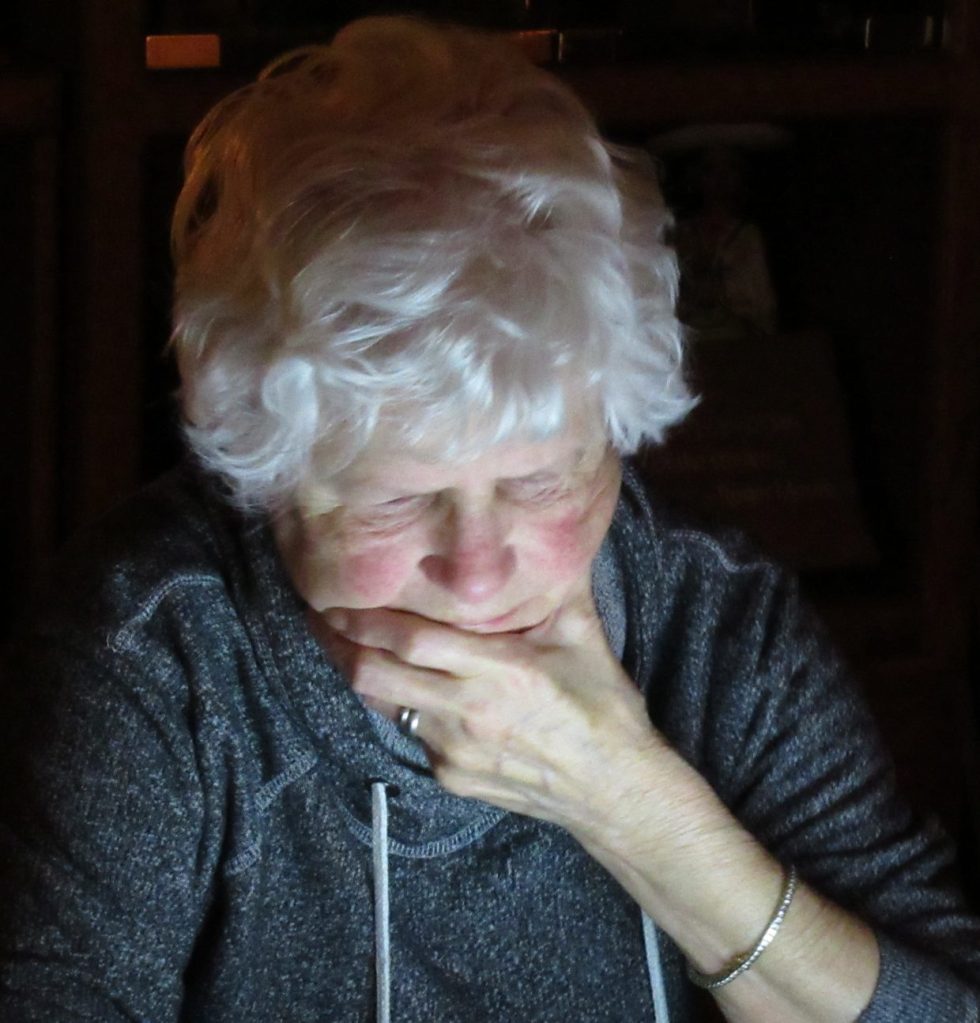
The young lady in the photograph above. We met, at a boarding school dance, in England, when we were both seventeen years old. We have been together ever since. Why am I so proud of her? Let me count the ways.
When she discovered my love of Spain and the Spanish language, she took time out from her own career in order to learn Spanish. When I asked her why she was learning the language, she replied ‘because if I am going to be with you, I want to share your life, and that means loving the things you love.’ We became engaged in Santander, Spain, on her 21st birthday. Then, the following year, when I received an offer to study and teach at the University of Toronto, she promised me that if I called her, she would come out and join me.
I called her as a Thanksgiving Gift from my Canadian family. She packed up her clothes and her career, bought a wedding dress, and travelled to Toronto that December. We got married on Christmas Eve. We had very little money. We didn’t have a wedding photographer. Nor did we have a honeymoon. I guess we never needed one. We had just enough money put by to last us until the end of January. So, First week of the New Year, she set out in search of a job. A qualified Diagnostic Radiographer, she was hired by the Doctor’s Hospital in Toronto, and she financed my graduate studies for the next three years.
Our next adventure was a Canada Council (as it was back then) Doctoral Fellowship that took us back to Spain where I completed the research for my thesis at the local library, with its trove of manuscript documents. We returned to Canada after two years, and took up residence in Fredericton, New Brunswick, where we still live. Her adventurous life led her to a certificate in accountancy, taken via a correspondence course. Then, she presented me with our daughter. We bought an American Cocker Spaniel and she started showing and grooming dogs, becoming Show Secretary of the Fredericton Kennel Club. She trained and groomed two Canadian Champions, an ASCOB (Willy) and a Parti-color (Smudge).
Our daughter decided she wanted to be a gymnast. Parents were requested to ‘get involved’ with the local club and my beloved became a gymnastics judge. She rose in the gym circles and became first provincial judging chairperson and then a nationally qualified judge, officiating at the National Gymnastics Championships and also at the Jeux du Canada Games.
She travelled with me to Oaxaca, Mexico, and fell in love with the Pre-Colombian Mexican Codices that we found there in abundance. She studied them carefully and then taught me all about them. I, in my turn, introduced them to my own students. When I took my first Multi-Media Courses at the University of New Brunswick, she followed them with me. The result was two-fold – our first web page which she built with with HTML, no templates in those early days, followed by our online Quevedo Bibliography. This, about ten years later, morphed into the online searchable data base that she built with the assistance of the technicians at the Digital Library in Harriet Irving Library.
Now, we are growing old together – such sweet sorrow. this Christmas we will celebrate 57 years of marriage. And yes, my beloved is still my most valuable Christmas present – and the person of whom I am most proud. I remember the old Worthington beer advertisement. “Behind every good man, there’s a good woman.” The cartoon shows a lady carrying a bottle of Worthington.
My beloved has stood behind me all my life. She has carried for me, not a bottle of Worthington, but the burden of assisting, helping, encouraging, supporting, carrying the load when it became too heavy for me. She has been a silent partner in so many ways, but one without whom I would be nothing.
A harder prompt might have been “Tell us about a time when you felt you really belonged”! On the outside looking in is the story of my life.
On the Outside Looking In …
I walked home on my own. As usual. I’d hated the church Christmas party with all its trumped-up noise, childish games, and artificial gaiety. The priest, formidable yet effeminate in his long black skirted robe, had made us sit in a circle on the floor, legs crossed. He stood inside that circle and placed a bar of chocolate on the wooden boards. Then he walked around the group and whispered a word in each boy’s ear. “You must wait until you hear your secret word,” he explained. “Then one of you, when I speak that word, may claim the chocolate bar,” he stared at us, large, horsey teeth, black hair streaked with grey, eyes golden, fierce, like an eagle’s, beneath bushy eye-brows. “When you hear your secret name, you must grab the chocolate bar. Understood?” I had come to the party on my own as both my parents worked. The mums and dads who had brought their offspring to the party leaned forward in keen anticipation. The boys all nodded. “Are you ready?” The priest watched us as we nodded and then he shouted “Alligator!” Nobody moved. “Elephant!” The boys shuffled forward, like inch worms, hands twitching, fingers flexing and grasping. “Tiger!” A sigh emerged from multiple mouths. Some of the boys licked their lips. “Lion!” One boy moved, but the priest shooed him away. “Sit down. That wasn’t your word.” “M-m-mouse!” The boys heaved, a sea-wave about to crest and break. “I do love this game,” said the priest to the parents. “And so do the boys, don’t you boys?” “Yes, father …” came the chorus. “Monkey!” All the boys leapt into springy action. They dived, crawled, leaped to their feet, ran … a surging heap of boyhood writhed on the floor as the chocolate bar was torn apart and the long-awaited fights ensued. All the boys moved, except me. I just sat there. “I said ‘Monkey,’” the priest frowned at me. “That’s your word. When I say ‘Monkey’, you join in with the others and fight for the chocolate.” I shook my head. “Have some Christmas fun. Join in the game.” I again shook my head. “Why not?” “You’re just mocking us. I want to go home,” I stood up and walked away. I stopped at the door and turned and saw the priest glaring at me while a mound of boys continued to scrummage on the floor. As I walked home, it started to snow. Not the pure white fluffy snow of a pretty Merry Christmas card, but the dodgy, slippery mixture of rain, snow, and ice pellets that turned the steep streets of that little seaside town into an ice rink. I turned up the collar of my coat, bowed my head, and stuffed my hands into my pockets. Two houses before my own, I stopped in front of our neighbor’s house. The window shone like a beacon in the gathering dark. I drew closer, pressed my nose against that window and looked in. A Christmas tree, decorated with lights, candles, more decorations, a fire burning on the hearth, two cats curled up warm before the fire, presents beneath the tree, stockings hanging from the mantelpiece. For a moment, my heart unfroze and I felt the spirit of Christmas. Then I thought of my own house. Cold and drafty. No lights, no decorations. No fire. The snowball snuggled back into my chest and refused to melt. When I got home, our house stood chill and empty. My parents were out at work and the fire had died. Nothing was ready for Christmas. I sat at the kitchen table, took out my colouring book and began to draw. When my mother came home, I showed her my drawing. “Very nice,” she said without looking up. “But mum, you haven’t really seen it.” She blinked and stared at the picture. This time, she saw the Christmas tree and the lights, the cats and the candles, the decorations and the presents. But she never noticed the little boy standing outside the house in the falling sleet, peering in through the window.
What aspects of your cultural heritage are you most proud of or interested in?
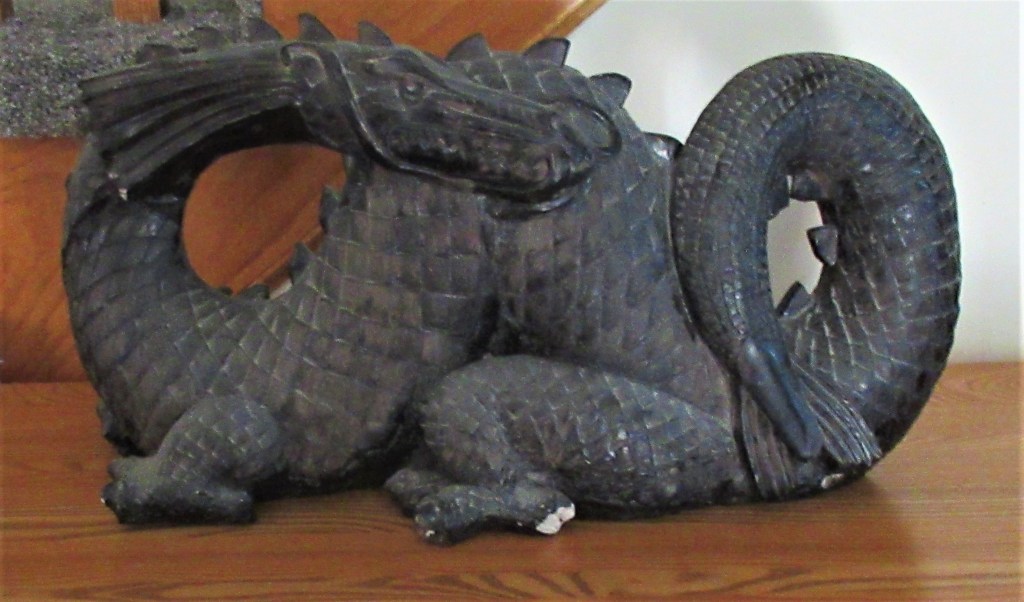
This dragon is not a dragon, well, it’s not a Welsh Dragon anyway. So, let us change the question – What aspects of your cultural heritage are you least proud of? Now that changes the perspective totally. I guess that I am least proud of the fact that, although born in Wales, I was never allowed to speak Welsh as a child. I speak with an English accent because I was sent to school in England so I wouldn’t even speak English like a person born in Wales. I am not proud of that aspect of my cultural heritage.
But I am proud of one little thing that stems from that Welsh cultural heritage – learning how to speak Welsh in my old age. It’s not easy to do that, here in Canada, but the internet carries many blessings, one of which is the learning of ‘foreign’ languages. Strange that Welsh should be considered a foreign language for somebody born in Wales. Something else not to be proud of, I suppose. Here’s my story.
Here I sit, an old man now, in front of my computer, learning at last my mother tongue, Welsh. I have discovered the beauty of simple words, not so much their meaning as their sound, the way they flow, the poetry of remembered rhythms: Cwmrhydyceirw, the Valley of the Leaping Stag, though legend has it that ceirw was really cwrw, and cwrw is beer, and its real name was the Valley of the Brown Stream Frothing like Beer.
Words have their own music, even if you cannot pronounce them properly: Mae hi’n bwrw glaw nawr yn Abertawe / it’s raining now in Swansea. Mae’r tywydd yn waeth heddiw / the weather’s worse today. Bydd hi’n dwym ddydd Llun / it will be warm on Monday. Place names also have their own magic: Llantrisant, Llandaff, Dinas Powis, Gelligaer, Abertawe, Cas Newydd, Pen-y-bont … Meaning changes when you switch from one language to another: gwyraig ty / a housewife, gwr ty / a househusband, a concept of equality that has ruled Welsh lives since long before Julius Caesar invaded Albion, coming from Gaul with his legions in 55 BC.
The photographer asks me to smile. He wants me to say ‘cheese’ so I say it in French [fromage], then Spanish [queso], then Italian [formaggio]. “No, no, no,” he shakes his head. “I want to catch the real you. Try again.” So I say it in Welsh [caws]. He checks the memory card in his camera and looks puzzled.
“Your facial expression changes each time you speak a different language,” he tells me. “Please, won’t you just say ‘cheese’ in English? I want the real you.”
French, Spanish, Italian, then Welsh: all different and he wants the real me. Each language carves a new a map into my face. Am I a clown, then, a comedian, a chameleon to wear so many masks and to slip so easily from one to another? And who am I, this stranded immigrant, marooned on a foreign shore that has finally become my home? Who or what is the real me?
“Cheese!” I say in desperation. “Got it,” he grins. “At last, I have captured the real you.”
I have a couple of priorities, of course. I am not sure which is #1. Maybe I’ll ask the readers to tell me which one my top priority should be.
I guess my first priority is to wake up. That is very important at my age. A couple of my friends went to bed and never woke up. So, I guess an important priority, perhaps #1, is to actually wake up.
Having woken up, my next priority is to roll over, sit up, pull back the blankets, and actually attempt to get out of bed. This isn’t always easy. My back sometimes stiffens up overnight. Or else my hips don’t want to function. Then there’s the gammy knee I hurt playing rugby all those years ago. Then there’s the quality of the light – do I need a light on? If I do, I must reach for it without cramping up. Early morning cramp is not a good thing and really complicates the next step.
If I am in the high bed, then lowering legs, touching the floor with toes, and using arms to push up the rest of the way is relatively easy. But if I am in the low bed, I must turn sideways towards my bad knee, place my feet at an angle, and do a one handed pushup in order to find the right balance to get to my feet. That means watching out for slippery carpets. I do not want to fall. Sometimes I call on the aid of my faithful teddy bear and, by half throttling him, I manage to get that extra leverage.
Oh dear, I forgot another priority – condition of ageing bladder. All of the above activities are dependent upon the state of the union. If that is a problem, then I must call for assistance – and I hate doing that.
Next priority – the trip to the bathroom. I wish I hadn’t said ‘trip’, because sometimes I do. The effects of that can be a sudden grasp at something solid, a stubbed toe, a twisted something or other, or, worst of all, another fall. We certainly don’t want that to happen, especially if we are suffering from what Max Boyce [remember him?] once called ‘twisted legs and tails’.
Other priorities follow when we have reached the bathroom. I won’t go into those. Nor will I mention the perils of the return journey, the difficulties of getting dressed, the embarrassment when I fail with the patented sock-pull machine and have to wiggle my socks off, one by one, and then put them on again.
So, here I am, fully dressed, standing at the top of the stairs… one hand on the hand-rail, one hand on my trusty walking-stick, and down I go, hopefully one step at a time.
So: What’s my #1 priority tomorrow? You tell me. Which would you choose? And before you answer, just remember Dylan Thomas’s words ‘for whether we last the night or no, is surely only touch and go’. Touch and go, tip and run – I remember them well. And luckily I remember waking up this morning. I would hate to face the alternative – not waking up.
I have been thinking about my parents a great deal recently. Earlier this week it was my my mother’s birthday. She would have been 110 years old. Funny how, as we age, our own minds turn back to the past. So, today’s prompt – What brands do you associate with? – gets an instant answer – none really.
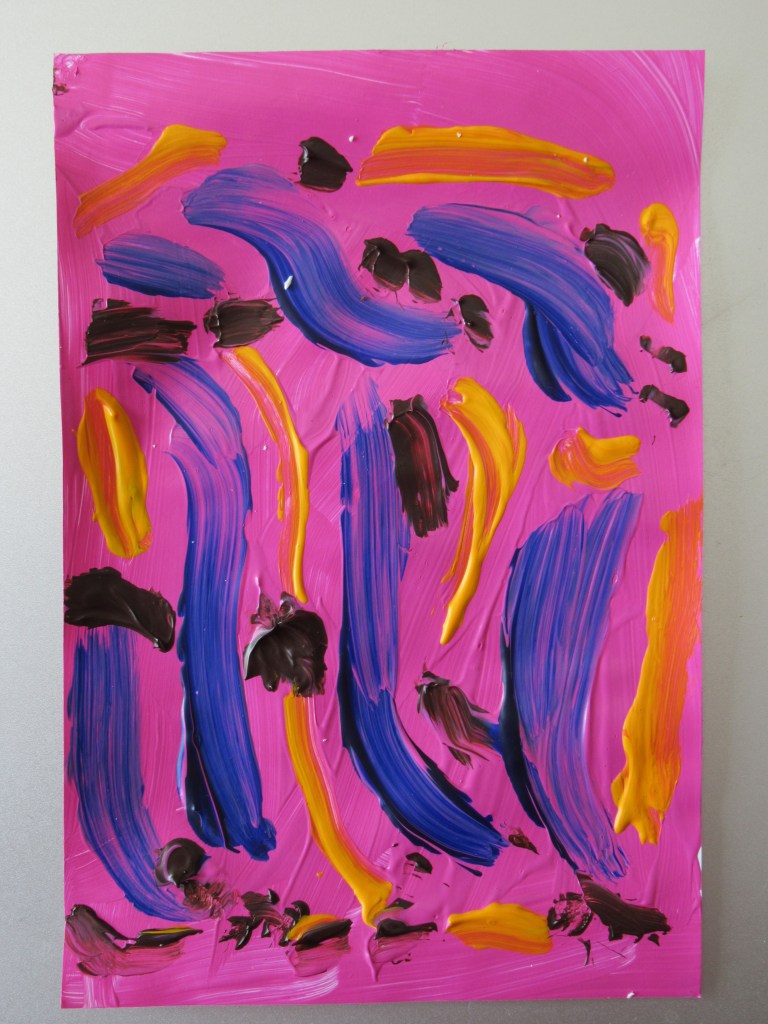
And yet, and yet, there is one. A long, long time ago, my father let me into a big secret: all the shops in our little sea-side town had signs that announced – Jones and Son, or Roberts and Son, or Edwards and Son. “Well, son,” he said, “I have a son, and it’s you. It is time I showed you my little secret.” He took out his pen, unscrewed the cap, and carefully drew an M. Then he drew a W beneath it, taking care that the ends joined neatly. Finally he drew the letter J. It bisected the letters so that the drawing in my painting above was produced: blue-black ink on white paper. “What is it dad?” I asked. “It’s my brand,” he proudly said. “Those are my initials. “I would love to establish something, use this as a brand name, and have ‘and Son‘ written beneath it.”
I didn’t understand. I can’t remember how old I was, but it was in the days when Shorty the Deputy [I pronounced it De-Putty, much to the amusement of my elders] Sherriff ruled the range in my colored comic books. “A brand? Why do you want a brand? Are you going to own a ranch and brand your cattle?” That ended the conversation. The brand was never mentioned again, until, now, but I have never forgotten it.
So, there is one brand with which I associate myself, my father’s brand. I entitled the painting remeMBEr in honour of my father, of his failed dreams, and of the dreams he achieved, including the initials MBE [Member of the British Empire]. The medal itself, together with the letter from King George VI is included among my family treasures. So, there we go – that’s the brand I associate with, my father’s brand.
when we two came together we closed an ancient circle becoming one with the standing stones that measure seasons and time
now we harvest the summers lilies lupins fox gloves blue bells a surfeit of wild flowers plucked from the maze of our days
we wait and watch the slow snow settling white on sarsen stone as time weaves crow’s feet into the corners of our eyes
2
i listen with my eyes to the words and thoughts of long-dead writers.
age-old and wise they walked alone along the hidden ways to set themselves free
they fled the royal courts where power and jealousy plotted twisted ways
cruel means justified by brutal ends. mindless quarrels bitter strife
i also ran away and slowing down i found an enviable life
enriched i live harvesting a wealth of goodness
days lived far from fear envy resentment distrust in wooded seclusion
Comment: I was invited to attend KIRA as writer in residence this month. However, a weakened immune system and a series of setbacks over the late summer made this impossible. That said, KIRA and the early morning light seen from the Red Room live on in my heart and I will try to complete my planned project, here in Island View, over the next month or so. Wish me luck.
My stamp album, of course. I am old enough to remember the joy of receiving letters from friends and pen-pals in far-away places with strange sounding names and oh, the joy of those colored squares of paper stuck in the top, right hand corner of the envelopes.
Then there were stamp dates, and stamp parties, where we gathered and swapped stamps, each trying to improve his or her collection. Not that I remember many young ladies saving stamps in those days, it seemed to be a boys only sport, like Conkers. I guess that was because those games were all dependent on one-up-man-ship. And yes, we have boycotts (some of them even open the batting for England), but I have never heard of girlcotts or one-up-woman-ship. I guess there are flaws in the language, all languages. Ceilings as well, probably – the height of linguistic folly.
Then there were stamp competitions when we could take our collections, more or less specialist, and show them off to our friends, admirers, and bitter rivals, hoping to gain fame and fortune. I for one never did. But I learned so much about the world, the rapidly changing world, as maps changed, borders changed, kings and queens changed, countries changed their names, divided their borders and morphed into something else.
Don’t forget those FDCs – First Day Covers – with their postal histories, not to mention the little booklets with the tear-out pages telling us all about Peter Rabbit, Flopsy Bunny, Mrs. Tiggy Winkle. and a dozen other tales. And then there were the special stamps – the penny blacks with their multiple Maltese Crosses, the Queen Victoria 9d green (mint), the Sea Horses, the French Painting Series, the Spanish Civil War stamps, issued on, and by, both sides of the conflict, and you mustn’t forget my own face as it appears on a Mexican do-it-yourself stamp, photo taken in Oaxaca, and the stamp sent back to Fredericton, NB, Canada, just for the fun of it.
My own stamp collection now sits in a cupboard, all covered in dust. I guess it is worthless. Nobody sends or receives letters anymore. Nobody collects stamps. Used stamps are now so much rarer. And those pristine new issues, so bright and cheerful, have never felt the lick of a lover’s tongue. And those envelopes have never borne the imprint of our secret messages – SWALK – PHTR – ICWTSY – and so many other little joys of a life that is long past, but never forgotten.
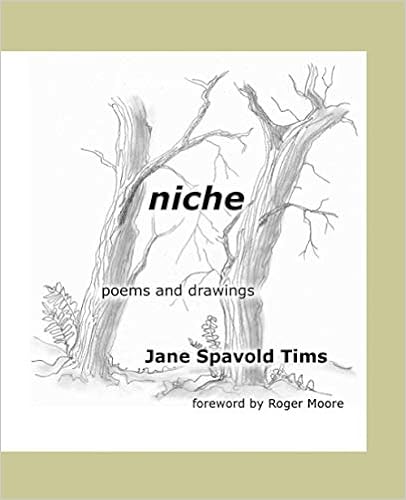
This is buy a book by a New Brunswick Author time, sponsored by the Writers’ Federation of New Brunswick (WFNB). Alas, so many New Brunswick authors are almost faceless to the wider world beyond the Province and the Maritimes. It gives me great pleasure, therefore, to highlight one of the books that I dearly love from a New Brunswick author, Jane Tims.
Here is my review of Jane’s book, first published (the review) on Brian Henry’s Quick Brown Fox (14 March 2021). Thank you, Brian, for the work you do in assisting and developing writers all across Canada – and beyond – and a special thank you for all you have done to help me over the years.
Niche, poems and drawing by Jane Spavold Tims, reviewed by Roger Moore
Independently published. Available from Amazon here.
Niche, the fourth poetry book published by Jane Tims, is a neat configuration of six segments that elaborate and illustrate the poet’s original definition of the multiple meanings of her title word niche.
It is difficult to separate the author from the act of narration as her keenly observed and skillfully executed drawings, together with their verbal representation on the page, are so autobiographical and so much an extension of her artistic and professional abilities that the objective separation of writer and text is scarcely possible. It is hard to forget that Jane Tims was, and to a great extent, still is, a highly competent professional botanist. The harnessing of the professional botanist, with her unique drawing skills and scientific knowledge, to the poet and auto-biographer is a key factor in the reading and interpretation of this text in which acute observation blends with an intimate knowledge of the observed botanical world, both flora and fauna, and this allows the poet, in her role of poetic narrator and lyrical voice, to weave a network of poems that are, at one and the same time, objective and intensely subjective.
The author emphasizes this when she writes in the Preface that “In biological terms, the niche is the quality of a space occupied by a living thing, the sum total of physical, nutritional, biological, psychological and emotional needs gathered together in one place.” She also reminds us that in human terms “niche can be a metaphor for home, community or personal space” and it is within these metaphoric spaces that the poetry text is elaborated. The text becomes a linked mixture of visual drawings, iterative thematic imagery and associative fields, all centred on the multiple meanings of niche. These terms are both biological and human in nature and the poet’s named world meets at this juncture between the human and the natural.
The section occupying space (1-19) bears the subtitle satisfying need and begins with a setting out of what this means in the following 12 poems and 4 accompanying drawings. The poem ‘apples in the snow’ with its companion drawing stands out for me.
The section strategy, subtitled solidifying position (21-43) outlines in poetic terms, how plants, animals, and humans ensure their own survival.
The section praying for rain, subtitled, avoiding danger and discomfort (45-68), offers views on discomforts and dangers. It also opens the discussion—relocate or stay where we are?
The section mapping the labyrinth or places I have occupied (69-83), which contains the wonderful sentence “When I get lost on the road ahead, I look to the road behind me,” throws open the multiple meanings of home.
The section new ways for water, subtitled coping with change (85-98), offers a double landscape, first, external, the things seen, touched, examined, remembered and described, and then the internal landscape that reflects upon them and is reflected in them.
Finally, forgetting to move, with its subtitle getting comfortable (99-111), presents an autobiography that links observer (the twin personage of author and narrator) to observed (nature, both flora and fauna, and the added element of autobiography and self) via the symbiotic relationship of botanist to botany.
Two moments stand out for me. (1) Sadness is in seeking the space that is never found. (2) Loneliness is in trying to return to a space once occupied but no longer available. The whole concept of the Welsh word hiraeth is summed up in these two lines. Carpe diem, Jane Tims’ poetry indeed seizes the day and, with its minute, intense observation, it preserves so many precious moments. It also pays attention to that which has been lost, those moments that are irretrievable. They will vary for each reader, but hopefully, like me, you will take great pleasure in discovering them for yourself.
Jane’s interview with Allan Hudson, another excellent NB author, can be found by clicking this link – South Branch Scribbler. The work of all NB authors should be celebrated over the first weeks of this month. Allan, thank you for supporting us – and you, too, Brian Henry. Living in NB, we need all the enthusiastic support we can get.








 rogermoorepoet