Fake News!

Fake News!

A long time ago, wrapped in the stifling chrysalis of academia, a friend of mine tried to flutter her wings by making a joke at a very serious conference. She was delivering a paper on one of my favorite Spanish poets, in which she examined the sundry variants of a sonnet that the poet first wrote in 1603, then re-wrote in 1613, revised again in 1627-28, and revised a couple more times before its final revision in 1643, about two years before his death (1645).

At the end of her paper, she was caught off-balance when faced by an apparently serious question from the audience “Did the poet make any more revisions after 1645?” In an effort at humor, she replied, “Well, actually, no. But when they were carrying his body to the church for the funeral, he popped his head out of the coffin and proclaimed in a loud voice ‘Hell, no, I won’t go. I haven’t finished revising the poem yet.’”

This off-hand academic pseudo-joke was greeted with a babble of excited voices and an elderly fellow scholar clapped his hands, exclaimed “Wonderful!” and, in the ensuing silence, asked her what documentary evidence she had for this astonishing revelation, hitherto unknown to the academic world. If she was off-balance before, she was clearly reeling at this stage: a punch-drunk amateur academic swaying before the hypnotic fists of Dr. Muhamad Ali. She smiled sweetly, said she would produce the proper evidence at the appropriate time, and left the podium.

Later, sharing drinky-poos with the some fellow scholars, I listened to her as she made excuses for her strange sense of humor and I smiled as she explained the situation to them. They were not amused. “You, madam, are an acknowledged expert in your field,” one of them told her. “Your fellow academics trust you and believe you when you make such statements. You must be very careful about what you say.”

Fake news, indeed!

Now I must make an apology on my own behalf. Alas, if you read one of the blog items I posted recently, you might be puzzled by the Gazunda tree. I am forced to admit there is no such thing, to the best of my knowledge, as a Gazunda tree, not in the main square in Oaxaca, nor anywhere else in the world. Of course, when it rains people have been known to go under certain trees to use them as an umbrella and thus to take shelter from the rain, but this is the full extent of the origin of the name: the tourist or the golfer or the walker or whatever goes under (say it fast — Gazunda) the tree when it rains. There is nothing more to the Gazunda tree than that little joke.

And this brings us to a really serious series of questions: how do we know things are true? How do we establish the truth of a statement? Why do we believe some people and not others, some facts and not others? How do we choose between a series of alternate truths all of them presented as factual realities when, in actual fact, not all of them are true? This leads us on to the basic foundations on which our knowledge is built: how do we distinguish between scientifically established facts, and hearsay, and gossip if we are ignorant of basic scientific knowledge and principles?

To this we must add the triple increases that threaten us. These are (1) the increase in the availability of real scientific knowledge that bombards us every day with fresh facts and new information; (2) the increase in sources of information and the easy access to those sources; (3) the fact that many of these sources, far too many in my opinion, present us with a fictional or heavily biased version of a pseudo- or alternate truth. And yes, in light of telling the truth, the whole truth, and nothing but the truth, we are indeed entitled to question the existence and indeed the very meaning of these words: truth and alternate truths.

Such questioning is present in the writings of some of the early-modern philosophers. This is exemplified in the following passage that comes, I think, from René Descartes:

“There is no earth, no heaven, no extended body, no magnitude, no place and that nonetheless I perceive these things and they seem good to me. And this is the most harrowing possibility of all, that our world is commanded by a deity who deceives humanity and we cannot avoid being misled for there may be systematic deception and then all is lost. And even the most reliable information is dubious, for we may be faced with an evil genius who is deceiving us and then there can be no reassurance in the foundations of our knowledge.”

“There can be no reassurance in the foundations of our knowledge.” These are chilling words and present us with the unfortunate fact that unless we ourselves, each one of us, to the best of our abilities search out the absolute truth about all we hear, say, and do, we are indeed lost and we must wander in the dark with no light to guide us. ‘A sad life this, when beneath the axe, we have no time to check our facts.’ 
Buy a Book by an Author from NB

Buy a Book by an Author from NB

This is buy a book by a New Brunswick Author time, sponsored by the Writers’ Federation of New Brunswick (WFNB). Alas, so many New Brunswick authors are almost faceless to the wider world beyond the Province and the Maritimes. It gives me great pleasure, therefore, to highlight one of the books that I dearly love from a New Brunswick author, Jane Tims.

Here is my review of Jane’s book, first published (the review) on Brian Henry’s Quick Brown Fox (14 March 2021). Thank you, Brian, for the work you do in assisting and developing writers all across Canada – and beyond – and a special thank you for all you have done to help me over the years.

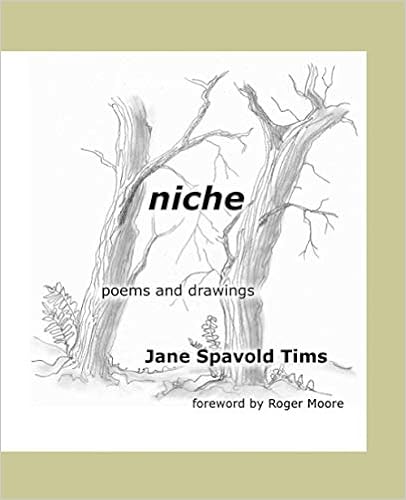
Niche, poems and drawing by Jane Spavold Tims, reviewed by Roger Moore

Independently published. Available from Amazon here.

Niche, the fourth poetry book published by Jane Tims, is a neat configuration of six segments that elaborate and illustrate the poet’s original definition of the multiple meanings of her title word niche.  

It is difficult to separate the author from the act of narration as her keenly observed and skillfully executed drawings, together with their verbal representation on the page, are so autobiographical and so much an extension of her artistic and professional abilities that the objective separation of writer and text is scarcely possible. It is hard to forget that Jane Tims was, and to a great extent, still is, a highly competent professional botanist. The harnessing of the professional botanist, with her unique drawing skills and scientific knowledge, to the poet and auto-biographer is a key factor in the reading and interpretation of this text in which acute observation blends with an intimate knowledge of the observed botanical world, both flora and fauna, and this allows the poet, in her role of poetic narrator and lyrical voice, to weave a network of poems that are, at one and the same time, objective and intensely subjective.

The author emphasizes this when she writes in the Preface that “In biological terms, the niche is the quality of a space occupied by a living thing, the sum total of physical, nutritional, biological, psychological and emotional needs gathered together in one place.” She also reminds us that in human terms “niche can be a metaphor for home, community or personal space” and it is within these metaphoric spaces that the poetry text is elaborated. The text becomes a linked mixture of visual drawings, iterative thematic imagery and associative fields, all centred on the multiple meanings of niche. These terms are both biological and human in nature and the poet’s named world meets at this juncture between the human and the natural.

The section occupying space (1-19) bears the subtitle satisfying need and begins with a setting out of what this means in the following 12 poems and 4 accompanying drawings. The poem ‘apples in the snow’ with its companion drawing stands out for me. 

The section strategy, subtitled solidifying position (21-43) outlines in poetic terms, how plants, animals, and humans ensure their own survival. 

The section praying for rain, subtitled, avoiding danger and discomfort (45-68), offers views on discomforts and dangers. It also opens the discussion—relocate or stay where we are? 

The section mapping the labyrinth or places I have occupied (69-83), which contains the wonderful sentence “When I get lost on the road ahead, I look to the road behind me,” throws open the multiple meanings of home. 

The section new ways for water, subtitled coping with change (85-98), offers a double landscape, first, external, the things seen, touched, examined, remembered and described, and then the internal landscape that reflects upon them and is reflected in them. 

Finally, forgetting to move, with its subtitle getting comfortable (99-111), presents an autobiography that links observer (the twin personage of author and narrator) to observed (nature, both flora and fauna, and the added element of autobiography and self) via the symbiotic relationship of botanist to botany.

Two moments stand out for me. (1) Sadness is in seeking the space that is never found. (2) Loneliness is in trying to return to a space once occupied but no longer available. The whole concept of the Welsh word hiraeth is summed up in these two lines. Carpe diem, Jane Tims’ poetry indeed seizes the day and, with its minute, intense observation, it preserves so many precious moments. It also pays attention to that which has been lost, those moments that are irretrievable. They will vary for each reader, but hopefully, like me, you will take great pleasure in discovering them for yourself.

Visit Jane Tims’ website here.

Jane’s interview with Allan Hudson, another excellent NB author, can be found by clicking this link – South Branch Scribbler. The work of all NB authors should be celebrated over the first weeks of this month. Allan, thank you for supporting us – and you, too, Brian Henry. Living in NB, we need all the enthusiastic support we can get.

Apologia

Apologia
pro vita mea

The fairground’s distorting mirrors distort.
I change as I walk past one and then another.

Rage, rage against that hump-backed shape
that looks back at me from the bottle-glass.

Magic: eye of a newt, eye of a toad, cat’s
eyes at night lighting the road to bed.

Bedlam all around me. Absurd this world,
gone carnival mad in the blink of an eye.

I need a white stick to walk through
this fog that clings to my clay-bound soul.

This wine I drink, these thoughts I think,
life’s fountain pen soon runs out of ink.

Watch the tides as they ebb and they flow.
When your time runs out, pack up, and go.

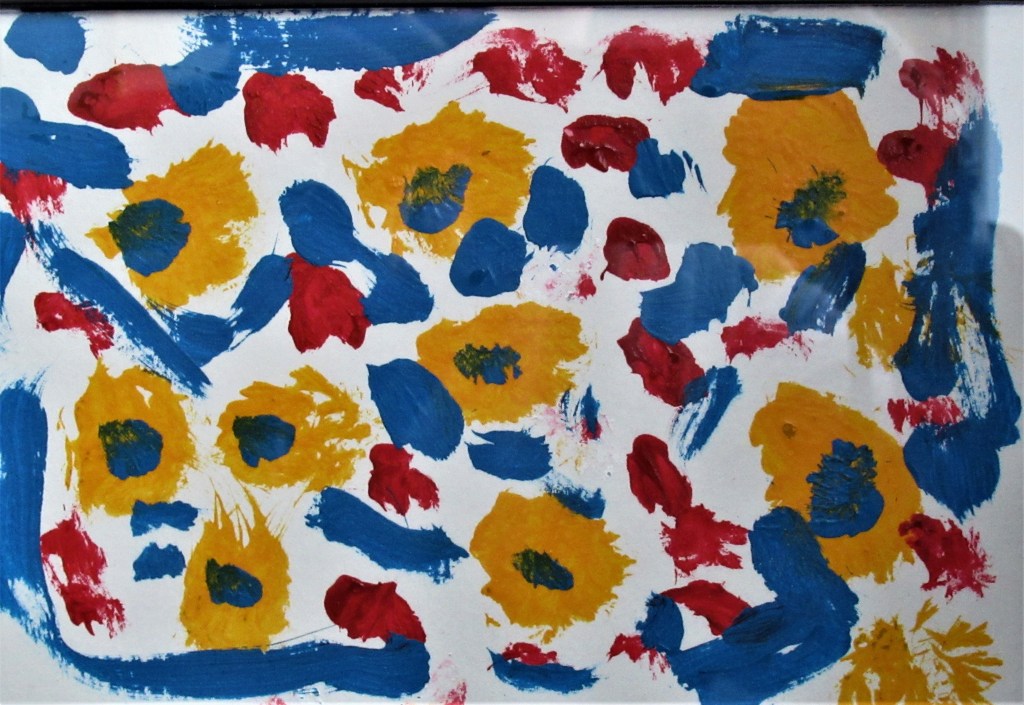
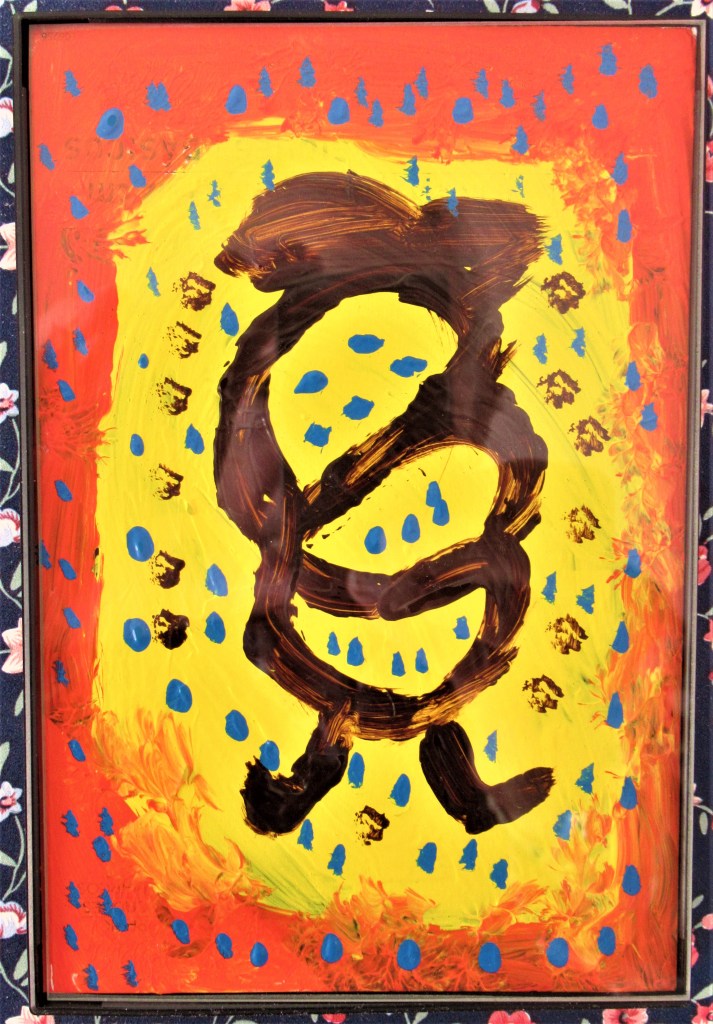
Comment: My friend Moo did himself proud with the above painting. What is it? I asked him. Dunno was his reply. I have shown it to several friends and speculation is rife: the dancer and the dance, dancer and diver, a blur of three figures, headless mermaid (I love that one). And yes, life is absurd (Albert Camus), a carnival (Bakhtin) in which knowledge is power and civilization is mad (Foucault).

Originality and imitation – how many genuinely original ideas are there? Very few. And the same goes for poetry – original poems are very rare. Most of our ideas come from elsewhere, even if we do not know it. The title of the above poem comes from Petrarch. It’s structure is traditional – a sonnet. Its ideas are borrowed from Camus, Bakhtin, Foucault. And yet, shuffle the cards (Cervantes) throw the dice (Mallarme’) and this poem and this post have both achieved a kind of originality and uniqueness by linking disparate ideas in a new unity.

Listen!

Listen

When I cannot write,
I take a paint brush,
and start to paint.

When I paint, I listen
to the brush as it moves
itself over the canvas.
I listen to the colors
as they demand attention
and tell me where to place them.

I listen to the paint as it says
‘just here, not too thick,
not too thin, a swirl please,
gently now.”

I also listen to flowers, trees,
the wind in the willows,
the songs of falling leaves,
and the voices of birds
that mourn their empty nests,
abandoned on the branches.

Comment:

This poem also came from yesterday’s prompt – what do you listen to? The act of ranting, based on a prompt, usually generates imagery and ideas that can then be used in either poetry or prose. For me, the secret is to cut away the dross and to search for the gems that are often hidden within verbal outpour. This leads, in my opinion, to enhanced creativity.

What do you listen to while you work?

Daily writing prompt
What do you listen to while you work?

What do you listen to while you work?

While I was actually working, although I never called it work, because I thought of it as a vocation, I listened to the complaints of the administration (often about my way of work). I also listened to my students (all too often their complaints about the system and the way they were being taught and treated). And then I listened to the problems that were daily laid before me in my office by these same students. These, problems and students, were many and varied. One day, I designed a label for my door that announced: Office of Creative Solutions. And yes, I provided many innovative and creative solutions to problems that, to young people, especially my students, seemed almost impossible to resolve.

Then I retired. At least, like an ageing horse, or an unwanted donkey, I was put out to grass. And in that clover-filled meadow, I grazed at leisure and worked no more. But I did have time to write and so I became a creative writer. At first, when I started creative writing, I forced my characters into the roles that I had chosen for them. Sometimes they complained. Then, one day, or maybe it was one night when I was dreaming, a host of my characters, minor and major, came knocking on my door. They carried a big arrow that had, written upon it, Office of Creative Solutions. They pointed it at me and began to complain about how I was treating them. I remembered the poem I had memorized as a child – The owl, he was a wise old bird, the more he spoke, the less he heard. The less he spoke, the more he heard. There never was such a wise old bird.

I remembered how I had listened to my students and how, by listening, I managed to find creative solutions to their problems. So, I listened to those characters as they yammered away. One by one, they told me their woes, and their problems. Then, the following day, I rewrote everything I had written previously and wrote the stories down in their own words, instead of mine. When I listened to them, I allowed my characters to tell their own stories, and to speak for me and through me.

Sometimes, when I run out of voices that come in the night and tell me what to say, I cannot write. Then I take a paint brush, and I start to paint. What do I listen to when I paint? I listen to the brush as it moves itself over the canvas. I listen to the colors as they demand attention and tell me where to place them. I listen to the paint as it says ‘just here, not too thick, not too thin, a swirl please, gently now.”

Now, when I am not working, I listen to flowers, trees, the wind in the willows, the songs of the falling leaves, and the voices of birds.

Waiting for Godots

Waiting for Godots

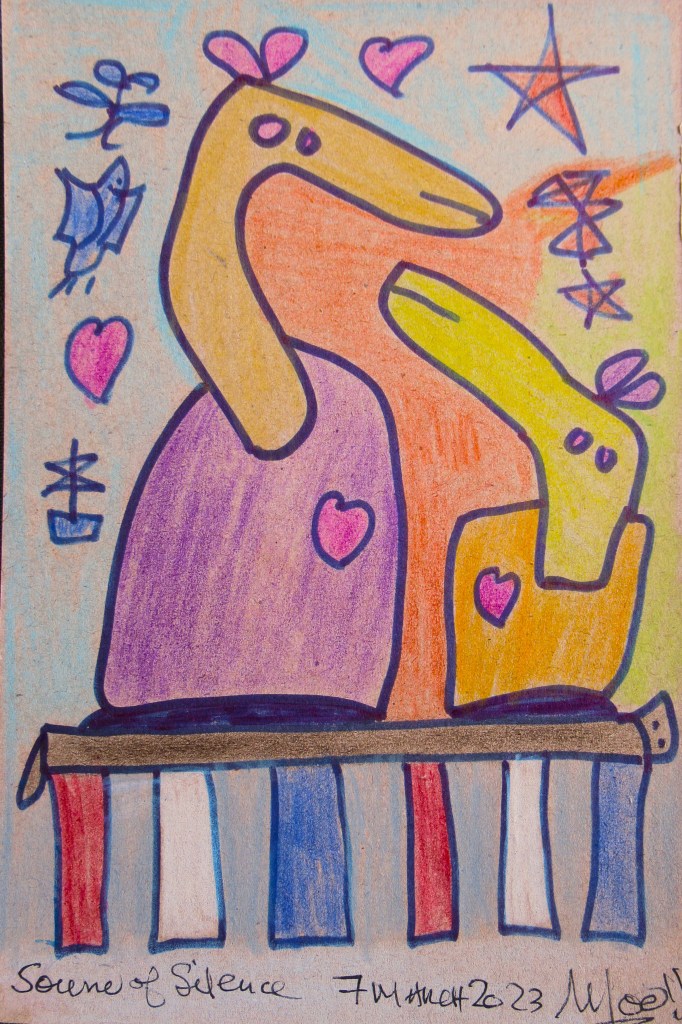
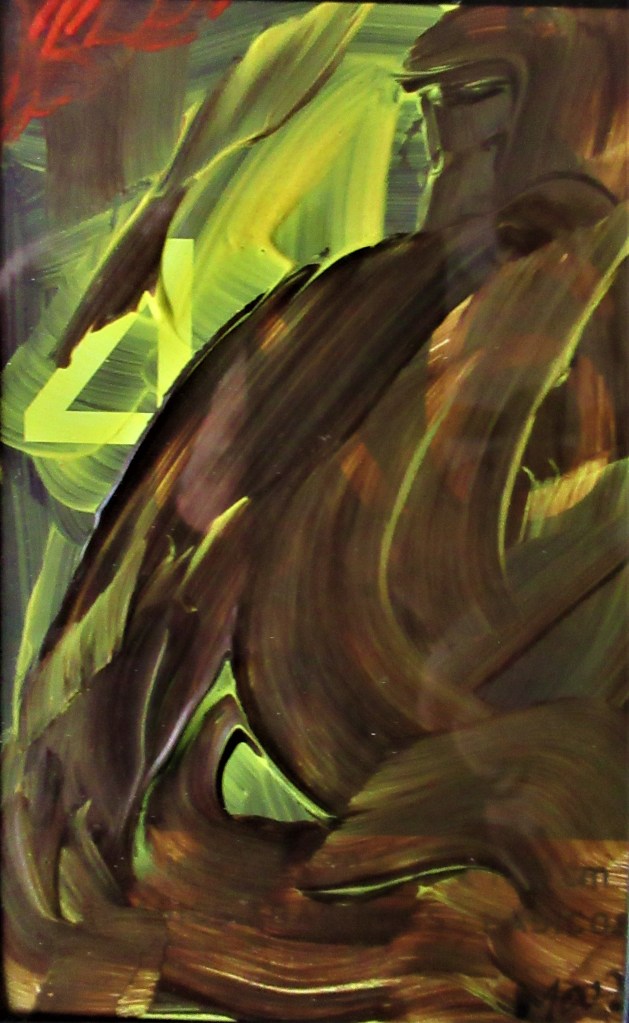
What do authors do when they send manuscripts to agents or presses? They have several choices. For example, they can listen to the sound of silence. Listen carefully to the paining above. What does it say to you? Absolutely nothing. Quite. It doesn’t communicate. It’s the sound of silence.

Another choice, they can read and re-read Beckett’s Waiting for Godot. Alas, in this case there are many Godots out there and all of them are super-busy gazing at their navels – and I don’t mean oranges. Some indulge in the wonderful world of “Mirror, mirror, on the wall…” and we all know what the answer is to that question. And we know what happened to Narcissus when he saw himself in the river water. Or have we forgotten? Our failure to share cultures is also a sound of silence – two solitudes, gazing at each other, neither one having anything in common with the other one, except maybe the weather. And we can’t always agree on that.

A third choice, they can climb into their dustbins, Queen’s English for garbage cans, and stand there waiting for someone to put the lid on so they can go back to sleep. Allusion / elusion – you don’t know what I am talking about? Well, maybe we are living in two separate solitudes. It wouldn’t surprise me in the least.

A fourth choice, they can take up painting, and scribbling, and drawing, and doing all sorts of things. But, if the phone rings and you don’t recognize the number – don’t pick up the phone. It’s probably a fraudulent scam call. And if you don’t know the e-mail address, put it in Spam and then block it. It’s probably some bot from another country trying to trap you into giving them your bank account details and signing your savings away. Whoever it is or they are , I doubt if it’s an agent or an editor!

A book is a book is a book

A book is a book is a book

“If one cannot enjoy reading a book over and over again, there is no use in reading it at all.” Oscar Wilde

A good friend of mine once told me that her creative writing writing prof in the MFA program told the class: “We are not writers. We are re-writers.” Our mission in life, then, is not just to rewrite, but to think and to revise. The art of writing lies in analysis, research, thought, and thinking carefully about (a) what we are about to write and (b) what we have just written. As a great Spanish writer once said “I write as I speak and when writing I count my syllables.”

So can the same principle be applied to reading? In my undergraduate poetry courses, one of my wiser profs announced that “It is better to read one poem a hundred times, than a hundred poems once.” Is re-reading better than reading? Good question. But it is what I call a swimming pool question: it has shallow ends and deep ends. Joke – it depends, you see, upon the quality of the material one is reading. For example, does a single reading of the Bible suffice? I read it through, page by page, when I was twelve years old. Was that it? No, I still return to it – the good book – from time to time, selecting, remembering, checking, looking for comfort, advice, or sometimes, pure joy in the sound of the language – King James version, of course.

What other books have I read and re-read? Lazarillo de Tormes, Don Quixote, The Hobbit, The Lord of the Rings, The first book in the Harry Potter series – it reminded me of elements of my own childhood, especially the cupboard under the stairs. Been there, done that, got the tee shirt. The Wind in the Willows, Gongora’s Polifemo, Quevedo’s Metaphysical Poems and his Cycle to Lisi. Octavio Paz’s Sunstone / Piedra de Sol, Lorca’s Romancero Gitano, his Poet in New York, and his plays. Platero y yo. Charlotte’s Web. Several of Shakespeare’s plays, including McBeth, Henry V, King Lear, and a couple more. Rudyard Kipling’s Kim and Stalky and Co. Mary Gentle’s Golden Witchbreed. Robert Bly’s Morning Poems, Iron John, The Sibling Society. Unamuno’s The Tragic Sense of Life and his Niebla. Enough, no more. It is not as sweet now as it was before. And there are so many more to which I have returned, again and again.

So, think about all the time wasted on trivial books, books that remained unfinished, books that have never been opened. One person’s vegetarian or vegan’s fare is a carnivore’s poison [sick]. Sometimes a book mirrors our thoughts. Sometimes it challenges us to rethink our lives and our philosophies. Sometimes it comforts us or takes us back into our childhood. And sometimes it just bores us and we cannot finish it.

A rose is a rose is a rose. A book is a book is a book. Or is it? We are not readers – we are re-readers. And if we aren’t, we ought to be. Think about that. Carefully.

Words

Words

Words grow like flowers, invasive,
cruel, beautiful, cutting, and when cut,
they wither and fade, like flowers too.

Catch them while you can, I say.
Catch them, hold them tight,
press them to you heart,
for time is voracious
 and will soon devour them,
 swallowing them in the black holes
of forgetfulness, carelessness,
and memory loss.

Shine a light on your words.
Underline them, grace them with stars,
think about them, carefully.

And remember, the word
once spoken or written
can never, ever be recalled.

Click here for Roger’s reading on Anchor.
Words

Boxing Day

Boxing Day

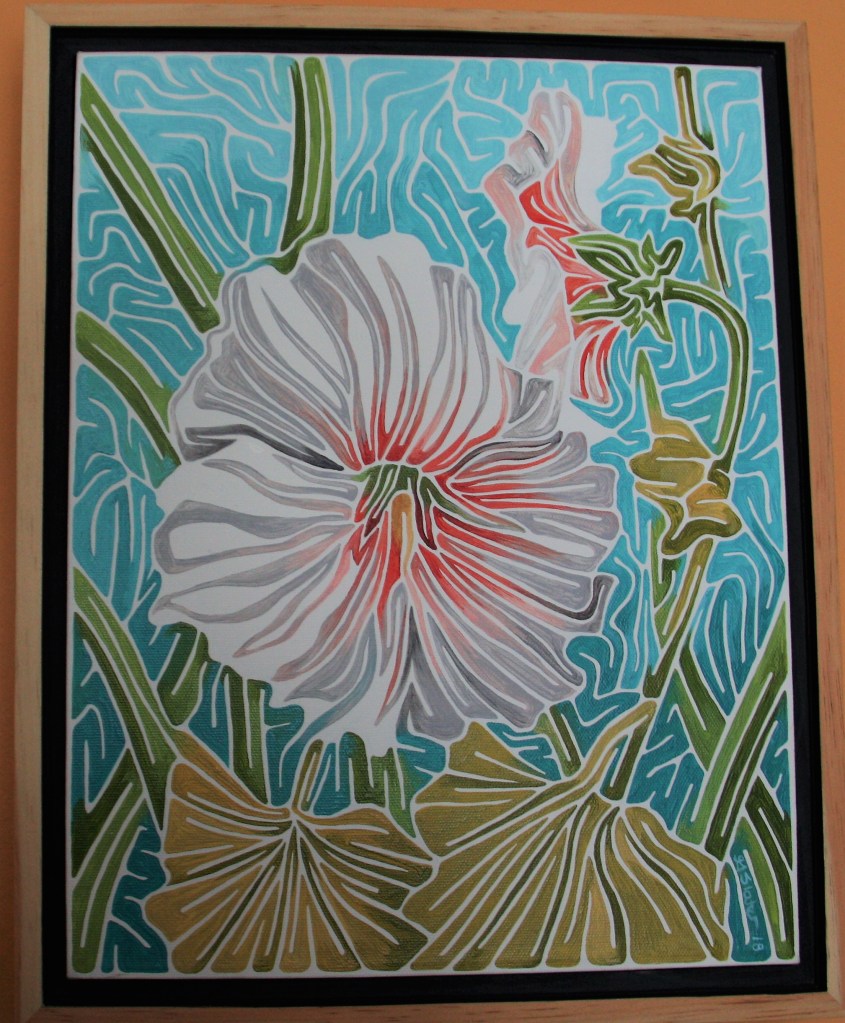
Still Life with Hollyhock
Geoff Slater

How do you frame this beaver pond,
those paths, those woods? How do you
know what to leave, what to choose?
Where does light begin and darkness end?

Up and down: two dimensions. Easy.
But where does depth come from?
Or the tactility, the energy, water’s
flow, that rush of breathless movement
that transcends the painting’s stillness?

So many questions, so few answers.
The hollyhock that blooms in my kitchen
is not a real hollyhock. Intertextuality,
visible and verbal: this is a poem about
a painting of a digital photograph of a
hollyhock, a genuine flower that once
upon a time flourished in my garden.

A still life, naturaleza muerta in Spanish,
a nature morte in French, a dead nature,
then, portrayed in paint and hung alive,
on display, in this coffin’s wooden frame.

Click on this link for Roger’s reading.
Still Life with Hollyhock

Comment: Back home in Wales, Christmas Day was for family and Boxing Day was for friends. I guess the same traditions still exist here in Island View. And what better friend than Geoff Slater? I met him in 2017 at the first KIRA residency and we have been friends ever since. We have worked on so many projects together: painting, creative workshops, videos, sound recordings, poetry, and short stories. He has illustrated several of my books, McAdam Railway Station, Tales from Tara, Scarecrow, and I have put some of his drawings to poetry, Twelve Days of Cat. Last, but by no means least, his painting of a hollyhock from my garden appears on the front cover of my latest poetry book, The Nature of Art and the Art of Nature (Cyberwit, 2021). The title of the collection, incidentally, came from sundry discussions we had on the nature of art and the Prelude: On Reading and Writing Poetry (pp. 7-31), was written at his suggestion. Poems to Geoff can be found on pp. 43, 44, and 61-62 of The Nature of Art.

So, Boxing Day is for friends. And I dedicate it to Geoff Slater and all the many friends I have made in KIRA, Kingsbrae, and throughout my multiple meanderings through the realms of academia, coaching with the NCCP and the NBRU, researching in communities like the ACH, the AATSP, and the MLA, various editorial positions on academic journals like the IFR, BACH, STLHE Green Guides, STLHE Newsletter, La Perinola, AULA, CJSoTL, Canadian Modern Language Review, Calíope, translating for different associations, including the Discalced Carmelite Nuns in St. Joseph’s Convent, Avila, and volunteering with STLHE and the 3M National Teaching Fellowship. To all those friends out there, including my friends and e-friends in TWUC, the LCP, and the WFNB, and those on Facebook, my blog, and my online Skype and Zoom courses and meetings, plus, of course, those I know via Quick Brown Fox, you are not forgotten. Here, for you, on Boxing Day, is a hug or a wave of the hand and a great, big thank you for being there.

Selection of my books
on the sea-shore at Holt’s Point.

Into the Sunset

Into the Sunset

So, the writing is back. I have reformatted The Nature of Art and the Art of Nature and am now checking it through one last time before I send it to the publishers. This feels good. I haven’t stopped painting though. Luckily the original, hanging on the wall, looks better than the photo. My angles are all wrong and the colours are definitely not as sharp as in the original. As I always said, when introducing Spanish Art via slides and photos: “Do not trust the imitations. Go back to the original.” Easier said than done, especially when the original may be tucked away in a foreign museum hidden in a small town. As Dylan Thomas once said of Swansea Museum: “it’s the sort of museum that ought to be in a museum.”

As for the Introduction of Art, and please note I do not write ‘the teaching of art’, here’s my article on my career as an art facilitator! ‘In the beginning was the picture and the picture was in the book.’ I guess my art career ran parallel to my career as a facilitator of Spanish literature, prose, theatre, and poetry. Some things you can present and introduce. But no, you cannot teach them, not unless you are completely without humility and understanding.

Now that’s what it is meant to look like!