Safety Blankets

IMG_5811_2


Serendipity, really, that the links below should appear so close together. First, Meg Sorick’s post on drawing toys  and childhood memories. Some of us can draw (well done, Meg, congratulations). Others can’t, and must take a line for a walk, or must color or crayon or live with their black and white memories. Yet we never forget these early comforters, these early friends.

Traumatic, sometimes, the separation of us from our childhood beloveds and then the substitution of wool and cotton, of Teddy and struggle from the flesh and blood that never quite fulfilled the hollowness within us.

“Grow up,” the grown ups said. And offered us a world of cynicism and misery.

I remember when I asked the priest (I was about 4 years old at the time) if I would see my dead dog when I got to heaven.  He told me that dogs didn’t have souls and I’d never see him him again. Tough luck. I was lucky. The dog wasn’t. Apparently that particular priest had never heard of the Rainbow Bridge.

‘You must grow up,’ he said.

“If that’s your reality,’ I said, echoing the words of Atahualpa, ruler of the Incas,  “I don’t want to go to your heaven, and I don’t want to grow up. Ever.”

“So what will you do, who will you be?”

“I’ll be Peter Pan,” I said. I think I was four, but I might have been five.

At an international conference, a few years ago, while I was still recognized, before the age of 65, as a real, productive human being, a young lady, hearing my strange, outlandish accent, asked me “Where did you grow up?” “I don’t think I have,” I replied.

Why do we have to grow up? Picasso said that he had spent most of his adult life learning to see the world once more through the eyes of a child. And why ever not? Metaphors, beliefs, myths, acceptance, understanding, friendship, openness, willingness to learn  … things that are gradually worn away as hierarchy, authority, obedience, socialization are taught to us by those who think know best.

Are these the ones who also brought us so many things that are wrong with our world? The inability to think for ourselves, fear of authority, the need to fit in and be accepted, fear of the mob, the crowd, of those who believe in what they are told to believe. The fear of the other. The need to destroy that which we don’t understand.

Advertisements? I love them and sing them all day long. Tee-shirts with slogans? Wonderful. I wear them and show them proudly to my friends. Sound bytes? I never question them and I circulate them to my friends. For ‘whether I think for myself or no, I’m sure is only touch and go’. You may or may not recognize the poet, but I do. I was born less than a mile down the road  from him. You’ve probably never heard of him, but I have.

Accept my poet-neighbor and reject what modern society throws at me? It’s a difficult choice, isn’t it? How do we choose and why? What do we think and why do we think it? Or do we just follow the mob, the herd instinct, the sheep?

“If there were five sheep in the field, and one got out, how many would be left? Mary.”

“None, miss.”

“What do you mean, none? What’s one from five, Mary.”

Mary was the local farmer’s daughter. She didn’t think like that.

“No, miss,” said Mary. ” Sheep don’t think like that. If one got out the field, the rest would follow. There’d be none left.”

Terrible mathematics. Wonderful sheep psychology. A young creative mind thrown on the rubbish heap of ‘true’ knowledge at five years of age. Dismissed as an ignorant fool. What a pity.

And what’s wrong with Teddy Bears and childhood toys? I love them. I still have my daughter’s Paddington Bear beside my bed. Yellow Sou’wester, yellow welligogs, for those who know what they are. Here’s Meg Sorick’s take on my folly:

https://megsorick.com/2018/12/09/the-year-of-drawing-adventurously-week-49-toys/

Who is Meg Sorick? In my own mind, she is a bright, intelligent human being, who looks upon our ageing and cynical world with childhood in her mind, and intelligence in her paint-brush and her pen.

As for the real world? What’s it all about, Alfie, Bertie, Cecily, Dewi?

Living in my own world, with a creative Joey in my Kangaroo pouch, not really Roger the Ripper Roo, I honestly don’t know. A Marsupalian view of the universe? Why ever not? If you can believe in the koala, and the marsupials, and the kookaburra, and the platypus duck, you can believe in anything. Read the linked article below about childhood teddies … if you dare … I did … many won’t.

https://www.theguardian.com/society/2018/dec/12/still-have-childhood-teddy-psychological-power-toys-we-keep




Rejection

IMG_0023.JPG


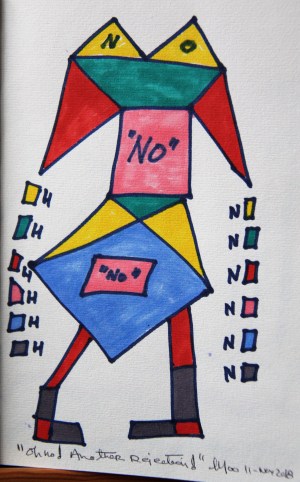
“Oh no, another rejection!”

“And rejection equals dejection, or doesn’t it?”

“Only if you let it get you down. I wait until I am in a foul mood and ready to tear things to pieces because my mean streak is surfacing. Then I go to my rejections pile, re-read the rejection letters, then read again the pieces that have been rejected.”

“Why on earth would you do that?”

“Above all to work out why the work was rejected. What did the editors see that I didn’t? When I write, I wear rose-tinted glasses and all my little babies are the prettiest, the strongest, the fairest in the land, especially when I give them the ‘mirror, mirror on the wall’ test.”

“I’ve never heard of that.”

“It’s simple: you look in the mirror and ask ‘Who’s the fairest writer of all?’ and the mirror answers ‘Why, you are, of course.’ If you believe that, and as writers, we often do, then rejection becomes a hard realistic rock, shattering both Ego and Id. The immediate response is to deny the editor’s taste and judgement. It is amazing how many stupid, dumb, and uncultured editors there are out there. They hate us and don’t understand us.”

“That’s true.”

“No it isn’t. The fault, dear Brutus, lies in ourselves, not in our editors, that we are not great writers. Understand that, and you have a chance to succeed and to improve. Re-reading allows me to try and understand what went wrong, why the mirror lied, how the rose-tinted glasses distorted the actuality of the written page. Understand the other and how the other perceives what and how you write and maybe, just maybe, you can condition yourself to improve. Many budding writers are dropped on stony ground and fall by the wayside. Others land in the desert and their things of beauty bloom where nobody sees them. Some fall on seemingly fertile ground and earn an immediate immortality that fades in a season when the fad wears off. A few writers, an occasional few, go back to the drawing board and water their flowers with the sweat of their brow. Eventually, if they are lucky, their work may be accepted.”

“You always preach the bus story, Julius.”

“Of course I do. Get off the bus early, and you’ll never finish your journey. Remember Sir Walter Raleigh: ‘it’s not the beginning, but the continuing of the same until it be thoroughly finished that yieldeth the true glory.’ He didn’t sail the Golden Hind around the word by setting up house in Cadiz and living in luxury on a beach in the south of Spain. He continued on and on, always forward, until he arrived back in his home port.”

“So we must just keep going, then?”

“Of course. But never blindly. Take criticism to heart, remembering that it comes from another’s heart. Learn from your mistakes. Correct them when you find them. Never give up.”

“You’re always happy, Julius. I bet you never get rejected.”

“Oh I do, Brutus, I do. And each rejection is a dagger to the heart. But I keep going. For example, last week I received my fifteenth consecutive rejection. So much work, so much genius, and all denied.”

“But you’re still smiling.”

“Indeed I am. I have just received my second acceptance in two days. I no longer feel betrayed by my editors.”

“I’ll never betray you, Julius.”

“You will, Brutus, you will. Never fear, et tu, Brute.”

Anniversary

Empress 048


Anniversary

Kicked him out, she did, just like that. Told him to sleep in the spare bedroom. She couldn’t take it any more. She couldn’t sleep. He had to go.  It was the diuretic that did it, mind, the diuretic.

After the radiation treatment, they gave him hormone injections, told him he’d put on ten to fifteen per cent of his current body weight, but not to worry. It was quite natural. It was the hormones, see?

He stood on the bathroom scales without a care in his heart. Watched his weight rise, five per cent, ten per cent, fifteen per cent. When he reached twenty per cent, he started to worry. Swollen ankles. Swollen knees.

At twenty-five per cent, he was really worried. Socks no longer fitted. Couldn’t put on his shoes. Couldn’t bend to tie his laces. Had to wear sandals and slip-ons.

At thirty per cent, he started to cry. He was ugly, so ugly. He was down to one pair of shoes and one pair of sandals that fitted. He went to the pharmacy. The pharmacist took one look at his feet and gave him a long list of Latin names. Told him he’d need a perscription, from his doctor, to get pressure socks, and medical shoes that would help him walk.

“It’s the feet, see, the feet. Once they start to swell, you’re in big trouble. There’s nothing we can do. Go see your doctor.”

“I’ve seen the doctor.”

“Go see him again.”

So he did. Broke down crying when he entered the surgery.

“I’m down to one pair of shoes. You’ve got to do something, doc.”

So the doctor wrote him out a perscription for pressure socks, medical shoes, appointment with a psycho-something, attendance at a clinic, everything he wanted. Then, just as he was about to leave, the doc stopped him.

“Hang on a sec,” he said. Sat at the desk. Checked the computer. Wrote out another perscription. “New tablets,” he said. “Take these yellow ones. Stop taking those brown ones.”

He went away happy. Stopped at the pharmacy. Got the new pills. Went home. Took them. And straight away started to pee. He peed all day and he peed all night. Every 15 minutes. That’s when his missus kicked him out of bed.

“Go,” she said. “Every fifteen minutes. I can’t stand it.”

So he went. Grabbed his faithful Teddy Bear and went to the spare room with its cold, lonely bed. Except he had his Ted.

Lost four pound that first night. Twelve pound the first week. Twenty pound the first month. God, he felt good.  Tried to get back to his own bed. Missus wouldn’t let him in.

“Go sleep with your Teddy,” she said. So he did.

He’s looking pretty good now. Back down to ten per cent body weight up. Says he can live with that. Likes sleeping with his Teddy. Says it doesn’t snore. Or kick. Or punch him. Unlike his missus. It’s the first anniversary next week. He says he and his Teddy are doing fine. They’re going to have a Teddy Bears Picnic to celebrate.

No, sorry, I don’t know what his missus thinks about that.

Coat of Arms

coatofarms.png


I’ve never yearned for a coat of arms. All those advertisements for this and that, DNA tests to prove your ancestry, where your family name comes from, how many famous people were in your past, how many convicts … and the convicts were often poorer family members, wallowing in poverty and forced into theft, money, a loaf of bread,  a chicken, a lamb, some eggs, something to feed the children, to pay the bills … the possibility of blue bloods and royalty outweighed by the probability of some dark skeletons swinging on gallows somewhere in the distant past.

Yet when I got my online advent calendar this year, there was the coat of arms game … make your own coat of arms. So I did. The choices were very limited, not too original, and came with a ‘clan history’ that has absolutely nothing to do with me. A bear and a dog … I can live with those, especially as the bear is apparently my Canadian spirit animal. A Welsh dragon draped round the top of the frame … wrong color and definitely not Y Ddraig Coch, the blood Red Dragon of Wales, but still a symbol I can happily live with. Down below, we have Sun and Moon, the symbol of Oaxaca and title of the first book in the Oaxacan Trilogy (first published in 2000). Unfortunately, I have reversed the symbols to give us Moon and Sun. Oh dear. Such things happen.

Then we have a snowman and a beer tankard. Sounds good to me. I have now lived in Canada for more than fifty years in Canada and I know all about snowmen, and the taste of beer, sometimes mulled, to take away the cold. I am not so sure about ‘my clan’ as I don’t really think that I have one. I feel it is a very foreign term  like Hi there, gang. I can take Robin Hood and his Merry Men, but Roger and his Merry Gang, no thank you, that’s not for me. Sorry. As for ‘throughout the land’, I wonder which land they are referring to: Wales, England, France, Spain, Mexico, Canada … I don’t really feel that any of these stand up as my ‘land’ … except possibly for Canada, and as for Canada, well, this land is enormous. I have certainly visited some of it, but by no means all, and there is so much more to see and hear.

‘In Battle’, well, I have never been in a battle. I dislike violence and fighting, and I cannot imagine how a phrase like that got in there. ‘Fierceness’ same thing, I am as mild as milk and very easy-going. ‘Loyalty’, yes: that’s what the bear and the dog are famed for. ‘Us bears never forget’, or words like it, from the Chronicles of Narnia. Oh dear, there I go … I can hear mother bear now … ‘Stop sucking your paw’.

Seize the day is goodCarpe Diem … but never in battle … in poetry, maybe, or else in gathering old age where every moment of every day seems more and more precious. I wold have preferred Horas non numero nisi serenas, but they didn’t have that one, even though, nowadays particularly, it is the happy hours that I count, and not all of them spent in a local bar, or home alone, with my own beer mug.


SNAFU 2

IMG_0167.JPG


SNAFU 2

            I drive to the hospital through falling snow. No wheel-chair parking when I get there. Damn. Not a walking-stick person hobbling towards a car in a wheel-chair space and nobody sitting in a car, exercising the engine, reverse lights glowing. That means  a normal parking spot. Unless I drive round again and take a second look. I do just that. SFA. Nothing doing. The usual SNAFU.

            I drive to the normal person’s lot, stop at the gate, lower the window, stick my arm out, but I can’t reach the button that will give me a ticket and raise the barrier. Behind me, the impatient parkers are a nose away from my rear bumper. Nothing doing. Arms too short. I open the door. Seat belt holds me back. Someone toots. I undo the seat belt. Lean out. Push button. Take ticket. Ticket falls onto ground. The gate opens. I get out of car. Slip on ice. Fall to knees. Cling on to car door with one hand. Grab for ticket with other. More people toot. I give them a one finger salute. Fall back into car. Finally drive through gate.

“Round and round and round I goes.
Where will I park? No one knows.”

            Vast car park. Not a parking spot in sight. On the third circuit, someone un-parks right in front of me. I drive straight in to the vacated spot. Too fast. Car skids on ice. Oh no! Close, but no contact. Thank God. I’ve now got a spot about 100 metres from the hospital entrance. 100 metres. I used to run that distance in 10.07 seconds. With snow underfoot, even with my stick, I’ll be lucky to walk it in under five minutes. Drat. I am already late for my appointment.

            I hobble to the foot of the steps and arrive there just as two large women, faces covered and dressed in voluminous head to foot robes start to walk down. They are arm in arm and enormous. One has a hand on the right-hand rail, the other a hand on the left. Together they take up the whole stairway. I wait for them to descend the twelve steps. They start to descend, then stop three steps from the bottom and engage in animated conversation. “He also serves who only stands and waits.” And waits. And waits. When they finish talking, they descend the final steps and the one on the right swings her arm and shoulder, nearly knocking me down. I lurch forward, grab the hand-rail to save myself from falling, and move slowly upwards. I hold the rail in my left hand, my stick in my right, and climb one step at a time, always the right leg first. Heart thumps in chest. Arteries surge. My head pounds. 12-11-10 … 3-2-1 …zero. I am at the top. I’ve made it.

            I start to cross the road. Half-ton hell bent to park in now vacant wheel-chair spot nearly runs me over. I recoil. Start to fall. Get a grip with my stick. Lurch a little. And salute the driver. He doesn’t even turn his head. Bastard. Balance regained, I get to the hospital door. Young boy holds it open for me. “Thank you,” I say. “You’re welcome, grandpa,” he smiles. I hobble down the hall. Punch a simpler machine to get my number. Wayne Gretzky. Number 99. My luck has changed. The board shows #98. I am next.

            Humorless, the lady who calls my number. Bad-tempered. Cold her little cabin. “Hello, bonjour,” she says and I reply in French. Grim glance. Speaks to me in English. Goes through the gears. “Have you fasted?” “No.” “Why not?” “They didn’t tell me to.” It’s here on the computer,” she stabs the screen with an angry digit. “It wasn’t on my piece of paper.” She checks the paper, sniffs, and tut-tuts. “You should have fasted.” My middle finger itches. “Can you pee in a bottle?” “I can try.” “Try hard.” “Wouldn’t it be better if I tried soft?” I get vicious, filthy look. “None of that or I’ll call the supervisor.” I read out loud the notice on her desk: Do not place samples on counter. “What do you think I am?” I ask. “A travelling salesman?” “Eh? What’s that?” “Nothing,” I mutter. She rumbles round, produces the usual plastic bottle and a see-through bag. “We need a sample. You know how to take a urine test?” “Of course I do, I studied all last night, didn’t I?” She grunts. I grunt back. I pick up my papers and my little gifts. And off I go to perform pee-pee.

            The stalls are empty. I walk right into one. Hang stick on door. Free hands. Open bottle. Strain. Nothing. Man comes in whistling and washes hands. Running water. Miraculous. Pee-pee flows. Bottle overflows and I soak hands and fly. Shit. Well at least I don’t have to perform that trick. Yet. No plastic potty and accouterments this time round. I grab stick. Move to the washbasin. Wash hands. Go to door. Press the automatic door button. The door doesn’t open. I pull again, harder. Nothing. I hang my stick and my bottle on the automatic door button and pull the door with both hands …

“Doors marked ‘Pull’ reduce the speed,
of those who ‘Push’ before they read.”

            The man on the other side of the door stops pulling and pushes hard, very hard, just as I pull, hard, very hard. Door flies open. I topple over backwards, hit my head on the floor, and see multiple stars. I have just enough time to wish I’d brought my plastic potty before my world turns smelly, then black.

On The Outside Looking In


IMG_0192.JPG


Billy was walking home on his own. As usual. The church party was awful. As usual. Lots of trumped up noise and artificial gaiety.

The priest had made the boys sit in a circle on the floor, legs crossed. Then he put a bar of chocolate in the middle of the circle. He walked around the group and whispered the name of an animal secretly, he loved secrets, to each one.  Then he explained the game to them.

“I cannot remember what animal name I bequeathed to each boy,” he said, staring at them, his eyes golden, like a fierce eagle’s, beneath bushy black eye-brows. “I will say the name of an animal until one of you, whoever it happens to be, hears his own secret animal name. When you hear that secret name, you must grab the chocolate bar before anyone else can get it. Understood?”

The boys all nodded and the mums and dads who had brought them to the party smiled in anticipation.

“Are you ready?” He watched the boys as they nodded and shouted “Alligator!”

Nobody moved.

“Elephant!” The boys shuffled forward, like inch worms, hands twitching, fingers flexing and grasping.

“Tiger!” A sigh from the boys, some of whom were already licking their lips.

“Lion!” One boy moved, but the priest shooed him away. “Sit down. I didn’t give the name lion to anyone.”

“M-m-mouse!” The boys heaved, a sea-wave about to crest and break.

“I do love this game,” said the priest to the parents. “And so do the boys, don’t you boys?”

“Yes father …”

“Monkey!” All the boys moved as one. Some crawled, some dived, some leaped to their feet and ran. A surging heap of boys writhed on the floor as the chocolate bar was torn apart and the long awaited fights ensued.

All the boys moved, except one. Billy just sat there.

“I said ‘Monkey’, Billy,” the priest frowned at the boy.

Billy nodded.

“When I say ‘Monkey’, you join in with the other boys and fight for the chocolate bar.”

Billy nodded again.

“Go now and have some fun. Join in the game.”

Billy shook his head.

“Why not, Billy?”

“It’s a stupid game. I won’t play it. I want to go home.” Billy stood up and walked out of the church. He turned at the door and saw the priest glaring at him while a mound of boys continued to scrummage on the floor.

As Billy walked, it started to snow. Not the pure white fluffy snow of a Merry Christmas, but the dodgy, slippery mixture of rain, snow, and ice pellets. Billy turned up the collar of his coat and, bowing his head, stuffed his hands into his pockets. He turned the corner onto the last street before his own and stopped.

A house. With a window lit up in the gathering dark. He drew closer, pressed his nose against the window and looked in. A Christmas tree, decorated with lights, candles, more decorations, a fire burning on the hearth, two cats before the fire, presents beneath the tree, stockings hanging from the mantelpiece. For a moment, Billy’s heart warmed up. Then he thought of his own house. Cold and drafty. No lights, no decorations. No fire. A snowflake settled on Billy’s heart and refused to melt.

When he got home, the house stood cold and empty. His parents were at work and the fire had gone out. Nothing was ready for Christmas. Billy sat at the table, took out his colouring book and began to draw the cartoon you see at the top of this page.

When his mother came home, he showed her his drawing.

“Very nice,” she said, barely glancing at it.

“But mum, you haven’t really looked.”

Billy’s mother stared at the picture again. This time, she saw the Christmas tree and the lights, the cats and the candles, the decorations and the presents. But she never noticed the little boy standing outside in the snow,  peering in through the window.


P.I.S.S.

IMG_0170.JPG

I found the acronym PISS in the below the line comments section in the Guardian. I love it: apparently it stands for Post Imperialist Stress Syndrome, another lesser buzz-word from the referendum and its aftermath. It refers to the idea that a whole (and elderly) generation of Brits cannot get over the fact that they no longer have an Empire and yes, they want their Empire back. How that is going to happen is anybody’s guess.

So, here’s the weather forecast: heavy rain over Britain during Brexit. In fact, to use a local saying the rain will indeed be “pissing down”. For a while, everybody can wear rose-tinted glasses (you can see them in the cartoon), but soon enough reality will return and then the reconstruction of British Empire 2.0 can begin. The rich won’t suffer: they never do. But what will happen to those who are currently staggering under the current burdens of austerity? Nobody knows and the only ones who really care are the sufferers themselves.

Eau Canada: it’s great to live in a bilingual country where such fractures can be faced and overcome. Yet who knows what fractures face us in the future as we predict fires, floods, high winds, ice storms, power losses, and a host of climate change adaptations that will be as difficult to surmount as the political changes voluntarily sought by a small majority of 2% in a referendum where only 60% of the people voted.

As the Chinese curse would have it: “May you live in interesting times.” Whatever your beliefs, your faith, your vote, your IQ factor … interesting times are indeed upon us. But keep them at a safe distance from me, s’il vous plaît … And let’s watch it all unfold in virtual reality on the telly … I prefer to live my life that way.

Ghosts

IMG_0125.JPG

How many ghosts loom out of our past and stand over our beds at night ready, willing, and waiting to enter our dreams and haunt us? I guess we all have them. But, like the animals in Animal Farm, where some are more equal than others, I guess some of us are more haunted by our childhood past than other people are.

What haunts me most from my childhood? Loneliness, rejection, and abandonment, I think. An only surviving child, I was sent to boarding school at a very early age. This initiated the sense of rejection. In my own mind, I was clearly being thrown out and equally obviously, nobody wanted me around. This reinforced my sense of abandonment. Rejection and abandonment were complicated by loneliness. When I came home for the holidays and talked about ‘school’, nobody in the family knew what I was talking about, because nobody in my family had ever been to a boarding school. My school experiences were foreign to the rest of the family.

We lived in a working class area of Wales. It didn’t take long for my ‘posh accent’ to further single me out and this led to even more torment inside and outside the family. I will not repeat some of the things that were said, but I have never forgotten them. Only recently have I begun to understand what many of those words and snide comments actually meant.

“Sticks and stones can break my bones,
but words will never hurt me.”

The old Welsh proverb seems to ring true. I certainly got the sticks and stones, above all the sticks, daily beatings and canings in school. Back home, the words swarmed like black-fly and yes, they stung, hurt, and did a great deal of damage, much of which still clings around me.

Loneliness: how important was that? Both my parents worked, so when I was home from school for the holidays, I was either at home all day during the working week, alone from early morning until late afternoon when my parents came home, or fostered out to family members, not all of whom wanted me around. Many, many days I spent at home, on my own, face pressed against window panes, waiting, watching the eternal rain.

There were some blessings: I learned very early how to cook and I have carried the love of cooking with me always and everywhere. For me, cooking is a joy, a filler of space and time, a beloved occupation that dispels loneliness, and abandonment, and fear. Cooking: the thinking, the planning, the creativity, the activity … I hated cleaning up afterwards, always have. But, it’s amazing how many people love you, and love to hang around you, when you know how to cook, and how to cook differently and well.

Why do I write about this now? Well, I read this article on trauma and addiction a few minutes ago and it moved me greatly. Clearly it’s time for me to face some of those past ghosts and to banish them from my life. Can I do this? I don’t know. But I’ll give it a WIGAN, a jolly good try.

Rain / Il pleut

IMG_0144.JPG


I remain fascinated by Guillaume Apollinaire’s Calligrammes. I first met them when, as a  teenage flâneur in Paris, I wandered the quays along the banks of the Seine, entranced by the literary treasures of the bouquinistes. Eighteen years old, I had just been released from a twelve year sentence to a boarding school education (6-18 years of age). I loved the freedom of Paris and the joys of choosing my own poets and my own poetry books will always stay with me. Apollinaire was not a set text. He was a personal discovery and a true  joy. I remember the light blue cover and the worded rain drops inscribed upon it when I bought my first Livre de Poche, the poems of Apollinaire.

Caligrammes are out of fashion now, their virtues taken over by the joys of concrete poetry. I still write some, drawing them out by hand. I find this much easier than planning them on typewriter or computer, though I have done both. The cartoon – poem hybrid, printed above, is my intertextual reflection on Apollinaire’s original Rain / Il pleut which can be found on page 62 of the above link from Le Mercure de France.

I look at the snow steadily mounting outside my window and I hope that we will not see rain for a long, long time. Not until Easter and the welcome warmth of spring. That said, I miss the rain. It was a constant part of my childhood and I remember spending day after day, head pressed to the window pane (yes, I do know how to spell it), watching the raindrops sliding down while behind me, the old coal fire threw out enough heat to warm me in my daily loneliness.

Run, Turkey, Run

IMG_0117.JPG

Do turkeys vote for Thanksgiving or Christmas? Good question. An equally good question, do turkeys have a democratic vote? Well. I doubt that. If they did, they would probably vote for vegetarians and vegans, and who could blame them? I certainly wouldn’t.

One of my memories of the Dominican Republic is seeing young ladies standing on corners by the highway with chickens and geese beneath their arms. The birds looked very excited to be out, flapping and squawking at their moment of liberty. Every so often, a car would stop, a bird would be exchanged for cash, and off it would go, flapping and squawking happily away with its new family. Little did it know the fate that lay in wait. I am reminded of Boxer, in Animal Farm, promised freedom and an after-work-life of clover-filled pastures only to be led unceremoniously into the rag-and-bone man’s truck, destined for the glue factory.

I am reminded too of the Quebec referendum and Separation H. The vote was close and, as the Parizeau man said: “as soon as they have voted ‘yes’ we have them in the lobster pot.” The lobster pot, the roasting dish: Thanksgiving, Christmas, Brexit, Separation H … oh boy, the joys that await us as we mark our little square boxes with their little neat crosses, never remembering the crosses, row on row, that mark the graves in Flanders Fields where all those lovely poppies grow. ‘Sheep unto the slaughter’, thought the French troops as they bleated like sheep while marching towards the meat-mincer of Verdun. A voiced protest, maybe, but not really a mutiny. In spite of that, 1 in 10, 10%, the true meaning of decimation, were then shot by their own side … for mutiny. Afterwards, the offending regiments were forcibly broken up. Clearly, the authorities didn’t want the war effort affected by the voicing of any hint of the realities of that war.

So, my fellow democrats, liberals, free-thinkers, and well-wishers: let us link hands and join in the Lobster Quadrille, or if you’d prefer the YouTube version, click on the second link. And while you are waiting for the link to appear you may as well sing that sublime chorus so often associated with Separation H:

“Parizeau, Parizeau:
is it yes or is it no?
Parizeau, Parizeau:
into the lobster pot you go.”