Wet Welsh Rain

IMG_0730 (2)

Wet Welsh Rain

              Day after day, rain, drives in over Singleton Park and Swansea Bay. It claws its clouded way, shroud clad in grey cloud, up Rhyddings Park Road, through Brynmill, and up to the Uplands and Sketty, as it was then, now Sgetti. In those days, the rain got everywhere. It swirled around ankles and knees wetting everything below the hem of the raincoat. Umbrellas kept the shoulders dry. But when the wind blew, and gamp and brolly turned inside out, and people looked as though they were duelling with the wind, and threatening to poke each other’s eyes out, then a good soaking was sometimes better and safer and, in the worst of the rain and the wind, the gamps and brollies came down.  As for the puddles: they were everywhere. You walked in them, whether you wanted to or not, and your leather shoes turned into a pulp that let in water. Socks slopped around your feet, wetter than soggy blotting paper aka blotch [hands up if you remember blotch!]. Heads down, we faced the wind, draped around bus stops, waiting for buses that never came singly, but only in threes after much long suffering. Wind like a whiplash drove the rain before it and everywhere, woolen scarves turned into wet wash cloths and woolen gloves became underwater rain-sodden mittens.

Comment: As Tropical Storm Arthur gathers in the North Atlantic, we would do well to remember the good old days of summer holidays in Wales when it rained every day, bob dydd, during the whole two-week vacation. But did it really rain back then? Who remembers now? I seem to remember it was sunny every day, especially when the cricket was suspended with the words Rain Stopped Play displayed across the television screen. Ant the lunch time cricket scores: what joy to listen to them and to discover one day, as I listened on my illicit radio hidden in my school dormitory,  that play had been stopped because of “piddles on the putch, sorry, I mean puddles on the pitch” [hands up if you remember that announcement!]. I am sorry to say that particular radio announcer did not stay in his job for long. A great pity: I found him rather amusing.

We would do well, too, to recall the twelve days without electric power that followed Hurricane Arthur, back in 2014 [hands up if you remember Hurricane Arthur!]. Alas and alack: how accurate are our memories? And did all of those things really happen? As the street vendors and newspaper vendors [hands up if you remember paper boys!] used to cry out on street corners “Echo, Echo, South Wales Echo: Read all about it” or “Post, Evening Post, South Wales Evening Post, read all about it!” The South Wales Echo and the South Wales Evening Post hands up if you remember them … Oh those were the days … or were they? … click here and read all about it!


Limbo Dancing

IMG_0724 (2)

Limbo Dancing

Yesterday I went limbo dancing
in the bedroom mirror.
Lower and lower I danced
until I fell into the mirror
and became my reflection.

Rough were the waters.
I know how to swim, but
I thought I would drown,
except the light was too shallow
and my feet touched bottom
when I let down my wheels.

I swam on and in
looking for a deserted island
on which to build
my idle, sandcastle dreams.

Two people said they saw
my reflection swimming,
a goldfish in a silver space.

They said I stared back at them
with circles of longing
ringing my eyes, but I laughed
when they said they had seen me,
for when I looked in the mirror
that reflected the mirror,
I saw myself limbo dancing,
stranded between
heaven and hell
in a dance hall called Virus
where I drank Corona.

Whose eyes watch me now
as my video goes viral
and I twist and I dance
in a fantasy land
filled with sweet nothings.

Finisterre

fundy 05 mist+wolfepipers 081

Finisterre

Nothing left now but this pain in my heart.
It makes me think about ageing, growing old,
that unstoppable process of the body’s slow,
inevitable breaking down from all to nothing.

I should probably go to the doctor, but what
can she, will she do? She can’t stop the hands
on my body clock and lop ten or twenty years
from my life. Nor can her pills, lotions, potions

gift me with the long-sought magic of the Fountain
of Youth. The truth, unwelcome as it is, is that
the day I was born I took my first steps on the path
to death, my own death, an inescapable law

that tells me that body and spirit will be forced
apart, that the flesh will wither and perish,
and that the person the world and I know as
me will no longer be able to hold together.

Comment: Finisterre, the Pillars of Hercules, the Nec Plus Ultra beyond which there is nothing, Terra Incognita … that spot in Newfoundland where my friend, Dr. Leo Ferrari, who founded the Flat Earth Society, stood at the edge of the world and looked at the horrible void below him which ended in nothingness.

Nihilism is the point of view that suspends belief in any or all general aspects of human life, which are culturally accepted. Most commonly, nihilism is presented in the form of existential nihilism, which argues that life is without objective meaning, purpose, or intrinsic value. Moral nihilists assert that morality does not exist at all. Nihilism may also take epistemological, ontological, or metaphysical forms, meaning respectively that, in some aspect, knowledge is not possible, or reality does not actually exist.

The term is sometimes used in association with anomie  to explain the general mood of  despair at a perceived pointlessness of existence that one may develop upon realizing there are no necessary norms, rules, or laws.

Nihilism has also been described as conspicuous in or constitutive of certain historical periods. Many have called post-modernity  a nihilistic epoch and some religious theologians and figures of religious authority have asserted that post-modernity and many aspects of modernity, represent a rejection of theism, and that such rejection of theistic doctrine entails nihilism. All the above is borrowed shamelessly from this Wikipedia article on nihilism.

What this leads to is the danger of losing our faith in these troubled times. G. K. Chesterton wrote, a long time ago, in the century before last, that people who lost their faith were inclined to believe anything. Please, do not believe everything and anything you hear. For example, no, Leo, my friend, the world is not flat. And no, my beloved readers, drinking Chlorox or Drano will do you much more harm than good. In fact it may well turn you into the nihil [Latin for nothing] from which nihil-ism is formed.

More important: believe in life, in positivity, in the light that will shine through this darkness. Believe, as Our Lord Don Quixote [thank you, don Miguel de Unamuno, for that wonderful book, and thank you also for gifting us with your philosophy in The Tragic Sense of Life] believed that yes, we can see all of this through and that yes, we are the children of our deeds, and that yes, as my friend Pedro Calderón de la Barca told me a long time ago, obrar bien, to do only good, be the best that we can be, that’s what really matters in this vale of tears and shadows, this tv reality show that we call life.

Don’t tell me

IMG_0624 (3)

Don’t tell me your troubles …

… words wrapping themselves around your neck, the tune a loose scarf, brilliant in the sunshine, and so warm, flapping as you walk the street … people see frayed ends … wave back at you … the sun picking out gold spots in your hair … all’s well with the world … a marching song … the world walks over the hills … and far away … you march to work or play … every day is a new day … blood stirring with this call to arms … to alarms … everything up for grabs … tunes in your head … words wrapped around you  … warming you …
… a sad song … rain drops falling … mist or mizzle … you walk through damp, low clouds … you are sad … but comforted … wrapped warm in a verbal comforter … the sun breaks through … throws its arms around you … hugs you …. until raindrops radiate … gathering on eye-lash … at leaf’s end … twinkling an abundance of radiant flowers …         … a Nor’easter … snow in the air … on the trees … on the ground … a steady accumulation … you know how it is, East Coast Canada … down by the Fundy …  a fire in the fireplace … warm heart … warm hearth … no travel today … books and computer beckon … a time to read … to write … to remember the old ways … the old days … those memories … a warm scarf wrapped around the neck … and the comforter … so comforting … so much to wrap around you … so much to wrap your head around …

Downsizing

image1 (53) - Copy

Downsizing
Francisco de Quevedo

I chose each book, held it in my hands for
one last time, then placed it peacefully in
its cardboard coffin. Old friends, they were
but I broke that friendship and set them
free to fulfill their promised after-me-life
on another person’s shelves. I used to love
to listen to their lilting speech, to hear sage
thoughts with open eyes and mind. I replied
to their wisdom: words penned on each page.

Mind to mind, though they had lived five
hundred years ago, I strove to engage them
in a lively conversation, Bakhtinian dialogues
within our shared time and space, and
that space my basement library with its books.

One day, a man from the university drove up
in a hearse and bore them all away. Released
to a wider world beyond my walls, they will
nourish younger minds than mine. I hope their
new owners will bless them, welcome them,
cherish them, as I have done throughout my life.
Blind now, with tears, my eyes that devoured
their words. Deaf now, these ears of mine that
heard dead men’s words, for I can listen no more.

Comment: “Escucho con mis ojos a los Muertos / I listen with my eyes to the words of the dead.” Francisco de Quevedo (1580-1645). It was a hard thing to do, that disemboweling of my library, but it had to be done. I am grateful to the Harriet Irving Library at the University of New Brunswick for taking pity on my plight and redeeming my books. Hopefully they will have all gone on to a better life. It was sad to walk past them, to watch them slowly gathering dust, like a book on a shelf, as Elvis used to sing. It was even sadder to know that I would ever be able to peruse them all again, let alone read them from from cover to cover, certainly not in this life time.

And is that my own fate, to be reduced to words on a page, to become a dusty book lying forgotten on a shelf? Pobre poetas de hoy,  wrote my friend and fellow academic poet, José María Valverde, destinados a ser polvo seco de tesis doctoral / Poor poets of today, destined to become the dry dust of doctoral theses. So: my thought for today … rise up and resist. Take an old friend off the shelf. Dust him or her off. Open the pages. Settle down for a moment or two. Breathe deep. Begin your conversation with your long lost friend. We may not be close in the flesh, distanced as we are by lock downs and separation, but we can become closer in our minds. Pick up one of my books. Dust me down. Read me. Begin that conversation. Now. Before we too are gone, swept down stream by time’s river and lost in the mists that curtain the sea.

And, just in case you thought that last line was very good and very unique and original, here’s the conversation it came from: Nuestras vidas son los ríos / que van a dar en la mar, /  que es el morir / our lives are the rivers that will flow down to the sea, which is death (Jorge Manrique, 1440-1479). I had that conversation with Jorge Manrique in Santander in the summer of 1963. His Coplas was on the pre-university reading list at Bristol University, placed there, I believe by Salvador Bacarisse who was related to a long line of Spanish musicians and poets. If memory serves me well, our first essay, in our first week, in our first year of Spanish, entailed writing a commentary on the Coplas and how to read and understand them.

Si jeunesse savait, si vieillesse pouvait / If youth knew how, if old age was able to (Voltaire). I wish I knew then what I know now. And I wish I could do now, some of the things I could do back then. Meanwhile, do not despair: pick up one of my books or browse my blog for a poem, and have a short and hopefully profitable conversation with me as you listen to my failing voice with your younger eyes.

White Wolf

IMG_1843 (2)

White Wolf
Rhodri Mawr

Winter’s white wolf
shakes ice from her coat,
makes snowflakes fly,
blanches our world.

Nose pointed skywards,
she howls a North wind
straight down from the Pole
as we shiver indoors.

Snow gathers in the air,
thick as winged moths,
then drops to the ground,
plays dead in deep drifts.

Snow banks climb higher,
blotting out light.
Soon, Arctic cold will wrap us
in its endless night.

Avila 2008 381 (2).jpg

White Wolf  in Island View


Comment: Y blaidd gwen yn y gaeaf / The white wolf in winter, translated from the original Welsh of an anonymous Gŵyr poet, circa 1613. Oh I do love messing about with images and words. I don’t have a photo of a white wolf, so instead I have posted a photo of my lapdog, Tigger, who weighs in at 115 lb. Tigger, of course / wrth gwrs, is a delicate champagne color rather than white. When he sheds hair in the summer known in the doggy trade as ‘blowing his coat’, it is like a snow storm coming off the back porch. The nesting birds and the chipmunks and squirrels can be seen carrying chunks of his fur back to their nests. They will keep wonderfully warm, wrapped in the raggle-taggle gypsies torn from coat. There are several jokes and pieces of misinformation or weird humor, woven into my poem. I wonder how many you can spot? Each of my poems is a puzzle, in one way or another, so have fun solving the riddles!

The Rain in Spain

Avila 2008 164.jpg

The Rain in Spain

The rain in Spain
stays mainly on the plain.
Except it doesn’t.

It falls on the Basque Country,
the Province of Santander,
now known as Cantabria,
on Asturias and on Galicia.

In Galicia, a native brown bear
has been seen after an absence
of one hundred and fifty years.

La Costa Verde, the Green Coast,
boasts dairy cattle, lush grass,
the best milk, butter and cheese.

Beyond these green hills,
over the Escudo and up to Burgos,
you find Spain’s meseta,
a tableland in a rain shadow area,
a veritable plain,
arid, dusty, dry,
a plain in Spain
that sees and feels no rain.

Comment: Un chubasco … a heavy downpour building on the meseta outside Avila. These severe rainstorms come out of nowhere. High winds, heavy rains, they drench you and the countryside in a matter of seconds and they go as suddenly as they come. However, the normal pattern of weather is dry and dusty. And no, the rain in Spain does NOT stay mainly on the plain. In Santander, on the Green Coast, la Costa verde, they have a saying: En Santander, en el verano, / no dejes el paraguas de la mano In Santander, in summer, never let your umbrella leave your hand. And its true: rain is constant and comes in from nowhere. They have other sayings, equally as efficacious, like Nunca llueve en los bares / it never rains in the bars. I miss Avila. I miss Santander and the Basque Country. I miss my childhood vacations, spent in Spain. But when they tell you that “The rain in Spain falls mainly in the plain” … well, just don’t believe them. Check, double-check, and then check again. As they sing in Newfoundland, about sailors and sailing ships, “A sailor ain’t a sailor ain’t a sailor anymore.” Nor, my friends, is the truth. Cum grano salis: take everything you hear with a large pinch of salt!

Avila 2008 205.jpg


Applause

DSC02548

Applause

All that I hear
around me:
the mixing and matching
of shingle and stone,
waves hissing,
grinding the beach down
as they move in and out.

Comment: We are surrounded by news, fake news, false news, and systematic deception. What can we now trust? I no longer know. But I do know that the above poem is not nihilistic. It expresses the reduction of applause and insubstantial glory to the minutiae of the daily doings of the natural world, in comparison to which we humans are nothing. “Look on my works ye mighty and despair” … hand gestures, smiles, thunderous applause from the chosen gathered to bear witness and paid to applaud, whatever the event. Alas, I cannot say it as well as Shelley. Here’s his Ozymandias (11 January 1818).

I met a traveler from an antique land
who said: “Two vast and trunkless legs of stone
stand in the desert . . . Near them, on the sand,
half sunk, a shattered visage lies, whose frown,

and wrinkled lip, and sneer of cold command,
tell that its sculptor well those passions read
which yet survive, stamped on these lifeless things,
the hand that mocked them, and the heart that fed:

and on the pedestal these words appear:
‘My name is Ozymandias, king of kings:
look on my works, ye Mighty, and despair!’

Nothing beside remains. Round the decay
of that colossal wreck, boundless and bare
the lone and level sands stretch far away.”


Doing Time

IMG_0687 (3)

Doing Time

Time bends like a boomerang,
flies away,
comes flying back to
the thrower’s hand.

Endless this shuffle.
Unmarked days
drop off the calendar.

Hands stop on the clock.
The pendulum
swings back and forth
but nothing else moves.

‘As idle as a painted ship
upon a painted ocean.’

Yet the seas seem to move,
the winds seem to blow,
the sails seem to swell,
while our garden
fills with birds
and squirrels,
light and dark.

Morning ablutions.
Each day is a twin
of the day before.
Like wise each week.

The TV screen fills up
its washbasin of tired
looking faces bore us
with their endless wisdom.

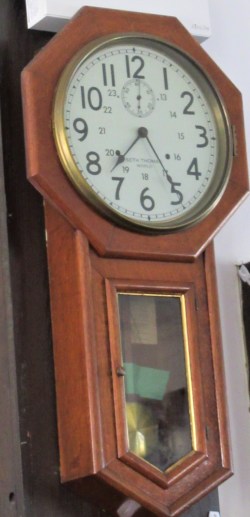
Time hands heavy:
an albatross around the neck,
or an emu, an ostrich,
a flightless dodo,
an overweight bumble bee,
too heavy to fly.

Comment: An interesting article that I read today suggests that the lock down is bending time out of shape and that we need to adapt our minds and our body clocks to a new temporal reality. Seconds hang heavy. Days present the same routine. The routine makes the divisions between each day seem irrelevant. This is what my Spanish friend and teacher, the poet José Hierro, meant when he wrote about his time in jail as a political prisoner after the Spanish Civil War: “El tiempo aquí no tiene sentido” / time in here has no meaning.

A similar effect is noticed by those of us who were imprisoned in boarding schools from an early age. The first day back, we draw a railway train at the beginning of a long track and we number each day from the beginning of term. Then we cross off the days, one by one. Often, before the first week is even over, we forget about counting the days: they are all the same, lookalikes with a rhythmic similarity that sends us to sleep as routine takes over and we sleepwalk through life.

How important is time? How important is it to distinguish Monday from Wednesday, Friday from Thursday, this Saturday from a week on Sunday? It becomes less and less important. The TV chatters on and on. The shows we follow illuminate our days. I turn on the radio at five on Friday for Cross Country Check Up, which airs on Sunday. I go without breakfast and don’t even notice that I haven’t eaten. I make a cup of coffee and it sits there on the table with the cup of tea that I forgot to drink this morning. Each time I take my tablets, I write that fact down so that later in the day, I can check that I have actually taken them. The notes mount up and the bottles of tablets run down. Each mandarin orange has a tiny key and I wind those oranges up so they will go tick-tock as I eat them. My Teddy Bear has an alarm clock between his legs and a flashlight in his ear so that I can tell the time on cloudy nights when I can no longer see the Platonic dance of the rotating stars.

Garbage Day

image1 (17) - Copy.jpeg

Garbage Day
(1789 AD)

all the dustbins
dancing down the street
trying no doubt to achieve
a spring time copulation
so they can give birth
to even more dustbins

you can’t have a revolution
without dustbins
dusty … dusty … filthy
dusty dustbins
a sadistic way to look at
dustbins full of sawdust
heading off down the street
between potholes
and blowing bins
a right Danse Macabre
conducted by
St. Vitus

me sitting there knitting
Montreal Canadians
this Red Cap
I keep flying high

even though I stand
upon Gibraltar’s Rock so fair
not to mention Paris
the Place de la Bastille
with tumbrils rattling

Old Moll in a Moll’s Cap
toothless fairy
at a Goblin Party
watch out
for toad s’tools
[sick this poem
this joke

and all that’s in it]

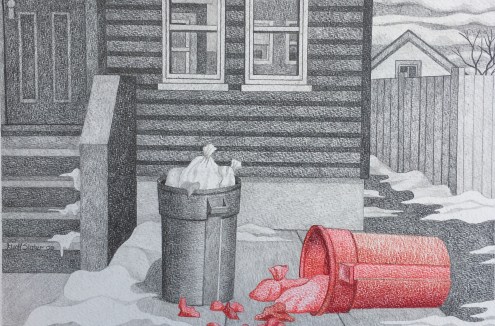
Comment: A wonderful drawing by my friend, line painter Geoff Slater. The poem, of course, represents the garbage in (and out of) the garbage can. 1789 is the date of the French Revolution. I found this poem in my discard file, so it was one of those that didn’t make it anywhere. Maybe it shouldn’t have made it here either. But it takes all sorts to make a world and Geoff’s red dustbin reminds me of the red caps knitted by the old women beneath the scaffold and the guillotine. Funny things, guillotines: invent them and they drop on you when you fall out of favor. There are so many allusions in this poem that I am ashamed to say I remember them all, and not all of them are pleasant. Mind you, few things are pleasant nowadays and remember: it is better to leave your dustbins out to roam the streets and be plundered by the crows and swept away by the high winds than to leave them festering and smelling bad and all cooped up in the locked down garage.