Last night, a cataract of flame flowed down the cathedral wall. A wooden bull danced in the square, sparks struck fire from his horse-hide hair. A red speck on my shirt burned through to my skin.
Today a heart of fire burns in an iron barrel: who will be chosen for the daily sacrifice?
A sharp blue guillotine poised between buildings: this slice of morning sky. Scorched circles, open mouths: wide-open butterfly eyes burn holes in the crowd’s dark cloud of a face.
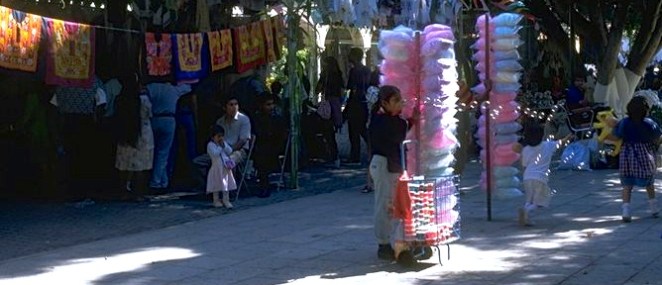
A street musician stands in the shade beneath the arches playing a marimba. Sun tip-toesits danse macabre across bamboo tubes. Sunlit bubbles float dreams across the square.
Dreams are important throughout mythology.Do we create them ourselves?Or do they come to us as celestial messages?Can they exist without us?Or do we form a symbiotic relationship, each dependent on the other?
Dreams
I once stole the nose from a sacred statue. Today I watch it cross the square attached to a face. Eight Deer walks past with a fanfare of conches: you can tell him by his donut with its little tail.
A shadow moves as zopilote wings his way across the square. I spoke with him once on a midnight bus. He begged me to fold his wings and let him sleep forever.
A gringa called Nuttall sells tins of watery soap. Her children fill my days with enchantment as they blow bright bubbles through a magic ring.
Eight Deer, eight years old, sets out on his conquests. Nine Wind births nine of his people from flakes of flint, or was it from the magic tree in Apoala?
The voices in my head slip slowly into silence. Sometimes I think they have no need of me, these dreams that come at midnight, and knock at my window. Other times I know they cannot live without me.
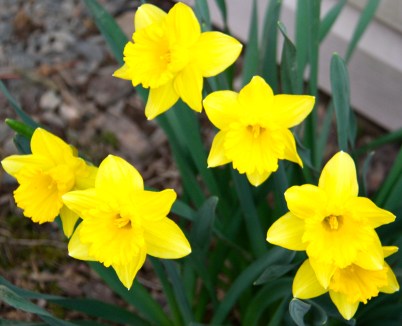
March 1 is St. David’s Day: Dewi Sant, patron saint of Wales. While we are here, immersed in cold and snow, in Wales, spring is arriving, the daffodils are out, trees are budding. This poem is a reminder that winter will end and sunshine and spring will return. So for St. David’s Day, I wish you joy and hope.
Earth to Earthlings
“Get out and about,” she told me. Take off your socks and shoes. Walk barefoot on the earth and grass: twin pleasures, you can choose.”
I took two canes, one in each hand, and left the house to walk the land.
In the garden I took off my shoes to walk barefoot on the lawn; when grass sprang up between my toes I was instantly reborn.
I stood in the shade of the crab apple tree and let leaf and flower spill over me.
Sunlight took away my frown and freckled a smile on my face. I was blessed again with hope and light; earth and grass filled me with grace
When white blossoms filtered down they gifted me a flowery crown.
I stooped to reach my shoes and carried them home in my hand, maintaining as long as I could my contact with this magic land.
The iguana that guards the front door of our house. At night he comes alive, goes round on patrol, checking and securing everything and everybody. Beware the jaws that bite, the claws that clutch!
Striations
There are striations in my heart, so deep, a lizard could lie there, unseen, and wait for tomorrow’s sun. Timeless, the worm at the apple’s core waiting for its world to end. Seculae seculorum: the centuries rushing headlong. Matins: wide-eyed this owl hooting in the face of day. Somewhere, I remember a table spread for two. Breakfast. An open door. “Where are you going, dear?” Something bright has fled the world. The sun unfurls shadows. The blood whirls stars around the body. “It has gone.” she said. “The magic. I no longer tremble at your touch.” The silver birch wades at dawn’s bright edge. Somewhere, tight lips, a blaze of anger, a challenge spat in the wind’s taut face. High-pitched the rabbit’s grief in its silver snare. The midnight moon deep in a trance. If only I could kick away this death’s head, this sow’s bladder, this full moon drifting high in a cloudless sky.
Comment: a fitting ending for the month of February: ubi sunt? Where have all those days gone: Ou sont les neiges d’antan?
Duermeivela: that time when the waker dreams he is waking, yet is still asleep. His mind wanders through a labyrinth of old memories, streets and squares, myths and legends. It is a mythical time of great creativity. To wake up from it is to be filled with hiraeth: a longing for all that is lost and can never be recaptured.
Daydreams
The alarm clock shuffles its pack of sleeping hours: a clicking of claws, needles knitting outwards towards dawn’s guillotine.
A knife edge this keening wind sharpening my bones tingling fingers and toes.
Ageing eyes refurbished in the morning’s sky fire. Ravishing rainbows dazzling the eyelash of day.
Old myths grow legs. They wander away to gather in quiet corners, where the wind weaves dry leaves into endless figures of eight.
An old man now, I dream of white rabbits, running down tunnels, escaping the hunter’s hands.
When my dreams break up, they back into a cul-de-sac: a wilderness of harsh black scars.
Scalpels, my finger nails, carving red slashes on white-washed walls, trenchant shadows, twisted dancers, old warrior kings bent into pipe wire shapes.
Light in dark bright yellow stridence shrill golden dog’s bark to warn off death’s wolves that freeze her blood
she dreaded night’s unease the devil’s wintry anti-spring life’s darkest sparks
but loved the daffodils’ sunny March cadence of brief piercing dance
Comment: A Golden Oldie. My mother loved daffodils and planted them all over the garden in Cardiff, Wales. They are the national flower of Wales and break into blossom just in time to welcome St. David on St. David’s Day, soon to be upon us, Dydd Dewi Sant.
Daffodils A poem for the lady who brought some to us when Clare fell
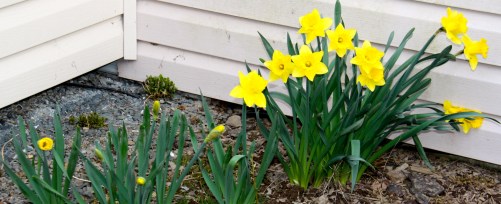
Daffodils in our garden, last year in Island View. We won’t see the live ones until May, at the earliest. I dream of them at night, tossing their heads in sprightly dance’, in Roath Park and Blackweir Gardens, Cardiff. They will be out now, all ready to welcome Dydd Dewi Sant on March 1.
Daffodils
For ten long days the daffodils endured, bringing to vase and breakfast- table stored up sunshine and the silky softness of their golden gift.
Their scent grew stronger as they gathered strength from the sugar we placed in their water, but now they have withered and their day’s done.
Dry and shriveled they stand paper- thin and brown, crisp to the touch. They hang their heads: oncoming death weighs them down.
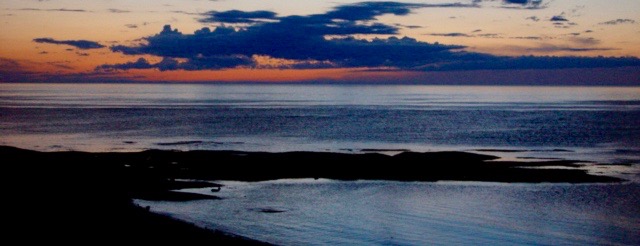
Sunset at Ste. Luce. We wait for the choir to arrive. Take a deep breath: it will soon be here.
Angel Choir (on seeing the Northern Lights at Ste. Luce-sur-mer) Sonnet
Listen to the choristers with their red and green voices. Light’s counterpoint flowering across this unexpected son et lumière, we tremble with the sky fire’s crackle and roar.
Once upon another time, twinned with our heavenly wings, we surely flew to those great heights and hovered in wonderment. Now, wingless, our earthbound feet are rooted to the concrete. If only our hearts could sprout new wings and soar upwards together.
The moon’s phosphorescent wake swims shimmering before us. The lighthouse’s finger tingles up and down our spines. Our bodies flow fire and blood till we crave light, and yet more light. We fall silent, overwhelmed by the celestial response.
When the lights go out, hearts and souls are left empty. Leaving the divine presence is a gut-wrenching misery. Abandoned, hurt and grieving, we are left in darkness.
Comment: The Spanish mystics, St. John of the Cross, and St. Teresa of Avila, wrote, in the sixteenth-century, about the ‘dark night of the soul’. That dark night also arrives when the communion with the spiritual finishes and the communicants are left alone, in their loneliness, abandoned to their earthly selves. To leave the divine presence is a heart-breaking, gut-wrenching misery. To turn from the marvels of nature can produce lesser, but still deeply moving feelings of grief and sadness. The secret is to preserve that joy and to carry it with us always, warm, in our hearts. Doing so makes the pain of separation much more bearable.
from an original painting by Rogier van der Weyden (1399/1400-1464)
Black Angel
You cannot hide when the black angel comes and knocks on your door.
“Wait a minute,” you say, “While I change my clothes and comb my hair.”
But she is there before you, in the clothes closet, pulling your arm. You move to the bathroom to brush your teeth.
“Now,” says the angel. Your eyes mist over.
You know you are there, but you can no longer see your reflection in the mirror.
Comment:
I first saw the Black Angel in Aldebarán’s cultural store in Ávila (2006). She sat there, in the shop window, along with several other angels, and I worshiped her from the distance of the street. Her image was taken from an original painting from Rogier van der Weyden (1399/1400-1464). This was turned into a 3-D image and then converted into the statue I saw in the shop window.
I brought the statue back to Island View, placed it on the shelf above the fireplace, where it still rests, and wrote several poems on the theme of Angels. I gathered them together in a chapbook entitled All About Angels that I self-published in Fredericton in 2009. The chapbook was dedicated to Clare’s great-aunt, D. E. Witcombe who departed this world on October 15, 2008.
All About Angels was also based on a book of a similar title, Sobre los Ángeles, written by Rafael Albertí, one of the major poets of Spain’s Generation of 1927. I avoided the ambiguity of the Spanish title — Sobre (in Spanish) can mean Above or Beyond as well as About — by limiting my own title to All About Angels.
For Carl Jung, angels are the messengers sent to inform people of the state of their world. For me, they are also the wild creatures that inhabit the world around me and often take the form of chickadees, crows, mourning doves, woodpeckers, deer, foxes, chipmunks, the occasional bear, and other spiritual creatures. They can be best seen in those moments of solitude when we are most open to the natural world around us. Then, and sometimes only then, we can hear the urgent messages they bring.






 rogermoorepoet