Old Wounds

Old Wounds


“The slow wound
deepens with the years
and brings no healing.”

The Minister. R. S. Thomas

How deep time’s wounds
have cut and carved,
not just in flesh and bone,
but in the embers
of that slow-burn fire
 they call the heart.

Memory and mind
have also played their part.

Some days, those wounds
don’t ache at all.

But there’s no real healing,
and a moment of madness,
a knife-edged finger nail,
careless, in the dark,
opens them up again
to bleed afresh
and remind us
of the frailty of the flesh.

Comment:
The opening quote, from the Welsh poet, R. S. Thomas, made me aware of so many sad things that have happened in my life. Usually they lie dormant, asleep like an ancient volcano. Occasionally they erupt, and memory’s hot lava breaks through to the surface and spills like blood. Hard as I may try to control those moments, they are, in essence, uncontrollable. The scars itch. I scratch them with sharp finger-nails, and the old wounds open and bleed again.

Bay of Santander – 1963

Bay of Santander
1963

I stood there
on the sea wall
calling out to the dark
“Help!” “Save me!”

Moon hid her face
behind veiled clouds.
All hope denied
I called out to the tide,

outgoing, to take me
with it, out to sea,
past the island
and the lighthouse,

out to where the waves,
stronger than anything
I ever knew, would thrust
strong fingers under my arms

and lift me up,
then drag me down,
so I could finally rest
in peace, and drown.

Comment:
This painting is called Picking at Scars. Some scars run so deep that they are always there. When they itch, you scratch them, and they bleed afresh. The scar of loneliness is one such scar. Alone, in a foreign land, learning their language, the culture, their customs, feeling not just unaccepted, but unacceptable, and the moon at night shining on a land, a bay, a city, to which you know, deep in your heart, you will never belong. That loneliness walks with me still and, sixty years later, it still leaves me desolate.

Joy of Words

Joy of Words

If the words won’t come, don’t worry.
Sooner or later, they will arrive, driving
down in flurries. Think wind-driven leaves
or the soft white whisper of snaking snow.

There is a moment when all sounds cease
and you can be at one with your inner self,
there, where summer sunshine twinkles
and soft rains bring forth clarity and joy.

What are words anyway, but soap bubbles
emerging from an iron ring to rise in
child-hood’s skies, soaring, dying, around
the cloudy thrones of sun-kissed clouds.

We, their so-called creators, are left below,
building cotton-wool castles spun from air.

Comment:

The painting, animales de fondo, comes from a book by Juan Ramon Jimenez in which he describes human beings as ‘animals living at the bottom of an ocean of air’. I have tried to capture the concept both verbally and visually.

On Writing Poetry

On Writing Poetry

I sit here writing poetry
and, head in hands, I cry
at all the things I’ve left unsaid,
and then I wonder why
I wasted so much time on things
that perished before my eye.

Outside the night is dark and cold
and shadows flit and filter by.
I know that I am growing old,
that soon my story will be told,
and when it ends, I’ll die.

I know that death is not the end,
yet I do not want to die.
I want to paint the autumn trees,
the clouds that float on high,
with evening lights that stain the sky.

But rhyming is not all I do.
I’ often write in prose, with words
that wound and sow dark seeds
that root and flourish, grow like weeds,
and nourish other people’s needs.

Alas, I know not what I do,
nor yet what I have done,
nor when, nor where, the seeds
were sown, nor if they aided anyone
to turn away from the dark inside
and walk in the light of the sun.

Candles

Candles

Candle-light

Three candles burn at my table.
Outside,
the night wind howls like a dog
and scratches its pelt on my roof.

The wind has torn
branches from the trees
and polished the evening frost
until it sparkles
like eighteenth century silver.

A moth circles and sizzles
in a sacrifice of flame.

I keep my vigil at night’s altar
and place a wrinkled palm
into the candle’s liquid flame.

Put out a candle, put out a child.
Who would put out a dog
on a night like this?

Outside,
playing tag between dark trees,
the wind runs wild.

What historical event fascinates you the most?

Daily writing prompt
What historical event fascinates you the most?

What historical event fascinates you the most?

First, let us define ‘historical’. Here’s what I found – (1) of or concerning history. (2) concerning past events. (3) The historical background to such studies. (4) Belonging to the past, not the present. (5) Famous historical figures.

Now let us think of the number of times we hear on the TV sports shows that such and such an event is making history “right before our eyes”. Wow! In a boxing match, almost ever punch thrown is “an historical event”. Ditto rugby – with every try scored, every penalty missed, and every tackle made. Ditto soccer, basketball, baseball, athletics. So, from the battery of past events that adorn my life, I am being asked to choose “which historical event fascinates me most”. Double wow.

My answer – the day of my birth, about which I know absolutely nothing. Or, to be more specific, the actual action of being born, about which I know even less. So, how do I study the historical background, when no eye witnesses are left alive to assist me? More important, nobody in my family wanted to talk about such an important – for me at any rate – event.

I do have some factual memories – tales told to me later. I was born at exactly 8:00 pm. I know this because my parents’ dog had been left at a neighbor’s house while my home-birth was taking place. As the clock struck eight, Paddy, the dog, jumped straight through their window, and ran up the road towards the house that was now to be our house, barking. “Ah,” said our wise neighbor, “there goes the dog. That means the baby’s been born.”

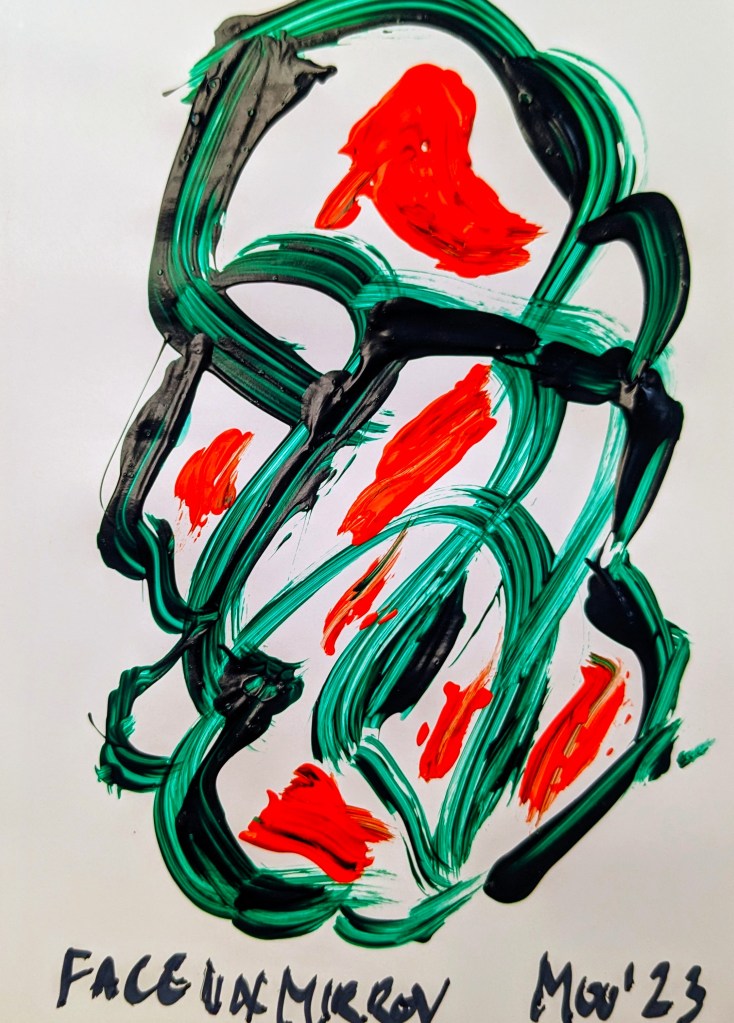
That is one version of the tale. My own version is the squawking of the stork who carried me, a sudden screech as he dropped me, a slow descent from a bright blue sky, a tumble down the chimney into the fireplace. And there I was. All covered in soot and ashes. I needed washing, of course. But baby, just look at me now. [See self-portrait above – Face in a Mirror].

My maternal grandfather swore that I had not been born at all, but found under a gooseberry bush. That would account for the green tinges in the painting. Apparently, all babies in South Wales were found under gooseberry bushes at that time. Unless they were delivered by the milkman.

And there’s many a tale about merry milkmen for, as they say in Wales, “It’s a wise man who knows his own father.” And I guess that is also a hysterical historical event about which I know nothing. But perhaps that’s why when the milkman who delivered the morning milk used to say “Good morning, son” when I met him at the the doorstep.

Come to think of it, the mailman also used to call me “Son” when he delivered the mail. Hmmmm – so did the butcher, the baker, and the candle-stick maker. Oh dear, so many historical events to choose from.

Tell us about a time when you felt out of place.

Daily writing prompt
Tell us about a time when you felt out of place.

Tell us about a time when you felt out of place.

A harder prompt might have been “Tell us about a time when you felt you really belonged”! On the outside looking in is the story of my life.

On the Outside Looking In …

            I walked home on my own. As usual. I’d hated the church Christmas party with all its trumped-up noise, childish games, and artificial gaiety.
            The priest, formidable yet effeminate in his long black skirted robe, had made us sit in a circle on the floor, legs crossed. He stood inside that circle and placed a bar of chocolate on the wooden boards. Then he walked around the group and whispered a word in each boy’s ear. 
            “You must wait until you hear your secret word,” he explained. “Then one of you, when I speak that word, may claim the chocolate bar,” he stared at us, large, horsey teeth, black hair streaked with grey, eyes golden, fierce, like an eagle’s, beneath bushy eye-brows. “When you hear your secret name, you must grab the chocolate bar. Understood?”
            I had come to the party on my own as both my parents worked. The mums and dads who had brought their offspring to the party leaned forward in keen anticipation. The boys all nodded.
            “Are you ready?” The priest watched us as we nodded and then he shouted “Alligator!”
            Nobody moved.
            “Elephant!” The boys shuffled forward, like inch worms, hands twitching, fingers flexing and grasping.
            “Tiger!” A sigh emerged from multiple mouths. Some of the boys licked their lips.
            “Lion!” One boy moved, but the priest shooed him away. “Sit down. That wasn’t your word.”
            “M-m-mouse!” The boys heaved, a sea-wave about to crest and break.
            “I do love this game,” said the priest to the parents. “And so do the boys, don’t you boys?”
            “Yes, father …” came the chorus.
            “Monkey!” All the boys leapt into springy action. They dived, crawled, leaped to their feet, ran … a surging heap of boyhood writhed on the floor as the chocolate bar was torn apart and the long-awaited fights ensued.
            All the boys moved, except me. I just sat there.
“I said ‘Monkey,’” the priest frowned at me. “That’s your word. When I say ‘Monkey’, you join in with the others and fight for the chocolate.”
            I shook my head.
            “Have some Christmas fun. Join in the game.”
            I again shook my head.
            “Why not?”
            “You’re just mocking us.  I want to go home,” I stood up and walked away. I stopped at the door and turned and saw the priest glaring at me while a mound of boys continued to scrummage on the floor.
            As I walked home, it started to snow. Not the pure white fluffy snow of a pretty Merry Christmas card, but the dodgy, slippery mixture of rain, snow, and ice pellets that turned the steep streets of that little seaside town into an ice rink. I turned up the collar of my coat, bowed my head, and stuffed my hands into my pockets. Two houses before my own, I stopped in front of our neighbor’s house.
The window shone like a beacon in the gathering dark. I drew closer, pressed my nose against that window and looked in. A Christmas tree, decorated with lights, candles, more decorations, a fire burning on the hearth, two cats curled up warm before the fire, presents beneath the tree, stockings hanging from the mantelpiece. For a moment, my heart unfroze and I felt the spirit of Christmas. Then I thought of my own house. Cold and drafty. No lights, no decorations. No fire. The snowball snuggled back into my chest and refused to melt.
            When I got home, our house stood chill and empty. My parents were out at work and the fire had died. Nothing was ready for Christmas. I sat at the kitchen table, took out my colouring book and began to draw. When my mother came home, I showed her my drawing.
            “Very nice,” she said without looking up.
            “But mum, you haven’t really seen it.”
            She blinked and stared at the picture. This time, she saw the Christmas tree and the lights, the cats and the candles, the decorations and the presents. But she never noticed the little boy standing outside the house in the falling sleet, peering in through the window.

What aspects of your cultural heritage are you most proud of or interested in?

Daily writing prompt
What aspects of your cultural heritage are you most proud of or interested in?

What aspects of your cultural heritage are you most proud of or interested in?

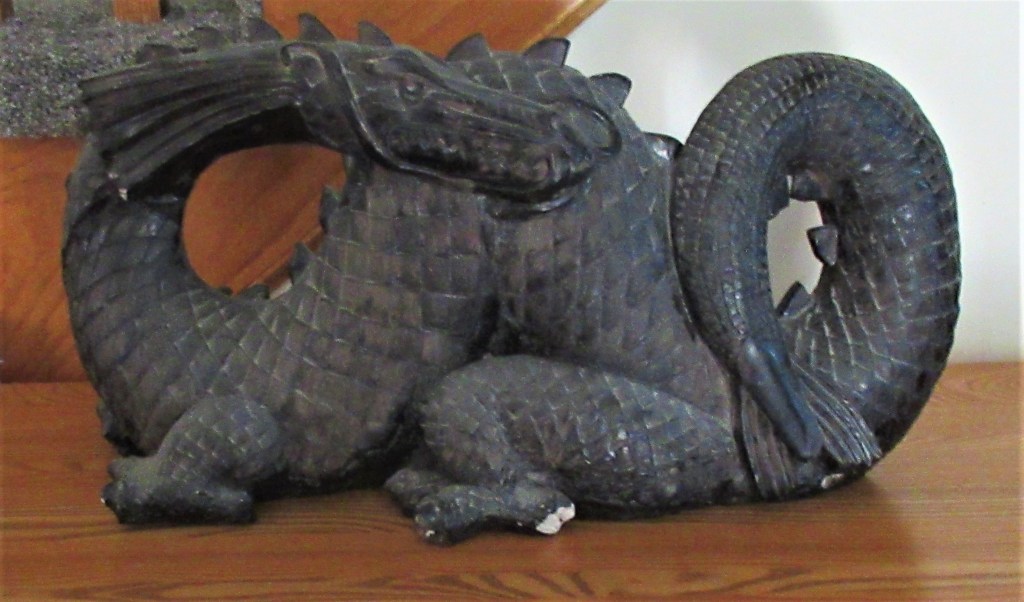
This dragon is not a dragon, well, it’s not a Welsh Dragon anyway. So, let us change the question – What aspects of your cultural heritage are you least proud of? Now that changes the perspective totally. I guess that I am least proud of the fact that, although born in Wales, I was never allowed to speak Welsh as a child. I speak with an English accent because I was sent to school in England so I wouldn’t even speak English like a person born in Wales. I am not proud of that aspect of my cultural heritage.

But I am proud of one little thing that stems from that Welsh cultural heritage – learning how to speak Welsh in my old age. It’s not easy to do that, here in Canada, but the internet carries many blessings, one of which is the learning of ‘foreign’ languages. Strange that Welsh should be considered a foreign language for somebody born in Wales. Something else not to be proud of, I suppose. Here’s my story.

Here I sit, an old man now, in front of my computer, learning at last my mother tongue, Welsh. I have discovered the beauty of simple words, not so much their meaning as their sound, the way they flow, the poetry of remembered rhythms: Cwmrhydyceirw, the Valley of the Leaping Stag, though legend has it that ceirw was really cwrw, and cwrw is beer, and its real name was the Valley of the Brown Stream Frothing like Beer.

Words have their own music, even if you cannot pronounce them properly: Mae hi’n bwrw glaw nawr yn Abertawe / it’s raining now in Swansea. Mae’r tywydd yn waeth heddiw / the weather’s worse today. Bydd hi’n dwym ddydd Llun / it will be warm on Monday. Place names also have their own magic: Llantrisant, Llandaff, Dinas Powis, Gelligaer, Abertawe, Cas Newydd, Pen-y-bont … Meaning changes when you switch from one language to another:  gwyraig ty / a housewife, gwr ty / a househusband, a concept of equality that has ruled Welsh lives since long before Julius Caesar invaded Albion, coming from Gaul with his legions in 55 BC.

The photographer asks me to smile. He wants me to say ‘cheese’ so I say it in French [fromage], then Spanish [queso], then Italian [formaggio]. “No, no, no,” he shakes his head. “I want to catch the real you. Try again.” So I say it in Welsh [caws]. He checks the memory card in his camera and looks puzzled.

“Your facial expression changes each time you speak a different language,” he tells me. “Please, won’t you just say ‘cheese’ in English? I want the real you.”

French, Spanish, Italian, then Welsh: all different and he wants the real me. Each language carves a new a map into my face.  Am I a clown, then, a comedian, a chameleon to wear so many masks and to slip so easily from one to another? And who am I, this stranded immigrant, marooned on a foreign shore that has finally become my home? Who or what is the real me?

“Cheese!” I say in desperation. “Got it,” he grins. “At last, I have captured the real you.”

What brands do you associate with?

Daily writing prompt
What brands do you associate with?

What brands do you associate with?

I have been thinking about my parents a great deal recently. Earlier this week it was my my mother’s birthday. She would have been 110 years old. Funny how, as we age, our own minds turn back to the past. So, today’s prompt – What brands do you associate with? – gets an instant answer – none really.

And yet, and yet, there is one. A long, long time ago, my father let me into a big secret: all the shops in our little sea-side town had signs that announced – Jones and Son, or Roberts and Son, or Edwards and Son. “Well, son,” he said, “I have a son, and it’s you. It is time I showed you my little secret.” He took out his pen, unscrewed the cap, and carefully drew an M. Then he drew a W beneath it, taking care that the ends joined neatly. Finally he drew the letter J. It bisected the letters so that the drawing in my painting above was produced: blue-black ink on white paper. “What is it dad?” I asked. “It’s my brand,” he proudly said. “Those are my initials. “I would love to establish something, use this as a brand name, and have ‘and Son‘ written beneath it.”

I didn’t understand. I can’t remember how old I was, but it was in the days when Shorty the Deputy [I pronounced it De-Putty, much to the amusement of my elders] Sherriff ruled the range in my colored comic books. “A brand? Why do you want a brand? Are you going to own a ranch and brand your cattle?” That ended the conversation. The brand was never mentioned again, until, now, but I have never forgotten it.

So, there is one brand with which I associate myself, my father’s brand. I entitled the painting remeMBEr in honour of my father, of his failed dreams, and of the dreams he achieved, including the initials MBE [Member of the British Empire]. The medal itself, together with the letter from King George VI is included among my family treasures. So, there we go – that’s the brand I associate with, my father’s brand.

Poems for KIRA 2023 # 1

1

when we two came together
 we closed an ancient circle
becoming one with the standing stones
that measure seasons and time

now we harvest the summers
 lilies lupins fox gloves blue bells
a surfeit of wild flowers plucked
from the maze of our days

we wait and watch the slow snow
settling white on sarsen stone
as time weaves crow’s feet
into the corners of our eyes

2

i listen with my eyes
to the words and thoughts
of long-dead writers.

age-old and wise they walked
alone along the hidden ways
to set themselves free

they fled the royal courts
where power and jealousy
plotted twisted ways

cruel means
justified by brutal ends.
mindless quarrels bitter strife

i also ran away
and slowing down i found
an enviable life

enriched i live
harvesting a wealth
of goodness

days lived far from fear
 envy resentment distrust
in wooded seclusion

Comment: I was invited to attend KIRA as writer in residence this month. However, a weakened immune system and a series of setbacks over the late summer made this impossible. That said, KIRA and the early morning light seen from the Red Room live on in my heart and I will try to complete my planned project, here in Island View, over the next month or so. Wish me luck.