Beaver Pond

Spotify:
Remember to scroll down to the appropriate audio episode.

The Beaver Pond
Last October

Leaves walked tip-toe footprints,
delicate, on dark water.
Wrinkled brown tongues lapped
towards dry land. Everywhere
low light fell bright on stripped
white branches.

Open were the pond’s shiny spaces,
dry and withered were its reeds.
Clouds floated in the tarn’s spotted mirror.
Islets of seeded grass marked spots
where underwater logs rotted back to life.

We gazed on emptiness, empty nests,
and a burnt, tanned earth that waited
for what strange second coming?
The wind’s chill arm wrapped us
in the silent thought of oncoming winter.

Man from Merthyr

Spotify:
Remember to scroll down to the appropriate audio episode.

Man from Merthyr

 Memory loss punched holes in your head
and let in the dark, instead of the light.
Constellations faded from your sight,
erased by the arch-angel’s coal-dust wing.

 “I’m shrinking,” you said, the last time I saw you,
you, who had been taller, were now smaller than me.

 Tonight, when the harvest moon shines bright
and drowns the stars in its sea of light,
I will sit by my window and watch for your soul
as it rockets its way to eternity.

My eyes will be dry. I do not want pink runnels
running down this coal-miner’s unwashed face.
I’ll sing you this lullaby, to help you sleep.

“When the coal comes from the Rhondda
down the Merthyr-Taff Vale line,
when the coal comes from the Rhondda
I’ll be there,” with you, shoulder to shoulder.
Farewell, my friend, sleep safe, sleep deep.

Fun in Fundy

Spotify:
Remember to scroll down to the appropriate audio episode.

Fundy

Salt on the sea wind sifts raucous gulls in packs,
breeze beneath wings, searching for something
to scavenge. Seaweed. The tidemark filled with
longing. A grey sea crests and rises. Staring eyes:
stark simplicity of that seal’s head filling the bay.
Next day, his body stretched dead on the beach.

The river runs rocky beneath the covered bridge.
Campers have created first nation’s rock people,
heaping stone upon stone. At low tide, on the dried
river bed, there is no easy way to say no. White foam

horses stamp and foam in the sea farrier’s forge. Cold
winds blow at Cape Enrage. Wolfe Point sees late
gales transform the beach: the sandbar carved:
a Thanksgiving turkey, stripped to bare rib bone.

Dead birds sacrificed so I can walk here in comfort,
my anorak stuffed with their plundered plumage.

Ruins of the Heart

Spotify:
Remember to scroll down to the appropriate audio episode
.

Ruins of the Heart

Dusty paths meander under drifting clouds.
A worn-out, shadow rag, this ruined land.

An old man with a sly-eyed dog herds thin cows.
Threatened, I stoop and gather stones.

Moving targets, the dog, a shadow of dust
on burial mounds, wind-stirred with weeds.

Abandoned in this wilderness, a wild thorn
thrusts a spear through my derelict heart.

A rag-bag my own body, stitched together
with threads of long-forgotten tales.

Fear sets nightmare shadows dancing,
skeletons come alive on sculpted graves.

Carved faces, a woman, courted by men.
Which one captured her flowering heart?

Who pierced it with an arrow? Who scarred
her name letter by letter on this stone?

That first rock, freed from my fingers,
strikes hard on the canine’s cowardly frame,
setting earth’s shadows free to flee.

Aubade

Spotify:
Remember to scroll down to the appropriate audio episode.

Aubade

Driving in winter, early one morning,
from Island View
to the Georges Dumont Hospital in Moncton
for Cancer tests

1

The crows in the garden complain of the cold,
cawing from their look-out points
with short, sharp calls.

A life of ease they seem to live,
but when the mercury descends and water freezes
icy blinds inside our window panes and snow-
squalls bluster in from north and west,
who knows what’s best for those poor birds
aloft in their crow’s nest spars,
sailing snow’s seas,
steadfast in their skippering of wind-bent trees?

This Arctic cold is such
that neither man nor beast can love it much,
crouched close to whatever warmth there is,
shivering in the wind’s cold touch.

 2

 Yesterday, a dozen crows pecked at salt grains
scattered over this road.

A black-clad chorus, they rejoiced
when sunshine drew the white-tailed deer,
from winter depths of banked up snow.

Not long ago she was alive.
Now she lies stiff and broken.

Soon she’ll be picked up by workmen,
tossed into the back of their truck,
dumped, and forgotten.

What magic spell invokes what beginnings?
To what end do we prolong our days?
What myth, this fairy-tale I call my life?
Stars drift hidden through the sunny sky.

3

Driving home from the hospital,
bullied by fierce winds
on a snow-packed road,
I dream as I drive.

I envision a past
that never was, a future
that may never be.

As I hibernate in that past,
last summer’s flowers
flourish in my mind.

The car skids into a snow bank
and my world shakes in shock.

A thirty wheeler rumbles by:
there are so many ways to die.

Sharp-Shin

Spotify:
Remember to scroll down to the appropriate audio episode.

Sharp-Shin

She surveys her empire
from our back porch
steps into space
plunges her body’s weight
into fragile air.

A feathered arrow,
she makes contact, feet first,
bowling the unsuspecting robin
over on the ground.
His shrill shriek emerges
from a beak shredding failing air.

The hawk’s claws clench.
Her victim’s movements weaken,
eyes gaze into darkness.

One final spasm,
a last quick twitch,
and the robin is gone,
one wing dragging,
borne skywards
in the hawk’s claws.

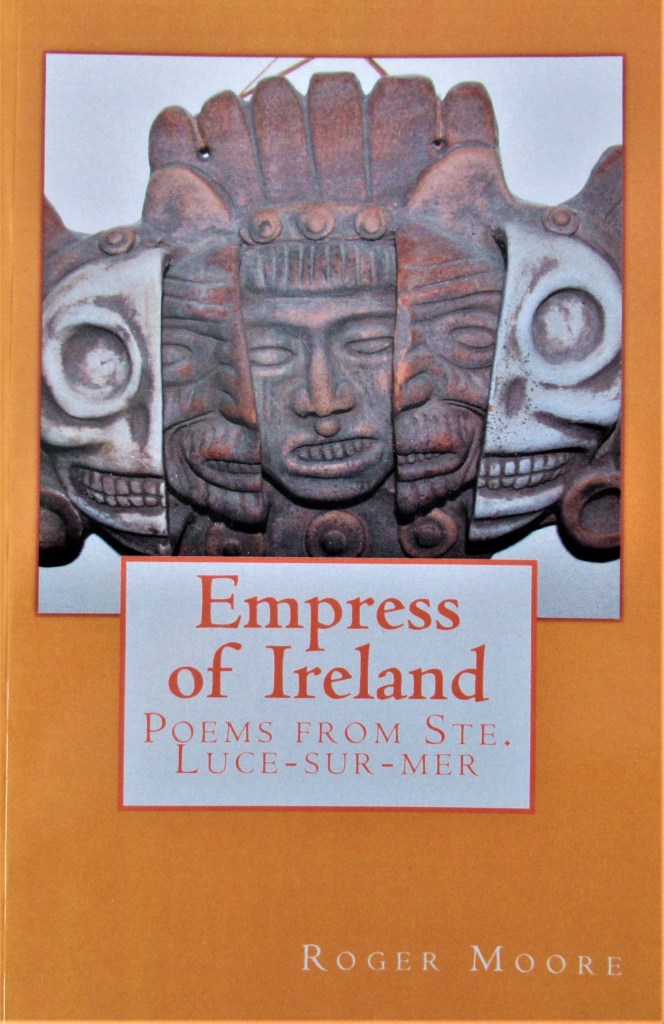
Empress of Ireland

Empress of Ireland
Poems from Ste. Luce-sur-mer

is available at the following link:
Click here to purchase Empress of Ireland

The Empress of Ireland

The poems which have come together to form the Empress of Ireland were begun in Ste. Luce-sur-mer, Quebec, in May 2002. It was off-shore from Ste. Luce, in the early hours of the morning of the 29th of May, 1914, that the Empress of Ireland collided, in dense fog, with a converted Norwegian collier whose bows had been strengthened for ice-breaking. There were approximately 15 minutes between the moment of impact (1:55 am) and the moment the Empress caught fire and sank (2:10 am). Although the disaster has received little international attention, more passengers perished in this accident (840) then in the loss of the Titanic (832) or the sinking of the Lusitania (791).

Introduction to the Empress of Ireland

Click on the link below to read an early post with a new sound recording of
A Survivor lights a candle
https://rogermoorepoet.com/2020/11/23/a-survivor-lights-a-candle/

I first heard voices in the cries of the sea birds on the beach at Ste. Luce-sur-mer.

Borne on the wind, over the sigh of the waves, they seemed high-pitched, like the voices of children, or of men and women in distress. These were lost voices, the cries of people alone and frightened by the dark. I heard them calling to me.

That night, there were knocks at my cabin door and finger nails scratched at my window. Tiny sounds, almost beyond the range of human hearing: the snuffling of puppies when they turn over in their sleep and tug at each other, whimpering in their dreams.

“Who’s there?”

I started from my sleep. But there was only the wind and the waves as the tide’s footsteps climbed a moonbeam path to ascend the beach. When I walked on  the sand next day, at low tide, there was a whispering behind my back. Little voices crying to be set free.

“Who’s there?”

A lone gull flew past my head and battered itself against the wind’s cage with outraged sturdy wings.  That night, the mist descended. The church stepped in and out of its darkness and shadows gathered, persistent, at my door.

I walked out into the night and saw a lone heron surrounded by gulls. It was as if an adult, clamoured at by children, was standing guard over the beach. Then I saw the shadows of little people searching for their parents, the shapes of mothers and fathers looking for their off-spring, lost among the grains of sand.

Beyond them, on the headland, the church stood tall above the shadows. I saw grandmothers and grandfathers, their lips moving in supplication, kneeling before the granite cross which stands above the sea. As I approached, they turned to me, opened their mouths, mouthed silent words, then disappeared.  When I went back to bed, faces and voices visited me in my dreams. When I got up next morning, they came to me in the speech of birds hidden in the foliage, in the words dropped by the osprey’s wing, in the click of the crab’s claw as he dug himself deeper into the sand.

“Release us”

“Speak for us!”

“Set us free!”

The words of the M Press of Ire are not my words. They could never be my words. Foundered words, they are, rescued from the beach, and dragged from the high tide mark with its sea weed, carapace, charred wood, old rusted iron, and bright bones of long dead animals polished by the relentless action of wind, sea and sand.

Gaza Street

This is the original version. It is much better than the revision that I posted earlier. Sometimes, when we revise, we lose the freedom of thought and association that comes with the early version. Message: keep your variations and keep an open mind. Over-elaboration is the poet’s worst enemy.

Wingless in Gaza Street

amputees deprived of flight
they flutter grounded in the gutter

galley slaves chained to broken oars
they ply blunt stumps relentlessly

shorn of strength and beauty
their once glorious shuttles weave dark circles

my mouth is a full moon open in a round pink circle
bone and its marrow settle in subtle ice

futile fragility of the demented heart pumping
its frequency of fragmented messages

frail beauty torn from its element of air
this brightness of moths drowning in inky depths

the seven o’clock news brought to you
from an otherwise deserted street.

Wingless in Gaza

IMG_0177 2

Wingless in Gaza

amputees
they buzz an unending dance
in the dusty gutter

galley slaves
chained to broken oars
they ply rhythmic
blunt stumps

shorn of strength and beauty
their once coloured shuttles
weave dark circles

my mouth is a full moon
open in a round pink circle
shadowed by a skull
bone and its marrow
settle in subtle ice

futile fragility
of the demented heart
pumping the same frequency

fragmented messages
panicked veins

frail beauty
torn from its element of air

this brightness of fragile moths
wing-shorn
drowning in the inky
depths of the gutter

the seven o’clock news brought to you
from an otherwise deserted street

Babs

Babs

It was March 17, St. Patrick’s Day.

Babs held the cat in her arms. The vet slipped the needle into the shunt he had inserted into the animal’s paw and the tiny wind of life gusted from the cat’s fragile body. The struggle ceased. The cat’s head settled and her tongue protruded, just a little, in that beloved and well-known gesture. It was all over.

Babs had found that lump, hard, but smaller than a pea, on New Year’s Day. The next day, she carried the cat to the vet where they took blood samples and ran tests. The vet’s assistant called later that afternoon. A lymphoma, she said, small but deadly. Steroids might help. They would give the cat a 40% chance at a life that would get more difficult, in spite of any known treatment. The alternative was to bring her back in and put her down now, that very afternoon. Babs looked at the cat: highlights strayed through her fur and her bright eyes sparkled like sunshine on a lake.

Throughout January the steroids went in and the cat glistened and grew fat. At first, Babs saw no sign of the lump but by Robbie Burn’s Day it was back. Babs started to count the days: January 31, February 2. The lump grew larger.

Three years before, on Valentine’s day, Babs had salvaged the cat from the SPCA where she languished, abandoned in a cage. The cat was a stray, half feral, taken in from the streets and subject to who knows what sort of treatment and feeding in its infancy. Babs wondered if it was in those days of neglect that the cancerous seed took root? Or did those seeds come later, when the cat wandered the garden and fed off the wild life, mice and voles, and drank from the streams that flowed through the killing fields with their fertilizers, their weed killers, their nutrients, and their poisons?

“What are we doing to ourselves,” Babs wondered as she sat at the kitchen table and sipped a cup of tea. “Was my cat the canary in my coalmine, doomed to warn me of what’s to come? Will my own system be invaded then poisoned with cancerous growths? Will I be subject to that stumbling, downward road that leads in the end to an inevitable death?”

She lay awake that night alone in the bed wondering in what ways cancer might ravage her body. How long would chemotherapy keep her alive? Who would be there for her, who would hold and comfort her, who would slip that releasing needle into her veins when her time came?

Babs ran her fingers over her body as she imagined herself sliding day by day down that slippery slope that leads to the grave. Then she caught her breath, her heart raced, and her blood turned to ice as her fingers tripped against the colony of killers: three small hard lumps that nested in her soft breast.