The End of Time

Meditations on Messiaen.
Quartet for the End of Time.

3

The End of Time

A thin violin crying
its cat-gut heart out
in tears of sound, falling,
rhythmic raindrops,
down a grey-streaked face
tight with stress and pain.

Such concentration,
such soulfulness packed
into each mindful note.

An audience of one,
I sit, head bowed,
meditating on the meaning
of meaning and nothingness,
the nothingness of being condemned
to oblivion yet oblivious
of the how and when.

Each note a hammer-blow,
then, the piano hammering nail
after nail into this coffin body
I drag through the motions
of extracting meaning
from this meaningless life.

Click on the link below for Roger’s reading.

The End of Time

Dark Angel

Meditations on Messiaen.
Quartet for the End of Time.

2

Dark Angel

He will come, the dark angel,
and will meet me face to face.

He will take all that I own,
for it is only temporary
and all my possessions are on loan.

My house, my wife, my car,
my daughter, my grand-child,
 my garden, my trees, my flowers,
They are not mine.
I do not possess them.

I only own this aching heart,
these ageing bones,
this death that has walked beside me,
step by step, every day
since the day I was born.

That indeed is mine,
and nobody else’s.
That is my sole possession.
That is the only thing I own.

Click here for Roger’s reading.
Scroll down to appropriate episode.
Dark Angel

A Stone


Meditations on Messiaen.
Quartet for the End of Time.

1

A Stone

I cast a stone into the sea.
A round, flat stone,
it skipped from wave to wave
and refused to sink.

My heart sank within me
as I counted each bounce:
five, six, seven…
then the stone sank
bearing with it
my seven deadly sins
and I wept no more.

I, who have lost all that I had,
mother, father, brothers,
land of my birth,
I laid them all to rest
and I dried my tears,
forgot my fears,
and counted my blessings
as I walked, no longer alone,
along the shore.

Click on link below for Roger’s reading.

A Stone

Waiting

Waiting

I remember pushing
my father around the ward.
Two weeks we had together.
He sat in his wheel chair
and I wheeled him
up and down.

“Cancer, ” they told me.
“But it’s kinder not to let him know.”

In those days, it was better to die,
without knowing why.
Did I betray him by not letting
him know what I now need to know?

One day, he begged for help
and I lifted him onto the toilet.
He strained and strained
but couldn’t go.

“Son,” he said, sitting there.
“Will you rub my back?”
How could I say no?

That strong man,
the man who had carried me
on his back,
and me standing there,
watching him,
trousers around his knees,
straining, hopelessly,
and me bent over him,
rubbing his back,
waiting,

for him to go.

Click here for Roger’s reading of
Waiting.

Blood and White Wash

Blood and Whitewash
A Thursday Thought

2-September-2021

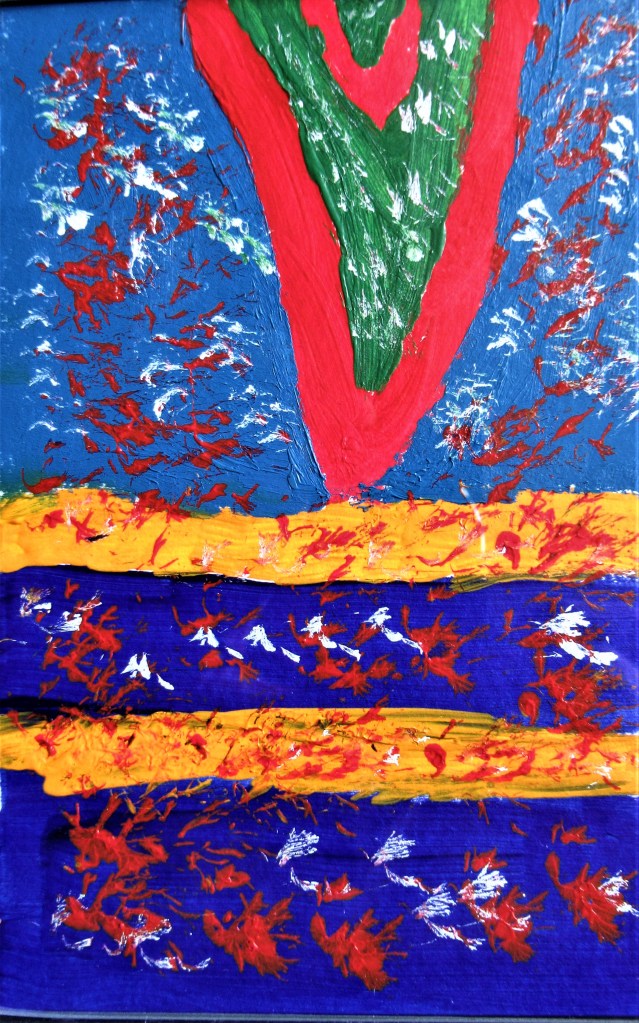
Blood and Whitewash is the title of this painting. It has a subtitle: My Plan of Attack.

The origins of the title, and hence of the painting, go back to the Goon Show, with Spike Milligan, Peter Sellers, and of course / wrth gwrs, Harry Secombe, the Swansea Comedian and Master Singer. Away in boarding school back in the late fifties, one of my greatest pleasures was listening to the Goon Show on one of the dormitory’s transistor radios. As a teenager, I found the jokes and the accents incredibly funny. Still do. That’s why I painted this painting. Alas, it is silent, and you cannot hear the accents.

The following snippet of dialog occurred on one such Goon Show, I cannot remember which.

“What are we going to do?”
“Well, this is my plan of attack.”
“That’s not a tack, it’s a nail.”
“No it’s not. It’s a tack.”

So above you have my painting of My Plan of Attack, resurrected after all those years. I throw my mind back to the First World War.

The General:
“He’s a cheerful Cove,” said Jimmy to Jack,
as he walked to Arras with his pack on his back.
But he did for them both, with his plan of attack.

And there in essence is the history of the painting. First, the plan of attack, then the failure and the blood-letting, and then the white-washing of the whole history, a white-washing that turns failure into success, defeat into victory, and loss into gain. But in WWI, it was the poor Tommies who bore the burden, and all the other front line troops who obeyed orders, went blindly over the top, and charged unbroken wire with fixed bayonets.

“If you want to find the sargent,
I know where he is, I know where he is,
If you want to find the sargent,
I know where he is.
He’s hanging on the old barbed wire.”

“If you want to find the chaplain,
I know where he is, I know where he is,
If you want to find the chaplain,
I know where he is.
He’s hanging on the old barbed wire.”

“If you want the whole battalion,
I know where they are, I know where they are,
If you want the whole battalion,
I know where they are.
They’re hanging on the old barbed wire.”

Singing as they marched to their deaths, obeying orders, like sheep, and nipped on by the eternal sheep dogs. Things were so bad at Verdun that instead of singing, the men marched, bleating, like sheep. “Sheep unto the slaughter.” There was so much ill-feeling and rebellion in the face of orders and certain slaughter, that French regiments were decimated, one man in ten shot for mutiny, as they marched bleating, instead of singing, to their deaths.

“Oh, we’ll hang out our washing on the Siegfried Line,
have you any dirty washing, Mother dear?”

“Those who do not learn from history are condemned to repeat it.” So, tell me, “where have all the young men gone, gone to graveyards everyone, when will they ever learn, when will they ever learn?”

And that, dear friends, is my thought for today: The History of My Plan of Attack. When, indeed, will we ever learn?
Waiting

The story of one man’s journey

Spotify
Scroll down to correct episode.

Waiting

I remember pushing
my father around the ward
in the hospital.
Two weeks we had together.

My father sat in his wheel chair
and I wheeled him
up and down.

“Cancer,” they told me.
“But it’s kinder not to let him know.”
In those days, it was better to die
without knowing why.
Did I betray him by not letting him
know what I now need to know?

One day, he begged me for help
and I lifted him out of his wheelchair
and placed him on the toilet.
He strained and strained
but could not, would not go.

“Son,” he said, sitting there,
“Will you rub my back?”
How could I say no?

That strong man,
the man who had carried me
in his arms, on his back,
and me standing there,
watching him,
his trousers around his knees,
straining hopelessly,
and me bent over him,
rubbing his back,
waiting,

for him to go.

Comment: Thank you, once again, Alejandro Botelho of Diverse TV. This was a great reading. If you, dear reader, are interested, you can listen to it HERE. Alejandro’s reading of my poem begins at 40.52 and ends at 42.33. But remember, the other poems are also well worth listening to and Alejandro has a great voice and wonderful interpretation. A further comment: first there is the text. Then there is Alejandro’s excellent reading. Then there is my own reading. From each of these the observant reader and / or listener will extract a slightly different emphasis and meaning. In my own case, following Alejandro’s reading of the original text, I have added some minor changes, to add to the intertextual rhythm of the words. Tolle, lege et vade mecum. A Cancer Chronicle is available HERE.

The Origin of the World

Dawn from the Red Room at KIRA. Another form of birth.

Spotify
Remember to scroll down to the correct episode.

The Origin of the World
Gustave Courbet
 
L’Origine du monde

The origin of the world and where I came from,
her deep, moist cave that cast me from dark to light.
She loved me, she said, depriving me of her warmth,
leaving me to go back to her lover, loving him more.

Was it guilt that drove her to drinking whisky?
A forty-ouncer a day at the end, sometimes more.
She would wake in the night, wander the house,
banging against chairs, tables, walls, and doors.

She ran up bills in local shops, and the keepers
would dun me for the money she owed. She also
borrowed cash and some days her fingers were bare.
She left pawn shop IOUs on the table and I drove

 into town to redeem her rings. Once, in a drunken
frenzy, she cursed her only child. A mother’s curse is a
terrible thing. Living albatross, it claws lungs and heart.
Its weight drove me to the bottle. I too sought oblivion.

Joy came when blackness descended, the albatross flew,
amniotic waters rocked me in warmth and comfort,
and my body’s boat floated once again on an endless sea.
Reborn each day, mornings cast me back from dark to light.

Comment: Here is the link to the DiversityTV reading of The Origin of the World. The Origin of the World begins at 28.40. I will attach my own reading from Spotify, just as soon as I complete it. I always find it fascinating to compare the way others read with the way I do. meanwhile, I would like to thank Alexandro Botelho for his invitation for me to participate in his DiversityTV show. I enjoyed his reading very much and I wish him all success with this venture.

Calling It a Day

Calling it a Day

This auriferous sky, sewn with sharp sequins.
Is there a warp, a leaning towards meaning,
a lurch maybe towards the moon’s dark side?
Questions: knights-errant questing for answers.

Who planted our DNA into that first Garden?
Or did the garden fill us with its own seeds?
Why did those little plants take root and grow?
Why do they now wander everywhere, restless?

This auriferous sky, sewn with sharp sequins.
Is there a warp, a leaning towards meaning,
a lurch maybe towards the moon’s dark side?
Questions: knights-errant questing for answers.

Rampant feet patrol our castle’s heights
while we seek instant gratification, swift
possession, our fingers probe each passing
cloud, reaching for all, but grasping none.

A satellite glides its razor edge, slices
the night’s eye into pin pricks of light.
The moon balances her orange unicycle
on thin black lines, hills edged with trees.

Lesser incandescence of a departed sun,
that low, lone moon slowly climbs the sky.
Released from their earthbound burdens,
who knocks this night at heaven’s gate?

Here on the back porch, midnight slowly
covers me with its dark gray cape of grief.
My grief is your grief, your grief is mine, all
grief is one, why do we all then grieve in vain?

Man from Merthyr

Man from Merthyr

Memory loss punched holes in your head
and let in the dark, instead of the light.
Constellations faded from your sight,
erased by the arch-angel’s coal-dust wing.

 “I’m shrinking,” you said, the last time I saw you,
you, who had been taller, were now smaller than me.

 Tonight, when the harvest moon shines bright
and drowns the stars in its sea of light,
I will sit by my window and watch for your soul
as it rides its coal-fired rocket to eternity.

My eyes will be dry. I do not want pink runnels
running down this coal-miner’s unwashed face.
I’ll sing you a Welsh lullaby, to help you sleep.

“When the coal comes from the Rhondda
down the Merthyr-Taff Vale line,
when the coal comes from the Rhondda
I’ll be there.”

With you, my friend, shoulder to shoulder.
“With my golden pick and shovel, I’ll be there.”
Farewell, my friend, safe journey, sleep deep,
as deep as a Rhondda coal mine may you sleep.

Why?

Why?

“Where are you going?” I ask again.
 “To see a man about a dog,” my father replies.
  “Why?” I ask.
  “Hair of the dog,” his voice ghosts through the rapidly closing crack as the front door shuts behind him.
  “Why?” I cry out.
 Years later I remember this episode. The mud nest nestles tight against a beam beneath our garage roof. Tiny yellow beaks flap ceaselessly open. Parent birds sit on a vantage point of electric cable, their beaks moving in silent encouragement. A sudden rush, a clamour of wing and claw, a small body thudding down a ladder of air to crash beak first on the concrete.
“Why?” I ask.
The age-old answer come back to me.
“Wye is a river. It flows through Ross-on-Wye and marks the boundary between England and Wales.”
The swallows perch on the rafters watching their fledgling as it struggles on the floor, the weakening wing flaps, the last slow kicks of the twitching legs.
“Why?” I ask.”
“Y is a crooked letter invented by the Green Man of Wye.”
“Why?” I repeat. “I want to know why.”
Silence hangs a question mark over the unsatisfied spaces of my questing mind.
A golden oldie. We would all like to know why. But there are no answers. Just riddles cast, like two trunk-less legs of stone, on the sands of time. Nothing beside remains. Yet still we ask the age old question: why? And still we receive the age-old answers from those ageing wise men who ruled our childhood and taught us everything they knew.
“Why?”
“Because.”

Comment:

Alas, we have lost our hollyhocks, not all of them, but most. They have been drowned in torrential rain, blown and bent, ravished by raging winds, and they have been scorched in a heat-warning scorched earth policy that left them and the garden all forlorn. As for the lawn, between chinch bug, crows, raccoons, and a surge in weeds and bugs, it is a desolation.

What is worse: they were so beautiful, those hollyhocks. Multi-coloured, stately, and tall. Hopefully, they will return next year. We do hope so. And equally hopefully next year will be a better year for them. And for you and me. Meanwhile, I savour the photos and mourn their loss. Meanwhile…

“Why?” I ask “Why?”

The answer echoes back across the years in well-known voices that have long been silenced.

“Because.”