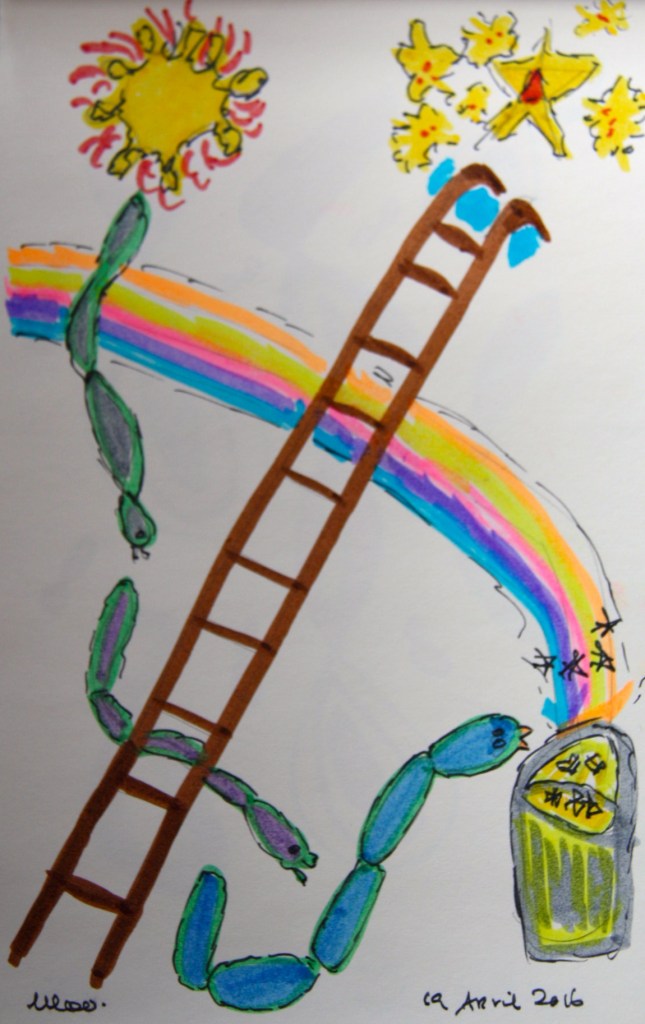
The Origin of the World

Dawn from the Red Room at KIRA. Another form of birth.

Spotify
Remember to scroll down to the correct episode.

The Origin of the World
Gustave Courbet
 
L’Origine du monde

The origin of the world and where I came from,
her deep, moist cave that cast me from dark to light.
She loved me, she said, depriving me of her warmth,
leaving me to go back to her lover, loving him more.

Was it guilt that drove her to drinking whisky?
A forty-ouncer a day at the end, sometimes more.
She would wake in the night, wander the house,
banging against chairs, tables, walls, and doors.

She ran up bills in local shops, and the keepers
would dun me for the money she owed. She also
borrowed cash and some days her fingers were bare.
She left pawn shop IOUs on the table and I drove

 into town to redeem her rings. Once, in a drunken
frenzy, she cursed her only child. A mother’s curse is a
terrible thing. Living albatross, it claws lungs and heart.
Its weight drove me to the bottle. I too sought oblivion.

Joy came when blackness descended, the albatross flew,
amniotic waters rocked me in warmth and comfort,
and my body’s boat floated once again on an endless sea.
Reborn each day, mornings cast me back from dark to light.

Comment: Here is the link to the DiversityTV reading of The Origin of the World. The Origin of the World begins at 28.40. I will attach my own reading from Spotify, just as soon as I complete it. I always find it fascinating to compare the way others read with the way I do. meanwhile, I would like to thank Alexandro Botelho for his invitation for me to participate in his DiversityTV show. I enjoyed his reading very much and I wish him all success with this venture.

Calling It a Day

Calling it a Day

This auriferous sky, sewn with sharp sequins.
Is there a warp, a leaning towards meaning,
a lurch maybe towards the moon’s dark side?
Questions: knights-errant questing for answers.

Who planted our DNA into that first Garden?
Or did the garden fill us with its own seeds?
Why did those little plants take root and grow?
Why do they now wander everywhere, restless?

This auriferous sky, sewn with sharp sequins.
Is there a warp, a leaning towards meaning,
a lurch maybe towards the moon’s dark side?
Questions: knights-errant questing for answers.

Rampant feet patrol our castle’s heights
while we seek instant gratification, swift
possession, our fingers probe each passing
cloud, reaching for all, but grasping none.

A satellite glides its razor edge, slices
the night’s eye into pin pricks of light.
The moon balances her orange unicycle
on thin black lines, hills edged with trees.

Lesser incandescence of a departed sun,
that low, lone moon slowly climbs the sky.
Released from their earthbound burdens,
who knocks this night at heaven’s gate?

Here on the back porch, midnight slowly
covers me with its dark gray cape of grief.
My grief is your grief, your grief is mine, all
grief is one, why do we all then grieve in vain?

Man from Merthyr

Man from Merthyr

Memory loss punched holes in your head
and let in the dark, instead of the light.
Constellations faded from your sight,
erased by the arch-angel’s coal-dust wing.

 “I’m shrinking,” you said, the last time I saw you,
you, who had been taller, were now smaller than me.

 Tonight, when the harvest moon shines bright
and drowns the stars in its sea of light,
I will sit by my window and watch for your soul
as it rides its coal-fired rocket to eternity.

My eyes will be dry. I do not want pink runnels
running down this coal-miner’s unwashed face.
I’ll sing you a Welsh lullaby, to help you sleep.

“When the coal comes from the Rhondda
down the Merthyr-Taff Vale line,
when the coal comes from the Rhondda
I’ll be there.”

With you, my friend, shoulder to shoulder.
“With my golden pick and shovel, I’ll be there.”
Farewell, my friend, safe journey, sleep deep,
as deep as a Rhondda coal mine may you sleep.

Why?

Why?

“Where are you going?” I ask again.
 “To see a man about a dog,” my father replies.
  “Why?” I ask.
  “Hair of the dog,” his voice ghosts through the rapidly closing crack as the front door shuts behind him.
  “Why?” I cry out.
 Years later I remember this episode. The mud nest nestles tight against a beam beneath our garage roof. Tiny yellow beaks flap ceaselessly open. Parent birds sit on a vantage point of electric cable, their beaks moving in silent encouragement. A sudden rush, a clamour of wing and claw, a small body thudding down a ladder of air to crash beak first on the concrete.
“Why?” I ask.
The age-old answer come back to me.
“Wye is a river. It flows through Ross-on-Wye and marks the boundary between England and Wales.”
The swallows perch on the rafters watching their fledgling as it struggles on the floor, the weakening wing flaps, the last slow kicks of the twitching legs.
“Why?” I ask.”
“Y is a crooked letter invented by the Green Man of Wye.”
“Why?” I repeat. “I want to know why.”
Silence hangs a question mark over the unsatisfied spaces of my questing mind.
A golden oldie. We would all like to know why. But there are no answers. Just riddles cast, like two trunk-less legs of stone, on the sands of time. Nothing beside remains. Yet still we ask the age old question: why? And still we receive the age-old answers from those ageing wise men who ruled our childhood and taught us everything they knew.
“Why?”
“Because.”

Comment:

Alas, we have lost our hollyhocks, not all of them, but most. They have been drowned in torrential rain, blown and bent, ravished by raging winds, and they have been scorched in a heat-warning scorched earth policy that left them and the garden all forlorn. As for the lawn, between chinch bug, crows, raccoons, and a surge in weeds and bugs, it is a desolation.

What is worse: they were so beautiful, those hollyhocks. Multi-coloured, stately, and tall. Hopefully, they will return next year. We do hope so. And equally hopefully next year will be a better year for them. And for you and me. Meanwhile, I savour the photos and mourn their loss. Meanwhile…

“Why?” I ask “Why?”

The answer echoes back across the years in well-known voices that have long been silenced.

“Because.”

After the Floods

After the Floods
(2004 BC & 2018-2019)

as the crow flies
so the pigeon
holding straws
within its beak
time to rebuild

who now knows
the unknown
perceives the abyss
beneath egg-frail
cockle-shell hull

waters recede
islands re-emerge
bald skulls of hillocks
stripped of grass and trees
water-logged fields
old bones dug up
displayed in the ditch

mud walls fallen flat
warped wooden planks
water-swollen
so much stolen
by water wind and wave

Patience

Thursday Thoughts
Patience

Patients must be patient.
The waiting-room
is where the doctor
makes them wait.

My father waited, patiently,
to see the specialist.
At the stroke of noon,
nurse told the waiting patients
not to wait patiently
and to all go home.

“Come back next week,” nurse said.
“What’s up?” I asked.
“The doctor,” she said,
“has a very important meeting.”

I hurried for a taxi.
My father on his Zimmer
followed slowly behind.
On the hospital steps
I met the doctor.

“Damnation!” he said,
into his cell phone.
“I’m going to be late
for that appointment.
I’ve left my golf clubs behind.”

Thursday Thoughts: I remember that day well. My father was due to visit the hospital for his appointment with the stroke specialist. I wanted to drive him there, but he insisted on waiting for the old folks’ ambulance. It was due at 9:00 am and his appointment was for 10:30 am. We waited patiently, watching the hands on the clock moving slowly round. 9:00 > 9:15 > 9:30 > 9:45. “I can drive you,” I said. My father shook his head: “If I don’t take the ambulance, they won’t come to pick me up again. They’ll say I have other means of transport.”

The ambulance / ambwlans (in Welsh) arrived just before 10:00 and dad was sure they’d make his appointment time. Except there were still empty seats and that meant more passengers to pick up. Used to the system, my father waited patiently while I got more and more frustrated. Finally, the ambulance was full and we made our way to the hospital, getting there about 10:45. “Run,” my father said, thrusting his appointment papers at me, “tell the nurse I’m on my way.” Run I did. When I got to the waiting room, I found it full of people with never a chair for my father to sit on. When he arrived, a younger patient offered him his seat and he flopped down into it.

Names rang out. Patients disappeared. Some returned to the waiting room, then walked out. Some didn’t return. At 11:15 my father demanded tea. I got him a cup. At 11:30, a man stood up and started to preach to his captive audience. “Does that every week,” dad muttered in my ear. “He’s mad.” “You can’t take it with you,” the preacher thundered. “There aren’t any pockets in shrouds.” People fiddled and looked uncomfortable. Most had teacups perched precariously on saucers, and some rattled them, whether in applause or anguish, I still don’t know.

Then at noon the nurse appeared and announced what you have read above. “Dr. XXX’s patients: you can all go now. Dr. XXX has an important appointment. Come back next week.” My dad pushed me. “Run,” he said. “Get a taxi. They’ll all be wanting one and by the time I get there there’ll be none left.” That was the only visit I made with my father to that particular hospital. I had so many questions to ask that specialist, but, alas, I never met him.

What I did learn was that patients must learn patience. Hospitals, like airlines, run to their own schedules. A sign should be placed above every hospital door. “Abandon hope, all ye who enter here.” Just a thought, nothing more. The delays in all our medical systems, caused by the Covid-19 pandemic, have been disastrous for many people, especially the old. Missed appointments. Delayed and cancelled treatment. Long waits and delays. The medical staff have been placed in such stressful conditions. Many are finding it difficult to cope with their inability to fulfill their desires to help their patients. Many are so stressed out. Two of my own doctors have cried when talking to me. I think of it as Covid Collateral Damage, CCD, just like the Colony Collapse Disorder that wiped out our bee population a few years back. Now we are the bees and hospitals and nursing homes are the hives.

Looking back, that morning spent waiting with my father, was a lesson in what old age has in store for us Golden Oldies as we age. Patience: as patients, we must learn patience. And remember, as Bette Davis once said “Old age is not for cissies.” And those are my thoughts for today!

Prostate

Prostate

Pictures and models.
1 Prostate: normal size and shape.
2 Prostate enlarged.
3 Prostate enormously enlarged.
4 Prostate lumpy, malformed,
          cancerous, and me prostrate.

Lumpy and treacherous:
a gross shape growing
its grossness within me.
Gross, but mine and a vital
part of my living body.

A mad world this, twisted
time and fairground mirrors
distorting everything, and me
grossed out by the mechanical
clockwork, tick-tock, snip-snap,
removing samples for some
lab to examine and test.

“Give them back!”
I want to scream.
I guess I’ll get them back
on Judgement Day,
when the body resurrects
and I am whole again,
warts, cancer, and all.

Meanwhile, the biopsy’s done.
I get up from the bed
and the nurse hands me a towel
so I won’t drown my sorrows
in my body blood, a crimson
tide, ample, thick, flowing red.

Comment: After a couple of phone calls, some e-mails, and some messages on Facebook, I realize that some of my friends are actually following this blog and reading it. Thank you for the care and attention you have shown me by writing or calling to inquire about my health. All is well. I visited my urologist yesterday for a regular check-up and sat there a little longer than usual, waiting. Never one to waste time, I studied the things in the office and discovered a model prostate over which I could run my fingers (I didn’t!). It showed the four stages of prostate enlargement and cancer development as outlined above. I had no paper with me, so I jotted down four poems on the back of the paper bag in which I carried the injection I would later receive. This poem was one of them. The reference to Judgement Day and the recovery of body parts comes from one of Quevedo’s Suen~os, El suen~o del infierno, I believe. Anyway, my apologies, if I have worried you. I am fine, thank you. However, as Quevedo also wrote, “The day I was born I took my first step on the road to death”. Alas, I too am one of Dylan Thomas’s ‘poor creatures, born to die,’ as are we all. If not now, when? Not too soon, I hope. Blessings and thanks to all who read this. Take care and stay healthy.

Christmas Angel

Christmas Angel

Once upon a time
he sang carols,
but now he chokes
on red-herring bones
and obscure meanings.

When he opens his mouth,
his tongue falls bleeding on the silver tray
encased in wood
passed round to collect the money.

His knees are dusty from lack of use.
What wooden doll’s head
rocks back and forth on his shoulders?

On Christmas Eve, a painted
clothes peg lies in a wicker cradle.

He swaddles it with birdsong
and hums forgotten words
to half-remembered tunes.

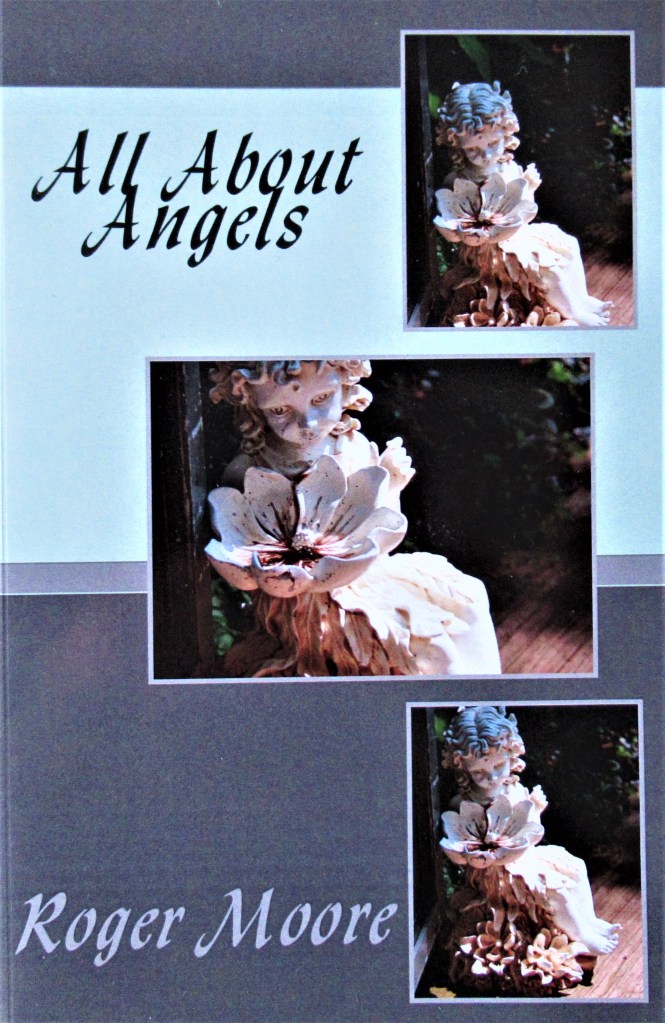
Christmas Angel can be found in
All About Angels.


All About Angels
Paperback edition


All About Angels
Kindle Edition

Building on Sand

Building on Sand

Everywhere the afternoon gropes steadily to night.
Some people have built fires,
others read by candlelight.

Geese, drifts of snow their whiteness,
settle on the riverbank. They walk
on thin ice at civilization’s edge.
Around them, the universe’s clock
ticks slowly down.

Who forced that scream
through the needle’s eye?
Inverted, the Big Dipper,
hangs its question mark
from heaven’s dark eyelid.

Ghosts of departed constellations
stalk the sky. Pale stars bob
phosphorescent on the flood.

The flesh that bonds,
the bones that walk,
the shoulders and waist
on which I hang my clothes,
now they stand alone
and listen at the water’s edge
to the whispering trees.

They have caught the words
of snowflakes strung between the stars.
Moonlight is a liquor
running raw within them.

Comment: The verse version (above) is from Though Lover’s be Lost. The prose version (Below) is from Stars at Elbow and Foot.

Building on Sand

Everywhere the afternoon gropes steadily to night. Some people have built fires, others read by candlelight. Geese, drifts of snow their whiteness, settle on the riverbank. They walk on thin ice at civilization’s edge. Around them, the universe’s clock ticks slowly down. Who forced that scream through the needle’s eye? Inverted, the Big Dipper, hangs its question mark from heaven’s dark eyelid. Ghosts of departed constellations stalk the sky. Pale stars bob phosphorescent on the flood. The flesh that bonds, the bones that walk, the shoulders and waist on which I hang my clothes, now they stand alone and listen at the water’s edge to the whispering trees. They have caught the words of snowflakes strung between the stars. Moonlight is a liquor running raw within them.

Click here for Print Version

Click here for Kindle edition

Rainbows

Rainbows

For my teenage daughter
who has just cried on my shoulder

not knowing which courses to take
nor what university to attend.
21 December 1991
12:50 pm.

Rainbows go up and down.
Only you can say which way to go:
upwards to the heavens
or downwards to the earth below.

Rainbows are a promise
of ever sunnier skies.
We see them after rainstorms
or in tear-filled eyes.

There’s no shame in grief.
Every cloud has a silver lining
and rainbows gather round it
waiting for our mind’s refining.

Search for your rainbow.
Follow when it points the way.
But remember, when you fall
to earth, like you did today,

that always at the rainbow’s foot
there lies a pot of gold.
Well that’s what the Irish
Fairies say, or so I am told.