Therapy Garden

DSC02020

Kingsbrae 10.3
10 June 2017

Therapy Garden

Sitting, absent-minded, empty,
waiting for the sunlight to heal
my old bones and fill my fragile form
with light so that I may shine,
a lighthouse on the land,
light pouring out from me,
light enough to enlighten
the unenlightened
in their soul’s dark endless
night, no moon, no stars,
and me, walking unafraid,
knowing I need fear nothing,
even in terminal darkness,
for my body now overflows
with therapeutic light
that floats its boat on an inner
sea of tranquility.

Journal: Wandering the gardens on a warm sunny day, just taking in the fresh air and the sunshine. I stopped in the tranquility Garden and sat  a bench in the shade and wrote these words. They again very “raw” and I may well revisit them. Comments gratefully accepted.

Scent and Touch

img0137_1

Kingsbrae 9.4
9 June 2017

Scent and Touch

A feather upon the cheek,
this fern frond held
fragile, hesitant
between fine fingers.

Touch and smell:
two senses engaged.
A paint brush sounds,
brush-brushing lightly
the expectant skin.

Faint the taste tested
suggestive
on tongue tip.
No sight, just insight.

I have a sense of senses lacking.
My words reach out like fingers,
but they can neither retain
nor explain the meaning of it all.

Comment: “Built in cooperation with the Canadian National Institute for the Blind, the Scents and Sensitivity Garden is dedicated to the memory of St. Andrews’ resident Albert McQuoid. The garden features raised beds that allow handicapped, sight impaired, and wheelchair bound visitors the opportunity to enjoy the feel, and scent, of the plants and flowers right within arms’ reach.”

Labyrinth

IMG_0150


King’sbrae 9.3
9 June 2017

Labyrinth

What thread will lead
blind Theseus
this labyrinth through?

Light the ladybird sun
caressing his one cheek
the other in shadow.

Fanciful the bumble bee,
heard but not seen
its miracle of ponderous,
heavier-than-air flight

Sight-blessed,
life’s obstacle course:
a flat track frolic
for all those confident
of foot and touch.

Listen to the ladybird:
she cracks her wings
and launches upwards
to join her companion,
the bee, twin specks
together now in the sky.

Love Spoon

039

Kingsbrae 9.1
9 June 2017

Love Spoon

Celtic the Knot
binding heart and soul
the love spoon
carved
by caring hands

Sharp moon blade
honed by the wind
white
wooden clouds
flowing against
dark sky grain

Sweet surge
time and tide
tied together
knotted
our heart strings
twisted our love
forever in this
Celtic Knot

Comment: Celtic Knot is the name of one of the more formal gardens at Kingsbrae. It is also one of the symbols carved into Welsh Love Spoons and signifies eternal love. Carving the love spoon was one of the traditional tasks given to the young man when he asked for the hand of his beloved in marriage. In addition to showing craftsmanship and woodcarving skill, the task of carving the wood spoon kept the young man’s hands occupied while he was courting. Parents would then be able to check on the progress of the love spoon and ensure that their daughter’s virtues were in safe and trustworthy hands.

Poetic Process: Thursday Thoughts

img_0186


Kingsbrae 8.3
8 June 2017

Poetic Process: Thursday Thoughts

The end result of the poetic process, however we define it, is the poem. Whether the poem be good, indifferent or bad, depends on a set of critical value judgments of which the poet may or may not be aware at the time of writing. The end product must be allowed to look after itself. But what about the process?

The question is simple, but the answer is more difficult, because the actual nature of the process will vary with each one of us. If the end point is the poem, how do we write the poem, what is its starting point? Is it when we sit down to write? Is it when the pen nib (yes, I still write the old-fashioned way) makes contact with the paper? Is there a pre-writing starting point and if so, where does that begin? Is it in the poet’s head, or the poet’s eyes? Does it reside in touch or scent? Good questions: no answers other than the failsafe … it depends.

One thing that has emerged from this KIRA retreat is that above all we need time to be artists. Art and poetry take time, and artists, whatever their medium, need time to think, time to practice, time to splash paint on canvas, time to sit down and put their head in their hands and meditate … “What is this life,” writes W. H. Davies, the great Welsh poet, “if full of care, we have no time to stand and stare.”

Elise Muller came up with an interesting exercise for developing self-expression. “Write down a question with your dominant hand,” she said. “Then answer it by writing with your less dominant hand.” I tried this. “What do you mean by writing process?” my right hand asked. My right hand held the pen about half an inch from the page and made me stop … and think. I thought about the critical analyses, usually ultra-academic,  that I had written and read over the years. Then I started to organize them into do’s and don’ts. The thoughts of certain serious writers sprang to mind … then I switched my pen to my left hand.

Uncontrolled, uncontrollable thoughts came tumbling out and spilled off the end of the pen on to the empty page that rapidly filled with visual and verbal images: evening falls and the stars grow into flowers in the darkness … three deer enter an empty field and dance on the dandelions … the sky fills with snowflakes that erase, one by one, all the objects in the yard … the tide flows back in and the bay recovers its memories of silver fish beneath the waves … the half -empty / half-full glass becomes meaningless: its essence is to filter the sunshine and to sparkle with light … clouds gather into small, wooly herds and the wind chases them across the sky …

To be filled with poetry and creativity we must first be emptied of the cares of the world. Then, when our heads are empty and free there is space for them to fill with the most beautiful images and ideas. This creative process needs time. Time to download and forget our worries. “Time to stand beneath the boughs and stare as long as sheep and cows” (W. H. Davies again). Time to be ourselves. Time tobe. Time to become one with nature.

To gain this state of freedom, we need to be free of financial cares and woes. We need to escape from domestic duties. We need to be alone (when we need to be alone) and among friends of a like mind (when we need company). “The time to see when woods we pass, where squirrels hide their nuts in grass” (W. H. Davies, yet again). So, in the poetic process, we need that freedom to create, to cut the ties that bind so tightly, to walk and watch and stop and stare. When that old, tired head is empty, the poetry will flow back in. And it will be a poetry not of grinding ideas but of dancing metaphors and sparkling words. “A dull life this, if full of care, we have no time to stand and stare.”

KIRA has gifted me with this time, this quality time. Clare and the WYPOD and my Fictional Friends and the Thursday Grunts and my fellow New Brunswick writers have encouraged me to take advantage of it. The process is in process. Some of the results are already being seen on these pages.

My thanks to all those who made this adventure possible. I would also like to thank all those who now facilitate this process every day.


Words

IMG_0167.JPG


Kingsbrae 8, 2
8 June 2017

Words

Here, on the seashore,
the whisper of waves,
splashed with a flash of sun,
wind fingering the hair,
the light a delight,
and wordless this world
though its beauty be
configured in words.

The scything of the sea,
the land seized in snippets,
grey stones, red rocks,
gelatinous mudflats
blue on white striations.

Seagull wings
snipping celestial ribbons,
salt caked keen on lips,
sea weed scents sensed
yet never seen.

Captivated we stand here,
unattached our single wings,
save to this singular beauty:
peregrine the falcon soul,
so solitary as it soars.

Comment: So many of these new poems are just that, “new” and “raw”. Words, for example, is just a couple of hours old. That is the gift of time that I have been given. The writing process is so rapid that there is little time to digest the last thought and image sequence, before the next comes tumbling along. I guess it’s just a question of rolling merrily along and we’ll see later what we still think is fit for survival. The selecting of these poems will be an interesting task … and who will select the selectors …

Flute

IMG_0134 (2)

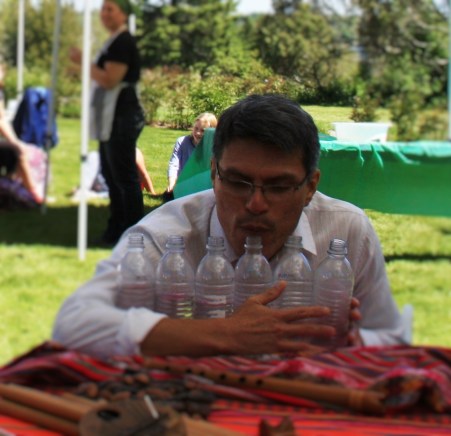
Carlos Carty Making Magic

Kingsbrae 8.1

Flute
(for Carlos Carty)

Songs without words:
a black alpaca rolling on green grass,
two deer dashing across the lawn,
three Indian Runner Ducks actually running,
four tents, canopies billowing beneath the sun,
Passamaquoddy stretched out before me,
a dark island stark in the bay,
sunlight descending a ladder of cloud.

Song without words without end:
music of wind through rock,
waves lapping against stones,
a breeze tapping rhythm from river reeds,
plucked and pierced, the reeds:
the world’s first flute.

Life and breath are one.
The young man opening the water bottles,
sipping the right amount, pursing his lips,
blowing into the bottle neck,
making sweet music:
a song of joy.

Absences

Avila 2008 006

Kingsbrae 7.3
7 June 2017

Absences

Pigeons flapping
across abandoned squares.

Clothes peg dripping
raindrops from a deserted line.

Ile Ste. Croix,
lonely in the bay,
longing for Champlain’s
return.

Endless rock and roll
tide after tide
water without end.

A whole day goes by
without putting
pen to paper.

The blank page
waits for the pencil’s
resurrection.

Yellow Bird

IMG_0176

Kingsbrae 5.1.1
5 June 2017

Yellow Bird

Broken-winged, a bird I found,
panicking upon the ground.

I stooped to lift it from the land:
it nestled in my open hand.

A matchstick splint with cotton tied,
a canary cage to rest inside.

With healing done, an open door:
my yellow bird will fly no more.

I take a pencil, draw a tree,
my bird begins to sing for me.

I erase the cage bars, one by one,
paint a lion’s mane of sun.

Now yellow bird sits in his tree,
and sings all day, to inspire me.

Comment: I split the original post into two segments. The first, 5.1.1 is the poem Yellow Bird and the voice recording. The second, numbered Kingsbrae 4.3 Encaustic, contains the summary of the first evening’s artistic discussion.

Hymn of Praise

IMG_0021.JPG

Kingsbrae 4.2
4 June 2017

Hymn of Praise

Woodhenge, Stonehenge,
bay and shore henge,
the sun rising out of the sea henge,
this forest older by far
than the Christian God,
and those Druids, my ancestors,
late-comers, five thousand years ago,
bound to this earth by the same
rays of sunshine that bind me now.

No man kills
in praise of the life-giving Sun,
that Celestial Father
who raised with Earth Mother
the beauty of our flowers,
the bounty of our fields.

Here, at Kingsbrae,
sitting at my window,
I raise my Sunday hymn of praise
to the Sun who gifted me my life
and who’ll still be there
when I end my days.