The Origin of the World

IMG_0265

The Origin of the World
Gustave Courbet:
L’Origine du monde

The origin of the world and where I came from,
her deep, moist cave that cast me from dark to light.
She loved me, she said, depriving me of her warmth,
leaving me to go back to her lover, loving him more.

Was it guilt that drove her to drinking whisky?
A forty-ouncer a day at the end, sometimes more.
She would wake in the night, wander the house,
banging against chairs, tables, walls, and doors.

She ran up bills in local shops, and the keepers
would dun me for the money she owed. She also
borrowed cash and some days her fingers were bare.
She left pawn shop IOUs on the table and I drove

 into town to redeem her rings. Once, in a drunken
frenzy, she cursed her only child. A mother’s curse is a
terrible thing. A living albatross, it claws lungs and heart.
Its weight drove me to the bottle. I too sought oblivion.

Reborn each day, mornings cast me back from dark to light.
Joy came when blackness descended, the albatross flew,
amniotic waters rocked me in warmth and comfort,
and my body’s boat floated once again on an endless sea.

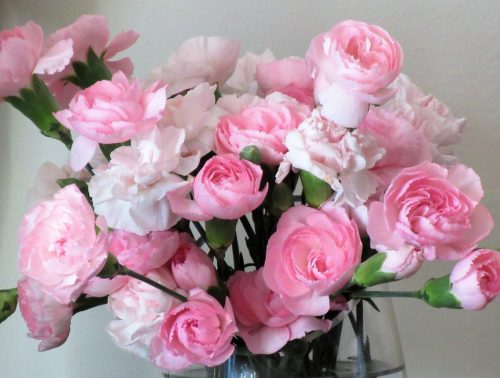
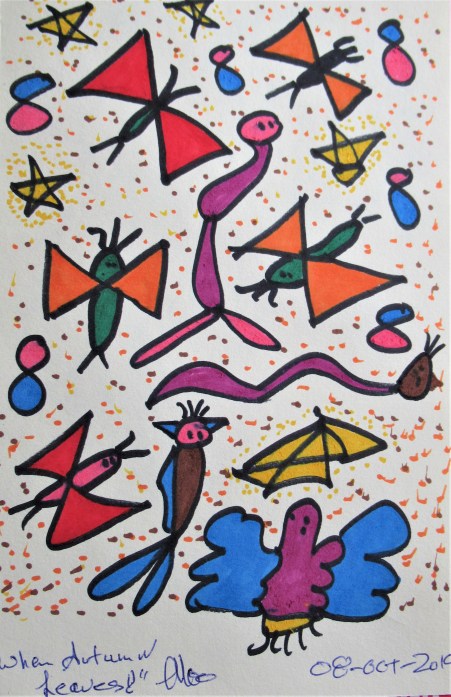
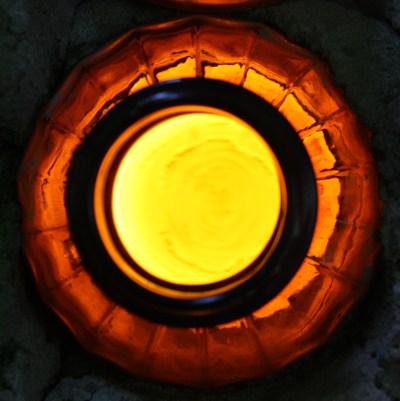
Comment: The photos show light shining through bottles in The Bottle House on Prince Edward Island. There is something very special about sunlight shining through stained and colored glass. Color distorts, speckles hands and face with a pointillistic magic, and the circular framework becomes a sun in its own right. As for Courbet’s painting, it still has the power to shock the viewer as it sets the eternal conundrum of the power relationship between the viewer (male) and the viewed (female). And remember: El ojo que ves no es ojo porque lo ves, es ojo porque te ve  / the eye you see is not an eye because you see it, it is an eye because it sees you, as Antonio Machado tells us. As for the poem, it stands or falls on its own, as does the painting. Visual shock or verbal shock: take your pick, but I hope you do not walk away unmoved.

IMG_0251


Still Life with Hollyhock

IMG_0206

Still Life with Hollyhock
Geoff Slater

How do you frame this beaver pond,
those paths, those woods? How do you
know what to leave, what to choose?
Where does light begin and darkness end?

Up and down: two dimensions. Easy.
But where does depth come from?
Or the tactility, the energy, water’s
flow, that rush of breathless movement
that transcends the painting’s stillness?

So many questions, so few answers.
The hollyhock that blooms in my kitchen
is not a real hollyhock. It is the painting
of a photo of a genuine flower that once
upon a time flourished in my garden.

A still life, then, a nature morte, a dead
nature, portrayed in paint and hung alive,
on display in this coffin’s wooden frame.

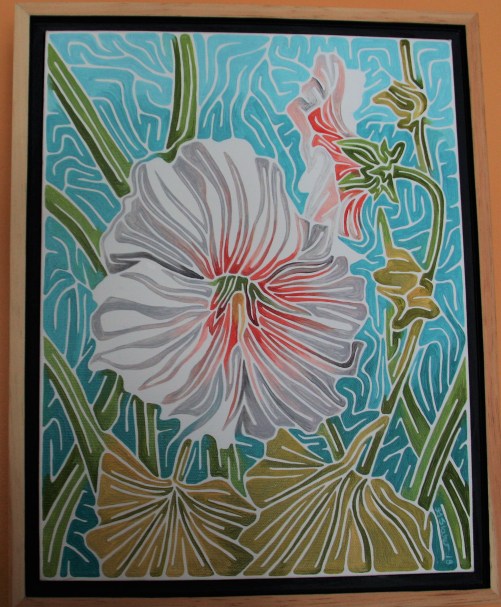
Comment: I love the way language changes the way we look at life.  A still life painting becomes nature morte in French and naturaleza muerta in Spanish. Still life becomes dead nature. Fascinating. I also love the way in which the camera captures nature and the natural world. We think it is an accurate depiction, but really it isn’t necessarily that accurate. Filters, light and shadow, mood: they all fluctuate and sometimes we capture that which we never saw and sometimes that which we saw is never captured. Oh the subtle enigmas of creative art.

IMG_1005 (3)

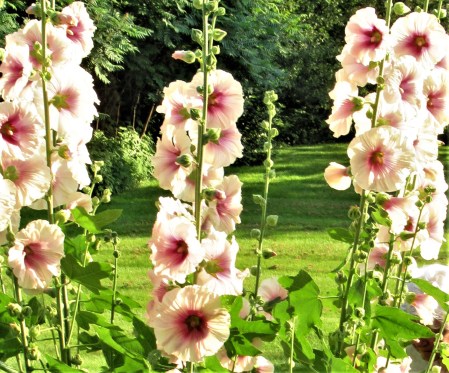
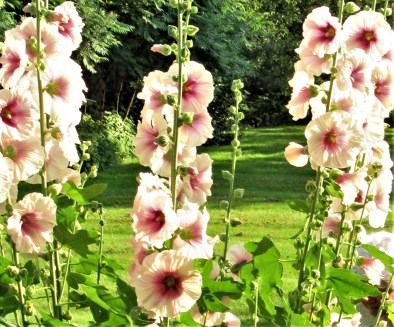
And it is the same with the hollyhock, my hollyhock, Geoff’s hollyhock. At the top of the page is Geoff’s painting of my hollyhock. The above is a photo of my hollyhock. Which bloom did Geoff capture and reproduce in paint? Language: and what do I mean when I say ‘my hollyhock’? My indicates possession, ownership. How and in what way does one own a hollyhock? How does one possess a garden, a flower bed, a tree? Are they not free, living, beings with a life and maybe even a mind of their own? Does one hollyhock talk to another hollyhock as the trees are said to converse with the trees? Do the trees in the garden possess a soul and if they do, in what sense do they possess one? And what is a soul anyway? I guess it depends upon the church and creed to which you belong. Certainly the garden has a life of its own and we discover that every spring when the grass and flowers grow back and the dandelions return.

image5

Questions: dangerous things, questions. Several of the questions posed above could have landed me in an Inquisitional institute in Spain in the 1500’s and 1600’s. That is a frightening thought. Alas, the philosophy of all that is way too deep for this poor poet and apology for a philosopher. One thing I do know, though: I love the garden going on outside my window and it is a privilege to be allowed to watch it, admire it, and follow its progress as the sun returns and the draws the birds back with it.

IMG_0198

¡Vale! Hail and fare thee well.

The Rain in Spain

Avila 2008 164.jpg

The Rain in Spain

The rain in Spain
stays mainly on the plain.
Except it doesn’t.

It falls on the Basque Country,
the Province of Santander,
now known as Cantabria,
on Asturias and on Galicia.

In Galicia, a native brown bear
has been seen after an absence
of one hundred and fifty years.

La Costa Verde, the Green Coast,
boasts dairy cattle, lush grass,
the best milk, butter and cheese.

Beyond these green hills,
over the Escudo and up to Burgos,
you find Spain’s meseta,
a tableland in a rain shadow area,
a veritable plain,
arid, dusty, dry,
a plain in Spain
that sees and feels no rain.

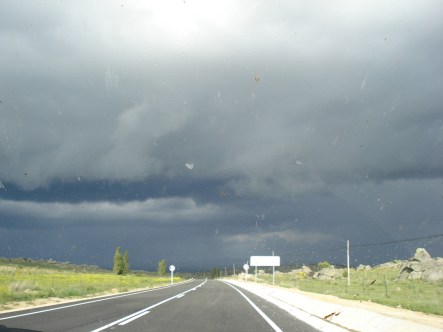
Comment: Un chubasco … a heavy downpour building on the meseta outside Avila. These severe rainstorms come out of nowhere. High winds, heavy rains, they drench you and the countryside in a matter of seconds and they go as suddenly as they come. However, the normal pattern of weather is dry and dusty. And no, the rain in Spain does NOT stay mainly on the plain. In Santander, on the Green Coast, la Costa verde, they have a saying: En Santander, en el verano, / no dejes el paraguas de la mano In Santander, in summer, never let your umbrella leave your hand. And its true: rain is constant and comes in from nowhere. They have other sayings, equally as efficacious, like Nunca llueve en los bares / it never rains in the bars. I miss Avila. I miss Santander and the Basque Country. I miss my childhood vacations, spent in Spain. But when they tell you that “The rain in Spain falls mainly in the plain” … well, just don’t believe them. Check, double-check, and then check again. As they sing in Newfoundland, about sailors and sailing ships, “A sailor ain’t a sailor ain’t a sailor anymore.” Nor, my friends, is the truth. Cum grano salis: take everything you hear with a large pinch of salt!

Avila 2008 205.jpg


Bird’s Nest

No.5 1948 Jackson Pollock.jpg

Bird’s Nest
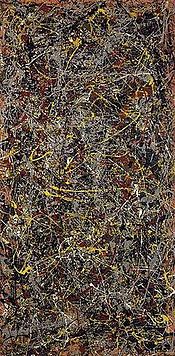
Jackson Pollock No 5 (1948)

This bird’s nest starts with a startling tweet
that wins a trilled, thrilled response. A flutter
of heart-string wings, creator, viewer, join

with the creation. Thin threads of life mix
and match their tangled weave, existential
tapestry, fathered in a feathered nest.

World without end, this labyrinth without
an entry point, without a beginning,
with a spaghetti-thread middle that meets

not in a breath-catch of the mind, but in
a brush-flick of coloured rain, a cycle
recycled of circled paint, circular

in its circumnavigation, its square
eight by four-foot globe of a new world whirled
in stringy whorls, reinvented beauty

drawn haphazardly from the bicycle
tour de force of this artist’s inner mind.

Comment: In my latest poetry book entitled The Nature of Art and the Art of Nature, I explore the relationship between art and the natural world. I have always been fascinated by what we see, how we see it, and how it affects us. The tiny print above is scarcely representative of the eight by four-foot world that the artist creates, or re-creates. And what is modern art? Is it a re-creation of the world as we see and feel it or a representation of a new internal world glimpsed by the artist’s mind and hand-turned into a new reality, the work of art? I guess it depends on the artist, his or her way of life, the way they approach the macrocosm, and how they view the microcosm of their own inner lives.

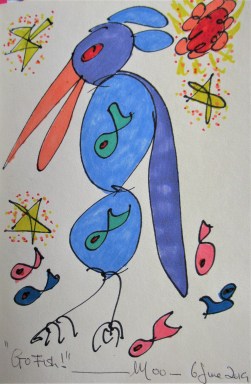
Creation: such a lovely word. Such joy generated as we create something new, be it something verbal, visual, or tactile. For me, it is more a verbal world than a visual one. My forays into art are wonderful, enjoyable, but very personal and artistically limited, even though I love taking a line for a walk or allowing the marker to trace images on the page. Dreams and a dream world: we need them. Sometimes reality is too much for us and we have to shut out the noise of the world and, in Antonio Machado’s words, ‘saber estar solo entre la gente‘ / know how to walk alone among the crowd. The loneliness of the long-distance runner. The isolation of the loving heart trapped within its cage of flesh and bone. The solitude of the spring nest on the pillars at Long’s Creek, overlooking the head pond at Mactaquac, as it waits for its restless occupants to return from their long journey back to the north from the south and start the rebuilding process, each twig, each straw, a minor miracle. And then the hatching and the fledglings and the return flight south that gifts the empty nest such loneliness as it waits for the cycle to begin again once more.

IMG_0824 (2)

Scorched Earth

IMG_1783 (2)

Scorched Earth

A scorch mark
still scars this woodland
where deer grazed
until spring grass
fed the flames
sown by an unknown hand.

RCMP
cars blocked
the lower road,
uniformed officers
directed us to detour
up and away.

Below us we could see
smoke, no flames,
two firetrucks.
The acridity of ash,
breeze-borne,
filtered through the car
making us cough.

No more will the deer
roam this particular place
until wounds are healed
and all trace of the fire,
like them, has fled.

Comment: Driving to the head pond at Mactaquac, a week or so ago, we met an RCMP roadblock and were diverted by the officers. We ascended Mactaquac heights, and came down the other side, rejoining the lower road which was blocked by another set of RCMP cars. It was the week after the shootings in Nova Scotia. All we could think of was the respect we have for the RCMP. The knowledge that, if someone drove a police cruiser, stolen or faked, and wore an RCMP uniform, stolen, faked, or genuine, and flagged us down, well, we would have had no doubts and we would have obeyed that person implicitly. This was apparently what happened in Nova Scotia when the gunman, dressed like an RCMP Officer, flagged some of his victims down, then shot them as they sat in their cars. I guess the wounds of forest and deer will heal more quickly than those of the victims’ families. Pax amorque / peace and love. 

Rain


Fundy 2004 003

Rain

rain
song-birds
trilling liquid notes
spring songs
flooding gardens

oh!
competitions
ritualistic rivalries
staking out territories
winter stalwarts
versus
nouveaux venus
with their summer wealth
of well-fed health

everyone competing
for their garden niche
males en garde
guarding each square inch
their earthly paradise
carved in my yard

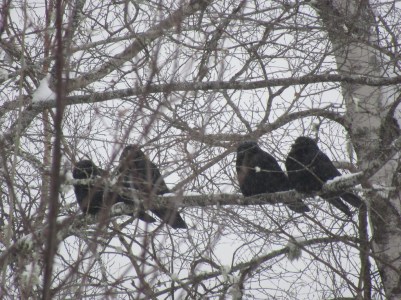
Comment: They lit up the Mountain Ash as if it were a Christmas Tree, American Goldfinches, twenty-four of them. The rain ran down the window panes and all the photos blurred and distorted. One at each end of the garden, two robins sang. Two pair of Purple Finches, the bright male and the dowdy female, pecked beneath the feeder as the chickadees, siskens, and juncos flitted in and out. The red squirrel scattered the ones in the tree and the grey squirrel ran at and over the ones on the ground. Chaos. And the rain, rain, rain came down, down, until the garden was empty and birds and animals had taken shelter.


Biopsy

UNADJUSTEDNONRAW_thumb_2788

Biopsy

Driving home
from the hospital
after the biopsy,
thinking of the indignities
inflicted on my body,
cold, exploratory fingers,
the insertions,
the ardent desire
to say
“Enough,
no more!”

Oh God,
I am so cold.

Fierce winds
push me
along a snow-packed road.

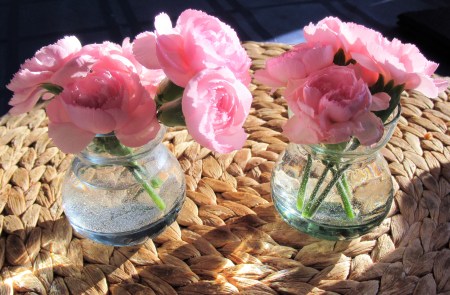
I dream of sunshine
of summer flowers,

IMG_1005 (3)

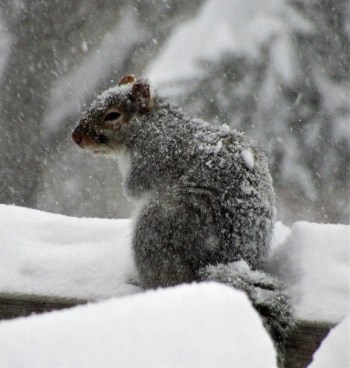
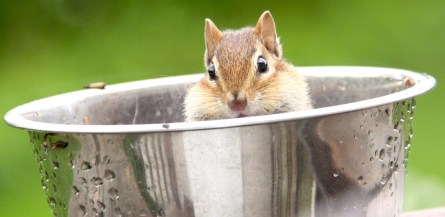
of chipmunks and squirrels,
of bird seed scattered
so others may survive.

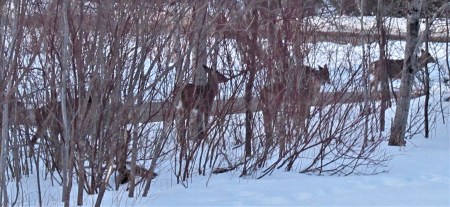
I dream of five deer
walking at midnight
through my garden.

IMG_1740 (2)

Magic,
their shadows
under moonlight
on the snow.

I skid into a snow bank
and my world shakes in shock.

A thirty-wheeler slithers by:
there are so many ways to die.

IMG_0266

Comment: Was it really only five years ago that I wrote those lines? I hadn’t even started this blog back then. So much melted snow, so much water under so many bridges. I look back at my journal and read that on April 1, 2020, in the USA, there were 3,800 dead from Covidis and 300,000 people affected. This morning, when I got up, those figures were higher, much higher: 63,019 dead and 1,070,032 affected. What a difference a month makes, let alone five years.

Affected, such a silly word when each individual person that these figures represent is, or was, a living, thinking, loving, human being, with an extended network of family and friends, each one of whom is in turn affected by the loss or sickness of a group member, be it a brother, a child, a sister, a mother, a father, a son, a daughter, or just a friend …  just a friend, another silly thing to say, as if just friends were not important, collateral damage, so to speak … and now, throughout our world, in macrocosm and in microcosm, we are, each one of us affected, in one way or another. Here in New Brunswick, Canada, we wash our hands, we wear masks, we stay home as much as possible, we maintain distancing when we go out on essential errands … I know it is different in other parts of Canada, and of the world, but we are all affected, and some so much more than others.

So, wherever you are, whoever you are, be strong, be brave, dance when and if you can, sing to yourself, sing for your family and friends, reach out to others, and above all take care of each other and survive. 

IMG_0171

My heart and these words go out to you: Byddwch lawen a chadwch eich ffyd a gwnewch y pethau bychain mewn bywyd / be joyful, keep your faith, and do the small things in life as Dewi Sant, St. David of Wales, a real person, is said to have said, almost 1500 years ago.

Last Dance

IMG_0177

Last Dance

The shy lady in the corner,
body withered by cancer,
stands up to dance.

She bows to the band
then floats into movement.

Dancing alone she clings
to the empty air as she
once clung to her man.

Nymphs and shepherds play
sweet music at midnight in this
room turned sacred grove.

Her dance-steps are a draught
of joyous water from the fount
of eternal youth and lasting love.

Comment: Another Golden Oldie pulled out of the magic hat of a forgotten manuscript. Such a joy to rediscover these things. Draught is the English form of American draft, incidentally, as in draught cider. I hate how my spell-checker corrects my spelling, even when it is correct. Wednesday was dance night in the hospice. At seven o’clock a band would arrive and set up at one end of the dining room. Tables were cleared away and chairs placed in rows so that patients could sit and listen or move onto the dance space that awaited them. This one old lady, shy and very much worn down by her treatment, stood up when the last dance was called and floated in an ethereal space that was hers and hers alone. The other patients stood around in a circle and applauded as she danced  and the band played on and on until everyone was dancing and the room was filled with joy and forgetfulness. Such is human strength, even in the face of apparent and imminent disaster. Dance on, my friends, dance on.

IMG_1256 (2)


Heroes

IMG_1203 (2)

Heroes

In 1898, when Spain lost Cuba, they lost the last vestige of their world-wide Empire and were forced to turn back in on themselves. Miguel de Unamuno, along with other artists from the Generation of ’98, turned to the concept of intra-historiaHistoria / history means the great historical events, battles and conquests, kings and kingdoms (how male it all was!). Intra-historia / intra-history meant the every day lives that ordinary people led, lives that had remained basically unchanged for centuries, except when the men who made history rode through.
Do the small things in life: that’s all most of us can do and have done, throughout the centuries. And we are the true heroes, certainly of intra-history, you and I, and people like us, because we have worked all our lives at our daily tasks, we have brought up our children, we have made the small, micro-world which we inhabit into a better place. Intra-history is dedicated to the house-wives and the house-husbands, heroes all, who have done those small things in life, walked the dogs, fed the chickens, milked the cows, gone out to work, day after day, to put food on the table, delivered and brought up the children, looked after the sick, assisted the dying on their departure from this world, buried them, and given them peace. Heroes all, especially in these times of troubles, I salute you. 
Nurses, health care workers, pharmacists, ambulance drivers, supermarket workers who allow us to bring the food to the table, care-givers, cleaners, garbage men, street-workers, heroes all, I salute you. It is time the ‘little people’ reclaimed their world and took it back for the REAL people, the real heroes.
So, my heroes, be brave, battle on, and accept this floral tribute.
cropped-img_0172.jpg

Bleeding Heart

IMG_1338 (2)

Bleeding Heart

White moths
wing their snowstorm,
pale stars through the night.

A candle flickers in the darkness.
Hands reach out to grasp me.
A feathered shadow flies
frail fingers across my face.

Butterflies
stutter their eye-lash kisses
against closed cheeks.

Awake,
I lie anchored by what pale visions
fluttering on the horizon?

Eye of the peacock,
can you touch what I see
when my eyelids close?

Black rock of the midnight sun,
blocking this day’s dark cave,
when will I be released
from my daily bondage?

Last night, the planet
quivered beneath my body
as I felt each footfall of a transient god
who mapped in runes
the ruins of my bleeding heart.


IMG_0811 (2)

Comment: Another Golden Oldie, also dug out from the rejection / dejection of striations. I tinkered with it this morning. Funny what a shift in structure and a twitching of the metaphors will do. New lamps for old: indeed, and why not? We are not just writers, we are re-writers and some thoughts can be reworked to rise again in the shadows of the adopted children that are our poems. This bleeding heart plant vanished a couple of years ago. We dug up the flowerbed, inserted a rockery, and watched and waited. After two years, the bleeding heart plant resurrected itself from within the stones. Survival, renewal, faith, hope: key words nowadays. Who locked that plant down? Who let it rise up again? When we have gone, how will our gardens get on without us? Very well, in all probability, but they may be more of a tangled garden than a cultivated one. And what’s wrong with a tangled garden? Why, nothing at all, my friends, absolutely nothing at all.

image5