Addiction by KTJ

Addiction

Joy, desire, companionship, laughter,
sharing feelings, caring, and dreaming.

Two people so alike in many ways,
painfully different in others.

All my cravings, and desires
set out before me in a beautiful world
so different than my own.

A broad chest to lay my head on,
listening to a heartbeat
that is not my own. 

Strong arms holding me close,
providing comfort.

Cool grass between my bare toes,
earth from the gardens
embedded under my fingernails.

Like an addict,
craving love and validation.

Basking in the glorious
short-term feeling of bliss.

This world, this person,
both my drugs of choice.

Fantasy, then reality,
going from one to the other,
walking out of fire into
an ice bath over and over.

A fantasy world
hiding beneath
a dark cloak of reality.

Comments:

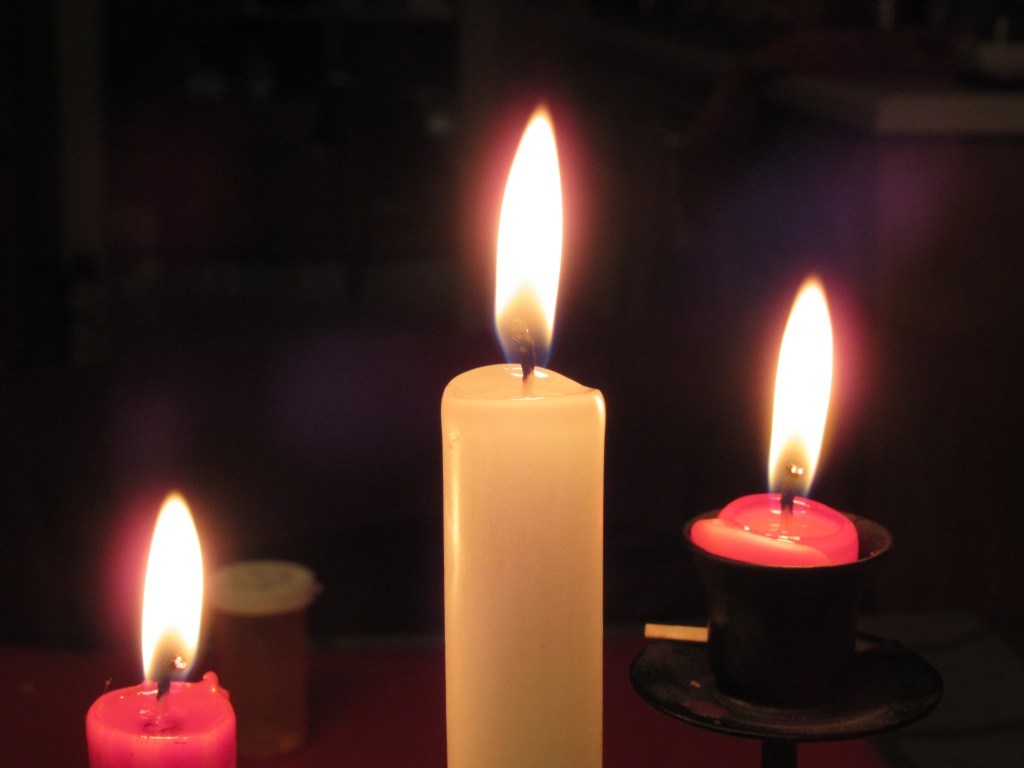
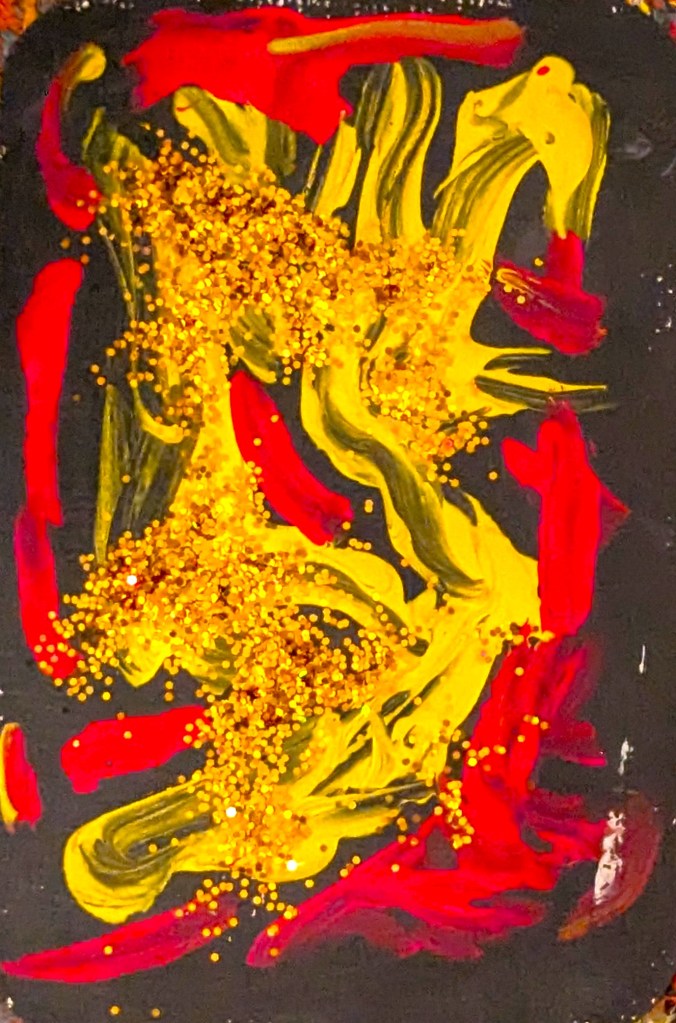
It’s funny how your paintings speak to me. As soon as I opened this email, my first thought was… this is the perfect painting for my poem “addiction”. The colors and the art work bring to life the sentence, “like walking out of a fire and into an ice bath”. KTJ 

So, here we are – the poem and the painting can now be found on the same page. I don’t usually put other people’s poems up on my blog. However, should any of my readers be inspired by one of Moo’s paintings, and should that reader decide to write a poem about it, I would happily consider publishing both poem and painting on this blog. No money involved – my pitiful pension won’t stretch that far.

No promises. But an interesting start to a new idea.
Pax amorque
rogermoorepoet.

What makes a teacher great?

Daily writing prompt
What makes a teacher great?

What makes a teacher great?

When Moo descended from Mount Academia, he brought down with him the ten tenets to which great teachers, knowingly or unknowingly, commit. He asked me to transcribe them here, since they were in danger of being neglected and / or forgotten.

  1. Mastery of the subject – great teachers know their subjects inside out. They do not read their graduate school notes to their students, heads bowed, chins on chest, droning on in a low, boring mumble. They encourage questions and are open to debate with their students about the subject that they know so well and openly love.

    Master thy subject.

  2. Humility – great teachers are humble. They know that they are not omniscient. They also know that knowledge changes across time and that they too must change and follow new ideas. They also know, perhaps instinctively, that some of their students are as intelligent as they are. They never dismiss their young charges as idiots, fools, or lunatics to be beaten and forced into the required shape.

    Be humble.

  3. Flexibility – great teachers are flexible, not rigid. They can bend the rules, reshape the syllabus, change pace and tone to match the needs of their students. In addition, they ask their students about their needs and try to address those needs in a personal way, sometimes on a one on one basis.

    Be flexible.

  4. Reaching out – great teachers reach out to their students as a group and as individuals. They never paint themselves into the know-all corner where they alone know best, and they know, with absolute certainty, what’s best for their students. Great teachers know, above all, that one size, in great teaching, neither fits nor benefits all.

    Reach out.

  5. Equal treatment – great teachers treat their students equally. They do not fawn on the best and scorn the worst, nor do they teach by the WWII convoy system, teaching only at the speed of the slowest. By extension, great teachers try to create an atmosphere of love in learning and joy in the subject.

    Practice equality.

  6. Honesty – great teachers are honest, fiercely honest. They know their own strengths and weaknesses, their own limitations. They work on their weaknesses, striving to turn them into strengths. They also push the boundaries of their limitations, striving always to keep up with the ever-changing frontiers of knowledge.

    Be honest.

  7. Human beings – great teachers know that they are human beings and they recognize early on in their careers, that while they are teaching a subject, they are also preparing fellow humans for a life beyond the ivy-covered walls of academia. By extension, they emphasize the humanity of their students and try always to develop and sustain that humanity.

    Be human.

  8. The meaning of meaning – great teachers reach out beyond their subjects to teach the meaning of meaning. Why is the subject important? What can each individual use this hard-earned knowledge for, in their own lives? How can they reshape their own lives and create better ways of learning and living? This teams up with reaching out and enters the realm of learning for learning’s sake and love of learning and love of knowledge.

    Love thy learning.

  9. Creativity – great teachers are creative. They open their students’ minds to new ideas, fresh knowledge, better ways of doing things. They never use phrases like ‘thinking outside the box’ and they do not build better boxes, one or two sizes larger than current boxes, inside which their students must now sit, work, and think. Creative teachers tear down the walls of medieval academia and open their students’ minds to the winds of change and fresh knowledge.

    Be creative.

  10. Life long learning – great teachers teach students how to think for themselves, how to teach themselves, how to self-assess, how to check and double-check the knowledge (all too often nowadays, fake news and / or false knowledge) handed down to them from a multitude of sources, far too many of them unreliable. Great teachers teach their students to know themselves. They also teach them how to work out whether a source is a reliable fount of information, or not. In short, they teach life long learning and neither they, nor their students, ever give up hope.


    Teach Life Long Learning.

Describe one simple thing you do that brings joy to your life.

Daily writing prompt
Describe one simple thing you do that brings joy to your life.

Describe one simple thing you do that brings joy to your life.

Painting.

I was always told that I couldn’t paint. “You don’t have a clue. Give it up now. You’re wasting your time, and ours.” Same with drawing and any other form of visual and creative art. I tried to build model aircraft – Spitfires and Hurricanes, Gloucester Gladiators, SE5s -. They were ugly, lumpy, had crooked wings, and never flew properly. The few that I managed to launch often fell apart on landing. Same with model kites. The one I did manage to build took off in a half a gale and got stuck in a tree.

Failure!!!!!

Much later in life I re-discovered Henri Matisse. “I make meaning out of shape and color.” Then I stumbled across Salvador Dali’s famous statement: “I don’t know what it means, but I know it means something.” From there I started to take lines for a walk, and moved into cartoons – you will find some earlier on these pages *click here* – or – *click here* – or just explore these early pages for yourself.

From these cartoons, I moved, with the encouragement of Geoff Slater, the Art Director at Kingsbrae International Residencies for Artists (I was the first writer in residence, June 2017), to actually painting, for the first time, with acrylics on canvas. This led me to my Pocket Paintings / Peintures de Poche, made with acrylics on 4″ x 6″ postcards. What fun. I now have well over a hundred of these and, guess what! – just like my books, I give them away to my friends for free.

These simple, linked acts – writing – painting – gifting – bring me great joy.
Long may it continue.
Pax amorque.

Coming Soon ….

Coming soon ….. to a Rollator near you.

Yesterday I checked the galley proof and all seems well. The distortion on the photo above is all mine (!) and the original cover is much clearer, better, straighter, and brighter.

I have not posted for two weeks, and yet some of my faithful followers have still clicked on this site to see how I am doing. Thank you so much.

Several things happened last month. (a) I started a stretching and exercise program. (b) I upped my walking to 4000 steps a day. (c) I used a combination of Rollator [Nexus 3] and shopping cart to build up, slowly, to an hour a day of aerobic exercise.

That’s all good news for the physical body and the mental state, but not such good news for the creative cycle. Blog postings have suffered and my online social presence has been greatly reduced. On the good side, I have been out and about, around the garden and around the block, and have re-established contact with neighbors, friends, and the local canine newbies and golden oldies.

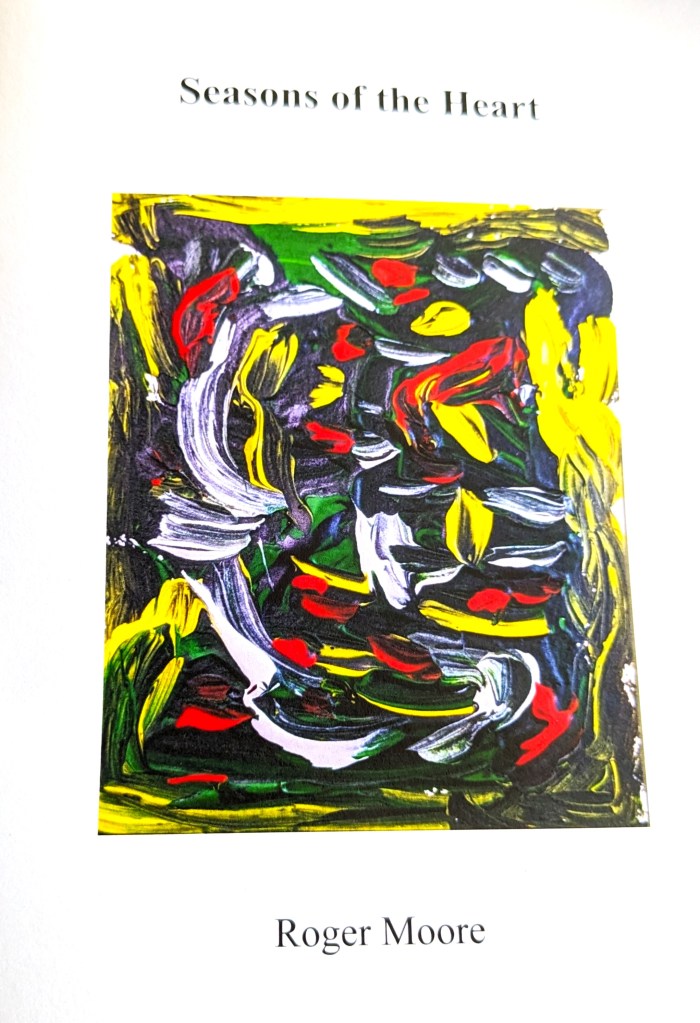
I also managed to edit and correct and revise Seasons of the Heart and this chapbook of poems, based on my meditations on Anam Cara (by John O’Donohue) will soon be available to gift to my closest friends.

As you probably know by know, I do not sell what I call my “Covey Collection” of self-published chapbooks and books. If you wish to support my efforts as an artist, you can do so by clicking on this link and seeing if there is anything that fancies your tickle, sorry, I mean tickles your fancy.

B & W

“Slim words couched
in the empty whiteness
of the page.”
John O’Donohue,
Anam Cara

black words
          white page
thoughts
          floating in space

airs and graces
          whirlwind words
blowing through
          freshening
cleansing

cotton clouds
          silky sky
that one word
          waiting
to be spoken

that one thought
          soon to be word-borne
out from the dark

a new existence
          to brighten us
blind us with light

White Space

White Space

A place of silence,
          white space
at page edge,
          bearing witness
to the absence
          of words.

A place to pause,
          rest,
to think.

A place,
          like the white space
between lines of prose,
          where eye and mind
can pause and rest.

Bewildering
          the pounding
of earwig music,
          the advert repeated

again and again,
          the omnipresent
sound byte.

Everlasting,
          the loop, the loop,
the interminable loop
          that intrudes on
silence.

Words

Words emerge
          from the silence
of blood and bone.

They break
          that silence
the day they are born.

Silence,
          once broken,
cannot be repaired.

A word once spoken
          cannot be recalled.

The greatest gift –
           knowing how to be alone,
how to sink into silence.

A world of words
          smothered at birth
and that world,
          dismissed, forgotten,
sometimes still-born.

A lost world of words
          whirled on the silent wind
that fans the unborn fire within.

The spider web of the mind
          blown clear by the wind
that blows unspoken words.

The hush of the tadpole
          swimming
into its own metamorphosis.

The sultry oblivion
          of blood and bone.

Poetry that expresses the authenticity of being. Playful, yes, but packed with meaning. Taste it on the tongue. Savor it in the mind. Touch the words on the page. Indulge yourself in the white spaces between the words. Read and re-read each poem. Dive into its depths. Swim – but do not let yourself drown. When you surface again, return to the light and remember, all will be well.

Illumination

Two Poems to help you find your way in the dark!

1

Suit of Lights

I am a man of straw
          shivered by raw winds,
frosted by the cold
          enveloping this enigmatic body
with its rattle of drying bones.

I walk with two canes,
          not just a sick man,
but a stick man.

My broken body
          hangs on the coat hanger
of my battered bones,
          its worn-out sack
knitted from skin,
          bonded with blood.

The magic hour descends.

Earth glows
          with a different light,
my world is transformed,
          translucent, bright.

A touch of the almighty,
          this beauty surrounding me,
blessing me.

I wear a sudden clarity
          with this suit of lights.

2

Illumination

You must find it for yourself.
         Were I to tell you what it is
and where it dwells,
          the light it brings you
would be warped,
          untrue.

Only
          you can find
that light.

Only you
          can strike the match,
ignite that blaze,
          trap its warmth
in your own bone cage.

Enlightened,
          you must dig and dig,
deeper and deeper,
          until you lose yourself
in a bottomless pit.

When you are lost,
          look up.

In the dark above,
            you will find
a tiny pinhole of light,
          a star to guide,
a glow-worm
          to light your way
in the darkest night.

Silent Light

Silent Light

Silent light,
          breaking soundless,
dispelling night’s mists,
          lighting up flowers,
so graceful,
          when decked out in light.

At night,
          the moon turns into a mirror,
a silver boat
          suspended in space.

Silent,
          its light enlightening
the heart’s dusky craters,
          the mind’s gloomy shafts,
where hidden treasures hide,
          waiting for the light.

The Value of Space

Space, round an object,
     reveals its aura,
its implicit innocence.

Consider the shimmer –
          a sunlit orange
basking in its basket.

Observe
          the pride of the cat,
nestled on cushions,
          its coat prickling
with sunlight.

Space
          surrounds us.
We walk within it,
          live because of it.

Space
           fills us.
Water
          in our body’s sponge
a part of us,
          as we become
a part of it.

Author’s Notes

We crave the space around us, the silence between words, but invasive noise destroys us, body and soul. We must seek the sanctity of silent light and space.

What does freedom mean to you?

Daily writing prompt
What does freedom mean to you?

What does freedom mean to you?

When I look at that one word, alone on the page, I think, above all, of the multiple meanings attached to such a word, then I think of how it can be twisted in so many ways to make it mean whatever the speaker wants it to mean. So, let me begin by asking, what does freedom mean, in general, not in my own specific case.

Freedom – “the power or right to act, speak, or think as one wants without hindrance or restraint.” Interesting – no mention here of right or wrong, of truth or lies, of harassment or of perjury. Freedom – speech with no hindrance or restraint.

Freedom – the “absence of subjection to foreign domination or despotic government.” Wow! The first is very interesting but the second is extremely problematic. We need a definition of despotic and of government. We also need further clarification as to who decides what governmental despotism means. If beauty is in the eye of the beholder and if there is no arguing about taste, is the definition of despotism purely subjective? Who shall guard the guards? Does a despot consider himself or herself to be despotic? Do his or her followers? Or is it only the people who suffer and become victims of the despot’s hands, feet, orders, laws, commands, bullies, or general conduct?

Freedom – “the state of not being imprisoned or enslaved.” This is certainly much clearer. Thank you.

But consider where this very brief analysis has led us. And we haven’t even started on the Biblical meanings of freedom – “freedom from sin” – “and the truth shall set you free” – and here we are only scratching the surface of the possible religious and philosophical meanings of what the Spaniards call libre albedri’o, or free will.

What does freedom mean to you?

And now we move into the personal and the personal circumstances will change for each one of us. In my own case, freedom is my new Nexus 3 Rollator. It allows me to put aside my canes and walk around the block, something I have been unable to do for several years now. Wow – freedom to walk on my own, just leaning on my wheeled walker. Freedom to talk to my old friends, many of whom I have not seen or spoken to for a long time. Freedom to meet and talk to new neighbors, many with their lovely children and wonderful dogs. Freedom to breathe in the fresh air of early spring and to visit the flowers as they start to grow. Freedom, for me, is also the ability to see with my own eyes. Last month, I had my lenses laser-polished and now I can see again with 20/20 vision. Wow – that is really freedom, to to be able to read all but the tiniest print, without needing to use glasses. Freedom, for me, is also the ability to be able to cook, shop, move, live, without excessive pain. My new powers of walking have helped me with that. Long may it continue. It is also the good fortune to have enough money and strength to live in my own house and not to need a care home or regular home help.

Freedom – Such a magic word – such a powerful word – such a personal word. The freedom to choose to be myself, dependent on nobody else – and long may that freedom continue.

Prompts and Impromptus

Prompts and Impromptus

The creative process is different for each one of us. I think of three different creative modes.

The Quarry and Treasure Trove – I write in my journal every day. I have done so for nearly forty years. For me, it is a treasure trove of creativity and I can return to it anytime I want to to revive old memories and to research old moods. I think of it as a quarry that contains valuable images and metaphors that can be used in different ways to create and recreate. I also find that, as I journal, I distinguish between that which is mere dust and ashes and can be abandoned, and that which is a genuine gemstone that can be polished and published. Writing regularly helps me to distinguish between the commonplace and that one piece of gold that emerges.

Impromptus – Some people, like the cat above, wait patiently for inspiration to come. Sometimes it does, sometimes it doesn’t. When it doesn’t, they blame Writer’s Block or something similar. While you can sit and wait for inspiration, using the methods outlined in The Quarry and Treasure Trove you can ‘go out and make things happen’. Seek and you will find. Knock and it will open. Now that’s inspiration for you!

Prompts – The creative writer can also use prompts. I have used those that appear in Word Press, but only in sporadic fashion. I do not use them everyday. In fact, I have been a bit down and otherwise engaged recently, and my visits to social media have been very limited. I apologize to my friends – we few, we happy few, we band of siblings.

One of my best friends has been helping me through this rough patch. She has been putting together a book of creative prompts. She converted that into a webpage called  judyandco.com and I highly recommend her work to anyone who, like me, gives up the ghost for a little while, and then wishes to regain the creative spirit. As she wrote to me only this morning – “there’s a bunch of free stuff on there” -.

So, for those who need a kick start for their creativity, try clicking on  judyandco.com – I am sure you will find inspiration there.

It’s A Small World

It’s A Small World

Light returns to Island View after Monday’s eclipse. Here it is post the total eclipse and daylight is being restored. It was a wonderful experience, totally unlike the last total eclipse we saw, at Skinner’s Pond, In PEI, on 10 July 1972.

That one was unexpected. Nobody talked about it. Nobody said a thing. We travelled to Skinner’s Pond, the birth place of Stompin’ Tom Connors, just to see where he was born. We parked the car, put the dog on a leash, and walked on the beach. Normal sea-side sounds – waves, sea birds, wind among the dune grass – swallows rose and fell, twittering joyfully. A world at peace. Then it happened.

A shadow moved across the sun and the world started to darken. The dog went wild, strained at the leash, started to whimper. The bank swallows began to gather, then, as the darkness deepened, they dived for their burrows and vanished from sight. We shivered and wondered. We had no glasses of any kind. We avoided looking at the sun, and just experienced the world as it darkened and became colder and more silent, save for the sound of the wind in the grass. As the light returned, the dog settled down, the swallows emerged from their tunnels and took to the skies, twittering again. Life, light, and warmth returned to normal.

Monday’s eclipse was so very different. We weren’t intending to watch it, other than on the television. While I was out shopping, early that morning, I joked with the people I met that, during the eclipse, I was going to tuck myself into bed and hide my head under the blankets, in case it was dangerous. [Yes, I have read Day of the Triffids and seen the movie. Now that does date me.] On the way home, I met one of my neighbors. Was I going to watch the eclipse? Once in a life experience. Did I have the right glasses? He told me to avoid normal sunglasses. Told me I wouldn’t get the right glasses now. All sold out. He gave me a strange look when I told him of my decision to bury my head in the blankets – just in case – so no harm would come to me.

Several news items turned up on my computer. In one of them I read that approved special glasses – true specifics and details given – had vanished from the stores in Fredericton. Only one place still stocked them – Canadian Tire, South Side. Ha! I drove back into town and there, on the door of CT-South, I saw a sign – Eclipse Glasses available at Check Outs. I joined the line up of late buyers, bought two pairs, and headed joyfully home.

When the eclipse started, I drove around the block, looking for the best place from which to view it. I parked here, there, and everywhere, tried my glasses out – a small, black line, curved, was slowly and silently invading the sun’s disc. I drove back home and discovered, after an experiment or two, that our back porch was the perfect spot for viewing. We put chairs on the deck, sat down, and watched as the blackness on the sun’s face grew larger. No beach view this. The Island in Island View is in the St. John River / Wolastoq, on the other side of the hill. No sea gulls, no swallows, in our garden. In fact very few birds at all.

As it grew darker, we could hear the soulful hooting of some mourning doves. They soon grew silent. The crows, on the other hand, rose up to defend their territory, just like they do when a hawk passes over and puts its shadow between them and the sun. What a racket of sheer defiance.

Through our glasses we could see wavy lines of light flickering around the visible parts of the sun’s circumference. Occasional red streamers, flared up and out. Then the eclipse became total. We took off our glasses and for two minutes and seven seconds (or so) we basked in celestial glory. Breathtaking. Spell binding. A mystical moment of myth and magic. We sat in silence. Then, the spell broke. The sun emerged from its moon shadow and light returned. The earth warmed. Life was as it was. Nothing had changed, except for us. Light broke where no sun shone, and suddenly we realized so many truths.

How tiny is our world. How enormous is the space around us. How mighty is the universe. How fragile are we humans. How small and insignificant is our world. How glorious is our existence, the joy of life, of witnessing, of seeing such power and such glory. The joys of knowing that we are sentient, and alive.

Two images of partial eclipse – with clouds – Kingsbrae International Residencies for Artists (KIRA, June 2021).