Identity: Wednesday Workshop

IMG_0067


Identity
Wednesday Workshop

5 July 2017

Today’s workshop settles on the question of identity, loss of identity, and the attempt to recover any form of cultural identity that one feels one has lost. These questions are particularly important in the current age when so many differences are so easily erased. Language, culture, identity, music … they are all tied closely together.

The search for identity runs parallel to the search for the poetic voice (or the writing voice) that is so unique to each good writer. In fact, one can distinguish between good writers and lesser writers merely on the basis of voice. Lesser writers rarely establish a distinct voice while good writers usually have voices that are uniquely their own.

What to do we mean by voice? When we read Shakespeare or Miguel de Cervantes we know almost immediately whose work we are reading. The same is true of the great musicians. Bach, Mozart, Beethoven, Mahler, all have sequences and styles that are individual to them, as do Scarlatti, Brassens, The Beatles, Gordon Lightfoot, Gilles Vigneault, Edith Butler … their style, their voice is established. We listen to them and we know who they are.

Cultural identity is also very important. It is tied into language, childhood beliefs, fairy tales, myths, the basic culture that we receive as children. When we all listen to the same radio stations, or download the same ITunes, or watch the same TV programs with their infinity of ad nauseam advertisements, then we are socially engineered to be the same or, if not the same, remarkably similar within a series of very limited and extremely limiting patterns. When we establish our own identities, — and this is always difficult both for people who have had their culture taken from them and for immigrants, or the children of immigrants, who want to retain their culture at the same time as they blend in and fit in socially — then at the same time we develop our own voices.

When I hear the poetry of Lorca, of Antonio Machado, of Miguel de Unamuno, of Octavio Paz, of Dylan Thomas, of Gerard Manley Hopkins, of Wilfred Owen, I hear their very distinctive voices and recognize their individual styles and the cultural / poetic identities that they have established. The goal that we, as writers, are aiming for is to establish our own style, our own voice. To do this, we must listen to ourselves and discover how we think and how we feel. Then we must listen to others of our own generation. We must make comparisons and establish what we do differently, why we are different, what forms our differences … our own individual voice may come from speech rhythms, from language usage, from the establishment of a certain form of narrative, from the use of imagery or metaphor … there are so many different ways in which we are, each of us, different … or capable of being perceived as different.

When we write often enough and frequently enough, we at last begin to recognize those words, those phrases, those rhythms, those ideas, that are ours and nobody else’s. This is when we start to discover our own voices and our own personalities. It is a goal worth striving for … step by step … poco a poco … little by little … and a step forward everyday … until we grow into the type of writer or poet, fully established (or establishing), that we were always meant to be.

It is never easy to capture oneself and place oneself on the page in readable form. It’s a bit like trying to draw Picasso’s blue vase using only one blue pencil: not easy. It’s much easier to take a selfie with a flashy cell-phone.  Cell-phone selfies are easy, but verbal selfies are what we are seeking for. They take much longer to ‘produce’ and it is only when we finally achieve them, that we realize how difficult they are to actually achieve. But remember, read and re-read my earlier postings: don’t give up; don’t get off the bus!

 

Middens by Jarea

img_0359

Kingsbrae 25.4
25 June 2017

Middens by Jarea

Garbage dumps they are to us,
filled with childhood treasures,
shaped flints, arrowheads, spear
tips, scrapers for deer hide,
so many castaway items.

Garbage dumps to us, maybe,
but for the Passamaquoddy
who first settled this area
and lived on this shore,
these precious middens
are anything but dumps.

They are guide posts,
lighthouses in the moonlight,
signposts to point the way
for wayfarers and wanderers,
at high tide, low tide,
and especially when the mudflats
bathe beneath sun and moon
and the channels twist and turn,
serpentine labyrinths in their wanderings.

Garbage: we dig up what they have left,
expose past lives to scientific theories,
and destroy their navigational knowledge,
the science they left behind.

An Angel at Jarea

15 May 2002 Pre-Rimouski 141

Kingsbrae 25.3
25 June 2017

An Angel at Jarea

An angel moves through the room
in the silences between our chatter.
He fills the interstices of speech
with the wonder of feathers
enlightened by rainbows.

Tranquil his footsteps
as we sense his presence.
He places his hand on an arm,
his arm around our shoulders,
and now, commanding silence,
a finger on his lips.

We sit here
scared by our intimate inadequacies,
scarred by the fierceness of his immanence
as we sense the vacuum
of his soon-to-be absence.

Trinity

Avila 2007a 039.jpg

Kingsbrae 22.4
22 June 2017

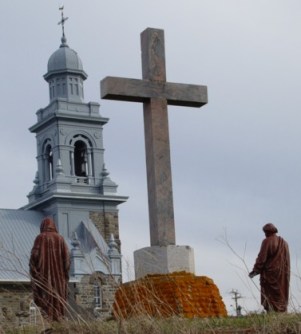
Trinity

A coming together of cultures,
these three statues, placed
equidistant, an equilateral
triangle, all things being
equal and none more equal
than others; three brothers;
mother, father, child; father,
son, and holy ghost: no women
there; perhaps three founding
cultures: English, French, and
Indigenous,  in alphabetical
order; and there they stand,
face to face to face,
a triangulation, in profile,
silhouetted, sharing positive
and negative space; and, at the dead
center of their union, at the spot
where all is still and nothing moves,
a living space, that takes away
your breath when you breathe
in air and light and sun and
a renewed hope; then faith runs
tingling round your body with
joy and life and love reborn.

Wollemi

IMG_0190


Kingsbrae 21.3
21 June 2017

Wollemi Nobilis

To see you on this day,
the summer solstice,
when time and the sun
stand still,
is to recall you as relictus,
then to acclaim you
as Lazarus,
risen from the dead.

Your fossil footprints
walked for so long,
two hundred million years,
and you walked with them,
unknown, unrecognized,
lost in the wilderness.

What poverty in language:
we either describe you
in impossible scientific Latin
or else we reduce you
to a chocolate coco pops
breakfast cereal.

Hand-cuffed, chained,
your feet rooted within
this immobile crockery pot,
you will never leave us now.

You are your own solstice,
a stationary seed,
growing to adulthood,
sown in a circle
of never-ending time.

Comment: I have been trying since Sunday, 5 March 2017, to write this poem. But what are four months in the life of a seventy-three year old poet or a pine tree that was thought to have become extinct 200 million years ago. I do not have the words to express how I feel looking at this throwback to the time of the Dinosaurs. And maybe that is how this poem should start for it is, after all, Wordless Wednesday … “I do not have the words …” and thoughts, too, jam in the brain and refuse to cycle, let alone re-cycle. So, I’ll leave this poem for now. That said, I will probably come back to it. Meanwhile, do I ever feel so absolutely, totally, and completely inadequate.

Rain

Empress 005 (2)

Kingsbrae 20.4
20 June 2017

Rain

Hand in hand, we walk
beneath black umbrellas.
Grass beneath our feet is wet
and water seeps through
our shoes, soaking our socks.

Cold and numb in spite of the date
(the summer solstice draws near),
my ears strain against the pitter
-patter of falling rain to catch
the nearby robin’s song.

He has mislaid his voice
and I can no longer translate
his liquid notes into soul music
that might lighten mind and day.

Clouds gather and empty themselves
over our umbrella-covered heads.
In spite of damp and dark that rule,
thoughts abound and hop around,
like frogs in a summer pool, while
light bulbs explode in my brain.

Eyeless in Kingsbrae

IMG_0150.JPG

Kingsbrae 15.3
15 June 2017

Eyeless in Kingsbrae

There’s warmth in a color,
and heat’s visible to the touch.
Shocking pink has a different
feel beneath the fingers,
and it has no name that you
and I, sighted, would ever know.

They push me, blindfolded,
around the garden. Gravel’s
crunch beneath the wheels
sharpens my inability to know,
to be sure of shadows and shapes
that are no longer there.

The ones who push me talk
and tell but cannot show.
How could they hold a rain
-bow before my eyes or
explain those lights that
crisp and crackle in the sky,
a visible Niagara Falls
with fairy lights
dancing up and down?

And those glorious choirs,
angel voices rising, falling,
grasping my eye-lashes,
trying to pry my eye-lids open.

Oh song of songs, and the singer
deaf to his own sublimity.
Oh dealer of false cards,
fingerless pianist, and dancer
shuffling on amputated stumps.

Kingsbrae Creations

Chaos


Kingsbrae 14.4
14 June 2017

Kingsbrae Creations

Carlos Carty has recorded me as I sat reading some of my poems out loud. He has also put some of them to music. I think of it as mood music, because he captures meaning from tone and voice and then adds a music he has created to match the emotions expressed in the poem. We have recorded six poems so far and I list them below. Just clink on the links and turn your volume up. Carlos and I hope you enjoy these Kingsbrae Creations, one of the many results of our collaboration here at Kingsbrae and KIRA. Here are the poems, click on their titles to access to voice readings and musical accompaniment.

Giving Back

Word Blooms

Scent & Touch

Small Corner

Yellow Bird

Love


“Don’t Get Off the Bus!” Wednesday Workshop

IMG_0061.JPG


“Don’t Get Off The Bus!”
Wednesday Workshop
Wednesday 14 June 2017

Journal: Roger Moore had the honor and pleasure of addressing the artists in residence at KIRA / Kingsbrae last night. He gave a brief biography of himself then stated that he did not consider himself to be a poet, the honor of the name is too high. He is, he stated, above all a writer. He began writing poetry at an early age, but was always put off by the lack of understanding shown by his contemporaries. Such slogans as “He’s a poet, but he doesn’t know it,” chanted endlessly, made him hide his poetic talent. In 1962, however, in his last year in school, he entered the Stroud International Festival for Religious Drama and the Arts and won first prize for a sonnet he wrote for that competition. This confirmed , in his own mind, that he could write and he continued to do so.

He attended Bristol University from 1963-1966, studying Spanish (Honours) and French. While at Bristol he published some 30 poems with the university’s literary review, the Nonesuch Magazine. He also wrote a weekly column in the student newspaper reporting on cross-country running in winter and athletics in summer. He began an MA in the University of Toronto in 1966 (completed in 1967) and decided to stay in Canada and work for his PhD (17th Century Spanish poetry). His encounters with the Toronto literary circles were not satisfactory and he realized that neither his style nor his subject matter were suited to the CanLit of the Canadian art scene. He hid again until 1977 when Fred Cogswell published Last Year in Paradise, Roger’s first poetry book, in the Fiddlehead Poetry Book series. By now, Roger had completed his doctoral thesis and published Towards A Chronology of Quevedo’s Poetry with York Press in 1976. From 1973-1977 Roger was first the Editorial Assistant and then the Assistant Editor of the International Fiction Review (University of New Brunswick). This position allowed him (a) to revise the submissions of writers whose first language was not English; (b) to translate articles from Spanish to English; and (c) to himself submit articles and reviews to the magazine. One of his first translations was of an article by Enrique Anderson Imbert, the Argentinian writer. Roger’s academic writing and editing is a different story and will be told at another time.

In 1979, Roger took his first workshops in creative writing at St. Thomas University  with Norman Levine, the Canadian Short Story writer. Norman Levine inspired Roger with a new taste for creative writing and he started writing short stories at this stage. He also started attending the Maritime Writers’ Workshops at UNB working with Patrick Lane, Susan Musgrave, Richard Lemm (twice) and Erine Moure. Roger was now submitting regularly to Canadian Literary magazines and his poetry was published first in Poetry Toronto (by bpnichol),  and then in Poetry Canada Review, The Fiddlehead, ARC, Ariel, the Cross-Canada Writers’ Quarterly, and in some twenty other Canadian literary magazines. In 1986, his second poetry collection, Broken Ghosts, was published by Goose Lane (Fredericton). Roger’s mother died in 1987 and his father followed in 1989. The poems he wrote at this stage were collected together and were awarded the Alfred G. Bailey Award for Poetry by the Writers’ Federation of New Brunswick in 1989. A second collection again won the Bailey in 1994, but neither of these collections were considered worthy of  publication by the multiple Canadian presses to which Roger sent them.

In 1991, Roger was the Atlantic Provinces Director for the League of Canadian Poets. He started, with JoAnne Elder, the Writes of Spring at St. Thomas University, and this continued for three years. The Writes of Spring was designed as a gender balanced, language balanced reading event in which eight poets participated. The reading group consisted of four men and four women, four of whom were Francophones and four Anglophones. These bilingual readings gave a wonderful insight into the poetry that was being written at the time within the province of New Brunswick. Roger started self-publishing his poetry in limited edition chapbooks at this time and gave his works to the participants and audiences in this series. He published six chapbooks this way: Idlewood, In the Art Gallery, Daffodils, Secret Garden, Iberian Interludes, and On Being Welsh.

In 1999, Roger chaired the third Atlantic Association of Universities’ Teaching Showcase at St. Thomas University. He edited the proceedings with Denise Nevo and they were published by Mount Saint Vincent University Press. Denise suggested that Roger might publish his poetry with MSVU and declared herself willing to edit and publish any work he might care to submit. This most fruitful collaboration with a wonderful lady who was also an outstanding editor allowed Roger to publish six more poetry books between 2000 and 2012, namely, Sun and Moon (Poems from Oaxaca), Though Lovers Be Lost, Fundy Lines (Prose Poems), At The Edge of Obsidian, Obsidian 22, and Monkey Temple. Roger continued publishing chapbooks and Dewi Sant (with the Central New Brunswick Welsh Society) and M Press of Ireland were among those that appeared, while Land of Rocks and Saints (Poems from Avila) was published by Nashwaak Press (Stuart Donovan) in 2008.

2015 saw three books appear in print: Stepping Stones (in collaboration with David Brewer of Rabbittown Press), Systematic Deception (in collaboration with Randi Drake of Ottawa), and Triage, his last poetry chapbook. In August 2016, John Sutherland, a member of one of Roger’s writing groups, introduced him to CreateSpace / Amazon / Kindle, and since then eleven books have been published online: Monkey Temple, Though Lovers Be Lost, Bistro, Sun and Moon, Obsidian’s Edge, The Empress of Ireland, All About Angels, Avila (Cantos y santos y ciudad de la Santa), Iberian Interludes, A Cancer Chronicle, and Nobody’s Child. Bistro (Flash Fiction), Avila (in Spanish), A Cancer Chronicle, and Nobody’s Child (short stories) are new, while the other seven titles have all been expanded and revised. Bistro was one of three finalists (and the only independently published book) in the New Brunswick book Awards (prose fiction) in 2016 (results announced, May 2017).

This Wednesday Workshop / KIRA Artist’s Report has two concealed messages. The first is that writing, like all creative activities, is a long apprenticeship (in the words of Fred Cogswell). The second is that if you want to travel from Halifax to Vancouver, you must stay on the bus. Quite simply, if you get off at Fredericton or Quebec City, Or Montreal or Toronto, and if you stay in one of those cities and don’t get back on the bus, you’ll never arrive at Vancouver. So: writers young and old … stay on that bus. Persist with your work. Never give up your dream. Never give in. Looking back from the vast old age of seventy-three, I realize now how easy it would have been to admit defeat and stop writing at so many stages of my writing career. I kept going and I encourage, nay URGE, any writer / creative artist reading this either to stay on that bus or to climb back on board. Quite simply, the world needs us and the world needs our poems, our paintings, our sculptures, our music, our encaustics,  and our stories.

Chronotopos

IMG_0066 (2)

Kingsbrae 13.1
13  June 2017

Chronotopos

plant a plant
deep its roots
rooted in fine soil
potting soil in a pot
firm the fingers
the spot well-chosen
in a flower bed
in a pattern
in an empty space
in a growing garden
within a larger garden
in an old estate
in a small town by the sea

Russian doll puzzle
garden after garden

(one a secret
with its birds and voices
lost in the hedgerow
and the echoes
of secret meetings
watched only by the guardian
the robin that watches)

planted and replanted
unfolding flowers
in a sunshine world
in a state of grace
hope and handicraft
hand in hand
with faith and belief
and everything planned
to take advantage
of this time and this space

these words so simple
these thoughts so complex

Comment: I began this poem on  10 March 2017. It formed part of my initial poetry sequence with Kingsbrae unseen, save for videos and photos of the gardens and their history, viewed on the Kingsbrae website. As I have grown into the KIRA experience, or perhaps I should write ‘as the Kingsbrae experience has blossomed within me’, so I have found these words prophetic, yet strangely inadequate, in the way all words are inadequate when tides flow, days flourish, and ideas blossom, sometimes in that formless world between sleep and dream where reality is something for which the writer reaches out but finds it is beyond the fingertips and just out of reach. As my Judo instructor told me, a long time ago:

“The more you strive,
you cannot reach it.
The hand cannot grasp it,
nor the mind exceed it.
When you no longer seek it,
it is with you.”