Searching for what exactly? For the exact word, le mot juste, the word that sums it all up, catches the essence of the thing and holds it in the mind forever.
Le mot juste? Think color. Think color blind. Think blind. Think of the world we see reduced to grey scale. Think of the seven colors that stripe the rainbow sky, each with a unique name: it seems so easy, so simple.
But the world has changed. Think now of the computer, its screen more accurate than the human eye and color coordinated by a million or more tiny little pixels that multiply the seven rainbow colors by a million or two and every color numbered beyond the recognition point of the human eye: le mot juste reduced to precision of number.
Think flowers. Think scent. Think of the limited ways we describe the smell of things.
I look across the breakfast table and see my wife of fifty years, a teenager reborn, walking into the café where we first met. I search my memory and my mind for the words to describe that beauty, that surge of excitement, but I cannot find les mots justes.
An osprey on the wind wings thrusting for maximum lift then flattened for feather-tip control
Wheeling up and away the soft-wing sway of him ascending his celestial staircase in a rush of blue air
Light his flight sky steps danced to wind music played over beach below and rock and rolling waves
Watch him wave good-bye with a waggle of his wings and a well-judged flick of his paint brush tail brown white and black lines neat strokes across a cerulean sky
For the first twenty-two years of my life Thanksgiving held no meaning, no life, no substance, no form, nothing familiar, nothing special to hold my attention.
When I emigrated to Canada my cousins changed all that with an invitation to visit them in Kincardine for Thanksgiving.
Turkey on the table, colored table napkins, and a family gathered, arms outstretched, to make me welcome.
We were all surprised at how alike we looked. “Like Cousin George, in Vancouver,” they said. “Like Cousin Elsie in Revelstoke.” “Like my mother’s mother, back home in Swansea,” I said.
They told me how the Second World War had brought the family back together on these special holidays: Christmas in Wales for the Canadian boys or Thanksgiving in Winnipeg for the Welsh boys learning to fly.
That Thanksgiving, the old family names turned to photographs: snaps of my mother’s wedding, my grandmother holding me, age three, on her knee.
And finally, as a special Thanksgiving gift, a long-distance call to Britain and Clare on the telephone saying “Yes,” she would come to Canada, and “yes,” she would marry me.
And I remember crying all the way from Kincardine to Toronto, and that was my first Thanksgiving in Canada.
Comment: A Golden Oldie, indeed. This poem is from my collection Secret Gardens. The secret love poems I write to Clare. It was published on our Silver Wedding Anniversary, 24 December 1991. It is a pleasure to re-publish it here for Thanksgiving, 2021. Now what am I going to do for 24 December 2021?
Meditations on Messiaen Quartet for the End of Time
6
Crystal Liturgy
Here, in the abyss, where song-birds pluck their notes and send them, feather-light, floating through the air, here there are no tears, no fear of shadow-hawks, for all blackness is abandoned in the interests of sunlight and song.
Here, the crystal liturgy surges, upwards from the rejoicing heart, ever upwards, into the realms of light, where color and sound alike brim over with the joy that, yes, brings tears of release to head and heart.
Here, the seven trumpets will sound their furious dance that will announce the end of this singer, the end of time, but not the end of song itself.
Here, seven-stringed rainbows reign. Here, the harp is tuned and plucked. Here, the everlasting music cements the foundations of earth and sky. Here, the master musician conducts his eternal choir, their voices rising, higher and higher, until they reach the highest sphere, and song and voice inspire, then expire, passing from our eyes and ears into the realms of everlasting light.
A whole lot of pens. But will they write one word of poetry?
Sense and Nonsense Wednesday Workshop 18 August 2021
Iterative Thematic Unity
Iterative thematic imagery is complicated term, used by academics, for a literary device that is really very simple. When the same or similar images are used again and again in a text this is repetition or reiteration, hence iterative. When they are bound thematically or within the associative fields already present in the poetry, then the repetition is said to be thematic. A work’s unity may be found within the three classical unities of time, space, and action, or it may be found within the imagery that links and unites. It seems complex, but it isn’t really.
“Now you are a river flowing silver beneath the moon. High tide in the salt marsh: your body fills with shadow and light. I dip my hands in dappled water.” The key images fall into two categories, (1) water: river / high tide / salt marsh / water and (2) light: silver / moon / shadow and light / dappled. Now the sense of the words becomes clear. You / your body is likened to a river seen in the moonlight. It can be touched: I dip my hands. This adds an extra sensory dimension and the depth of the images is apparent. And no, it is not a simple message, but it can be decoded and enjoyed because now you can make it yours.
Sense and Nonsense
When we talk poetry, what do we mean by sense and nonsense? Let us begin with automatic writing. Automatic writing is nonsense. Put your pen on the paper, do not let it off, write for five minutes, whatever comes into your head. The Surrealists published these thoughts, however distraught and distracted as meaningful poetry. Major poets (Lorca, Paz) have used these techniques to engender metaphors and images. However, they have searched among their subconscious thoughts and have rejected the dross to choose the genuine images that enlighten the inner world.
Sense or nonsense? “Eye of the peacock, / can you touch what I see / when my eyelids close for the night?” Key images: eye > see > eyelids > and these are linked to the eyes of the peacock, as displayed on his feathers, and this links to the ancient tale of the Argos and the Argonauts, and to the person who closes his eyes to sleep for the night, and the sense that we can touch (tactile) when we dream (visual), a mixing of the senses. The straightforward logic of the nightly news? Definitely not. But the logic of the subconscious world, of the dream world as defined by Carl Jung? Definitely. These words contain internal meanings that are different for each one of us. Logical meaning? Definitely not. Internal sensation that may generate ease or unease? Definitely. Sense or nonsense? That will depend upon the readers and how they react not in their logical minds but in that deep-seated region of subconsciousness where all imagery is related to what Carl Jung calls the racial subconscious.
Are there words or ideas here that you do not understand? Names and theories that you do not know? Literature in general and poetry in particular take you to places where you have never been and to places that you might never have thought of visiting. However, these are lands that will open their delights before you, if you deign to open up heart, mind, and eyes, and venture out to explore them. Use your dictionary, your thesaurus, your google search tool, and expand your verbal and linguistic horizons. Poetry is not an advert. It doesn’t sell you anything. But it can and does open new worlds and it encourages you to explore old worlds set within you. It will not persuade, cajole, and limit your mind and your choice, rather it will embolden you and help to open new horizons.
Spotify Don’t forget to scroll down to appropriate audio episode.
Ginger Marcinkowski (KIRA, August, 2019)
“My walk each morning, rain or shine, feathers my black galoshes with dewy grass. There I would ramble through gated doors that kept out the world and sealed in my pen’s work for that day.
I often found myself sidetracked, exploring paths that led through flowerbeds, and up to my favorite sculptures. I paused to watch my fellow artists as they focused on chosen subjects unaware that I was eavesdropping.
Then silently, I would steal away along the well-trod path to my studio, pausing long enough to greet the llamas and baby goats. If I listen carefully I can still hear their bleating.
In wonder, every day, I climbed the steps of wood that led to my studio, opened the door, and turned to breathe in my good fortune. “What a blessed woman you are,” I would tell myself before taking my place for hours on end at my desk, each moment, each stroke of the pen, each letter added to the growing lines on the page, a gift.”
Comment: I have been writing poems about the KIRA artists as part of my next poetry book, The Nature of Art and the Art of Nature. This is my KIRA2021 project. The Nature of Art is a revision and expansion of a poetry manuscript of the same name that placed second in the WFNB’s Alfred G. Bailey Award (2020). This poem appears in the section entitled Impressions of KIRA Artists. Currently this section contains eleven poems, but it is still under construction. This poem is interesting in that it is a ‘found’ poem, in the sense that Ginger wrote these words to me in an e-mail. I removed them, reordered them, polished them, and sent her back her own poem in her own words. What fun! This should help explain the use of inverted commas at beginning and end, for this poem is spoken in Ginger’s own words.
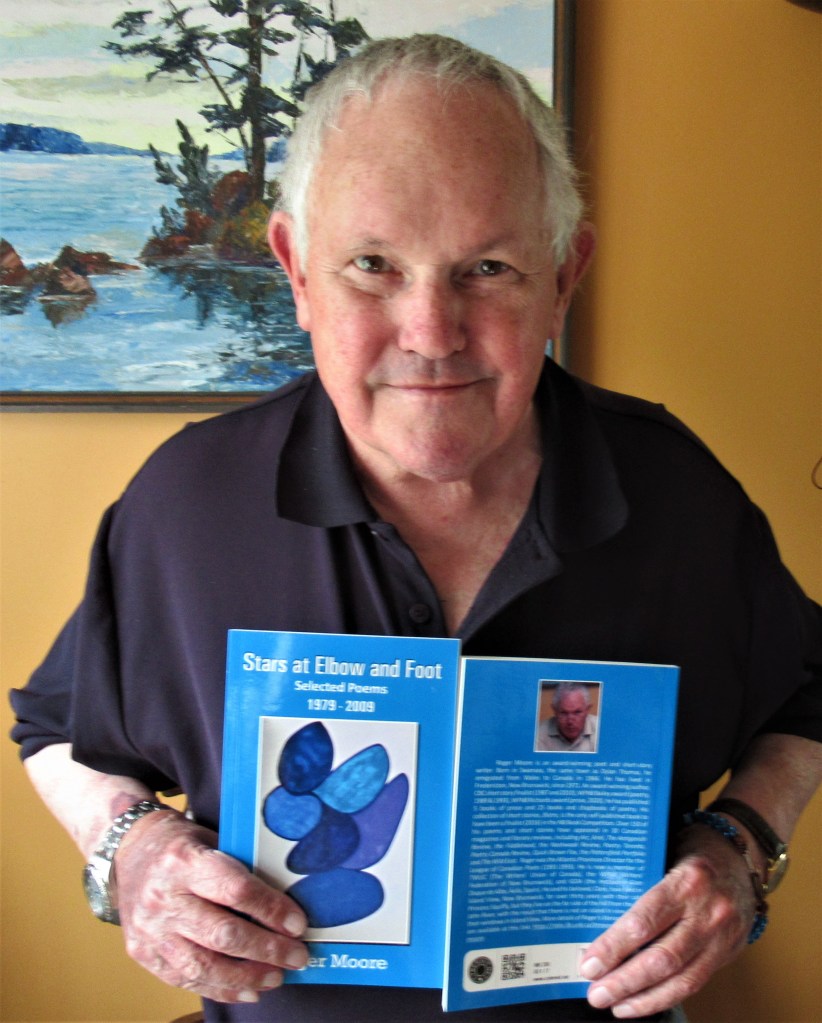
I retuned from the Red Room at KIRA to spend the weekend at home with Clare and this is what was waiting for me in the garage: a large parcel with books! So, we opened it and, to our delight, a constellation of stars emerged to bless us with their light and wisdom.
So, here I am, standing before the only island in Island View, with the first two copies of Stars at Elbow and Foot (Selected Poems, 1979-2009) out of the box and in my hands. Delightful. As soon as I have the purchasing details, I will place them online.
With regard to this collection, some thanks are due. First to my editor, Dr. Karunesh Kumar Agarwal who always does such a fine job in editing and publishing what I send him. Second to Allison Calvern who helped me choose, order, and revise the collection. Allison has always been such a strong supporter of writing, first here in Fredericton, and now in Ottawa. My thanks and best wishes go out to her. Third, to Chuck Bowie who told me with no uncertainty that THIS was the cover painting, and forget the others! Fourth, to Brian Henry of Quick Brown Fox who reached out to me one day, when my writing spirits were at low tide, and refilled my spiritual glass with encouragement and enthusiasm. Fifth, to all the readers and commentators on my blog and on Facebook. Your ticks are so important. Your comments are so welcome. Thank you all. Sixth, to the multitude of friends and editors who have encouraged me and my work, supported me, and pushed me to push myself further. Writing is a lonely task. We writers rely on others for so many things: support, advice, encouragement, and occasionally for the bus fares that help us stay on that writing bus and to never get off until we reach our destination.






 rogermoorepoet