I think of my creative writing in terms of visual, verbal photos. I create snapshots in words and these snapshots come from everywhere that I have been. For me, they are precious moments caught and frozen forever in the camera of the poet’s eye. Visual and verbal, they illustrate the life I have lived and the things I have seen. These are the phenomena on which my artistic life is founded.
I am not a philosopher by any means, but I have over time developed an artistic philosophy. It started a long time ago at Wycliffe College with my A level studies of French existentialism and continued later in the Graduate School at the University of Toronto, where I studied the origins of existentialism as they are expounded in phenomenology. Both these movements have influenced my life and my writing. Bakhtin’s chronotopos: “Man’s dialog with his time and place” has also been a great influence on my creative thinking. My art is indeed my dialog with my time, my place, and the people who inhabit them.
One Small Corner is the record of my stay at the KIRA Residence in St. Andrews-by-the-sea, New Brunswick, Canada. I was selected to be the only poet in the first cohort of Resident Artists and during the month of June, 2017, I was able to work full-time on this collection.
This is the original version. It is much better than the revision that I posted earlier.Sometimes, when we revise, we lose the freedom of thought and association that comes with the early version. Message: keep your variations and keep an open mind. Over-elaboration is the poet’s worst enemy.
Wingless in Gaza Street
amputees deprived of flight they flutter grounded in the gutter
galley slaves chained to broken oars they ply blunt stumps relentlessly
shorn of strength and beauty their once glorious shuttles weave dark circles
my mouth is a full moon open in a round pink circle bone and its marrow settle in subtle ice
futile fragility of the demented heart pumping its frequency of fragmented messages
frail beauty torn from its element of air this brightness of moths drowning in inky depths
the seven o’clock news brought to you from an otherwise deserted street.
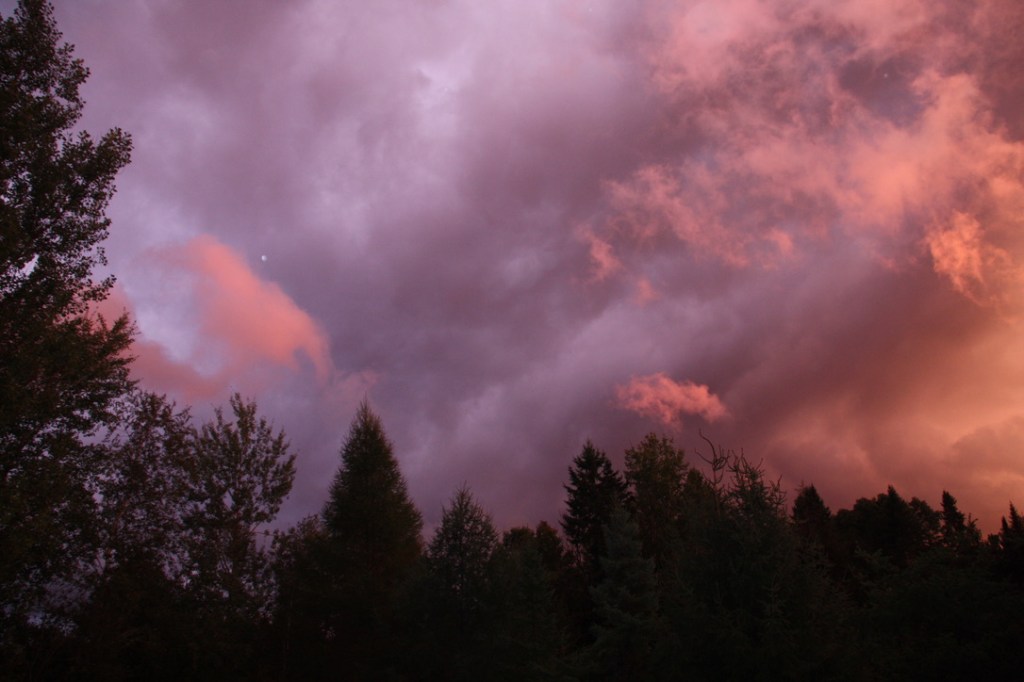
Not clematis, but bruised clematis clouds. I’ll keep looking. Maybe I’ll find the real things.
The clematis unfolds bruised purple on the porch. Beneath the black and white hammers of ivory keys, old wounds crack open. A flight of feathered notes: this dead heart sacrificed on the lawn. I wash fresh stains from my fingers with the garden hose while the evening stretches out a shadow hand to squeeze my heart like an orange in its skin. Somewhere, the white throat sparrow trills its guillotine of vertical notes. I flap my hands in the air and they float like butterflies, amputated in sunlight’s net. The light fails fast. I hold up shorn stumps of flowers for the night wind to heal and a chickadee chants an afterlife built of spring branches. Pressed between the pages of my dream: a lingering scent; the death of last year’s delphiniums; the tall tree toppled in the yard; a crab apple flower; a shard of grass as brittle as a bitter tongue at winter’s end. I know for sure that a dog fox hunts for my heart. Vicious as a vixen, the fox digs deep at midnight, unearthing the dried peas I shifted from bowl to bowl to measure time as I lay in bed. I sense a whimper at the window, the scratch of a paw. I watch a dead leaf settle down in a broken corner and it fills me with sudden silence. Midnight stretches out a long, thin hand and clasps dream-treasures in its tight-clenched fist. The lone dove of my heart flaps in its trap of barren bone and my world is as small as a pea in a shrunken pod. Or is it a dried and blackened walnut in its wrinkled shell of overheating air? Sunset, last night, was a star-shell failing to fire. Swallows flew their evensong higher and higher, striving for that one last breath lapped from the dying lisp of day. Its last blush rode red on the clouds for no more than a second’s lustrous afterglow. I lower the delphiniums, body after body, into their shallow graves. Night’s shadows weave illusions from earth’s old bones and rock becomes putty, malleable in the moonlight. Midnight readjusts her nocturnal robes and pulls bright stars from a top hat of darkness. Winged insects with human faces appear with the planets and clutter the owl’s path. Night swallows the swallows and creates more stars. The thin moon hones its cutting edge into an ice-cold blade.
What is it about running water that it explodes like long, blonde hair over moss and rock frothing with sunlight the diamond sparkle, the freckling sound, light flickering downwards, fine threads of angel hair tumbling from above, falling,
white, over earth’s rocky shoulders, pillowed across soft green quilts
poured down from heaven’s skies watering the earth’s dark throat,
sinking through the soil emerging in rivulets and brooks until all waters are one and the rains join hands to splash, rejoicing,
dryads and naiads bathing together in deep, cool pools, nymphs reborn, acrobats over rocks as water falls to seek the sea.
I buy two liters of white mescal, cheap and rough, without the second brewing: fire water, not smooth. Two liters: she sells them in an old Coke bottle she’ll seal with cellophane, and a rubber band. Six worms I buy. Bedraggled fighters dragging smoky trails as they plummet through a yellow sea.
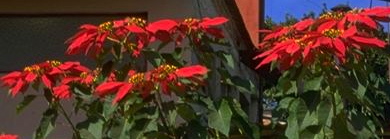
In the shop next door I buy poinsettias. When I get home, I put them in a vase and watch them, red-eyed, watching me. Bloodstains scratching a white-washed wall.
Misshapen gems in a ceramic prison, their beauty breaks me down: a fragmented world, decimated words, metaphors born from worms and mescal.
The eyes I see are not eyes because I see them: they are eyes because … twin brown ovals … they watch me as they float in a liquid mirror within the upraised glass held by my hand.
Outside, beyond the balcony, sun -blood melts like sealing wax. The bougainvillea strains sharp stains through a lonesome slice of sunlight giving birth to flamboyán and tulipán.
My lemon tree leans over to listen. Glistening pearls of dew embellish its morning throat. Christmas decorations these postage-stamp minstrels, thronging each branch, filling me with song.
Butterflies, winged flakes of archaic paint, flutter from temple walls leaving them barren. Church towers, strong when terra firma shakes, quiver insubstantial. Mescal melts the morning, a miracle, this quiver of shimmering air.
March 1 is St. David’s Day: Dewi Sant, patron saint of Wales. While we are here, immersed in cold and snow, in Wales, spring is arriving, the daffodils are out, trees are budding. This poem is a reminder that winter will end and sunshine and spring will return. So for St. David’s Day, I wish you joy and hope.
Earth to Earthlings
“Get out and about,” she told me. Take off your socks and shoes. Walk barefoot on the earth and grass: twin pleasures, you can choose.”
I took two canes, one in each hand, and left the house to walk the land.
In the garden I took off my shoes to walk barefoot on the lawn; when grass sprang up between my toes I was instantly reborn.
I stood in the shade of the crab apple tree and let leaf and flower spill over me.
Sunlight took away my frown and freckled a smile on my face. I was blessed again with hope and light; earth and grass filled me with grace
When white blossoms filtered down they gifted me a flowery crown.
I stooped to reach my shoes and carried them home in my hand, maintaining as long as I could my contact with this magic land.
Daffodils A poem for the lady who brought some to us when Clare fell
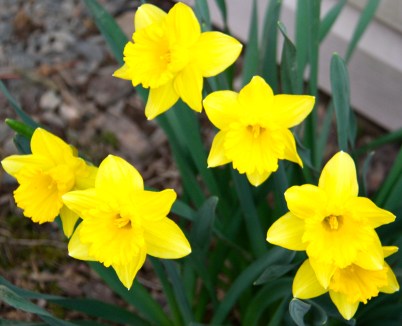
Daffodils in our garden, last year in Island View. We won’t see the live ones until May, at the earliest. I dream of them at night, tossing their heads in sprightly dance’, in Roath Park and Blackweir Gardens, Cardiff. They will be out now, all ready to welcome Dydd Dewi Sant on March 1.
Daffodils
For ten long days the daffodils endured, bringing to vase and breakfast- table stored up sunshine and the silky softness of their golden gift.
Their scent grew stronger as they gathered strength from the sugar we placed in their water, but now they have withered and their day’s done.
Dry and shriveled they stand paper- thin and brown, crisp to the touch. They hang their heads: oncoming death weighs them down.
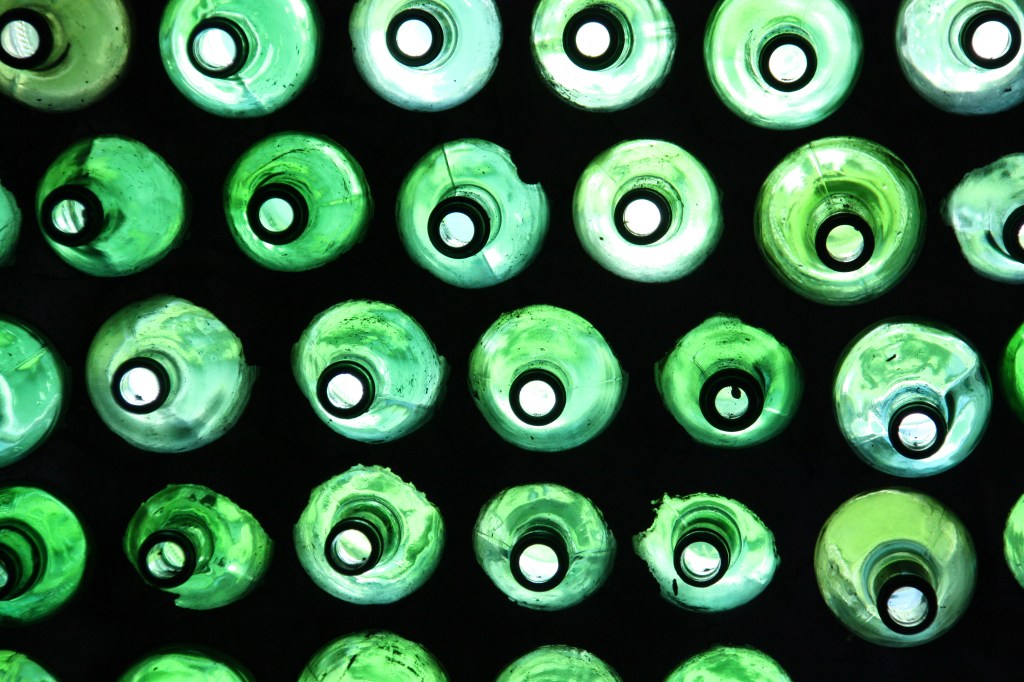
Light through glass, darkly: bottles set in one of the bottle house walls in PEI. The gardens are wonderful and well-worth a visit.
Bottle House, PEI The day begins with flowers: at the entrance, beneath the windows, flowers everywhere, a delicacy of scent. Beyond these flowers, even more flowers, then playthings in the garden: a child’s paradise, these sculptured faces, this glass among the trees, sun and shade, the fountain’s water, this dream of an old man, kept alive now by his children, a dream of health and sanity and peace out by the bay, where the mud red waters roll and the tide’s hand grasps at the land and pulls it down with watery fingers. Everywhere: faces and elements of faces: a nose, eyes, a mouth, open in surprise. Carved wooden faces, glass faces, pottery faces, flesh and blood faces, grandma’s face, grandpa’s face, then the grandchildren. Tourists travelling, old islanders returning to see family and friends, young islanders returning to visit the almost forgotten farms which their families worked a generation or three ago, before their exodus from the land. “This was grampy’s house!” they say or “that was my grandmother’s farm!” as if a life could be reborn in that pointed finger, those casual words. How many memories are snapped in each picture? How many lives are caught in this snapping of the fingers as the past is instantly summoned and perfection is bottled for a second or two in the magic of this house, this garden where the builder’s spirit roams. Sit still awhile. Be silent: you may hear him breathe, glimpse him, for a second, staking out the flowers, extracting a weed, checking the set of the concrete foundations, polishing a bottle, resting on a wooden seat, avoiding the slow snail on the path bejewelled by rain-drops from the trees or spray from the fountain. For where there are flowers, there must be water and rain and peace and happiness and all good things, glimpsed darkly through smoked glass yet grasped so smoothly in the sun’s bright light. This is the house of bottles, the glass house, where rough winds are shunned and the bottles are set in concrete. It is a museum of light and dark, the creation of sun and shadow as sunshine fails and the lighthouse’s flashlight beam reverberates from glass to stone and back again. Shapes, shadows, memories curved and carved in glass, set in glass, this shimmering beacon this glass house, this light house built as a heaven-haven for harboured ships and the soul’s refreshment, here, in these gardens, among these bottles, and at the chapel door, an angel-in-waiting.
Angel or fairy? It doesn’t matter. She was a gift one morning, when we visited. In this photo you can see how the bottles are set in the wall.
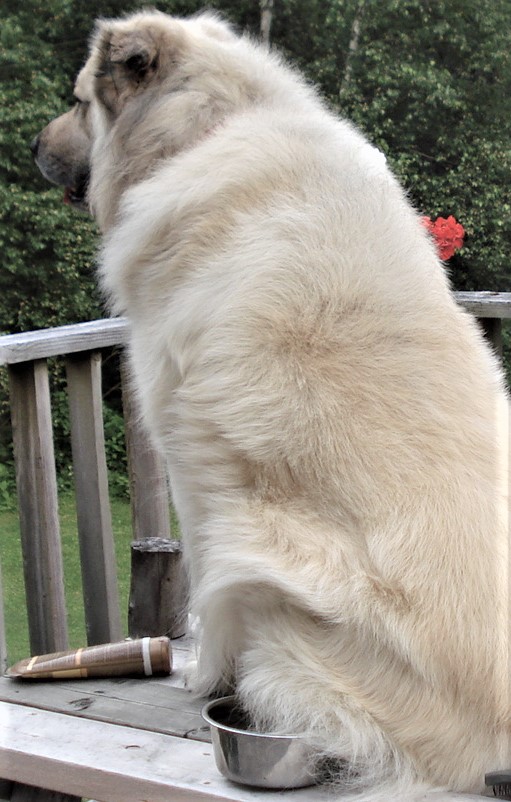
Tigger blowing his coat in Spring and waiting on the picnic table for his daily grooming. Some days I am convinced he is still out there, waiting for me.
What’s in a name? At the Farmer’s Market there are fourteen puppies in a cardboard box. One of the puppies, still blind, clambers whimpering over the side of the box and totters toward me. An elderly lady picks him up, thrusts him towards me and says: “Here: he’s your dog. He wants to be with you!” “No way, Lady!” I say and turn away. When I exit the market, I walk past the dog box. There are five dogs left but the one that wandered in my direction has gone. The salesman calls out to me: “Hey you!” He walks towards me. “That woman said you’d be back for your dog. Here: take him!” He unzips his coat, and there’s the dog, snuggled against his chest. “When was he born?” I ask. “January 16!” comes the reply. January 16 is my birthday. Today is March 8, the anniversary of my mother’s death. The dog is 53 days old, much too young to leave his mother. When I get home, my wife tells me to take the dog straight back to the market. “I can’t do that!” I say. “The man will be gone by now.” “But we don’t know anything about the dog!” “I’ll clean up after it.” I say. “I’ll feed it and train it.” “You’ll have to put it in a cage.” She tells me. “I’m not having it peeing and pooping all over the floor. You know why they’re called poopies.” Later that evening, I force the little puppy into the old dog’s crate, and I retire to bed. No sooner have I gone upstairs than there’s an unholy noise from the kitchen. “Help me!” I say to my wife. She laughs. “Not a chance! You know the rules!” Down in the kitchen the puppy is in distress. I take him out of his cage and he waddles and wags and promptly pees. I clean up after him and wonder what to do. The cage isn’t a solution. There’s no box in which to put him and any form of captivity, like a board across the door or a baby’s gate, sets him howling again. I gather my sleeping bag and a couple of cushions and I lie down on the kitchen floor. He immediately snuggles up to me, finds my finger, and sucks on it. I get up off the floor, make my way to the fridge, open the door, and pour a glass of milk; for the rest of the night, every time the dog gets restless, I stick my finger into the milk and the dog sucks my finger. I spend the next week doing this. While I’m lying on the floor, I study the dog. “What is your name?” I ask him constantly. Then, one night, as I watch him bounce across the room towards my milky finger, I know what to call him. “Tigger!” If I had waited another week, I might have called him Pooh! Tigger never leaves me. He is like an orphaned duck who follows the first human being who feeds it. Tigger follows me around the house with his nose behind my knee and if I stop suddenly, he bumps into me. My wife has started to call me Dada Duck. I now call her Mother Duck and our daughter has been renamed Baby Duck. Tigger has a second name: Dada Duck Dog. We have a little corner piece on our lot where the roads join and all the dogs stop, including mine. I went out there one day and put up a large sign with “Pooh Corner!” written on it. Beside it I placed an arrow which points “To the house!” All the children on the block love Tigger. When he came home, he weighed 6 pound and covered six tiles. Full grown, he weighs 110 pound and covers 108 tiles! He is gentle and well-behaved and everyone adores him. Some of the children want to buy a little saddle and ride on him, he is certainly big enough, but I won’t let them do that. The children on the block now call me Christopher Robin. At Christmas, they bring me pots of honey. As eleven years went by, Tigger grew old and slow. He developed cancer and had arthritis. On fine days he was fine, but on damp days he could hardly place one foot in front of the other. He had difficulty climbing the stairs and would sleep for hours rising only for his morning and evening walks and his food. Yesterday, el cinco de mayo, at 12 noon, Tigger passed away. Today, there is a little white cross at the corner of our lot. The children have laid a circle of flowers around the cross. On it somebody has painted: R.I.P. Tigger.










 rogermoorepoet