Brân

IMG_1063 (2)

Brân

Golden in the starlight, moon carved mountains and valleys, taut the skin, treacherous to the touch.  Heavy he is, glowing. He and his children. We carry them to the dark beneath the trees. Locate the secret, sacred place. Dig deep, bury him with the hoard.
We all know the place. Have measured it with footsteps. None will reveal it. Not under torture. Rather our lives than darkness eternal.
My mother limps beside me. Back-bent and broken. A crone in the moonlight. She’s been here before. Much too often. That’s how she bore me. Caught by the heathen. Captured and taken and twenty times taken.
Me, the blond son. Son of sea-raiders. Not black like my brothers. But never forsaken.
Head of the household, her man rejected her. Called for the Druids with mistletoe and magic, herbs and fragrance, scourging their medicine.
She would not drink them. Said she would keep me. Her biggest baby. Blond. To take vengeance.
Behind us, the villa in flames, there in the distance. Smoke rises heavenwards. Blots out the stars. “We should have fought,” my brothers say. “You would be dead,” my mother replies.
Brân, the white crow. King Arthur revenant. I fly the land, my brothers behind me. Black-haired, black-feathered. Strong as the crow flies. We travel at night. Fast now and furious.
My long bow penetrates. Shatters oak shields. Kills at a distance. None can withstand it. Daylight finds us grouped in the forest. Close to the place where the dragon lies buried. Close to my mother, the place where she sleeps.
Oh yes, they hunt us. But they don’t dare find us. Swift is their fate if they come close. Frightened they are, feared by the finding, wordless and dumb at the swift ending.

Comment: It’s an ill-wind, they say, blows nobody any good. So, ipso facto, some good must come from even the worst of things. Maybe, like Charles Dickens, I should write: ‘These were the worst of times, these were the best of times.’ The worst, because we have been under lock down, first voluntary, then involuntary, and now voluntary again, for 83 days. The worst, because we know that many people are dying and that many, many more are suffering. The worst, because we see some people, who think they are above the law, flouting the law and getting away with it while putting other innocent people at risk. The best, because we have seen extraordinary sacrifices made by the humblest people, many of whom, shop clerks, garbage collectors, street cleaners, bus drivers, taxi drivers, nurses, care-workers, house cleaners, were seen, if they were seen at all, as cheap labor to be exploited. However, thanks to CV, we now see them for what they are: the keys to making our lives and our economies function. The best, because where precautions have been taken the death toll has dropped and so have the infections. The best, because once again, we are free to move around so much more. However, many of us, after so long, no longer want to.

For me, safely distanced among the trees in my ivory tower, these have also been the best of times. I have made many new friends online. I have restructured the ordering of my acquaintances. I have gone into my computer files and found things that I cannot even remember having written. One such is Brân, the white crow, who is said to be King Arthur, still alive, and flying everywhere, ready to protect his from the evils that beset them. I do not know when I wrote this piece. Nor do I remember where the ideas came from. In what secret fold of the mind were they born? I do not know. But I do know that I have seventeen manuscripts, many of them rediscovered during this Dickensian ‘best of times / worst of times’, and all of them awaiting publication. This one is from a 67 page manuscript called A Cambrian Chronicle. 67 pages … and I don’t remember writing any of them.
Bath Time

62074164_10157302392400522_2936552509885382656_n

Bath Time

              My grandfather took a bath once a year, On New Year’s Eve, so he could be ready, so he said, washed and clean, for the New Year. His bath day / birthday was a family event. If we wanted a bath, well the bath water didn’t stay hot for long in the bath-tub at the top of the house, under the rafters, so an old tin bath was dragged into the kitchen and a black, iron kettle was placed on the hob, and water was boiled. One by one, we were immersed, and scrubbed, to emerge pink and glossy. All this happened in the kitchen in front of the fireplace, where we sat up wrapped in bath-robes and blankets, drinking hot cocoa so we wouldn’t catch cold. But my grandfather took his bath at the top of the house, under the rafters, in the old chipped enamel tub with its lion-claw feet, water-stained sides, and its old brass taps. He walked up there fully clothed, walked into the bathroom, and shut the door behind him, drawing the bolt with a finality that shut us all out. He sang the great choruses from Aida, and Nabucco, and we imagined him, wallowing there, in the warm water, with all his clothes on, for it was hard to imagine my grandfather naked. Then, half an hour later, he would emerge, looking just like he did when he walked into the bathroom. We never heard the water running, nor did we hear it draining away. All we heard was the The Hebrew Slaves’ Chorus and my grandfather swinging his Blacksmith’s hammer as he battered at the New Year’s Anvil.

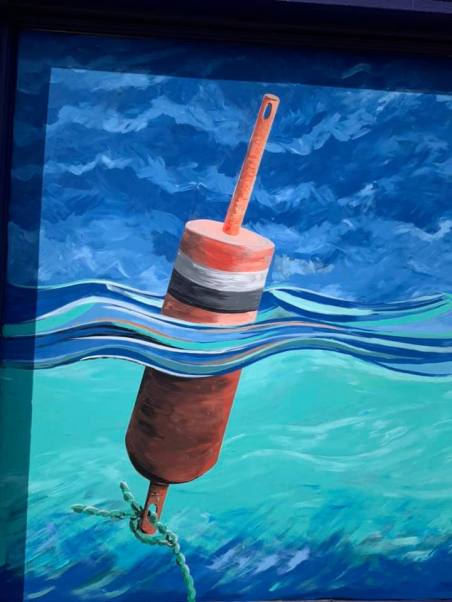
Comment: I didn’t have a photo of an old bath tub in my collection, so the lead picture is one of Geoff Slater’s murals: a buoy (pronounced ‘boy’ in Wales), taking a bath in the sea.  Let me know if you like these Welsh childhood memories, and I will keep adding to them. They are certainly fun to write and I find incredible the many ways in which memories surge as I am learning to speak Welsh. Each new chapter in my journey seems to start a new wave of thought.

Outrageous Fortune

IMG_1186 (2)

Outrageous Fortune

When the Black Dog descends it is difficult to see beyond the latest slings and arrows. Everything hurts and everybody hurts you. “Sticks and stones may break my bones, but words will never hurt me.” But they do. They gouge into the brain, splinter the mind, and leave us gasping for air, mouths open like landed, stranded fish.
How do we stop the hurt? We hurt ourselves more, much more, and then what they do to us can never ever be as bad as what we have done to ourselves. That cut-throat razor, that pop-gun with the cut cord, that carving knife, that finger stuffed into the electric socket … why, they ask, why did you do it? Head down, in silence, I know the answer, but I will not tell them.
They send me to doctors with fancy names who ask strange questions that I fudge or will not answer. They take my family’s money and then write reports and say that ‘his behavior is quite normal for a child of his age’.
Have they checked the scars on my mind, the black holes in my heart? Does the local priest who tells my parents that all is well also tell them about what happens in and out of church, in and out of school? I think of the city watch walking on the castle walls: “Nine o’clock and all’s well!”
Hurt yourself, I say. Hurt yourself so badly that nobody else will ever again be able to hurt you.

A Rare Visitor

IMG_1672 (2).JPG

A Rare Visitor

The rare Red Plastic Flamingo drops in to visit. He isn’t seen very often, especially in cold weather, for he should be flying somewhere in the Caribbean. It is cold here: you can see the snow outside. It probably drove him in to seek refuge inside in the warm.

The Red Plastic Flamingo is a strange bird, being land bound rather than aerial. He has four legs, as you can clearly see in the photo and is capable of running at great speed, faster than the fastest greyhound. It is rare and unusual to catch them in pensive pose, as here. Usually they are just a blur of movement, a moment of madness captured briefly flashing through the yard.

Rare Bird Alert: keep your eyes open. You may find one living close to you.

Aliens

IMG_1584 (2).JPG

Aliens

They came in from nowhere. Appeared on the coaster. Smallish, slightly flaky, dried on the outside, they craved liquid. Climbed into the coffee. I fished them out on a spoon. They floated down my throat.

Now they are within me. They have taken possession of my system. Now nothing is the same and I see things in a different way. That plate on the table, diminished and slightly blurred.

IMG_1585.JPG

Those flowers, edible now. Those geese in the garden, my brothers and sisters.

IMG_1380 (2).JPG

That cat, my friend.

IMG_1374 (2).JPG

My Father

IMG_0137

My Father (Solace 1)

1

            I saw my father yesterday evening. I walked through the zócalo, opened the main cathedral doors and walked in. The doors closed behind me. I looked towards the main altar and there my father stood, motionless. The evening light shone through the engraved glass panels and illuminated him as if he were some long passed saint come back to visit me. We stared at each other, but I couldn’t open my mouth to speak. The hairs on my neck stood on end and my hands shook. When I forced my mouth open, words stuck in my throat. He wore his best grey suit over a light blue shirt and a dark blue, hand woven tie: the outfit in which I had buried him.

               Three old women, dressed in black, broke the spell. One stood in front of me and wouldn’t let me approach my father. She held a large bag of knitting in her hands and the wool spilled everywhere as she pushed me away. The second threatened me with a pair of scissors that she held in her left hand and stabbed towards my face. The third beat a tailor’s measuring rod against my father’s head.  He nodded, smiled sadly, and they all turned their backs on me and hurried away out of the cathedral and into the square.

               Just for a moment, I stood there in silence. Then I pulled the doors open and ran in pursuit of my father. The setting sun filled the square with shadows that whispered and moved this way and that, as if a whole village had come down from the hills to walk beneath the trees and dance in the rays of the dying sun. I stood on the cathedral steps and called out my father’s name, but I could see no sign of him among the cut and thrust of the shadowy crowd.

               I ran out into that crowd and pushed at insubstantial people who stood firm one moment and then melted away the next like clouds or thick mist. I came to a side street and saw real people, flesh and blood beings, a group of villagers gathered behind their band. I stopped and as I did the village elder put a live match to the taper of the rocket that he clutched between his thumb and forefinger. The taper caught on fire and the rocket soared upwards with a searing whoosh. The village band marched forward and started to play a traditional dance as the rocket clawed its way into the sky to explode with a loud knock on the door of the gods.

               Tired of grasping at shadows and afraid of this living phalanx of men that marched towards me I went back to the cathedral and knelt at the altar of La Virgen de la Soledad, the patron saint of Oaxaca. Real wax candles stood before her altar, not tiny electric lights, and I inserted five pesos in the slot, took a taper, and lit a fresh candle from an ageing one that had started to sputter. I knelt and, for the first time in years, I prayed. I prayed for the soul I had saved from extinction by lighting my candle from his flame. I prayed for my father and my mother and, above all, I prayed for myself.

               On the way home to my second-floor apartment where I live alone, I bought two litres of mescal, one to send me to sleep, and the other so I would survive the next morning.

On the outside

IMG_0192

On the Outside Looking In …

I walked home on my own. As usual. I’d hated the church Christmas party with all its trumped-up noise, childish games, and artificial gaiety.
The priest, formidable yet effeminate in his long black skirted robe, had made us sit in a circle on the floor, legs crossed. He stood inside that circle and placed a bar of chocolate on the wooden boards. Then he walked around the group and whispered a word in each boy’s ear.
“You must wait until you hear your secret word,” he explained. “Then one of you, when I speak that word, whoever it happens to be, may have the chocolate bar,” he stared at us, large, yellowed, horsey teeth, no hair, eyes golden, fierce, like an eagle’s, beneath bushy eye-brows. “When you hear your secret name, you must run and grab the chocolate bar. Understood?”
I had come to the party on my own as both my parents worked. The mums and dads who had brought their offspring to the party leaned forward in keen anticipation. The boys all nodded.
“Are you ready?” The priest watched us as we nodded and then he shouted “Alligator!”
Nobody moved.
“Elephant!” The boys shuffled forward, like inch worms, hands twitching, fingers flexing and grasping.
“Tiger!” A sigh emerged from multiple mouths. Some of the boys licked their lips.
“Lion!” One boy moved, but the priest shooed him away. “Sit down. That wasn’t your word.”
“M-m-mouse!” The boys heaved, a sea-wave about to crest and break.
“I do love this game,” said the priest to the parents. “And so do the boys, don’t you boys?”
“Yes, father …” came the chorus.
“Monkey!” All the boys, except one, leapt into springy action. They dived, crawled, leaped to their feet, ran … a surging heap of boys writhed on the floor as the chocolate bar was torn apart and the long-awaited fights ensued.
All the boys moved, except me. I just sat there.
“I said ‘Monkey,’” the priest frowned at me. “That’s your word. When I say ‘Monkey’, you join in with the other boys and fight for the chocolate bar.”
I shook my head.
“Have some Christmas fun. Join in the game.”
I again shook my head.
“Why not?”
“It’s not right. You’re just mocking us.  I want to go home,” I stood up and walked out of the church hall. I turned at the door and saw the priest glaring at me while a mound of boys continued to scrummage on the floor.
As I walked home, it started to snow. Not the pure white fluffy snow of a Merry Christmas Card, but the dodgy, slippery mixture of rain, snow, and ice pellets that turned the streets of my little seaside town into an ice rink. I turned up the collar of my coat, bowed my head, and stuffed my hands into my pockets. Two houses before my own, I stopped.
A neighbor’s house. With a window lit up in the gathering dark. I drew closer, pressed my nose against the window and looked in. A Christmas tree, decorated with lights, candles, more decorations, a fire burning on the hearth, two cats curled up warm before the fire, presents beneath the tree, stockings hanging from the mantelpiece. For a moment, my heart unfroze and I felt the spirit of Christmas. Then I thought of my own house. Cold and drafty. No lights, no decorations. No fire. The snowball snuggled back into my chest and refused to melt.
When I got home, our house stood chill and empty. My parents were out at work and the fire had died. Nothing was ready for Christmas. I sat at the kitchen table, took out my colouring book and began to draw.
When my mother came home, I showed her my drawing.
“Very nice,” she said, barely glancing at it.
“But mum, you haven’t really looked.”
She stared at the picture again. This time, she saw the Christmas tree and the lights, the cats and the candles, the decorations and the presents.
But she never noticed the little boy standing outside the house in the falling sleet, peering in through the window.

Old Pal

IMG_1002 (2).JPG

Old Pal
It’s as easy as ‘Bob’s your uncle,’ as we say in Wales. Yet Bob is my uncle and life with him is never easy. On Saturdays I drive him to the local supermarket so he can purchase his groceries. He also buys cans of Old Pal dog food for Paddy, his ageing and eccentric Cocker Spaniel.
Bob always strips the labels off the cans he brings home. He trades them in for stamps so he can buy cigarettes and things. However, this stripping reduces the cans to bright, shiny aluminum canisters that sit together on the pantry shelf. He claims he knows in which order he stacks them, but I think he’s playing Russian Roulette, because he can’t tell the difference between soup, rice pudding, and dog food. They’re all locked in look-alike cans. Bob doesn’t care. His diet is a lottery anyway. He shoves the can’s contents into one end and as long as they come out the other, he’s happy.
“That’s what life is all about,” he tells me. “Munchies in and munchies out.”
            Bob’s quite happy with mushroom soup for lunch, or eating rice pudding. If he opens a mystery can and finds dog food in it, he just adds a spoonful of curry powder and heats it up on the stove. He stressed out about eating the meat in dog food when Mad Cow Disease hit Wales and consumers avoided beef, but his family doctor told him not to worry.
            “You’ll never get Mad Cow Disease from dog food,” the doctor told him.
“Why not?” Bob asked.
“Because dog food’s made from horse meat.  You can’t get Mad Cow Disease from a horse.
Bob loves dogs, but he hates Welsh Corgis. One day, he asked me to take him out for a drive. He put Paddy in the back seat, on an old blanket then patted him on the head before closing the car door.
I was already in the driving seat. I had taken the precaution of placing a plastic garbage bag over the passenger seat, in case Bob had an old man’s accident, but he told me not to worry.
“I’ll be all right. “I’ve got my Old Pal with me,” he pointed to the canvas bag at his feet. It rattled when he kicked it.
“Where do you want to go?” I asked Bob.
“Down the road,” he replied. “Let’s visit the Corgis.”
Down the road we went, driving happily, until Bob’s face came alive with joy.
“Turn right,” he cried. “There’s a Corgi down that street. Drive slowly now.”
I slowed down while Bob counted the houses.
“Stop,” he told me. “Now. Stop now.”
I stopped and Bob turned around and started slapping Paddy until the dog began to howl. Then Bob rolled down the window, pulled an empty can of Old Pal dog food from the canvas bag, unzipped his fly, stuck his old man’s magic screwdriver into it, and peed.
“The Corgi’s coming. He’s nearly here,” I could hear Bob’s chest wheezing.
“There he is,” Bob screeched with delight as a black-and-tan Corgi appeared at the gateway to the house. Bob whistled at the Corgi and, as the dog looked up, he threw the contents of the can … whoosh! … all over the dog. The Corgi jumped back, blinked, shook himself, and growled and snarled as the can drenched him in a sticky, smelly, golden shower.
“Take that, you dirty dog,” Bob cried. “Quick, drive away, now, before anyone sees us.”
I put the car into gear and accelerated away.
“This is so much fun. I’m so excited. I’m so excited I want to pee again,” Bob pulled a second empty can from the canvas bag. “Turn left. Third house up. Get ready, Paddy. There’s another Corgi on the way.”