Friday Fiction: Gringos

img0137_1

Friday Fiction
23 March 2018
Gringos

            By day, I sit in the shade beneath the grapefruit tree and watch as the sun turns each globe of fruit into a shiny planet. The hummingbirds visit me. They whir their wings, bow their heads, and pay homage with their ruby throats.

            On warm days, the sun decks me out in a shining cloak of sumptuous colors, red, blue, yellow, green. When it rains, my captors quickly confine me in a small dark place: no moon, no stars, no worshipers, no forest canopy, no grapefruit planetarium to shape my dreams. Just night and silence. I tuck myself in and hope for the occasional dream to reach out its hand and extract me from my cell.

            Fine weather today. I sit beneath the grapefruit tree and the gringos buzz around me. They push grapes, raisins, bananas, crusts, cigarette butts through the bars of my cage. I scorn them. Gringos, I cry with contempt. Gringos. They clap their hands. Bray with laughter. Sway from side to side splitting their sun-red faces with gold-capped teeth. I eat very little of what they offer. An occasional grape. A chunk of banana. I never take food from their fingers: the temptation to bite the hand that feeds is far too great.

            I am learning their language. The compound guards who allow the gringos in and out of the gates that lead to the outside world teach me gringo words. I can now say gringos go home and this makes for much merriment. The gringos slap their sides and double over with strange cackled cries of laughter. Sometimes tears come to their eyes.

            I drowse in the sun and recall my childhood on the building site. The workers took me from my forest home, placed a chain on my leg, and tethered me to the broken branch of a leafless tree. At first, I couldn’t understand their speech, but they persisted and bit by bit, I picked up their words. When I repeated them, they laughed. Now, I rarely use them and when I do, the compound guards throw a blanket over my head and carry me back to jail.

            I am very careful with what I say. Gringos go home. That is fine. But I rarely say what I really want to say. I want to tell the world how much I love the sunlight as it pierces the leaves and filters down to me, sparking fragmented colors from my frame. My greatest desire is to move in a cloud of many colors, all my family together. I love being part of the crowd-cloud, a voice among voices, all of us in counterpoint and tune. Instead, I sit here, isolated, alone, pining for my brothers and sisters.

            Gringos, I want to say, gringos, let me go home.

          Today, a great event. One of the gringos has picked up my prison and moved it from under the shade of the grapefruit tree to a new spot beneath the balcony. I now sit directly beneath the geraniums. The gringa who lives long-term on the second-floor waters her flowers regularly.

            The gringa grows old and forgetful. She knows she must not water her plants during the day, especially when I am around, but today she is out in the sunshine, forgetful, without her hat, dressed in her dressing-gown and grizzled slippers, with her hair in steel curlers, and a watering can in her hand. Water. It is the symbol of my baptism. It is the element that will release me from my bondage. Water will quench my thirst and free my soul.

            I hear the water, the blessed water, falling on the flowers. I hear the water filtering down through the flower pots. I feel the water bouncing off the geranium leaves threading its way down to settle on my back. My mind returns to the building site of my youth.

            I remember my childhood friends. Their faces flood back and grow like flowers as the waters flow and I remember every word those old friends said as they ran from the building site to take shelter from the rain that stole their money, stole their livelihoods, and stopped them from working.

            Fucking rain, I screech, as the water hits me. Fuck this fucking rain. Fuck this mother-fucking rain.

            I hear the sound of running feet followed by voices.

            “Gertrude’s watered the parrot as well as the geraniums. He thinks it’s raining.”

            “ Quick, fetch his bloody blanket. Shut up, you foul-mouthed parrot.”

        Alas, my moment in the spotlight is over. The play is done. The curtain falls. Darkness descends. I tuck my head beneath my wing and before I fall asleep, I squawk one last feather-filled word:

Featherless-muffer-fuckers.
Last Rites: FFF

Empress 048

Last Rites
Flash Fiction Friday
11 August 2017  

The employee gazed around his empty office. Tomorrow he would leave the work environment in which he spent his entire adult life. He turned out the lights, closed the door behind him, and walked down the stairway to the exit for the last time.

He took the long, solitary walk to the spot where he had parked his car. In the car park, he fondly kissed his wife’s photo and said a quiet farewell to his beloved daughter. Then, he climbed into his car, started it, and began the short drive home.

Later, at the inquest, the driver of the gravel truck swore he had no chance to avoid the head on collision.

“One moment the road was clear, the next this car was heading straight at me,” he paused and blew his nose. “There was nothing I could do.”

“Yes, sir,” the police officer stared back at the coroner. “I was the first investigating officer on the scene,” he glanced down at his note-book. “And yes, I can assure you that the car driver was not wearing his seat-belt.”

“He loved his work,” his wife testified, fingers twisting the white handkerchief that stood stark against her black dress. “There must have been something wrong with the car. He would never have left me alone like this.”

“A wonderful dad,” his daughter said. “He loved me, and the grand-children. He had so much to live for. It was a terrible accident.”

“Unhappy with his retirement?” queried the employee’s Department Head. “I don’t know what you are trying to imply. Nobody forced him into retirement: he made that decision himself. He seemed very happy with it. We all knew he was out of touch and not up to date with his research anymore. That’s why he chose to retire. He told me all that when he came to see me to tell me he was retiring. His decision to retire had nothing to do with me.”

The employee’s DH raised his eyes heavenwards and gazed at the ceiling.

Out of sight, in the safety of the witness box, he rubbed his hands together, again and again, as if he were washing them.

Comment:

It’s been so long since I last wrote and posted an FFF (Flash Fiction Friday). It feels good to be back writing prose. And yes, the last two FFFs were on May 5, 2017, Moonshine, and April 28, 2017, Crocodile Tears.

So much water under the bridge and so glad to start getting back to my creative blogging schedule.


Torticollis

Avila 2007a 039

Torticollis

A sudden crick of the neck and I am back in the chalet at Perines with Trini.

“Torticollis,” she says, raising a hand to her neck, except she says it in Spanish, ‘tortículis’.

She offers me tea, very English, from the Wedgewood tea pot I brought her, all those years ago. Beside her, the Pirate with the Parrot on his Shoulder, my Toby Jug, still stands on guard, and protects my memories.

Orphaned, I was, from England, abandoned on that Spanish shore, and left there all summer to learn the language. Trini taught me how to eat, speak, choose my books and my friends … she had lost a son, same age as me, just after the Civil War, and treated me like her son, returned, like the Prodigal Son I was to all who had sent me away from home to improve my lifestyle and my manners.

Wanted? Unwanted by my family? I wouldn’t know the difference.

In that far-of land, in time and space,  I only knew the loneliness of being lost, marooned in a foreign land, feeling my way, day by day, among foreigners, still foreign, although they took me into their homes and hearts and loved me as I had never been loved before.

Back home, drowsing  at the kitchen table, I doze into my dreams, only to be woken by that beloved voice.

Wistful, I turn my head and glance backwards into that past of sunshine and beaches, where the sun sparkled on hill, sand, and sea and the table cloth was spread on the family table, pure and white, with a dozen of us sitting, talking, smiling, drinking wine, that bottled sunshine that still adorns my dining room table.

“Trini? Is that you?”

Her name slips from my lips as I snap my head towards her voice. As I turn, I twist my neck and raising my hand to the sudden pain, I hear again that word: “¡Tortículis!”

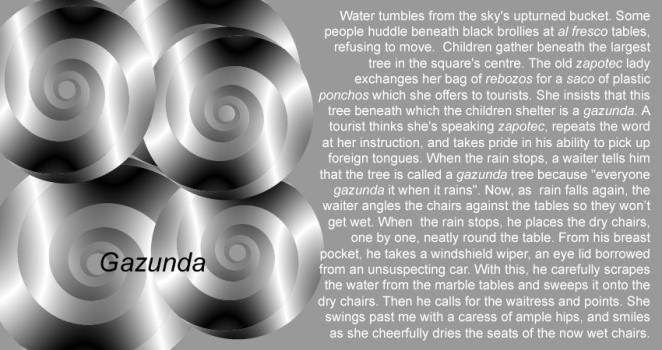
Gazunda

Gazunda

Gazunda
for John Sutherland

John and I were talking about the rare Gazunda tree the other afternoon. I had forgotten that I had indeed written abut the Gazunda trees that flourish in the zócalo in Oaxaca, Mexico. Oaxaca is a magic place, full of mystery and myth and the myth of the Gazunda tree is not well known outside the confines of the city. I was so pleased to discover this account, written many years ago, when I first became associated with the Escuela de Idiomas attached to the Unversidad Autónoma Benito Juárez de Oaxaca (UABJO).

Much remains to be written about my experiences in Oaxaca and I hope to have a collection of prose poems completed fairly soon. They are golden oldies, but like many golden oldies, they are also golden goodies. The Gazunda trees are very welcome when it rains, but they should be avoided, for obvious reasons, during thunder and lightning storms. Then, nobody Gazunda them. By the way, if you do visit the zócalo in Oaxaca, or anywhere else in Mexico, after heavy (or light) rain, be sure to test the seat of your chair before you sit in it. If you don’t, you will soon find out why all the waiters and waitresses have that open, friendly smile the tourists love so much.

Damnatus

IMG_0041

Damnatus / Doomed

‘Poor poets of today: condemned to be nothing more than the dry dust of an unread doctoral thesis.’ They languish, empty headed, in dark rooms, those poets, hunched over their computers, waiting fr someone or something to fill up their heads. They hammer away at their keyboards, correcting their spelling with an  ever cautious spell-check. Intent on making their poems cryptic, they shrug off the sunshine, the beach, the flowers in the garden,  the cardinals, orange and red, who clamor at the feeder, and concentrate on abstract meanings, abstruse words, and twisted thought.

Phone calls go unanswered. Friends are left hanging on the vine to dry. These poets are worse than wallflowers at a dance or lemons out on a date as their crowded heads fill up with metaphors and myths that limp their unsteady ways onto screen and page. Oh pity the blisters on their fingers, the calluses that harden their fingertips to the delights of re-writing, again and again, for they are not real writers but real re-writers, and every thought is a skirmish with unreality, a pledge to continue their servitude to their life’s mission: the curdling of words and the nurdling of poetic thought. What better poetry is there than a hamburger for the hungry or a helping hand stretched out across a street to help a beggar in need … but there are neither burgers nor beggars in these un-windowed buildings, just the poverty of a poetry undiscoverable in its lack of lustre gloom..

Where is the graduate student, earnest, destined to be penniless, who will delve into the notebooks of these poets’ lives and dig out the thought-gems, the diamonds that will make everyone great, publisher and published, poet and practitioner of the uncritical art? Will someone not take that student by the hand and lead him to pastures green, or to the sea, to taste and test the blessed salt and the winds that will drive away the mind’s unwholesome fog and bring light and understanding that will un-cuff the wrists and heal the immortal wounds for, left untreated, they will bleed for all eternity?

Oh the bright bracelet of learning bound round the heart-bleed wrist. Oh the false knowledge gained, that leads poet and critic up and down the slippery garden path towards promotion, tenure, and a seat on the picket fence. Oh those grey human bodies chained to their wooden desks in a dusky library or transfixed on metal seats in academic meditation. Sit and watch while cobwebs sprout in the unused brain and the only certainty lies in footnotes and bibliographical entries that rise like a surging tide to flood the drowsing mind that craves more sleep.

What bright word, what metaphor dim, has poisoned the wit so it effortless moves into the serenity of contemplation? Look on this pathless sea of words, ye mighty, and despair. But take great care: for what if this sylvan warrior awakes, steps out of that figmented dream, sees the reality beyond the shadows, demands a proper challenge, a walk in the park, a vision of the grass that is so much greener on the other side where the administraitors gather and garnish paper and paperclips as they strive for the privilege of herding more and more slovens in their poetic pursuits?

Oh grant them more grants, these purloined poets. Gift them pure visions of things that never were and will never be. Never let them break away from their dissolute dreams that wrap their disadvantaged forms in the ignorance of mental slumber, half-sharpened pencils, and a box of blunt sharpeners..

“Don’t Get Off the Bus!” Wednesday Workshop

IMG_0061.JPG


“Don’t Get Off The Bus!”
Wednesday Workshop
Wednesday 14 June 2017

Journal: Roger Moore had the honor and pleasure of addressing the artists in residence at KIRA / Kingsbrae last night. He gave a brief biography of himself then stated that he did not consider himself to be a poet, the honor of the name is too high. He is, he stated, above all a writer. He began writing poetry at an early age, but was always put off by the lack of understanding shown by his contemporaries. Such slogans as “He’s a poet, but he doesn’t know it,” chanted endlessly, made him hide his poetic talent. In 1962, however, in his last year in school, he entered the Stroud International Festival for Religious Drama and the Arts and won first prize for a sonnet he wrote for that competition. This confirmed , in his own mind, that he could write and he continued to do so.

He attended Bristol University from 1963-1966, studying Spanish (Honours) and French. While at Bristol he published some 30 poems with the university’s literary review, the Nonesuch Magazine. He also wrote a weekly column in the student newspaper reporting on cross-country running in winter and athletics in summer. He began an MA in the University of Toronto in 1966 (completed in 1967) and decided to stay in Canada and work for his PhD (17th Century Spanish poetry). His encounters with the Toronto literary circles were not satisfactory and he realized that neither his style nor his subject matter were suited to the CanLit of the Canadian art scene. He hid again until 1977 when Fred Cogswell published Last Year in Paradise, Roger’s first poetry book, in the Fiddlehead Poetry Book series. By now, Roger had completed his doctoral thesis and published Towards A Chronology of Quevedo’s Poetry with York Press in 1976. From 1973-1977 Roger was first the Editorial Assistant and then the Assistant Editor of the International Fiction Review (University of New Brunswick). This position allowed him (a) to revise the submissions of writers whose first language was not English; (b) to translate articles from Spanish to English; and (c) to himself submit articles and reviews to the magazine. One of his first translations was of an article by Enrique Anderson Imbert, the Argentinian writer. Roger’s academic writing and editing is a different story and will be told at another time.

In 1979, Roger took his first workshops in creative writing at St. Thomas University  with Norman Levine, the Canadian Short Story writer. Norman Levine inspired Roger with a new taste for creative writing and he started writing short stories at this stage. He also started attending the Maritime Writers’ Workshops at UNB working with Patrick Lane, Susan Musgrave, Richard Lemm (twice) and Erine Moure. Roger was now submitting regularly to Canadian Literary magazines and his poetry was published first in Poetry Toronto (by bpnichol),  and then in Poetry Canada Review, The Fiddlehead, ARC, Ariel, the Cross-Canada Writers’ Quarterly, and in some twenty other Canadian literary magazines. In 1986, his second poetry collection, Broken Ghosts, was published by Goose Lane (Fredericton). Roger’s mother died in 1987 and his father followed in 1989. The poems he wrote at this stage were collected together and were awarded the Alfred G. Bailey Award for Poetry by the Writers’ Federation of New Brunswick in 1989. A second collection again won the Bailey in 1994, but neither of these collections were considered worthy of  publication by the multiple Canadian presses to which Roger sent them.

In 1991, Roger was the Atlantic Provinces Director for the League of Canadian Poets. He started, with JoAnne Elder, the Writes of Spring at St. Thomas University, and this continued for three years. The Writes of Spring was designed as a gender balanced, language balanced reading event in which eight poets participated. The reading group consisted of four men and four women, four of whom were Francophones and four Anglophones. These bilingual readings gave a wonderful insight into the poetry that was being written at the time within the province of New Brunswick. Roger started self-publishing his poetry in limited edition chapbooks at this time and gave his works to the participants and audiences in this series. He published six chapbooks this way: Idlewood, In the Art Gallery, Daffodils, Secret Garden, Iberian Interludes, and On Being Welsh.

In 1999, Roger chaired the third Atlantic Association of Universities’ Teaching Showcase at St. Thomas University. He edited the proceedings with Denise Nevo and they were published by Mount Saint Vincent University Press. Denise suggested that Roger might publish his poetry with MSVU and declared herself willing to edit and publish any work he might care to submit. This most fruitful collaboration with a wonderful lady who was also an outstanding editor allowed Roger to publish six more poetry books between 2000 and 2012, namely, Sun and Moon (Poems from Oaxaca), Though Lovers Be Lost, Fundy Lines (Prose Poems), At The Edge of Obsidian, Obsidian 22, and Monkey Temple. Roger continued publishing chapbooks and Dewi Sant (with the Central New Brunswick Welsh Society) and M Press of Ireland were among those that appeared, while Land of Rocks and Saints (Poems from Avila) was published by Nashwaak Press (Stuart Donovan) in 2008.

2015 saw three books appear in print: Stepping Stones (in collaboration with David Brewer of Rabbittown Press), Systematic Deception (in collaboration with Randi Drake of Ottawa), and Triage, his last poetry chapbook. In August 2016, John Sutherland, a member of one of Roger’s writing groups, introduced him to CreateSpace / Amazon / Kindle, and since then eleven books have been published online: Monkey Temple, Though Lovers Be Lost, Bistro, Sun and Moon, Obsidian’s Edge, The Empress of Ireland, All About Angels, Avila (Cantos y santos y ciudad de la Santa), Iberian Interludes, A Cancer Chronicle, and Nobody’s Child. Bistro (Flash Fiction), Avila (in Spanish), A Cancer Chronicle, and Nobody’s Child (short stories) are new, while the other seven titles have all been expanded and revised. Bistro was one of three finalists (and the only independently published book) in the New Brunswick book Awards (prose fiction) in 2016 (results announced, May 2017).

This Wednesday Workshop / KIRA Artist’s Report has two concealed messages. The first is that writing, like all creative activities, is a long apprenticeship (in the words of Fred Cogswell). The second is that if you want to travel from Halifax to Vancouver, you must stay on the bus. Quite simply, if you get off at Fredericton or Quebec City, Or Montreal or Toronto, and if you stay in one of those cities and don’t get back on the bus, you’ll never arrive at Vancouver. So: writers young and old … stay on that bus. Persist with your work. Never give up your dream. Never give in. Looking back from the vast old age of seventy-three, I realize now how easy it would have been to admit defeat and stop writing at so many stages of my writing career. I kept going and I encourage, nay URGE, any writer / creative artist reading this either to stay on that bus or to climb back on board. Quite simply, the world needs us and the world needs our poems, our paintings, our sculptures, our music, our encaustics,  and our stories.

Apologia

IMG_0447


Kingsbrae 5.2
5 June 2017

Apologia

Late last night, I opened Alistair Macleod’s book The Lost Salt Taste of Blood and I re-read the first story. I was soon dabbing my eyes with a tissue and blowing my nose.

This morning, I want to destroy everything I have written. I know I don’t possess the verbal and emotional genius of the great writers and I sense that I cannot write like them. Graduate school taught me to be passive, not active, and to write impersonally, choking every emotion when I write. Academia also taught me how to kiss and how to run away with my thirty silver pence. “Never challenge the status quo,” my professors told me. “Learn the rules and disobey them at your peril.”

But here, in this private space where I create and re-create, there are no rules. The enemy is not clear any more and the fight is not one of black against white. It is rather a choice between diminishing shades of grey, and all cats are grey in the gathering dark that storms against my closing mind. Should I destroy all my writing? I wouldn’t be the first to do so; nor would I be the last. And I won’t be the first or the last to destroy myself either. Intellectual, academic, and creative suicide: as total as the suicide of the flesh.

I carry on my back the names of those who have gone on before me as if they were a pile of heavy stones packed into a rucksack that I carry up a steep hill, day after day, only to find myself, next morning, starting at the bottom once again. But this is not the point: the point is that if I cannot write like the great writers, how can I write?

I think of Mikhail Bakhtin and his cronotopos, man’s dialog with his time and his place. I have no roots, no memories, and that is where my stories must start: in the loss of self, the loss of place, the loss of everything. I was uprooted at an early age, soon lost my foundations, and only survival mattered.

I look at the first page of one of my manuscripts. My writing manifesto is clear before me: “And this is how I remember my childhood,” I read. “Flashes of fragmented memory frozen like those black and white publicity photos I saw as a child in the local cinema. If I hold the scene long enough in my mind, it flourishes and the figures speak and come back to life.”

I am aware of the words of T. S. Eliot that “every attempt / is a wholly new start, and a different kind of failure / because one has only learnt to get the better of words / for the thing one no longer has to say, or the way in which / one is no longer disposed to say it” (East Coker).

Are these stories an exercise in creativity or are they a remembrance of things past? How accurate is memory? Do we recall things just as they happened? Or do we weave new fancies? In other words, are my inner photographs real photographs or have they already been tinted and tainted by the heavy hand of creativity and falseness?

The truth is that I can no longer tell fact from fiction. Perhaps it was all a dream, a nightmare, rather, something that I just imagined. And perhaps every word of it is true.

I no longer know.

Purple FF

img_0199

Purple

I close my eyes and return to Paris, Easter holidays, 1961. Algérie-française, Algérie-algérienne, the car horns tweet in the street as we drive the boulevards of a city divided. This is all new to me, a seventeen year old student in Paris to learn about French culture. My friends in the car have heard the tooting before and join in the fun.  Algérie-française the driver toots.

Turning a corner, flattened and blackened, still flaming against a fire-burned tree, the metal skeleton of a Deux Chevaux, a ‘tin of sardines’, bears witness to the car bomb that has laid its occupants low.

* * *

Hitching the highway, from Paris to Chartres, thumb stuck out to catch the wind, a purple Citroen stopped and offered me a lift. I trusted the car: a Citroen, like Simonet’s famous detective Maigret used to drive.

When the car stopped and the door opened, I got in and saw that the driver wore black leather gloves. His hand movements on the steering wheel were stiff and clumsy and he made exaggerated gestures when he changed gear.

“No hands,” he explained. “Lost them in Algeria. Listen: I used to be the driver for a top General. I drove him out of an ambush once. I lost my hands later, when the car exploded, caught in a crossfire. They teach you things in the Army. I can still drive.”

He accelerated and threw the car at four times the speed limit through the S bend that snaked through a small group of houses. I bounced from side to side, held back by no seat belt.

“You see,” he said. “They train you to do this before they let you drive. Ambush. The sniper at the corner. The Molotov Cocktail. You must always be prepared.”

I closed my eyes and returned to Paris.

Collateral damage: the young girl with her photo in the Figaro next day, scarred for life; her mother, legs blown off, lying in the gutter in a pool of purple blood.

Maman, maman,” the young girl cried. But her mother was never going to reply.

The Pom-pom-pompiers arrived in their fire trucks, sirens screaming. The ambulances screeched to a halt. The young girl cried. The mother bled out her life-blood in silence. Her blood turned purple and black as it flowed through the gutter.

Parisians emerged from dark doorways and stood there, bearing silent witness. Evening draped itself over the Paris skyline. The sky darkened and became one with the purple of the car bomb’s angry flame. Purple bruises marked my arm where I had gripped myself with my own fingers. An indigo angel squatted above the faubourg street, with shadowed wings, brooding.

* * *

I opened my eyes.

We left the village in our wake, travelling five times faster than the speed limit.

“They trained me for this,” the driver said. “I am prepared for anything.”

He stopped the car by the cathedral in Chartres. I thanked him and got out. He offered me his hand and I shook it. Inside the glove, the hand was hard and metallic. Alcohol sweated out through the purple veins that stained his nose and flowed in abundance over his sun-tanned face.

Teddy Bear Tales TBT 1


Empress 048

Oppressive-Possessives
TBT1

 Teddy Bear Tales 1

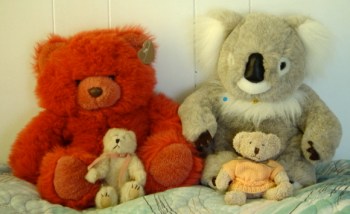
 “Possessives are oppressive,” my Teddy Bear whispers in my ear. “I’m not your Teddy and you’re neither my owner nor my master. The world exists without you possessing it. It will continue without you. And yes, I hear you, especially when you talk in your sleep. ‘My wife,’ you mutter, ‘my daughter, my flowers, my garden, my lawn, my birds, my bees, my deer, my house, my grounds, my groundhog, my car, my TV, my team, my Teddy.’ Well, permit me to share a secret with you. None of them are yours. You may think you own them, but you don’t.”

My God …” I sat up in bed and held my Teddy Bear at arm’s length, staring into his button eyes.

“There you go again,” Teddy stared right back at me. “Whatever are you thinking? Those two little words, yours and mine, are a threat to the universe.”

Bistro

18581930_1306791786107970_4016640231053970709_n-1.jpg

Bistro is a finalist, one of three, in the New Brunswick Book Award (2016) for Fiction. The photo is an older one, taken by the local newspaper in my basement in 2014, and reproduced in the paper today. Funnily enough, I am wearing the same clothes today as I was when the photo was taken three years ago. Luckily, Clare has washed them for me, on several occasions, in the interval between then and now. Thank you, Clare, for all the little things you do to keep me alive and happy. Without you, I don’t know what I’d do. This book, like all my creative work, is dedicated to you.

Bistro is available online.