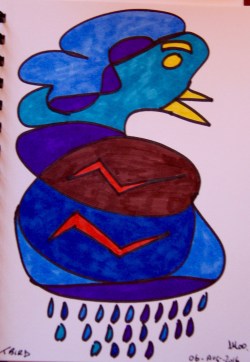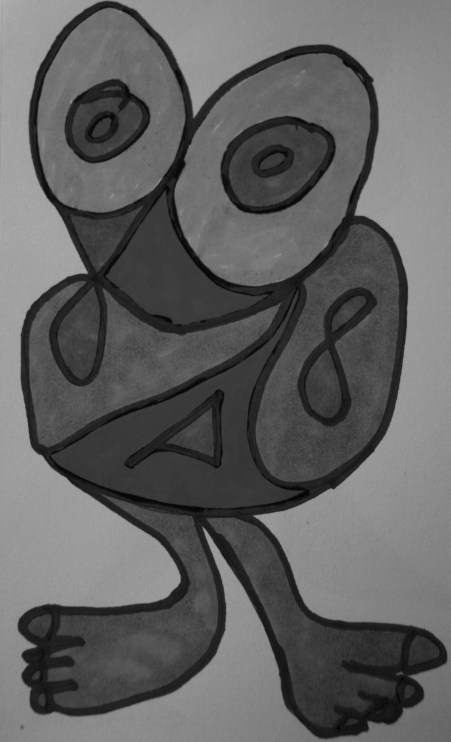
MT 1-7 Monkey’s Cage Rage

Chaos

Monkey’s Cage Rage
(Remembering  Dylan Thomas:
“Do not go gentle into that dark night…”)

“Do not go gentle!”
Monkey’s sharp teeth gnaw holes in the safety blanket;
a fist in the darkness, he punches the pillow, again and again,
until the dark fist tires and rage falls silent.

Angry words are forged in iron.
Monkey wants to rage, rage, rage,
against blind bars which bind him.

In dawn’s frail light, cage bars are less visible.
Iron bars seem softer in the silence
of their invisible, silken gloves.

This barred and barren cage
in which he bangs his head against the bars
means all the world to monkey.

But how can monkey lament the loss of liberty
when he wasn’t born free?


MT 1-5 Monkey Receives Tenure

IMG_0447

Monkey Receives Tenure
(In the Monkey Rhyming Dictionary, tenure rhymes with manure)  

“Gentlemen of the Committee: have you reached a verdict?”
“We have.”
“And is it unanimous?”
“It is, your honour.”
“Then will the committee Foreman stand and read that verdict to this court.”
“Guilty, Your Honour. The defendant is guilty, on all counts.”
“And are there no mitigating circumstances: a failure to complete an assignment on time, for example, or a questionable reference?”
“None, whatsoever, Your Honour.”
“What a pity! What a damnable pity!”

The monkey judge puts on his black wig, and raps with his gavel.
“Will the defendant stand.
I sentence you to a term of two years’ hard labour
at the Monkey Temple, renewable for another two years.

Should you continue to publish, and should you fail,
over that four year probationary period, to fall by the wayside,
or to do anything wrong, I sentence you to life imprisonment,
till death do you and the Monkey Temple part.”

The monkey judge coughs.
“There, now. Stop your sniveling. You’ll be reasonably well treated,
as long as you remember your station.
Life imprisonment in one of Her Majesty’s Monkey Temples
is not that bad.”


In Praise of the Other

img_0360

In Praise of the Other

I have lived with the Other. They treated
me well. To them I was the Other, yet

they fed me when I hungered, gave water
when I ran dry. I fell ill and they cared

for me, nursed me back to health. They taught me
their language, culture, history, and skills.

They loved me, never forced me to forget
myself and become one of them. They made

me what I am today: a believer
in the sibling-hood of woman and man.

Revisions: Wednesday Workshop

IMG_0486

Revisions
Wednesday Workshop
27 June 2018

Below are the texts of a poem that I am attempting to revise. Any comments on the text(s) or the revision process will be welcome.

In Absentia 1
Princess Squiffy

I hear her voice, delicate, distant. I
run to the sound, jump on the table in
my usual spot by her plastic plaything.
She isn’t there. He is and he’s talking.

I can see him, smell him. I hate him, his
other sex perfumes, but there he is and
when he stops talking, I can hear her voice.

I move to his talk box. A shadow, I
can’t quite make it out, then her voice again.
My whiskers stiffen, I lean forward, sniff,
but no smell. She has no smell, and scentless,

I cannot sense her, I bristle, she calls
me by my favorite names, mews, and I mew
back in reply. But I can’t smell her. There’s

no sense of touch … is this the hell all cats
will suffer … shadows on a screen, a voice,
haunting, memories shifting and dancing,
nothing solid … just shadows and absence?

Problems:
Repetition of scents / smells, there, voice (4), plus avoid all cats

Solutions:
Seems easy to tidy up … but … how do I end the poem with I hate him? Would it make the poem stronger? It would man a total rethink and restructure. 

In Absentia 2
Princess Squiffy

I hear her voice, delicate, distant. I
run to the sound, jump on the table in
my usual spot by her plastic plaything.
She isn’t here. He is and he’s talking.

I can see him, smell him. I hate him, his
other sex perfumes. He stops talking. I
can hear her warm, sweet words: where can she be?

I move to his talk box. A shadow, I
can’t quite make it out, then her tones again.
My whiskers stiffen, I lean forward, sniff,
but cannot sense her. I bristle. She calls

me by my favorite names, squeaks, and I mew
back. There’s no sense of touch, of her presence.
Is this the way we all will suffer? Wood

burns. Firelight flickering, shadows on
cave walls, long gone memories revived to
haunt us. Are these the torments held in hell?
Will dark shapes shift on half-lit screens? Will the

memories of loved ones come back to taunt
us, haunt us?  Will there be nothing solid
in the afterlife, just outlines and absence?

First Revision:
I quite like it, but it has become much longer and the cat’s voice has either been conflated with the human voice at the end or it’s an exceptionally intelligent cat, knowing all about Plato,  unless those can pass as feline memories because she was in the cave with him.

In Absentia 3
Princess Squiffy

I hear your voice, delicate, distant. I
run to the sound, jump on the table in
my usual spot by your plastic plaything.

You are not here. He is. I can hear you
talk. I stalk to his noise box. I see a
shadow, moving, but I can’t make it out.

My muscles first tense, then stiffen. I sniff,
lean forward, but find no trace of female
smell. I cannot sense you. You call me by

my favorite names, mew at me, and I
respond. Shifting shadows, your haunting tones,
memories dancing to the music of

your absence. I can’t eat. I bristle when
he laughs. Where are you, my love? He doesn’t
care for me the way you do. I loathe him.

Second Revision:
This is much shorter, builds up to the proposed new ending, eliminates the repetitions, and replaces hate with loathe, a very catty sound. However, I have lost the ending that I liked so much: the suggestion of Plato’s Cave has now been lost. So, let’s head to Plato’s Cave.

In Absentia 4
Plato’s Cat Cave

Princess Squiffy

I hear her voice, delicate, distant. I
run to the sound, jump on the table in
my usual spot by her plastic plaything.
She isn’t there. He is and he’s talking.

I can see him, smell him. I hate him, his
other sex perfumes, but there he is and
when he stops laughing, I can hear her voice.

I move to his talk box. A shadow, I
can’t quite make it out, then her voice again.
My whiskers stiffen, I lean forward, sniff:
she has no smell. I bottle-brush my tail.

Envoi
by Plato

Firelight flickering, shadows on walls,
distant voices echoing, memories
perched on our shoulders, night owls hooting.

Is this the hell we all will suffer, shapes
shifting on a screen, voices taunting us,
memories dancing to half remembered
melodies, nothing solid, shadows, absence?

Third Revision:
This poem has now changed shape and direction. I quite like it but it is dependent on a knowledge of Plato’s Cave. Does the cat belong in Plato’s Cave … I think of Kipling’s Just So story The Cat that Walked … perhaps it does. Perhaps it doesn’t.

Decision Time:

Playing around with the text was fun. The text moved in several directions and now I must choose my final direction.

Comments on any of the versions or on the revision process I used will be very welcome. And yes, nothing perishes. My poems, like my cats, have nine lives (well, four in this case, with possibly a fifth to come).

MT 1-3

img_0181

MT 1-3
Monkey Statue

(after Rabelais and his many experiments with goose down and geese)

Covered in concrete
a conquering hero
stands in the yard.

Pigeons feed on scattered breadcrumbs.
Squabs squat on the statue’s head.
They gift his shoulders with the fresh
white lime of guano,
as dry as dandruff.

Is this what all monkeys will become,
statues in a square, pooped on by pigeons?

The statue stretches out a hand,
clutches at a passing pigeon,
thrusts it head first between his legs,
strains hard, then wipes his …

Monkey takes the hint,
dons an anonymous grey
suit of medieval armor,
and runs.


MT 1-2 Monkey and the Bean Counter

 img_0181

Monkey and the Bean Counter

An acolyte in a charcoal suit runs by.
He neither stops nor speaks
but slips on slippery words
dripping from another monkey’s tongue.

This other monkey has eyes of asphalt,
a patented pewter soul,
ice water flowing in his veins.

“Hear not! See not! Speak not!”
The hatch of his mind is battened tightly down.
Nothing gets out nor in.

The acolyte’s fingers grasp at a khaki folder,
his manifesto for success.

The other monkey stalks to his office
and turns on the radio.
His favorite music is the clink of mounting money.

Disturb him at your peril:
this monkey is very important,
and very, very busy.

First, he empties all the chocolate candies from the box.
Then he sorts them into little piles:
green with green, brown with brown, blue with blue, red with red.
Then, like the Good Shepherd counting His flock,
he counts them again and again,
to ensure that not one has gone astray.


MT Warning and Prologue

img_0181

Monkey Temple

Warning

Any reference to any real monkey, living or dead,  is entirely coincidental. However, if you are a monkey and if the cap fits, please do not hesitate to wear it. 

Reader and listener discretion is advised.

 PS This manuscript  was begun at midnight  and completed  just before mid-day on April 1, 2012.


Prologue

These Monkeys Bite

A large sign at the entrance to Bristol Zoo, off Clifton Downs, announces to visitors the zoo’s motto: “Ask the animals: they will teach you.” My visits to Bristol Zoo always lead me to the Monkey Temple. It is an old, ruined, Indian Temple, half-hidden in the trees and populated by a colony of monkeys. Sometimes, the monkeys are playing in the open, sometimes they aren’t. Patience is everything: sooner or later, the monkeys will appear, revealing themselves in all their splendor.

I do not like to call these refuges from modern city life zoos; rather, I think of them in terms of nature reserves, preservation centers, museums, art galleries with living portraits, areas where human beings can break from the city’s restlessness and come face to face with a tiny part of a lost natural world, a world which we are so busily destroying.

Are monkeys people, you ask? Of course they aren’t. But they do have human qualities and there is no better place to see these human qualities than in the Monkey Temple. Do animals accurately reflect human qualities? Of course they don’t. The monkeys in the Monkey Temple are the distorting mirrors of fair ground, circus, and exhibition where bodies are fattened and flattened, thinned and skinned, turned inside out into falsified figures, stick creations bent out of woolly wires designed for cleaning pipes.

Please be reassured: the poems in Monkey Temple do not refer to any specific monkey, living or dead. If you see an aspect of yourself, or myself, twisted beyond the norms of reality, do not fret: it is entirely accidental, taken from the monkeys themselves.

Remember: “Ask the animals: they will teach you.”

But, be warned: do not place your fingers near the cages — these monkeys bite.

Monkey Temple

img_0181

Monkey Temple

The monkeys appear, as if by magic.
They tumble out of windows and doorways.
They clamber through the holes in the temple’s ruined roof.
They are quiet at first.
They inspect their surroundings.
They ogle the crowd gathering for the afternoon show.
They watch the watchers watching them.
They pulsate, for no reason at all, they pulsate, then ululate.
They jump up and down and swing from the temple’s roof.
They pontificate, gesticulate, and regurgitate.
They sit and sift for fleas.
They defecate and urinate.
They masticate cautiously.
They castigate and fornicate.
They ruminate. They masturbate.
They rush to the top of the temple
and on the uplifted faces of the crowd they ejaculate.

Monkey Temple is the first poem of the book of the same name. It serves as a Prologue. Below is my oral presentation of this poem.


Monkey’s Clockwork Universe

img_0181

Monkey’s Clockwork Universe

Some days, monkey winds himself up
like a clockwork mouse.
Other days he rolls over and over
with a key in his back like a clockwork cat.

Monkey is growing old and forgetful.

He forgets where he has hidden the key,
pats his pockets, and slows right down
before he eventually finds it
and winds himself up again.

One day, monkey leaves the key
between his shoulder blades
in the middle of his back.

All day long, the temple monkeys
play with the key, turning it round and round,
and winding monkey’s clockwork,
tighter and tighter, until suddenly
the mainspring breaks

and monkey slumps at the table
no energy, no strength,
no stars, no planets, no moon at night,
the sun broken fatally down,
the clockwork of his universe sapped,
and snapped.


Small Corner

Small Corner
18 June 2018

Here’s the original post from my time last June (2017)  in Kingsbrae / Kira. The text is attached.

https://rogermoorepoet.com/2017/06/06/small-corner-2/

Here is a recent reading.


It is interesting to compare the different voice versions. The text doesn’t change!