The Origin of the World

IMG_0265

The Origin of the World
Gustave Courbet:
L’Origine du monde

The origin of the world and where I came from,
her deep, moist cave that cast me from dark to light.
She loved me, she said, depriving me of her warmth,
leaving me to go back to her lover, loving him more.

Was it guilt that drove her to drinking whisky?
A forty-ouncer a day at the end, sometimes more.
She would wake in the night, wander the house,
banging against chairs, tables, walls, and doors.

She ran up bills in local shops, and the keepers
would dun me for the money she owed. She also
borrowed cash and some days her fingers were bare.
She left pawn shop IOUs on the table and I drove

 into town to redeem her rings. Once, in a drunken
frenzy, she cursed her only child. A mother’s curse is a
terrible thing. A living albatross, it claws lungs and heart.
Its weight drove me to the bottle. I too sought oblivion.

Reborn each day, mornings cast me back from dark to light.
Joy came when blackness descended, the albatross flew,
amniotic waters rocked me in warmth and comfort,
and my body’s boat floated once again on an endless sea.

Comment: The photos show light shining through bottles in The Bottle House on Prince Edward Island. There is something very special about sunlight shining through stained and colored glass. Color distorts, speckles hands and face with a pointillistic magic, and the circular framework becomes a sun in its own right. As for Courbet’s painting, it still has the power to shock the viewer as it sets the eternal conundrum of the power relationship between the viewer (male) and the viewed (female). And remember: El ojo que ves no es ojo porque lo ves, es ojo porque te ve  / the eye you see is not an eye because you see it, it is an eye because it sees you, as Antonio Machado tells us. As for the poem, it stands or falls on its own, as does the painting. Visual shock or verbal shock: take your pick, but I hope you do not walk away unmoved.

IMG_0251


Bird’s Nest

No.5 1948 Jackson Pollock.jpg

Bird’s Nest
Jackson Pollock No 5 (1948)

This bird’s nest starts with a startling tweet
that wins a trilled, thrilled response. A flutter
of heart-string wings, creator, viewer, join

with the creation. Thin threads of life mix
and match their tangled weave, existential
tapestry, fathered in a feathered nest.

World without end, this labyrinth without
an entry point, without a beginning,
with a spaghetti-thread middle that meets

not in a breath-catch of the mind, but in
a brush-flick of coloured rain, a cycle
recycled of circled paint, circular

in its circumnavigation, its square
eight by four-foot globe of a new world whirled
in stringy whorls, reinvented beauty

drawn haphazardly from the bicycle
tour de force of this artist’s inner mind.

Comment: In my latest poetry book entitled The Nature of Art and the Art of Nature, I explore the relationship between art and the natural world. I have always been fascinated by what we see, how we see it, and how it affects us. The tiny print above is scarcely representative of the eight by four-foot world that the artist creates, or re-creates. And what is modern art? Is it a re-creation of the world as we see and feel it or a representation of a new internal world glimpsed by the artist’s mind and hand-turned into a new reality, the work of art? I guess it depends on the artist, his or her way of life, the way they approach the macrocosm, and how they view the microcosm of their own inner lives.

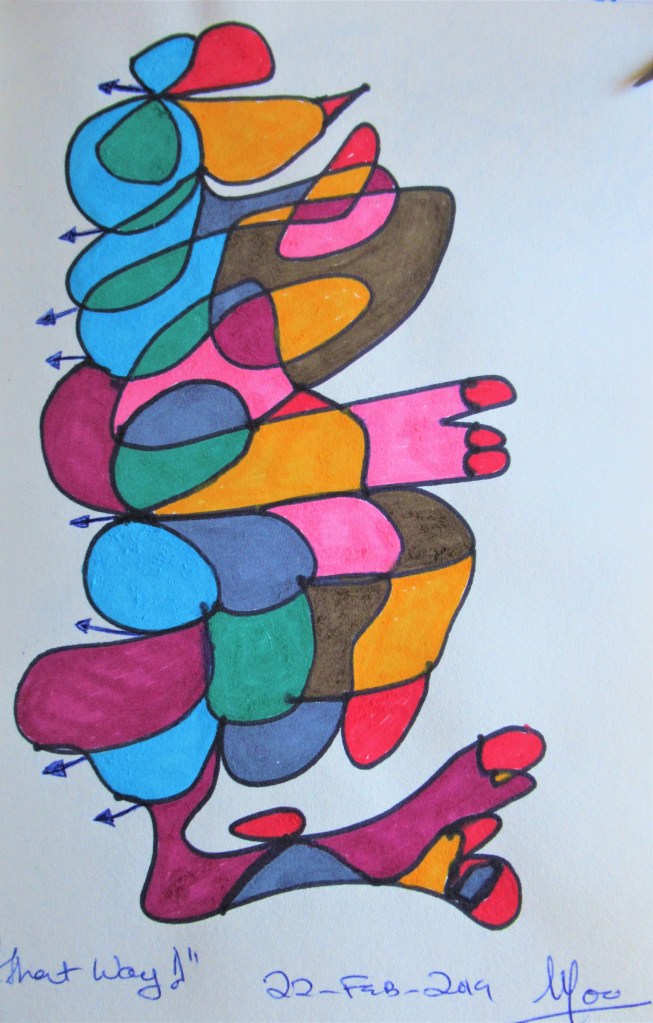
Creation: such a lovely word. Such joy generated as we create something new, be it something verbal, visual, or tactile. For me, it is more a verbal world than a visual one. My forays into art are wonderful, enjoyable, but very personal and artistically limited, even though I love taking a line for a walk or allowing the marker to trace images on the page. Dreams and a dream world: we need them. Sometimes reality is too much for us and we have to shut out the noise of the world and, in Antonio Machado’s words, ‘saber estar solo entre la gente‘ / know how to walk alone among the crowd. The loneliness of the long-distance runner. The isolation of the loving heart trapped within its cage of flesh and bone. The solitude of the spring nest on the pillars at Long’s Creek, overlooking the head pond at Mactaquac, as it waits for its restless occupants to return from their long journey back to the north from the south and start the rebuilding process, each twig, each straw, a minor miracle. And then the hatching and the fledglings and the return flight south that gifts the empty nest such loneliness as it waits for the cycle to begin again once more.

IMG_0824 (2)

Memory Loss

Time-Spirits

Memory Loss

A carton of eggs
abandoned in the supermarket.
Her cousin’s face, her daughter’s name,
the parking spot where she left the car.

Forgotten phone numbers.
Birthdays of family members
never remembered.

“What day is it today,” she asks,
for the third or fourth time.

Her programs no longer work.
Many files now inaccessible,
are written in coded jabberwocky.
I show her photos but to her they are
blank spaces, gaps in her photo album.

“I recognize your face,” she says to me,
but I can’t remember your name.”

Comment: Towards the end of her life, my grand-mother started to lose her memory. I penned this poem a long time ago, then recovered it from my poetry discards. Some years ago, a virus entered my computer system and destroyed many of my files. I had backed them up, but I never really accessed them all when I bought this new computer. Now, in this time of much sitting and screen viewing, when friends no longer knock on the door to share a cup of coffee or tea, time weighs heavy, and I can look at those old files again. This also what I have done with my chess, breaking out the first travelling chess set I bought back when I was nine or ten years old, and re-playing favorite games with its red and white pieces in their cardboard box. I haven’t played serious chess since I came to Canada and, as a result, I have forgotten the openings, mislaid the combative combinations of the middle game, and can now plot only the simplest of endings. This too, in its own way, is a sort of memory loss. Yet as I replay the Fischer-Spassky series of 1972, so much comes flooding back. Memory loss: some things do return, but as I age, I wonder if that other memory loss, the more fatal one, will one day grip me, as it gripped my grand-mother, and leave me damaged and un-repairable. I wake up some mornings, confused from sleep, and wonder whether this is what awaits us all.

Scorched Earth

IMG_1783 (2)

Scorched Earth

A scorch mark
still scars this woodland
where deer grazed
until spring grass
fed the flames
sown by an unknown hand.

RCMP
cars blocked
the lower road,
uniformed officers
directed us to detour
up and away.

Below us we could see
smoke, no flames,
two firetrucks.
The acridity of ash,
breeze-borne,
filtered through the car
making us cough.

No more will the deer
roam this particular place
until wounds are healed
and all trace of the fire,
like them, has fled.

Comment: Driving to the head pond at Mactaquac, a week or so ago, we met an RCMP roadblock and were diverted by the officers. We ascended Mactaquac heights, and came down the other side, rejoining the lower road which was blocked by another set of RCMP cars. It was the week after the shootings in Nova Scotia. All we could think of was the respect we have for the RCMP. The knowledge that, if someone drove a police cruiser, stolen or faked, and wore an RCMP uniform, stolen, faked, or genuine, and flagged us down, well, we would have had no doubts and we would have obeyed that person implicitly. This was apparently what happened in Nova Scotia when the gunman, dressed like an RCMP Officer, flagged some of his victims down, then shot them as they sat in their cars. I guess the wounds of forest and deer will heal more quickly than those of the victims’ families. Pax amorque / peace and love. 

Rain


Fundy 2004 003

Rain

rain
song-birds
trilling liquid notes
spring songs
flooding gardens

oh!
competitions
ritualistic rivalries
staking out territories
winter stalwarts
versus
nouveaux venus
with their summer wealth
of well-fed health

everyone competing
for their garden niche
males en garde
guarding each square inch
their earthly paradise
carved in my yard

Comment: They lit up the Mountain Ash as if it were a Christmas Tree, American Goldfinches, twenty-four of them. The rain ran down the window panes and all the photos blurred and distorted. One at each end of the garden, two robins sang. Two pair of Purple Finches, the bright male and the dowdy female, pecked beneath the feeder as the chickadees, siskens, and juncos flitted in and out. The red squirrel scattered the ones in the tree and the grey squirrel ran at and over the ones on the ground. Chaos. And the rain, rain, rain came down, down, until the garden was empty and birds and animals had taken shelter.


Biopsy

UNADJUSTEDNONRAW_thumb_2788

Biopsy

Driving home
from the hospital
after the biopsy,
thinking of the indignities
inflicted on my body,
cold, exploratory fingers,
the insertions,
the ardent desire
to say
“Enough,
no more!”

Oh God,
I am so cold.

Fierce winds
push me
along a snow-packed road.

I dream of sunshine
of summer flowers,

IMG_1005 (3)

of chipmunks and squirrels,
of bird seed scattered
so others may survive.

I dream of five deer
walking at midnight
through my garden.

IMG_1740 (2)

Magic,
their shadows
under moonlight
on the snow.

I skid into a snow bank
and my world shakes in shock.

A thirty-wheeler slithers by:
there are so many ways to die.

IMG_0266

Comment: Was it really only five years ago that I wrote those lines? I hadn’t even started this blog back then. So much melted snow, so much water under so many bridges. I look back at my journal and read that on April 1, 2020, in the USA, there were 3,800 dead from Covidis and 300,000 people affected. This morning, when I got up, those figures were higher, much higher: 63,019 dead and 1,070,032 affected. What a difference a month makes, let alone five years.

Affected, such a silly word when each individual person that these figures represent is, or was, a living, thinking, loving, human being, with an extended network of family and friends, each one of whom is in turn affected by the loss or sickness of a group member, be it a brother, a child, a sister, a mother, a father, a son, a daughter, or just a friend …  just a friend, another silly thing to say, as if just friends were not important, collateral damage, so to speak … and now, throughout our world, in macrocosm and in microcosm, we are, each one of us affected, in one way or another. Here in New Brunswick, Canada, we wash our hands, we wear masks, we stay home as much as possible, we maintain distancing when we go out on essential errands … I know it is different in other parts of Canada, and of the world, but we are all affected, and some so much more than others.

So, wherever you are, whoever you are, be strong, be brave, dance when and if you can, sing to yourself, sing for your family and friends, reach out to others, and above all take care of each other and survive. 

IMG_0171

My heart and these words go out to you: Byddwch lawen a chadwch eich ffyd a gwnewch y pethau bychain mewn bywyd / be joyful, keep your faith, and do the small things in life as Dewi Sant, St. David of Wales, a real person, is said to have said, almost 1500 years ago.

Heroes

IMG_1203 (2)

Heroes

In 1898, when Spain lost Cuba, they lost the last vestige of their world-wide Empire and were forced to turn back in on themselves. Miguel de Unamuno, along with other artists from the Generation of ’98, turned to the concept of intra-historiaHistoria / history means the great historical events, battles and conquests, kings and kingdoms (how male it all was!). Intra-historia / intra-history meant the every day lives that ordinary people led, lives that had remained basically unchanged for centuries, except when the men who made history rode through.
Do the small things in life: that’s all most of us can do and have done, throughout the centuries. And we are the true heroes, certainly of intra-history, you and I, and people like us, because we have worked all our lives at our daily tasks, we have brought up our children, we have made the small, micro-world which we inhabit into a better place. Intra-history is dedicated to the house-wives and the house-husbands, heroes all, who have done those small things in life, walked the dogs, fed the chickens, milked the cows, gone out to work, day after day, to put food on the table, delivered and brought up the children, looked after the sick, assisted the dying on their departure from this world, buried them, and given them peace. Heroes all, especially in these times of troubles, I salute you. 
Nurses, health care workers, pharmacists, ambulance drivers, supermarket workers who allow us to bring the food to the table, care-givers, cleaners, garbage men, street-workers, heroes all, I salute you. It is time the ‘little people’ reclaimed their world and took it back for the REAL people, the real heroes.
So, my heroes, be brave, battle on, and accept this floral tribute.
cropped-img_0172.jpg

Empty Nest

IMG_1258 (2)

Empty Nest

The wind at the window
scratches tiny notes.
I can no longer hear the tune
nor read the words.

Who walks beside me
as I pace my lonely path,
abandoned in this empty house.

My self-portrait
stares back at me:
a splintered selfie,
framed in a sliver
of silvery glass.

Above me,
a monkey moon,
that itinerant tinker,
walks a fractured way
over broken glass.

The knapsack on his back
is cobbled together
from cobwebs and clumsy
veils of drifting clouds.

Comment: Another Golden Oldie from that same throw-away manuscript that I discovered a couple of days ago. I wrote this one the year after my mother’s death. My father was in hospital and I had flown back to Wales to visit him. When I was not with him, I wandered alone in a large house, empty of people, but filled with memories. The whole experience was rather surreal, just like the imagery I conjured up to describe it. Early spring, but a cold one. After hospital visiting hours, I wandered an untidy house and an unkempt garden. My mother had departed. My father was on the way out. I was alone with a life-time of memories. “No hay pájaros en los nidos de antaño” wrote Cervantes in the Quixote. “There are no birds in last year’s nests.” With no brothers, no sisters, no close family, and no friends left in Wales, I found that out the hard way. Those days of wandering, ‘upstairs, downstairs, in my lady’s chamber,’ taught me that most difficult of lessons in the hardest of ways.

IMG_0456 (2)

Striations

IMG_0299

Striations

There are striations in my heart,
so deep,
a lizard could lie there,
unseen,
and wait for tomorrow’s sun.

Timeless:
this worm at the apple’s core
waiting for its world to end.

 Seculae seculorum:
the centuries rushing headlong.

Matins:
wide-eyed this owl
hooting in the face of day.

Somewhere,
I remember
a table spread for two.
Breakfast:
an open door,
a window that overlooks
a balcony and a garden.

“Where are you going, dear?”

  Something bright has fled the world.
The sun unfurls shadows.
The blood whirls stars around the body.

“It has gone,” she said.
“The magic.
I no longer tremble
at your touch.”

Comment: A real Golden Oldie. The lizard, it’s probably an iguana, came originally from Oaxaca, Mexico, and now sits over the door on the front porch. I had to bend his tail to get him into my carrying bag, poor thing. I found this poem in my poetry discards file, though what it was doing in there is a mystery to me. I think I discarded the longer manuscript in which it was included. Never mind, I have re-found, rediscovered it and it merits a place here, on my blog, along with the iguana. Byddwch lawen: rejoice and be glad.

With my angel

IMG_0258

… with my angel …

            … with my angel … face to face … the one I have carried within me since the day I was born … the black-one … winged like a crow … the one that hovers over me as I lie asleep … the one who wraps me in his feathered wings when I am alone and chilled by the world around me … the one who flaps with me on his back when I can walk no further … the one who creates the single set of footprints that plod their path through the badlands when I can walk no more …

img_0122

… ‘the truth’ my black angel says to me … I say ‘he’ but he is a powerful spirit, not sexed in anyway I know it … and yet I think of him as ‘he’ …awesome in the tiny reflection he sometimes allows me to glimpse of his power and glory … for, like Rilke, I could not bear meeting his whole angelic being face to face … as I cannot bear the sun, not by day, and not in eclipse … not even with smoked glass … when earthly values turn upside down and earth takes on a new reality … wild birds and bank swallows roosting at three in the afternoon … and that fierce heat draining from the summer sky … I remember it well … and the dog whimpering as a portion of the angel’s wing erased the sun until an umber midnight ruled … a simple phenomenon, the papers said … the moon coming between the earth and the sun …but magic … pure magic … to we who stood on the shore at Skinner’s Pond and sensed the majesty of the universe … more powerful than anything we could imagine … and the dog … taking no comfort from its human gods … whimpering at our feet …
… I saw a single feather floating down and knew my angel had placed himself between me and all that glory … to protect me … to save me from myself … and I saw that snowflake of an angel feather bleached from black to white by some small trick of the sunlight … and knowledge filled me … and for a moment I felt the glory … the magnificence … and there are no words for that slow filling up with want and desire as light filters from the sky and the body fills with darkness … and I was so afraid … afraid of myself … of where I had been … of where I was … of what I might return to … of my lost shadow … snipped from my heels …
… I don’t know how I heard my angel’s words … ‘the time of truth is upon you’ … ‘all you have ever been is behind you now’ … ‘naked you stand here on this shore … like the grains of sand on this beach … your days are numbered by the only one who counts’ … I heard the sound of roosting wings … but I heard and saw nothing more … I felt only midnight’s cold when the chill enters the body and the soul is sore afraid …
… ‘it is the law’ my angel said … I saw a second feather fall … ‘and the law says man must fail … his spirit must leave its mortal shell and fly back to the light’ … ‘blood will cease to flow … the heart will no longer beat … the spirit must accept and go’ … ‘do not assume… nobody knows what lies in wait’ … ‘blind acceptance … the only way … now …  in this twilight hour …  now when you are blind … only the blind shall receive the gift of sight’ … ‘all you have … your wife … your house … your car … your child … everything you think of as yours … I own … and on that day … I will claim it from you and take it for my own … now I can say no more’ …
… the sea-wind rose with a sigh and one by one night’s shadows fled … the moon’s brief circle sped from the sun … light returned, a drop at a time, sunshine flowing from a heavenly clepsydra filled with light …
… birds ceased to circle … a stray dog saw a sea-gull and chased it back to sea … and the sun … source of all goodness … was once again a golden coin floating in the sky …
… on my shoulder a feather perched … a whisper of warmth wrapped its protective cloak around my shoulders … for a moment, just a moment, I knew I was the apple of my angel’s eye … and I hoped and still hope that one day I might meet him again and understand …

Comment: An article on Marcus Aurelius in this morning’s paper made me think of this piece that I wrote, way back when, in the days when I was studying Francisco de Quevedo and the Neo-Stoic movement, courtesy of my good friend and colleague Henry Ettinghausen. “The day we were born we took our first steps on the road to death,” Quevedo wrote in one of his poems. With my angel is my own Neo-Neo-Stoic attempt to come face to face with that very personal reality, one which we all face, and to stare it down, eyeball to eyeball. Alas, in these troubled times, we must confront the knowledge that troubled times have been here before, that other generations have suffered them, and luckily, other generations have survived. We wouldn’t be here if they hadn’t. As another good friend, of mine Victor Hendricken, wrote on this blog just yesterday: “We continue to live on between inhale and exhale; we continue to live on between intake and exhaust, food and faeces. And in this time of self-isolation, we still abide by many of the same personal rules, including morning ablutions, setting and shutting off the alarm. Chin up, old boy. This too shall pass.” I found these words from Victor very comforting. With friendship, solid advice, and the ability to learn from those who have gone before us how to confront difficult times, this too shall pass.