Self-Isolation Day 18

IMG_1773 (2).JPG

Self-Isolation Day 18

So we are in the eighteenth day of our Self-Isolation. Yesterday I added a fifth book to my group around the table: The Art of the Middle Game by Paul Keres and Alexander Kotov, translated by Harry Golombek. I have had this book since 1964 when it was first published in Penguin Books. Once upon a time, I played serious chess, was president of a chess club, and read widely about the game. But I have not played any serious, face to face chess since I came to Canada and the last games I played were in 1994, when I visited the Dominican Republic, although I did pay a couple of games in Oaxaca on my first visits there.

I dipped in and out of this book yesterday, playing sample games here and there. It was a joy to rediscover the movement of the pieces and to see how great minds viewed the chess board. Sharpe’s Riflemen are wonderful to watch on YouTube, but they cannot rival the two sixteen piece armies that wage battle on the sixty-four squares of the chess-board!

The Art of the Middle Game uses descriptional notation. This means that when the King Pawn takes two steps forwards, it moves from King two to King four. In descriptional notation, this becomes P-K4. If it is the first move of the game, by white, then it becomes 1. P-K4. If the opposition follows suit, then his move is also transcribed as P-K4. This gives us 1. P-K4   P-K4. And this is where the confusion arises: each side has a K-4, and a Q-4 and every other square is doubled up as well in a mirror image of army facing army. After such a long time away from the game, I found my concentration wavering in places and thus I had pieces on the wrong squares and had to start all over again. Very frustrating.

When I played chess in Spain, also back in the sixties, I was faced with algebraic notation, long in use on the continent of Europe. The eight ranks are lettered a-h, from left to right, and the eight files are numbered 1-8 from bottom to top, with ‘white on the right’ i.e. h-1 always white. This means that each square has a single, plotted designation and it is much easier to follow the game as there is no mirror imaging. In this fashion, 1. P-K4 would become e2 – e4 followed by e7 – e5. None of this changes the nature of the game, but it does change the speed and ease with which it is transcribed and followed.

I remember buying my first pocket chess set, in Boots the Chemist (!) when I was 9 or 10 years old. It is an old cardboard set with red and white squares and pieces. I still have it and I am using it now. The scrawl that I call my handwriting is still unmistakable, after all these years. That same day I bought Harry Golombek’s The Game of Chess, and I taught myself how to play, based on that book. I remember looking at the descriptional notation and not understanding how the system worked, even after days of memorization. Then, one morning, as Dylan Thomas, another Swansea Boy once wrote, ‘light broke where no light shone’ and as all the squares fell miraculously into place, the system of descriptional notation suddenly made sense to me. “Threshold knowledge is a term in the study of higher education used to describe core concepts — or threshold concepts — which, once understood, transform perception of a given subject, phenomenon, or experience” (Wikipedia). The discovery of the key to descriptional notation was indeed a threshold experience, as was the transition to algebraic notation. What a wonderful world we live in.

CV-19 Week 3 Day 2

IMG_1053 (2)

CV-19 Week 3 Day 2
Reading in Multiples

Legend tells us that Francisco de Quevedo possessed a revolving book stand-cum-lectern. He placed this on his table at meal times and he would have four books open at the same time, moving rapidly in his reading from one to another. I have always liked this idea. As a result, I am now doing something similar.

I began by taking out Don Quixote, which I am once again reading in Spanish. The adventures of our Ingenious Gentleman are a delight and this time, the slowness of my 28th reading of the 1605 text allows me to taste every word, to roll the syllables round the tongue, and to savor every word. With CV-19 on the loose, there are no deadlines, no use by dates, and nothing to prevent me from delaying the full enjoyment of each word of the text. Equally important, there is no class preparation, no waiting audience, just me, an old man now, following the thoughts and adventures of an old man as written by an old man, Miguel de Cervantes, way back when.

I have the Collected Poems of Phillip Larkin on the table beside me. What a different world. What depth of insight and observation. What a bearing of witness to the follies and foibles of an England that I left behind so long ago, much of it vanished now, along with the old choir stalls and the hedgerows, the cuckoos and the skylarks. I read and re-read The Old Fools and realize just how close I am to that cliff edge, that precipice, that Alpine peak, beneath which I shelter and seek succour. Then I turn to This be the Verse and I start to laugh at this portrayal of middle-class parental pretensions. This is Larkin’s open wit, but his sly wit, like that of Cervantes, but more bitter, creeps up on you and catches you unawares, unless you know how and where to look for it.

At my left elbow, Juan Ramón Jiménez’s Platero y yo awaits my attention. No children’s book this, but a wonderfully poetic recounting of a poet’s observations of Moguer, a small seaside town in Andalusia. This too is a book to read slowly, to savour, to taste each word, each story. This too is prose poetry at its best. Cervantes wrote that ‘epic poetry can be written in prose’ / la épica también puede escribirse en prosa‘. JRJ might equally well have written that ‘poetry can also be written in prose’ … an edict that I have tried to follow in my own writing.

For my more serious reading, I am dipping into the late Roger Scruton’s A Short History of Modern Philosophy (from Descartes to Wittgenstein). This is heavier reading, in some senses, yet the parallels between Descartes philosophical observations and Cervantes’s literary ones are well worth considering, for Cervantes often offers the practical where Descartes puts forward the theoretical.

I will be adding more titles to my reading as I progress. Needless to say, I am also wandering through the labyrinth of my own earlier writings, and they are so much fun to revisit too. I will add more on this topic, as our enforced enclosure progresses.

Comment: These visitors came to my garden last summer. It is a delight to offer my photographs of them as a counter to CV-19 for these butterflies symbolize the brevity and the beauty of our lives. Butterflies on a rock: poetry and literature in Canada, and even more fragile in these times of utmost fragility. Keep well, keep safe, and keep in touch with your loved ones by telephone, Skype, Messenger, e-mail, and keep everything safe.

Le Pont Mirabeau

Le Pont Mirabeau

Beneath Mirabeau Bridge flows the Seine
and so does our love
must I be reminded yet again
that happiness always follows pain

Let night descend let the hours sound
the days go by … I’m still around

Hand in hand let us stay here face to face
while beneath the bridge of our arms
like flowing waves our gazes interlace

Let night descend let the hours sound
the days go by … I’m still around

Love flows away like waves that flow
love flows away
hope fills us with dismay
and life passes slow

Let night descend let the hours sound
the days go by … I’m still around

Days and weeks flow by bye bye
along with former loves
and past times that did fly fly fly
they will never come back again
Beneath Mirabeau Bridge flows the Seine

Let night descend let the hours sound
the days go by … I’m still around

Comment: I spent the school year in Paris in 1962-1963 and I have always wanted to translate Le Pont Mirabeau from French into English. Today, I found both the time and energy to do so. It’s not a great translation, but it is mine. It also contains new revisions from an earlier post but note that the links in the earlier post no longer function. Click on the link above to get the French original.

Intertextuality

Zeitgeist 1-10

Intertextuality

Intertextuality is the dialog that takes place between texts or as Merriam-Webster explains it: “the complex interrelationship between a text and other texts taken as a basic to the creation or interpretation of the text.”

Often we write from an intertextual perspective when we respond to other writers and their thoughts and imagery. This is why, in the creative process, reading can be as important as writing. Reading expands our vocabulary. It reinforces some of our own opinions and challenges others. Without reading, we are lonely rocks in sunless seas.

To be creative, we need to be aware of what others are writing and how they view the world we inhabit. When we read creatively we read with an eye to improving our creativity and our structures. We look for new ideas, new images, new words, new ways of expressing our thoughts.

Often we think we are being original when in fact we are re-processing, just as I am now, the ideas of other people. Given the nature of modern media, we are not always aware of all the multiple sources of our material: telephone, twitter, blogs, radio, television, newspapers (less and less), books, chapbooks, magazines, e-sources, lectures, chat groups, Facebook, and general conversations with other people who are also unaware of their sources. Thus ideas abound, float in the air, circulate and recirculate, submerge and resurface, shift their shapes and colors.

As writers we dip into that enormous moving mass of current and past culture and creativity and we choose our narrative lines, our characters, our structures, our images, our metaphors. As Jean-Baptiste Poquelin, better known as Molière, once wrote, “Mes idées? Je les prends où je les trouve.” My ideas? I take them from wherever I find them.

Imitation is the best form of flattery. Indeed it is. We cannot, however, borrow wholesale and just copy. Miguel de Cervantes borrowed the first five chapters of Don Quixote (the first sortie) from an earlier entremés entitled El Entremés de los romances. For a very long time, critics thought that Cervantes was the author of both pieces: they are very similar. However, even a quick analysis also shows that they are very different. The language of the entremés is much older while the conversion of theatre into narrative distinguishes them at a very basic level. Cervantes borrowed: but in borrowing, he adapted, he changed, he took the old form and converted it into something new and completely original. Nevertheless, we are still aware of the origins of the great novel that has many other borrowings woven into its fabric.

So, we indulge in intertextuality when we engage in a dialog with other texts and ‘borrow’ from other authors. To be original, we have to take that borrowing and turn it into something entirely different, something that becomes a part of ourselves and no longer exists as a part of that other text. Intertextuality is not copying. If we take a text in its entirety, if we ‘copy’, then we must acknowledge the source. However, when we indulge in a dialog with a text, when we transform a text, when we are ourselves transformed by a text, then that is a totally different situation. Think of the links between Akira Kurosawa’s 1954 film, The Seven Samurai, and its offspring, the 1960 western entitled The Magnificent Seven. They are very similar in so many ways … and yet they are so very different.

While intertextuality refers more to the larger elements of character and narrative structure, it also exists at the level of metaphor and image. Sometimes, without thinking, we use metaphors that we have heard before. Often we like the sound of a group of words, shuffle them around, and come up with a new meaning for them, a new metaphoric reality. This too is intertextuality.

At its best it is a very valuable addition to our creative tool kit.

While on the topic of creativity, let us spare a thought for our needs for creative time and space. We cannot create when we lack the blessings of time and space. Creativity is greatly hindered when we go hungry and need to complete back-breaking work just to sustain our lives and feed our families. Our relative wealth and leisure is a blessing: without them, we would be floundering in the pre-industrial world of subsistence farming, working at manual labor from dawn to dusk.

Let us spare a thought too for those oral societies that existed when people could not write. Or those early societies in which only the few, the happy few, were educated to the level at which they could actually read and write.

Intertextuality is a blessing, not a curse. Use it wisely, use it well.

Comment: I would like to thank Meg Sorick who suggested that I expand an earlier conversation that we had on the topic of Intertextuality.

Codification

IMG_0068 (2)

Codification

For me, it is vital to see how others read and interpret my work … what comes across, what doesn’t, how things are understood and read, sometimes in the same way, sometimes in different ways. It is always easy to pick out some favorite phrases. However, deciphering, interpreting, and then reacting to, a poem’s inner code, is a very different matter.

I love the cut and thrust of dialog … I was at our Tuesday night writing group meeting last night from 7-9:30 pm and we had a great time, back and forth across the table pecking, like wild birds perched on a literary feeder, at each others’ texts. My own texts are thickly layered and highly codified and I have become very interested in the theory of literary codification.

My own ideas are a development of those of Northrop Frye as he expressed them in The Great Code. When we lose our common code, to what extent do we need to explain a private one? This is of great import to Frye’s studies on William Blake, perhaps (in spite of his seeming simplicity in certain poems) one of the most difficult of English poets.

Perhaps the answer lies in Karl Jung’s theories on the racial subconscious: that we all share deep, (human) racial symbols that transcend words and often appear as symbols and images. If this is true, then we communicate, at a non-speech level, through metaphor and symbol, and that is more powerful and outreaching than linear language, however well and clearly codified it may be.

This emphasis on symbol, image, and metaphor leads us, of course, into surrealism, free writing, concrete poetry, sound poetry, and all those efforts to abandon the linear and reach into the subconscious roots of ‘that which binds us together as human beings’ … in my humanistic theories, to find the links that behind is more productive than the reinforce the fears and misbeliefs that separate. Alas, not everyone thinks that way in the literary world, and private codes can easily be used as wedges to force people apart.

We need codes, preferably codes that we can share. The question is, how explicit would we be, as writers, in explaining those codes? How closely should we imitate the writing codes of other people?

The eternal mystery of Aladdin’s Lamp: “New codes for old.” And don’t forget the magic words “Open Sesame.”

Ah, the joys of codification.

Commentary
This is a golden oldie, a repeat of an earlier post.  I am creating furiously at present and cannot always spend the time to create for the blog. Hence the repetitions and the golden oldies. Codification is something that has interested me for some time: the Biblical Code, The Western Tradition, Courtly Love, the Icy Fires of Petrarchism, Romanticism,  Impressionism, Expressionsim, Surrealism, Existentialism, Modernism, Post-Modernism … the -isms, once started, are apparently endless. All of these -isms spiral round the ideas of verbal codes. In codification, I would like to start a discussion on what these codes are, how they affect us, what do they mean, especially when they can be so totally personal. By all means, join the discussion: what do you mean by codes? How do you use them? How do you interpret the codes of other people? By all means post here, but better by far, rech out and discuss these things with your friends and your writing or art groups.

Revisions

img_0128

Revision
“We are not writers, we are re-writers.” I do not remember who said this, but it is extremely well said. We write, yes. But then we rewrite, sometimes obsessively, again and again. But how does that rewriting process take shape? Why do we rewrite? How do we rewrite? And what do we do when we re-write? These are all vital questions.

Mechanical revisions and rewrites
This, for me, is the search for typos, punctuation errors, mis-spellings, grammar corrections, that sort of thing. Yes, we can rely on a (reliable?) editor and a not so reliable spell-check, but the editor usually costs money. Or we can learn to do it ourselves, which is what I recommend very strongly.

Grammatical revisions and expression checks
These are usually a little more difficult to deal with. Do the verb tenses check out? Are subject and verb clearly delineated? Does the wording make sense, not just to us, but to the outside reader? A second pair of eyes is always useful at this point. Also, a sense of distance from the text is useful. Leave it a day (or two) and come back to it later when he creative rush has fled the system.

Structural revisions 1
Whenever we do a structural revision, it is essential to check that the revision ties in with the rest of the piece and that we maintain consistency throughout. A simple example: I decide, on page 77 of my novel, to change my main character’s name from Suzie to Winnie. Clearly, her name has to be consistent, both backwards (1-77) and forwards (77 onwards). While this is obvious, other changes, taste, color of hair, color of eyes, height, weight, tv program preference, may not be so easy to check and double-check. But it must be done.

Structural Revisions 2
This is where we must pay attention to the vision in the re-vision. We must ask the question, what does the poem / story / chapter / text want to say? What is it actually about? Often, in the flush of creation, we write words (actions, thoughts, emotions) on the page and they flow like water from a fountain. It’s a wonderful feeling. Later, during the re-vision process, we must ask ourselves, again, deep down, what do these words mean, what are they trying to say? This is actually a slightly different question from what am “I” trying to say?
The speaking / writing voice may want to say something, but the words (and characters and actions) themselves may want to say something else. Now we are faced with a dilemma: do we write what we want to say or do we follow the intricate word-path growing from what we have written? As a beginning writer, I did the former. As a more mature (and I hope, a slightly better writer) I now do the latter.
The result is often a piece that is radically different from it’s starting point. When you listen to what the story / poem / text / characters etc are telling you and when you follow words and characters, then structure changes, paragraphs switch places, thoughts move around, expressions change. We are no longer forcing words into our meanings, we let the meanings grow out of the words. This is particularly important in short story telling and the writing of poetry. It is vitally important to the novel where any inconsistency must have a relevance to the development of action, plot and character. It is also a totally different approach to the meaning of re-vision.

Summary
I realize many writers may have difficulty accepting these points. Those trained originally in the academic world, in particular, will respond negatively to the idea of the words ‘not being forced into the correct academic shape by the quasi-omnipotent academic mind’ aka Constable Thesis Editor. However, the more creative a writer is, the more that writer will respond to the creativity that lies within both the creator and the creation that has appeared on the page and, as writers, we must never lose sight of that creative act, for it is one of the most truly wonderful things that we can do.

Comment

This is a golden oldie. However, it is still worthy of being reconsidered. Why do we revise? How do we revise? I hope this article is of use to the many out there who are looking for help and encouragement.

Writers’ Block

IMG_0182

Writer’s Block
(For Kentucky Blue Angel)

This is a golden oldie that I am re-posting. Today, several people talked to me abut writers’ block. Here are my thoughts on the topic.

Every day, well, almost every day, I meet people who tell me that they cannot write anymore. They have abandoned their current project. They sit in their work space and stare at blank screens or empty walls. They have come face to face with the dreaded Writer’s Block.

While some consider Writer’s Block to be an actual illness, others flaunt it like a flag or a badge of honor:

“Don’t touch me — I’ve got Writer’s Block: I wouldn’t want you to catch it.”

“I’m having a bad week: I’ve got Writer’s Block.”

“Sorry, I can’t make the writer’s meeting, I’ve got Writer’s Block.”

According to Wikipedia, “Writer’s block is a condition, primarily associated with writing, in which an author loses the ability to produce new work or experiences a creative slowdown. The condition ranges in difficulty from coming up with original ideas to being unable to produce a work for years. Throughout history, writer’s block has been a documented problem.”

We have probably all experienced the sensation of being unable to write, unable to think, unable to continue. As an academic, I found that something similar happens frequently in examinations with young students whose minds suddenly go blank when faced by a white page and an awkward question. This form of Writer’s Block comes at the most unfortunate times. Students need to be switched on just when their minds switch off. And something similar happens to writers.

Examination Block can be overcome. In many cases careful preparation for an exam will reduce or eliminate examination block. These preparations may well include correct note-taking and relevant revision procedures. There should be no last minute all-night study the night before the exam and a good night’s sleep, proper food, and water are essentials. Appropriate physical exercises before the exam starts are also useful as these make the heart beat and the blood flow. All these things prepare both body and mind and free the student for that most important task: the struggle with the blank page and the awkward question.

Will a similar set of preparations work for those who suffer from Writer’s Block?

In order to answer this question, I would rather take a different approach. Instead of seeing Writer’s Block as a physical / mental presence that stops us writing, why not look at it as an absence that can be overcome? What can we call that absence? Personally, I look upon it as an absence of creativity. If the creativity isn’t there, then writing creatively won’t happen. So what do we do?

Let us define creativity. For me, creativity is the expression of the creative principle that dwells within all of us. It is there, within us. We may suppress it or we may let it be suppressed. We may ignore it or we may deny it: but it is still there. It is always there. Sometimes it is beaten out of us; or we think it is. But it is still there, beneath the surface, waiting to be called on. The Roman poets spoke of it as Deus est in nobis … the god that dwells within us.

Creativity, for me, is like a river that vanishes underground and then reappears: it will be back.

The most important thing in my opinion is what you do when you’re not writing, what you do when you’re faced with that wall of blackness, what you do when you stare at that blank screen and nothing makes your fingers dance on the key board.

Here’s what I do. I make up my mind not to force myself to be creative. Forget about writing. Do something else. Ignore all idea of Writer’s Block, or the End of the World, or the Imminent Disaster of not being able to write. It may take a mental effort, but forget about it.

Now do something else, something positive. Different people respond to different stimuli. Here’s what I do.

(1) I read books
I read other people in their creative moments. I love reading people who write in other languages that I speak and read, because my own mind tries to recreate their images, their stories. This re-creation is a form of creation in itself. New words, new ideas, new combinations, rise to the surface of the mind, like bubbles on a river.

(2) I color and draw
As any who have seen my drawings know, I cannot draw. However, I can take a line for a walk. And that’s what I do. Then I color the spaces I create. My friends thought I was wasting my time and I believed them until I read one of Matisse’s sayings: “My ambition: to liberate color, to make it serve both as form and content.” Voilà: I have my raison d’être. Nature abhors a vacuum. When you create a space, color and meaning rush in.

(3) I take photos
The capturing of a moment: a sunset, a new bird at the feeder, deer wandering through the garden, a black bear visiting, rain on a spider web, sunlight through a prism, a cat made out of cherry stones … the re-creation of the moment is the creation of the memory. More bubbles flow on the surface of the stream.

(4) I go for a walk, look at nature and the world around me, people too
It is incredibly important to do this. A visit to the local coffee shop, a walk around the super-market or corner store, a seat in the park on a sunny day … just be yourself, believe in your existence, watch things as they happen, relax, look and listen, empty yourself, let the world flow back in … look at the ducks on the lake or the goldfish in the tank … more bubbles on the water, more ideas floating down the stream …

(5) I listen to music
De gustibus non disputandum … we can’t argue about taste. Where music goes, each person must make their own choices. The music I like fills my mind, relaxes me, flows out when it ends, takes my mind for a walk and leaves … a vacuum … into which dreams and colors, words and ideas, build like clouds …

(6) I cook
Cooking has always relaxed me. Sometimes the repeating of an old recipe helps clear my mind. Sometimes I have a need to invent something new. Hands and mind occupied, the secret, sacred underground river of creativity flows on …

(7) I sew
Last summer, an unexpected event led me to join a quilting group … oh what fun … a man quilting among a dozen women … I learned so many things … so many different ways of looking at the world … so many concepts that I would never have dreamed of on my own … Sewing runs in the family: I still have my grandfather’s sewing kit … darning and sewing needles that served him for two years before the mast … that darned his socks as he survived in the trenches of the First World War … it bears his name and I use it with pride … and what memories arise in my mind as I choose the needle … his needle … the one that will lead me into the next adventure, be it quilt, button or patch …

(8) I keep a journal
… and come hell or high water, I write in it every day and have done so since 1985. That’s 31 years during which I have scarcely missed a day. The writing maybe banal, it may be nothing but a note on the weather or a comment on a sporting event … but it’s there … a vital challenge to the idea that Writer’s Block can take me over and stop me writing. This journal is 95% drivel … maybe more … but bobbing along the stream of words are ideas, verses, rhyme schemes, choruses, stories, flashes of inspiration, jokes, memories, magic moments, falling stars, … the secret is to catch these falling stars, to recognize these rough diamonds and to return to them and polish when the moment is ripe … and it will be, sooner or later … for bubbles are buoyant and will lift you to the stars.

(9) Free Writing and the Creation of Metaphors
I also use the journal for free writing and automatic writing. These techniques, drawn from the Surrealists, allow the mind to wander at random. While wandering, the mind creates an interior monologue or a stream of consciousness that in fact turns up a series of delightful metaphors that can be polished and re-used at will. When I use this style of writing, I am reminded of Dalí’s saying (again and as always, from memory): “I don’t know what it means, but I know it means something.” My own theory of metaphor is that the metaphor is defined by two (sometimes more) points and rather than settling on one or the other (as in a simile), the mind moves and flickers sub-consciously between the two extremes so that meaning is sensed, but rarely can be grasped or stated in definitive terms. Thus, the marvelous line from André Breton, quoted by Mr. Cake,  “The wolves are clothed in mirrors of snow” has, according to my theory of metaphor, four defining points, namely, wolves … clothed … mirrors … snow. All four of these defining points creates an image, a very personal image, in the reader’s mind. The mind moves quickly between each defining point and meaning is lost in the rapid shift from image to image. Quite simply, “the hand cannot grasp it, nor the mind exceed it.” This means we have to return, as readers, to the unconscious level where the metaphors were first created. Then: “when we no longer seek it, it is with us.” This same analytical exercise can be performed for each line of Breton’s poem. When we indulge in free writing, much of what we write can be abandoned. The secret is to recognize and rescue the little gems we so often find.

(10) I believe
Through all this runs a thread of belief … belief that the black cloud of despair will not win. The Writer’s Block will go. Creativity will never be not lost. It is there, beneath the surface, always ready to be contacted, waiting to rise and take you over again. And all too soon and quite unexpectedly, one form of creativity slips into another and the creative writing (it never really went away because of the journal) comes back.

Writer’s Block: it does exist. It’s how we deal with it that’s important. Creativity rules: forget Writer’s Block and let creativity and the multiple ways back to creativity grow and flow. Sooner or later the clouds will lift, the sun will return, the block will unblock and the words will flow again.

Remember the words on the Roman sundial: Horas non numero nisi serenas … I count only the happy hours. And remember: the clouds will lift, the sun will return.

Trust me.
And believe.

A Different Kind of Doorway

different kinf of doorway.png

A Different Kind of Doorway

When one door closes, another opens. And yes, they are so important, these doors, that open and close. One day everything is open to us; the next, the future seems closed. But another door opens and we walk right through.

Avila 2008 072 (2).jpg

Or maybe we don’t. So much depends. The brain drain, as they called it. The migration of students from Great (as she used to be) Britain to North America.  “Make sure,” they told us, “That you can see light at the end of the tunnel. If you can’t, don’t go.” I went to Canada for a year and stayed here for the rest of my life. I came to New Brunswick for a year and stayed here for the rest of my life.

Regrets? None. Dim o gwbl /  none at all, as we say in Welsh, the language of my maternal grandfather, from the land of my father(s), who never spoke a word of it. A language that I am just learning now with great pleasure, in the evening of my life. I am losing my French. I am losing my Spanish. I am learning Welsh.

So how do we open those doorways? Well, that depends on you, each one of you. Keep your eyes open. Study. Learn. Don’t waste your life. Recognize your talents. Don’t despair. Never give in. Nil carborundum illegitimi. No. Don’t allow yourself to be beaten down. Believe. Breathe deep and believe. And remember: there is always light at the end of the tunnel. Any tunnel. Don’t give up. Never give up. You just have to find that light. Seek: and you will find it.

Avila 2007a 105 (2).jpg

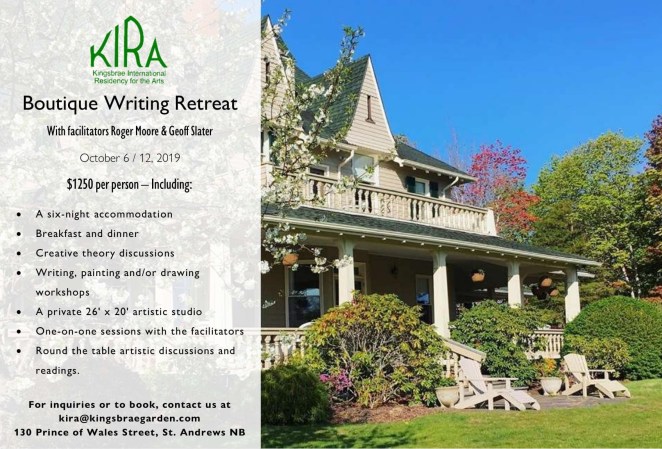
KIRA

KIRA Boutique Writing Retreat Advertisement.jpg

Commentary:

This is the new advertisement for the KIRA (Kingsbrae International Resdencies for Artists) Fall Session (October 6/12, 2019). Geoff Slater and I will be again facilitating a week of creative workshops, including drawing and painting (Geoff) and writing (Roger, both poetry and prose). These will take place in the KIRA Residence, just beside Kingsbrae Gardens. Residential enrollment is limited to five people. Just send us an e-mail if you are interested in attending this workshop. If you click on the KIRA link in the first line (above), be sure to watch the opening video. Pictures speak louder than words and the video will help you to understand what Creativity at KIRA is all about.


Growing Up

IMG_0817 (4).JPG

Growing Up
in Brynmill

They drag the kids kicking and squealing
from childhood’s universe into an older
world of smoking and drinking, forbidden
fruits stolen after Christmas dinner when
drowsy grown-ups’ eyes are turned away.

Why do bigger boys follow smaller ones,
buying their sisters’ kisses then thrusting
their fingers into little girls’ knickers, or
invading Woolworth’s and tucking stolen
goods in shirts with their buttons undone?

The games they play: offering a little girl
a cigarette  or a sweet while two boys
wait behind the garden gate with a sharp
knife to  press against the victim’s throat.