They asked him to speak at her funeral but he never knew who she really was. He only knew she loved the whisky bottle more than she loved life. “What can I say?” he asked. “Say that you loved her.” “I didn’t.” “Say how much she loved you.” “She didn’t. And she loved her bottle so much more.”
Should he say how he found her, soaked in urine, covered in vomit, naked on the kitchen floor? Should he describe the blend of alcohol and body scents, her personal perfume, flooding the bedroom? Should he repeat the four-letter words, and worse, she used when he tried to stop her drinking? Should he tell how she took her rings to town, pawned them, and left the slips on the table where he would find them? He paid her debts, collected her rings, returned them. Should he tell how she sold them again and again? How she would play hunt the thimble, round and round the house until she found where he had hidden them, then took them, and pawned them once more?
The chaplain shrugged. “Say what you want, whatever you wish, but you have to speak.” And speak he did, so choked up with emotion that he broke down and cried and never a word emerged from his mouth. An audience of chairs. The few friends who attended also broke down and hugged him, and said he had spoken volumes and they had understood every single word.
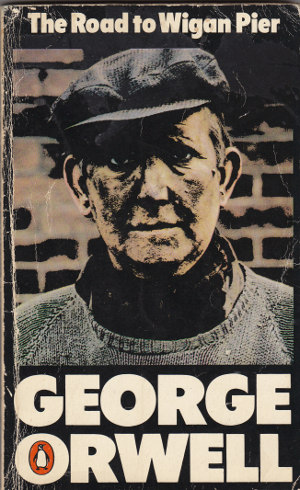
And every valley shall be filled with coal. And the miners will mine, growing old before their time, with pneumoconiosis a constant companion, and that dark spot on the grey slide of the sidewalk a mining souvenir coughed up from the depths of lungs that so seldom saw the sun and soaked themselves in the black dust that cluttered, clogged, bent and twisted those beautiful young bodies into ageing, pipe-cleaner shapes, yellowed and inked with nicotine and sorrows buried so deep, a thousand, two thousand feet deep down, and often so far out to sea that loved ones knew their loved ones would never see the white handkerchiefs waved, never in surrender but in a butterfly prayer, an offering, and a blessing that their men would survive the shift and come back to the surface and live again amidst family and friends and always the fear, the pinched -face, livid, living fear that such an ending might never be the one on offer, but rather the grimmer end of gas, or flame, or collapse, with the pit wheels stopped, and the sirens blaring, and the black crowds gathering, and no canaries, no miners, singing in their cages.
Six in the morning. The phone rings, shatters our dreams.
A skeletal voice at the other end announces the name of the deceased in ritual words, ending with my condolences.
Five in the morning here, nine in the morning over there. Death at a distance, three thousand miles and four hours between us, yet the phone call arrives on time, instantaneous.
Your father, your mother, her mother, gone, their absence heralded by the police, a lawyer, a doctor, a nurse practitioner, an anonymous nurse, someone you will never meet.
That call can come anytime. While you are out in the car, or in the garden, digging, or maybe shovelling the snow.
And maybe that’s how death will come, says Seamus Heaney, by telephone, an unexpected call from an unexpected caller.
The phone rings and your partner listens, then hands over the receiver: “It’s for you, my dear.”
Each of the select will be marked with a seal, ash on the on the chosen one’s forehead signifying all grief and guilt consumed, reduced to the ashes of this burnt-out sign.
Dust to dust and ashes to ashes, for of dust are we made, and though the embers may glow for a little while, that ash will soon grow cold. Words are quick forgotten yet memories linger.
They wander among celestial fields of glory where nimbuses of nebulae crab sideways to claw-crack veiled mysteries in an effort, often vain, to reveal them and lay them bare.
Bird song, far below, flickering fading, luminous confusion of son et lumière, infused with the ineffable joys of paradise and time eternal, successive yet simultaneous.
Birds in the branches of the Tree of Life gather its fruits with multitudinous song.
Forgotten offerings litter the hidden path, trodden by the few wise men who in the world did live. Gold, frankincense, and myrrh may not be accepted. The offerings are we ourselves, for a broken and a contrite heart will not be despised.
Blood and Whitewash A Thursday Thought 2-September-2021
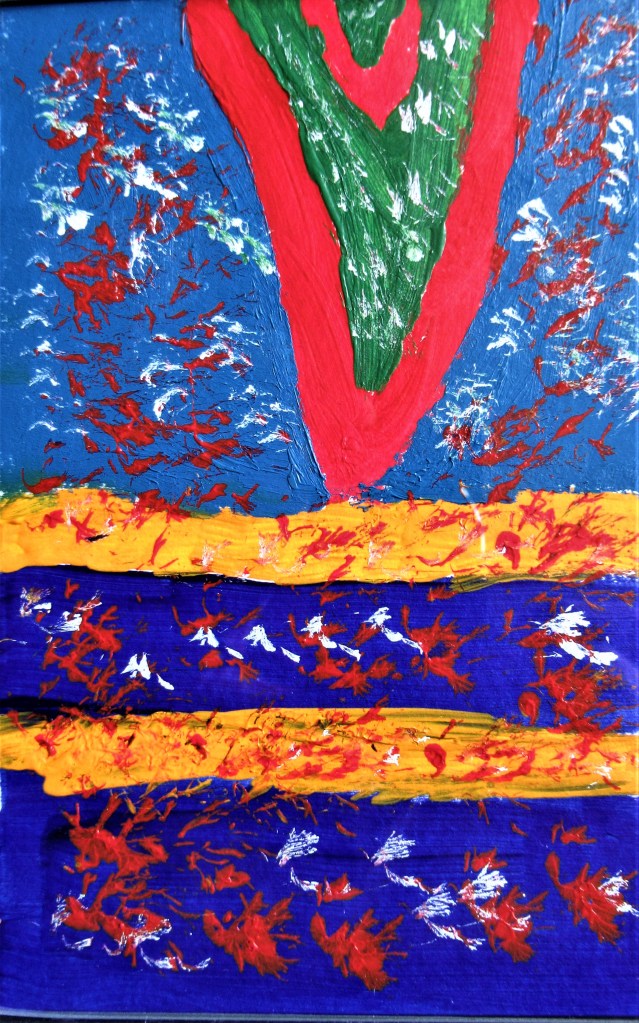
Blood and Whitewash is the title of this painting. It has a subtitle: My Plan of Attack.
The origins of the title, and hence of the painting, go back to the Goon Show, with Spike Milligan, Peter Sellers, and of course / wrth gwrs, Harry Secombe, the Swansea Comedian and Master Singer. Away in boarding school back in the late fifties, one of my greatest pleasures was listening to the Goon Show on one of the dormitory’s transistor radios. As a teenager, I found the jokes and the accents incredibly funny. Still do. That’s why I painted this painting. Alas, it is silent, and you cannot hear the accents.
The following snippet of dialog occurred on one such Goon Show, I cannot remember which.
“What are we going to do?” “Well, this is my plan of attack.” “That’s not a tack, it’s a nail.” “No it’s not. It’s a tack.”
So above you have my painting of My Plan of Attack, resurrected after all those years. I throw my mind back to the First World War.
The General: “He’s a cheerful Cove,” said Jimmy to Jack, as he walked to Arras with his pack on his back. But he did for them both, with his plan of attack.
And there in essence is the history of the painting. First, the plan of attack, then the failure and the blood-letting, and then the white-washing of the whole history, a white-washing that turns failure into success, defeat into victory, and loss into gain. But in WWI, it was the poor Tommies who bore the burden, and all the other front line troops who obeyed orders, went blindly over the top, and charged unbroken wire with fixed bayonets.
“If you want to find the sargent, I know where he is, I know where he is, If you want to find the sargent, I know where he is. He’s hanging on the old barbed wire.”
“If you want to find the chaplain, I know where he is, I know where he is, If you want to find the chaplain, I know where he is. He’s hanging on the old barbed wire.”
“If you want the whole battalion, I know where they are, I know where they are, If you want the whole battalion, I know where they are. They’re hanging on the old barbed wire.”
Singing as they marched to their deaths, obeying orders, like sheep, and nipped on by the eternal sheep dogs. Things were so bad at Verdun that instead of singing, the men marched, bleating, like sheep. “Sheep unto the slaughter.” There was so much ill-feeling and rebellion in the face of orders and certain slaughter, that French regiments were decimated, one man in ten shot for mutiny, as they marched bleating, instead of singing, to their deaths.
“Oh, we’ll hang out our washing on the Siegfried Line, have you any dirty washing, Mother dear?”
“Those who do not learn from history are condemned to repeat it.” So, tell me, “where have all the young men gone, gone to graveyards everyone, when will they ever learn, when will they ever learn?”
And that, dear friends, is my thought for today: The History of My Plan of Attack. When, indeed, will we ever learn?
Memory loss punched holes in your head and let in the dark, instead of the light. Constellations faded from your sight, erased by the arch-angel’s coal-dust wing.
“I’m shrinking,” you said, the last time I saw you, you, who had been taller, were now smaller than me.
Tonight, when the harvest moon shines bright and drowns the stars in its sea of light, I will sit by my window and watch for your soul as it rides its coal-fired rocket to eternity.
My eyes will be dry. I do not want pink runnels running down this coal-miner’s unwashed face. I’ll sing you a Welsh lullaby, to help you sleep.
“When the coal comes from the Rhondda down the Merthyr-Taff Vale line, when the coal comes from the Rhondda I’ll be there.”
With you, my friend, shoulder to shoulder. “With my golden pick and shovel, I’ll be there.” Farewell, my friend, safe journey, sleep deep, as deep as a Rhondda coal mine may you sleep.
Pictures and models. 1 Prostate: normal size and shape. 2 Prostate enlarged. 3 Prostate enormously enlarged. 4 Prostate lumpy, malformed, cancerous, and me prostrate.
Lumpy and treacherous: a gross shape growing its grossness within me. Gross, but mine and a vital part of my living body.
A mad world this, twisted time and fairground mirrors distorting everything, and me grossed out by the mechanical clockwork, tick-tock, snip-snap, removing samples for some lab to examine and test.
“Give them back!” I want to scream. I guess I’ll get them back on Judgement Day, when the body resurrects and I am whole again, warts, cancer, and all.
Meanwhile, the biopsy’s done. I get up from the bed and the nurse hands me a towel so I won’t drown my sorrows in my body blood, a crimson tide, ample, thick, flowing red.
Comment: After a couple of phone calls, some e-mails, and some messages on Facebook, I realize that some of my friends are actually following this blog and reading it. Thank you for the care and attention you have shown me by writing or calling to inquire about my health. All is well. I visited my urologist yesterday for a regular check-up and sat there a little longer than usual, waiting. Never one to waste time, I studied the things in the office and discovered a model prostate over which I could run my fingers (I didn’t!). It showed the four stages of prostate enlargement and cancer development as outlined above. I had no paper with me, so I jotted down four poems on the back of the paper bag in which I carried the injection I would later receive. This poem was one of them. The reference to Judgement Day and the recovery of body parts comes from one of Quevedo’s Suen~os, El suen~o del infierno, I believe. Anyway, my apologies, if I have worried you. I am fine, thank you. However, as Quevedo also wrote, “The day I was born I took my first step on the road to death”. Alas, I too am one of Dylan Thomas’s ‘poor creatures, born to die,’ as are we all. If not now, when? Not too soon, I hope. Blessings and thanks to all who read this. Take care and stay healthy.
It’s late in my life, with the big hand stuck on the nine, at a quarter to some thing, and the small hand twitching its red-tipped needle of blood. Yesterday, the breakdown van called for my body and towed me to the doctor’s. “Cough!” she said. “Say ninety-nine! Now cough again!” All the while, cold hands probed my unprotected body. Bottoms up? Thumbs down? It’s hard to see that the wine glass stands a quarter full when seventy five per cent of the wine has gone and the empty bottle lies drained on the operating table. I sit in front of the mirror and examine the palpitating heart they have torn from my chest. Flesh of my flesh, it beats in my hand like an executioner’s drum. I hear the tumbril drawing near. My colleagues sharpen their knitting needles. My lungs are twin balls of wool knotted tight in my chest.
Variants
Not one of us knows when the skeleton in the limelight will peel off her gloves, doff her hat, lay down her white cane and use us as fuels for a different kind of fire. Grief lurks in the bracelet’s silver snare of aging hair. We kick for a while and struggle at dawn’s bright edge, we creatures conditioned by time and its impossibilities. What possible redemptions unfurl their shadowy shapes at the water’s edge? A dream angel, this owl singing wide-eyed like a moribund swan bordering on that one great leap upwards, preparing to vanish into thin air. Some say a table awaits on an unseen shore; others that a rowing boat is tied to the river bank, ready for us to row ourselves across. Who knows? Yesterday’s horoscopes sprinkle butterflies of news as the snow wraps us all in the arcane blanket of each new beginning.
Comment: It’s been a strange week. In spite of all my resolutions, I missed my Wednesday Workshop and my Thursday Thoughts. Never mind: the latter weren’t very pleasant anyway. It has been pouring with rain again, and, as the WWI song says “Back to bread and water, as I have done before,” except in this case, it’s pills and needles, and I get the first shot on Tuesday. Nothing to worry about. I’ve been there before. It’s all preventative. But the body-clock is ticking away and I am getting no older and people around me are drifting slowly away. One of the players I used to coach at rugby, an excellent prop forward, went AWOL on Wednesday, MIA, and I read about his passing yesterday in the obituary column of the local newspaper. 18 years younger than me. He might be gone, but his memory lingers on, strongly for me. I have been thinking about him and his family and their tragic loss. My heart goes out to them and I offer my condolences, but what can one do, other than sympathize, celebrate a life well-led, and accept that all of us, poor creatures, are born to die. And if not now, when?
Timothy heard his older brothers moving from room to room, searching for him. He knew they would find him but for now he had found refuge beneath his grandfather’s double bed. It was dark under there in that sepulchral space. He had placed his grandfather’s enormous Royal Doulton chamber pot between himself and the door so that the dog would not pick up his scent, run to his hiding place, and lay the Judas lick upon his cheek.
His grandfather had forgotten to empty the chamber pot. Dark urine splashed on Timothy’s hands and sleeves as he squeezed behind the giant china pot that overwhelmed his nose fills with his grandfather’s nocturnal vapors.
The voices got louder as his brothers climbed the stairs and approached the bedrooms on the upper floor.
“Where is he now, drat him?”
“Don’t worry, we’ll find him.”
“And then he’ll be for it.”
“I’ll beat him with the little red brush they use for cleaning the fireplace.”
“That will teach him.”
Timothy was familiar with those threats, especially the little red brush.
He remembered the fox the hounds killed at his feet, one sunny morning a year before. He cycled down the lane outside his family’s summer cottage. The fox limped along the side of the lane, saw the boy on his bike, but too tired to run from him, continued limping in the roadway. Timothy got off his bike, leaned it against the rough stone country wall, and watched the fox. Its tail, speckled with mud, dragged behind its low-slung body, sweeping the ground. Timothy observed the twigs and thorns protruding from its black-tipped orange redness.
Timothy walked towards the fox. It tried to move away from the boy but collapsed and lay at the edge of the lane, flanks heaving, tongue lolling out through the white strings of thick foam that choked the muzzle and streaked saliva on the forequarters.
The hounds came from nowhere, an incoming, barking tide that rounded the corner and rushed towards Timothy who froze with a fright that pressed him against the wall. Sun-warmed stone jutted sharp edges into his back. As he stood there, unable to move, a rough hand came over the wall and grabbed him by the shoulder. He felt himself hauled upwards. The flint points dug into his back and he yelped as the firm hand drew him over the top of the wall to safety.
“Get out of there, you stupid boy, or the hounds will have you.”
Timothy hid his face in the farmer’s rough homespun shirt. He shuddered as the dogs bayed and growled and scrapped and scratched. Then the fox, it must have been the fox, let out a high-pitched yap and whine and the pack gargled itself into a drooling, slobbering sort of silence. The farmer pushed Timothy’s face away from his shoulder and forced his head towards the spot where the hounds, on the other side of the protective barrier, rubbed their ears into the dead fox’s torn and bloodied body.
“That’s what they’d have done to you, my boy. Never come between a pack and its kill.”
Timothy watched a member of the hunt staff pull a knife from his jacket. The foxhunters broke into cheers and howls of pleasure when the man severed the fox’s brush and held it on high. The farmer thrust Timothy towards the Master of Hounds.
“Here, blood him, Master, he was in at the kill.”
The Master of Hounds opened his mouth to flash a smile filled with pointed, foxhound teeth. He stooped, dipped his fingers in the still warm fox blood, and streaked a smear across the boy’s face.
“There,” he said,” you’re blooded now. One of us, eh what?”
The mingled scents of fox and hound and blood and death and urine and feces made a heady mixture and Timothy started to hyperventilate. His breath came hard in his throat and, as he struggled to breathe, tears rolled down his cheeks.
Timothy feels safe in his secret hiding place beneath his grandfather’s bed. He can hear his brothers’ taunts and calls as they search for him, but they haven’t found him yet. Sticks and stones may break my bones, he whispers, but names will never hurt me. But names do hurt. Tiny Tim they call him and ask him where he hides his crutch. I don’t limp, Timothy once replied. When he said that, one of his brothers, Big Billy, kicked Timothy as hard as he could with the toe of his boot, just above the ankle. Timothy screamed with pain. You’ll limp now, said Big Billy, and his other brothers found the joke so funny that they all called kicked Tiny Tim at every opportunity. Limp, Timmy, limp, they chanted as they chased him round, limpTiny Tim, Tiny Timmy.
“He’s not up here,” one of his brothers called out.
“Must be out in the garden, the coward, we’ll have to hunt out there for him,” another replied.
“Can’t run, can’t hide,” said Big Billy. “Get the dog, we’ll track him down.”
The voices finally faded. Protected by the barrier of his grandfather’s cold but intimate body waste, Timothy curled up like a fox in his den and fell asleep. He dreamed of the proud brush of a tail flying in the wind, of a warm stone wall, drenched in sunlight, and of a farmer’s strong, all-protecting arm.
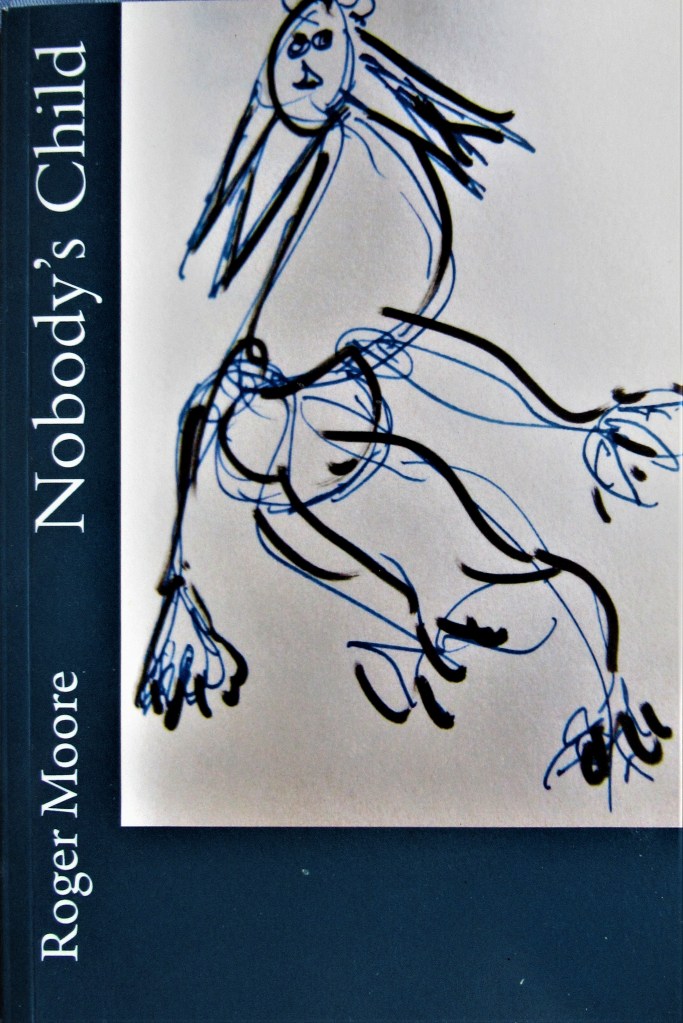
Comment: I have written several versions of this story, some longer, some much shorter, some in the first person singular, some in the second person. In all of them, the word-play on the little red brush (fox and fireplace) is paramount. This particular version occurs in my short story collection, Nobody’s Child available on line. Sometimes a story will not leave me alone. It wanders around, takes slightly different twists and turns, and new images and scenes emerge, as they do in this particular piece. Alas, I didn’t have a photo of a fox, so I used a photo of three plump pigeons hiding, you might even say ‘cowering away’, from a hungry hawk circling overhead while they hid in a crack in a wall in Avila, Spain. It always surprises me to know how many people (and animals) flee from what Robbie Burns called “man’s inhumanity to man”.






 rogermoorepoet