Stones

IMG_0619 (2).JPG

Stones
(3 May 1808 AD)

stones once thrown
can never be brought back
nor words once spoken
nor the bullet
once released
from musket or gun

here lies who knows who
face down in the dust
shirt soaked in blood
body pierced with lead

nor water time nor love
can ever flow back
beneath that bridge

some kneel some pray
some raise their eyes
to uncaring skies
every one of them dies
shooters
those waiting to be shot

even the soldiers
reloading their guns
never understand
how time’s tides run
ebb and then flow
until everyone goes

this you
lying face down
well know


Madness & Method

IMG_0622 (2).JPG

Madness & Method
(1729 & 1955-1962 AD)

his voice woke the wilderness
shook bread from heaven
he cast it on wild waters

scything and tithing
Frocester’s old barn
Gloucester a stomping ground
walking and biking
whenever he can

dry dusty parchments
old faded leaves
talking together
among the wheat sheaves
Hebrew Greek Latin
vernacular spaces
falling like rain
between words on a page

dearly beloved
moved into sundry places
a town mice stirred into open fields
harvesting blackberries and apples
gleaning like a country mouse
house tumbling wind-blown down

marooned now and listless
an old hermit crab
basking on a sun-dried beach
quilts and crisp  sheets
mermaid-hair pillowed
claws click and comb
fresh footprints laundered
warm summer sands

Carnival


IMG_0198

Carnival
(29 March 2019 AD
12 April 2019 AD
25 June 2019 AD)

house of cards
jacks and jokers
twos and threes
running wild
vacant faces
loaded wallets
crowded rooms

dry bones
wizened teeth
tongue-tied cheeks
feet shuffling

tiny corkscrew
worms gnawing
through what passes
as a brain

high-wire tumble
into this tumbril
wheel-of-fortune-barrow
plentiful cornucopia
copycat horn of luck

clock faces blank
no numbers no hands,
egg-white circles
stuttering uttering
cluttering
flustered minds
meaningless circus sounds

IMG_0618 (3).JPG

That Wall

IMG_0624 (2).JPG


That Wall
(1953 AD)

build that wall
top it with wet cement
place bottles in a row
sign it date it
carve the barrier in stone

when the cement sets
break those bottles
impenetrable barriers

walled now this garden
its interior holy of holies
a paradise for the chosen few
peace and roses only a dream
glimpsed from the outside

a climber climbs
rips flesh shreds clothes
mottles concrete with blood
wet washing hung in fleshy strips
a red flag now this Siegfried line
its shattered glass wire
its see-through brittle anger
excluding all intruders

walled this garden studio
this monument
built by my father
seeking to block who out
trying to lock who and what in

Swans


IMG_0627 (2)

Swans
(at the Vetch Field)

(circa 1950 AD)

White
their plumage
fierce eyes
folded angels’ wings
black-booted feet
paddling urgent
driving them on

skilled and silky
swift lunge
capable of breaking
leg or arm

all white ghosts
those swans
bodies and spirits
earthly dance done
long since gone
flown to the sky

anonymous
constellations spread
milky feathers
winged like swans

Comment:

The Vetch Field is where Swansea Town (now Swansea City) used to play their soccer. My father took me regularly to see the Swans play and, when young, I preferred the round ball game to the oval ball game. Swansea Town were always known as the Swans and the rugby team were always called the All Whites. No Ospreys and colored uniforms in those days and also no money in the rugby: everything was amateur. The inter-relationship of images in the poem above changes when the reader learns that the Vetch Field is also where the shroud-wrapped bodies of those prisoners who were hanged in nearby Swansea Jail were rumored to be buried. This may or may not be true, but be it myth or legend or plain falsehood, it gives added dimensions  to the imagery in this poem.

Courbet

Courbet
(1944 AD)

a deep moist cave
moss-grown cavernous
casting from night to day

synchronous memories
ascent descent blood scent
ejection rejection

tumbling down falling
insidious angel
no room at the inn
trapped no escape

Hieronymus Bosch
black-winged devils
cloud tormented
descending
anonymous red skies

factory and furnace
foundering foundries
mysterious birth myth
turned into lies

virgin berth
borne with tweezers
untouched the channel
from dark to light

Teddy Bear’s Nick Pit

IMG_0173.JPG


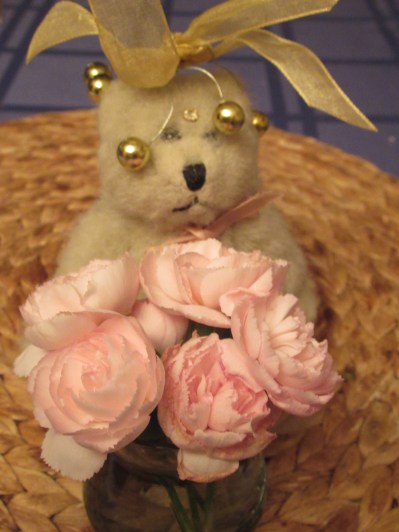
Today’s the day the teddy bears have their nit-pick: and what a nick pit it’s going to be. Who knows who’s starting what? Who knows where it will go? Who knows where it will end? More than anything else it reminds me of the monkeys in the monkey temple, sitting on their steps and pinnacles, in hierarchical orders, each searching the other monkey for nits and fleas and squeezing them between thumb-nail and middle finger nail, with a blood-red ‘click’ and a life-ending ‘clack’.

“Great fleas have lesser fleas upon their backs to bite them. And lesser fleas have smaller fleas, and so ad infinitum.” I remember this from my childhood, but, more important, the rhyme bite ’em / ad infinitum goes back much father than that, as you will see if you click on this Wikipedia article. Oh boy, Jonathan Swift, and you thought I was bad. I am Canadian Maple Syrup compared to his Irish Thistle Honey. And don’t talk to me about Swift’s views on famine, and how to avoid it.

Anyway, who knows what will happen. Apparently, my former family and clan, the Brits, do not know the old Spanish proverb: ‘Martes, ni te cases, ni te embarques‘ / Tuesday: don’t get married and don’t set out on a journey. Why ever not? Because Tuesdays were apparently the days when the Spanish Inquisition punished the adulterers, male and female, set them upon donkeys, naked from the waist up, and whipped them round the streets while the town criers sang out their crimes in time to the executioners who wielded the whips and painted their sins in red stripes upon their criminal flesh.

Tuesday, bruise day: it’s going to be fun (gallows’ humor). What will become of (once great) Great Britain? What will become of Europe? What will become of our cultural and philosophical world order? Climate change, cultural change, ideological change, political change, the wind of change …  I guess it’s blowing, but who knows in what directions it will blow us all? So easy to open Pandora’s Box: so difficult to pack everything back inside.

‘Martes, ni te cases, ni te embarques‘  …

By the bye:

I wrote this two or three days ago, before the test squad for the West Indies was selected. Today (Monday, Monday), Theresa a decided not to hold the vote tomorrow, Tuesday, Tuesday, which is now today. Does anyone really know what is happening? How United is the Untied Kingdom [sick]. I certainly don’t know. Meanwhile, the Teddy Bears are having a picnic, and they are all out there, in the woods, Sherwood Forest probably, watching out for the Sheriff of Nottingham, and nit-picking.


Name Game

IMG_0129.JPG

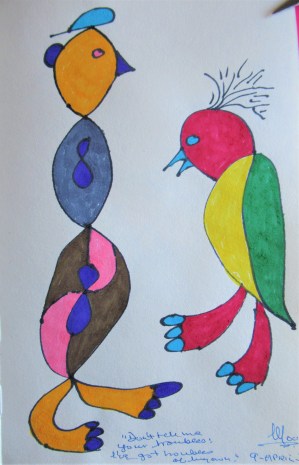
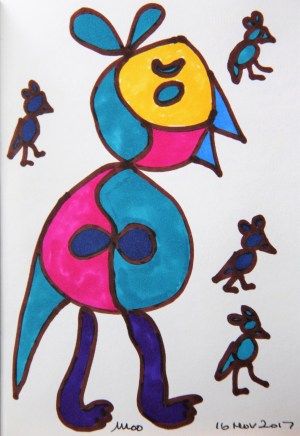
Quacker-quack-quack: I suppose there are better names for a sort of quacking duck cartoon. But then, what’s in a name? A rose by any other name would smell as sweet. But would it? What if we called it a dead rat or a mushroom riot fungal infection, would it then smell as sweet? Good question.

With names, we are looking for le mot juste, the single word or short phrase that sums up the moment and seizes it, framing it forever. As the Welshman once said, when Wales beat the South African Springboks rugby team: “Now I can die happy.” And that’s what he was called ever afterwards: Dai Appy. Then there’s Dai Arrears, who could never pay his bills on time, and Dai Lemmer, who never knew what to do, and Dai Alysis, who had a kidney problem, and Dai A’Beckett, who ate too much sugar and chocolate, and Dai Ear-Kneed, who always held his hand out for a little extra financial help, and Dai Lingual, who couldn’t speak any Welsh (you’ll have to think about that one), and Dai Ap Bolockal, who had a devilish sense of humor and always played practical jokes on his siblings, and Dai Urnal, who slept all night and only woke up in the day time, and Dai Heederal, who threw stones at sea-gulls, and Dai Nasty, who lived in a shoe with so many children that he didn’t know what to do, and Dai Rection, who always knew the way home no matter how much he had had to drink, and Dai Late, who never arrived early and thought he would live for ever, not to forget Dai Anthus, the florist, with a personality so split he was also known as Bill and Ben the Flower Pot Man,  and there’s Dai Yallog, who always mumbling to himself, born in the Mumbles, mind, and mumbled so much his wife called him Mono, and there’s Dai Verse, a rotten poet, couldn’t ever make his poems rhyme in either unofficial language, and Dai Vulge, the village gossip, who could never keep a secret, and … and … One day, I will write a book about all my Welsh friends called Dai, and indeed, there are a great many of them. What adventures they would have. Enough to turn Under Milkwood sour with jealousy, probably.

Meanwhile, back at the duck farm, Quacker-quack-quack is looking for a nice, friendly duck name. Please let me know if you have any suggestions. And stop throwing sand in the Winky Bird’s eye: he’s got enough problems as it is.


Show Don’t Tell

IMG_0141.JPG


A barber shop quartet, four of them, singing in unison, spring birds at a feeder, early morning sparrows at a jug of milk, abandoned by the milkman on the doorstep.

Except they were none of that. How could they be? They were four brothers, torn apart at birth. They never knew each other, never sang together, never embraced each other, never held each other in their arms. How could they have done so? The first one was stillborn. The second one survived for a while, but struggled to live, succumbed, and drifted away. The third one lived, marked for life by the scars on his forehead where they dragged him from the womb. The fourth one stopped struggling in the seventh month, but the mother carried him to term, even though she knew he was dead.

She carried them, blessed them, gave them all names, and buried three of them. They were her babies and she never got over their loss. Oh, she survived physically, but mentally she was destroyed.

The priests wanted to know what sins she had committed for God to be so angry with her that He destroyed the fruit of her womb. She had no answer. Some refused to bless her. Others ignored her completely. A few used her sorrows to drag the survivor into the tangled web of the church. “He has been spared. He will be one of us,” they said, and rejoiced at the potential strengthening of their celibate ranks.

Three of her children were ever before her. But the fourth lodged like an albatross on her shoulders and hung like a crucifix round her neck. She could never see him clearly. How could she? He was rarely before her eyes, never in the range of her sight. She tried to mold him like putty, but like water or sand, he slipped through her fingers.

Her husband hated him. Was he the father? It’s a wise man knows his father, or his son. Yet they looked alike. But no, they never thought alike, or walked alike. Nor moved in the same circles.

The father, a gambler, had borrowed a large sum of money and placed it with a bookie, betting that this third son would never live and that his death would make his father’s fortune, if the child was indeed a product of the seed his father deposited in his wife’s child bank.

The father lost his bet. The son lived. The father hated him every day of his life.  A rich man he would have been, if … if only … and the scars of that lost bet raged ragged on his face as the father cursed the doctor who had pulled his  son, if he was his son, alive and struggling from the womb.

If he was his son … a strong man, magnificently muscled , it was not his fault, never his fault, it was the fault of that worthless woman, the woman who had carried his seed, if it was his seed, the woman who carried his other three sons, and never brought them alive into this world …

The ostrich sees danger, and buries his head in the sand. The son sees danger and learns to run. The wife sees danger and  learns to suffer, to be beaten, to be abused, to be the victim because yes, she is filled with guilt, and how could it be otherwise, when the spirit is willing and the flesh is weak, so weak that it cannot give birth and eventually takes to the black holes of victimization, of alcoholism, and eventually of oblivion.

And the son learned to hide, to make himself invisible, never to be there, never to accept responsibility, never to sit at the desk when the buck was about to stop anywhere nearby, never to be blamed … never to turn down the solace to be found in the darkest depths of those same bottles that finally destroyed the woman he loved, who was also his mother.

Instructor’s Comments:

Rewrite.
Next time, show don’t tell.
Minimally acceptable.

D