Wet Welsh Rain

IMG_0730 (2)

Wet Welsh Rain

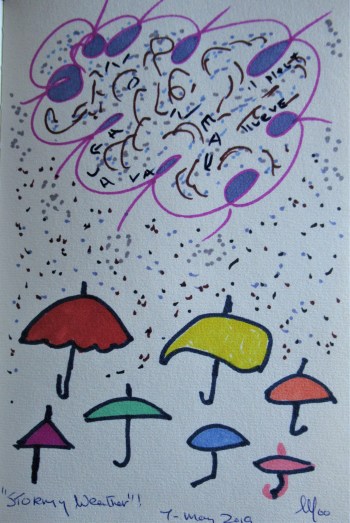
              Day after day, rain, drives in over Singleton Park and Swansea Bay. It claws its clouded way, shroud clad in grey cloud, up Rhyddings Park Road, through Brynmill, and up to the Uplands and Sketty, as it was then, now Sgetti. In those days, the rain got everywhere. It swirled around ankles and knees wetting everything below the hem of the raincoat. Umbrellas kept the shoulders dry. But when the wind blew, and gamp and brolly turned inside out, and people looked as though they were duelling with the wind, and threatening to poke each other’s eyes out, then a good soaking was sometimes better and safer and, in the worst of the rain and the wind, the gamps and brollies came down.  As for the puddles: they were everywhere. You walked in them, whether you wanted to or not, and your leather shoes turned into a pulp that let in water. Socks slopped around your feet, wetter than soggy blotting paper aka blotch [hands up if you remember blotch!]. Heads down, we faced the wind, draped around bus stops, waiting for buses that never came singly, but only in threes after much long suffering. Wind like a whiplash drove the rain before it and everywhere, woolen scarves turned into wet wash cloths and woolen gloves became underwater rain-sodden mittens.

Comment: As Tropical Storm Arthur gathers in the North Atlantic, we would do well to remember the good old days of summer holidays in Wales when it rained every day, bob dydd, during the whole two-week vacation. But did it really rain back then? Who remembers now? I seem to remember it was sunny every day, especially when the cricket was suspended with the words Rain Stopped Play displayed across the television screen. Ant the lunch time cricket scores: what joy to listen to them and to discover one day, as I listened on my illicit radio hidden in my school dormitory,  that play had been stopped because of “piddles on the putch, sorry, I mean puddles on the pitch” [hands up if you remember that announcement!]. I am sorry to say that particular radio announcer did not stay in his job for long. A great pity: I found him rather amusing.

We would do well, too, to recall the twelve days without electric power that followed Hurricane Arthur, back in 2014 [hands up if you remember Hurricane Arthur!]. Alas and alack: how accurate are our memories? And did all of those things really happen? As the street vendors and newspaper vendors [hands up if you remember paper boys!] used to cry out on street corners “Echo, Echo, South Wales Echo: Read all about it” or “Post, Evening Post, South Wales Evening Post, read all about it!” The South Wales Echo and the South Wales Evening Post hands up if you remember them … Oh those were the days … or were they? … click here and read all about it!


Limbo Dancing

IMG_0724 (2)

Limbo Dancing

Yesterday I went limbo dancing
in the bedroom mirror.
Lower and lower I danced
until I fell into the mirror
and became my reflection.

Rough were the waters.
I know how to swim, but
I thought I would drown,
except the light was too shallow
and my feet touched bottom
when I let down my wheels.

I swam on and in
looking for a deserted island
on which to build
my idle, sandcastle dreams.

Two people said they saw
my reflection swimming,
a goldfish in a silver space.

They said I stared back at them
with circles of longing
ringing my eyes, but I laughed
when they said they had seen me,
for when I looked in the mirror
that reflected the mirror,
I saw myself limbo dancing,
stranded between
heaven and hell
in a dance hall called Virus
where I drank Corona.

Whose eyes watch me now
as my video goes viral
and I twist and I dance
in a fantasy land
filled with sweet nothings.

Don’t tell me

IMG_0624 (3)

Don’t tell me your troubles …

… words wrapping themselves around your neck, the tune a loose scarf, brilliant in the sunshine, and so warm, flapping as you walk the street … people see frayed ends … wave back at you … the sun picking out gold spots in your hair … all’s well with the world … a marching song … the world walks over the hills … and far away … you march to work or play … every day is a new day … blood stirring with this call to arms … to alarms … everything up for grabs … tunes in your head … words wrapped around you  … warming you …
… a sad song … rain drops falling … mist or mizzle … you walk through damp, low clouds … you are sad … but comforted … wrapped warm in a verbal comforter … the sun breaks through … throws its arms around you … hugs you …. until raindrops radiate … gathering on eye-lash … at leaf’s end … twinkling an abundance of radiant flowers …         … a Nor’easter … snow in the air … on the trees … on the ground … a steady accumulation … you know how it is, East Coast Canada … down by the Fundy …  a fire in the fireplace … warm heart … warm hearth … no travel today … books and computer beckon … a time to read … to write … to remember the old ways … the old days … those memories … a warm scarf wrapped around the neck … and the comforter … so comforting … so much to wrap around you … so much to wrap your head around …

Bird’s Nest

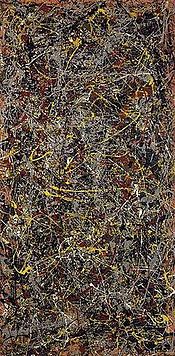
No.5 1948 Jackson Pollock.jpg

Bird’s Nest
Jackson Pollock No 5 (1948)

This bird’s nest starts with a startling tweet
that wins a trilled, thrilled response. A flutter
of heart-string wings, creator, viewer, join

with the creation. Thin threads of life mix
and match their tangled weave, existential
tapestry, fathered in a feathered nest.

World without end, this labyrinth without
an entry point, without a beginning,
with a spaghetti-thread middle that meets

not in a breath-catch of the mind, but in
a brush-flick of coloured rain, a cycle
recycled of circled paint, circular

in its circumnavigation, its square
eight by four-foot globe of a new world whirled
in stringy whorls, reinvented beauty

drawn haphazardly from the bicycle
tour de force of this artist’s inner mind.

Comment: In my latest poetry book entitled The Nature of Art and the Art of Nature, I explore the relationship between art and the natural world. I have always been fascinated by what we see, how we see it, and how it affects us. The tiny print above is scarcely representative of the eight by four-foot world that the artist creates, or re-creates. And what is modern art? Is it a re-creation of the world as we see and feel it or a representation of a new internal world glimpsed by the artist’s mind and hand-turned into a new reality, the work of art? I guess it depends on the artist, his or her way of life, the way they approach the macrocosm, and how they view the microcosm of their own inner lives.

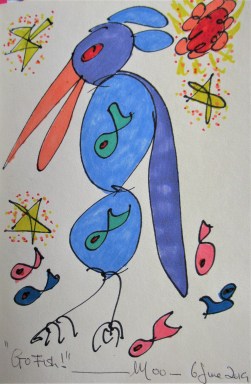
Creation: such a lovely word. Such joy generated as we create something new, be it something verbal, visual, or tactile. For me, it is more a verbal world than a visual one. My forays into art are wonderful, enjoyable, but very personal and artistically limited, even though I love taking a line for a walk or allowing the marker to trace images on the page. Dreams and a dream world: we need them. Sometimes reality is too much for us and we have to shut out the noise of the world and, in Antonio Machado’s words, ‘saber estar solo entre la gente‘ / know how to walk alone among the crowd. The loneliness of the long-distance runner. The isolation of the loving heart trapped within its cage of flesh and bone. The solitude of the spring nest on the pillars at Long’s Creek, overlooking the head pond at Mactaquac, as it waits for its restless occupants to return from their long journey back to the north from the south and start the rebuilding process, each twig, each straw, a minor miracle. And then the hatching and the fledglings and the return flight south that gifts the empty nest such loneliness as it waits for the cycle to begin again once more.

IMG_0824 (2)

Heroes

IMG_1203 (2)

Heroes

In 1898, when Spain lost Cuba, they lost the last vestige of their world-wide Empire and were forced to turn back in on themselves. Miguel de Unamuno, along with other artists from the Generation of ’98, turned to the concept of intra-historiaHistoria / history means the great historical events, battles and conquests, kings and kingdoms (how male it all was!). Intra-historia / intra-history meant the every day lives that ordinary people led, lives that had remained basically unchanged for centuries, except when the men who made history rode through.
Do the small things in life: that’s all most of us can do and have done, throughout the centuries. And we are the true heroes, certainly of intra-history, you and I, and people like us, because we have worked all our lives at our daily tasks, we have brought up our children, we have made the small, micro-world which we inhabit into a better place. Intra-history is dedicated to the house-wives and the house-husbands, heroes all, who have done those small things in life, walked the dogs, fed the chickens, milked the cows, gone out to work, day after day, to put food on the table, delivered and brought up the children, looked after the sick, assisted the dying on their departure from this world, buried them, and given them peace. Heroes all, especially in these times of troubles, I salute you. 
Nurses, health care workers, pharmacists, ambulance drivers, supermarket workers who allow us to bring the food to the table, care-givers, cleaners, garbage men, street-workers, heroes all, I salute you. It is time the ‘little people’ reclaimed their world and took it back for the REAL people, the real heroes.
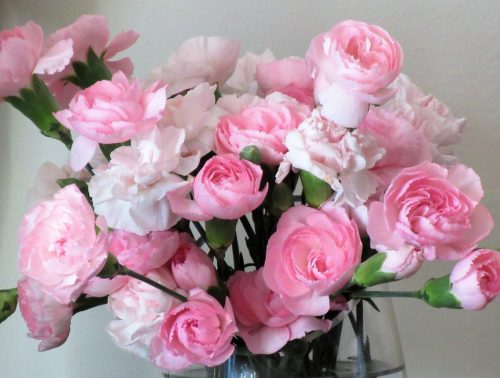
So, my heroes, be brave, battle on, and accept this floral tribute.
cropped-img_0172.jpg

Bleeding Heart

IMG_1338 (2)

Bleeding Heart

White moths
wing their snowstorm,
pale stars through the night.

A candle flickers in the darkness.
Hands reach out to grasp me.
A feathered shadow flies
frail fingers across my face.

Butterflies
stutter their eye-lash kisses
against closed cheeks.

Awake,
I lie anchored by what pale visions
fluttering on the horizon?

Eye of the peacock,
can you touch what I see
when my eyelids close?

Black rock of the midnight sun,
blocking this day’s dark cave,
when will I be released
from my daily bondage?

Last night, the planet
quivered beneath my body
as I felt each footfall of a transient god
who mapped in runes
the ruins of my bleeding heart.


IMG_0811 (2)

Comment: Another Golden Oldie, also dug out from the rejection / dejection of striations. I tinkered with it this morning. Funny what a shift in structure and a twitching of the metaphors will do. New lamps for old: indeed, and why not? We are not just writers, we are re-writers and some thoughts can be reworked to rise again in the shadows of the adopted children that are our poems. This bleeding heart plant vanished a couple of years ago. We dug up the flowerbed, inserted a rockery, and watched and waited. After two years, the bleeding heart plant resurrected itself from within the stones. Survival, renewal, faith, hope: key words nowadays. Who locked that plant down? Who let it rise up again? When we have gone, how will our gardens get on without us? Very well, in all probability, but they may be more of a tangled garden than a cultivated one. And what’s wrong with a tangled garden? Why, nothing at all, my friends, absolutely nothing at all.

image5

Sounds of Music

IMG_0147

Sounds of Music

Sounds of music everywhere, and in Cardiff now the black weir gurgles with laughter as you stride along. Gravel crunches in rhythm with your footsteps and the song birds invent new ways of singing their same old courting songs. Nesting birds pair up and sing about the joys of nesting. Beneath the trees, the Daffodils – Taffodils sway to the wood wind’s delicate fluting. A lace of golden lover’s hair, they curtain the sky above you as you climb the embankment, up and up, until the River Taff flows beneath you. Black and swift and deep and swollen with the last of the winter rains, the river surges along, its face freckled with sunshine.  The Taff, they say, cradles, as it murmurs its own sweet river song, the finest coal dust from the Rhondda Valleys and carries it out to be reborn in the sea. Here, in the river, fish and eels swim eyeless, so the fishermen say, as they gesticulate with brimming eyes and empty hands, weaving with hollow wind words mystical stories of the mythical salmon that were hooked, but lived to swim another day.

img_0146-3

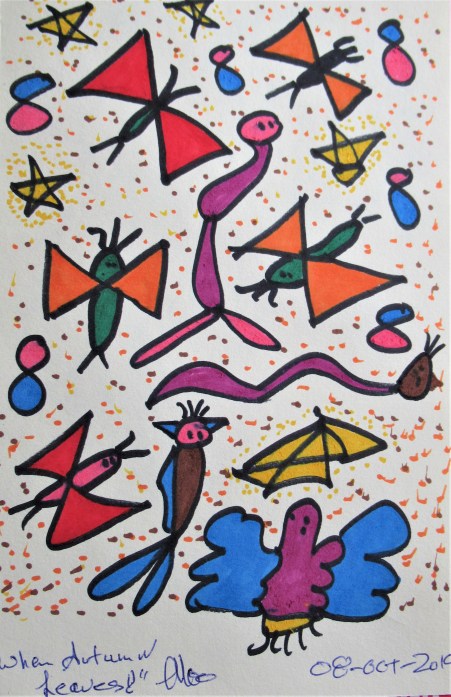
Comment: A crazy cartoon with a stick man dancing to music that occurs just off the screen at the side of the page. He dances unseen, unheard, as the deer dance at midnight, on their hind legs, reaching for bitter berries wintering on the mountain ash, as the sunlight dances when speckled trout rise to snap at flies, as my heart dances when my beloved walks into the room and lights my world with a smile. Spring in Wales: so far ahead of us as we languish here, on Canada’s East coast, hoping that last night’s minus temperatures will stagger to zero and then surge upwards into plus and double plus. Meanwhile, the grey squirrel chases away the red squirrel who frightened away the chipmunk, my beloved’s pet chipmunk for whom she put out the early morning seed to comfort him on this fresh frosty morning with its chill wind dancing between still-barren trees.

Scars

IMG_1095 (2)

Scars

It’s just a tiny splinter, lodged in my little finger. I take a needle from my sewing kit, put on my glasses, and break the skin around the small black spot in an effort to dig the splinter out.

Suddenly, the vision changes and I am back in my grandfather’s house. My father has bent me over his knee and is jabbing at the splinter in my thumb with a needle from my mother’s sewing kit.

“Hold still,” he pushes me down with the elbow of his left arm, then thrusts the needle again and again into the now bleeding spot on my thumb. “Hold still. Stop wriggling.”

“You’re hurting me.”

“Good.”

My mother comes into the room and inspects my thumb.

“Put your glasses on,” she tells my father. “At least you’ll be able to see what you’re doing.”

“Ow, ow!” I struggle with each piercing thrust of the needle but my father only holds me tighter.

Back in the present, I can hardly see this other splinter, let alone pull it out of my little pinky. I have broken the skin, so I place a band aid over the spot. Hopefully, the plaster will draw the splinter out, it usually does, quite painlessly. I put my sewing kit away and check my right thumb. My age-old splinter, still in there, winks its little black eye back at me from beneath the tear-filled eyelid of its tiny white scar.

We bear so many scars. Not all of them are visible.

Comment: So my granddaughter decided that she could polish up and improve my drawing notebook (top photo). And she did. Proof positive that a red pen in the hands of a young lady can work wonders. The thin red line of life, that link that joins us generation to generation, stretches back to times that only I can remember, stretches forward into times that I will never see. I wonder what my grandfather thought when he sat on his chair by the old Welsh fire and I climbed up, onto his knee. “Grandpa, tell me a story.” And he always did: “Once upon a time …  there was a thin red line …” And look, there’s my grandfather’s old chair down in my basement in Island View, New Brunswick, Canada. It’s a long way from my grandfather’s old home in Swansea. Just think, I used to climb up on the back of that chair, while he was sleeping, and blow on the bald spot on the back of his head … one long thin red line of inherited mischief …

18581930_1306791786107970_4016640231053970709_n-1

CV-19 Week 3 Day 3


IMG_1337 (2)

CV-19 Week 3 Day 3
A Change of Scene

Nothing serious happening with this change of scene, but this morning I put Phillip Larkin on one side and turned to a new book, Neil Sampson’s Apples on the Nashwaak (2019). This may be just the read you need in times like these. An excellent foreword locates the text of Neil’s narrative poem(s) in the long line of European narrative poetry. Neil’s introduction places his text in his own life on the land where he lives and wanders in Upper Durham, above the Nashwaak River. The text itself places us, as readers, in the long successions of repeated lives and deaths that mark the early settlements in New Brunswick, Canada. And yes, we have passed this way before, for better or for worse.

This is not a re-statement of ‘mal de todos, consuelo de tontos‘ / shared ill’s are a fool’s consolation. The colored apples on the stark tree that adorns the cover are a statement of hope, long term hope, even among the bleakness of difficulties, tragedies, and deaths. Like it or not, these things happen, and yes, there are survivors. Hopefully, there will always be survivors. And thus we must always live in hope. It is one of the threads that come through Neil’s poetry.

Only four trees are still alive.
The last of that first
generation
ponder existence and being
unable to walk
— no chance of pilgrimage —
have seeded their hope of redemption,
in Self.

Sounds like us, tucked away at home for three weeks and three days now ‘unable to walk’ outside and with no immediate ‘pilgrimage’ in sight or ‘hope of redemption’. Yet we sit here, un-suffering, following the news on television and radio, talking with friends on the telephone, reaching out to loved ones, near and far, on Skype, e-mailing and encouraging fellow un-sufferers, house bound, like us, ‘Children / hugging the chimney, // warm long after / the embers had died’.

Wait! In the orchard!
There’s One who’s come to call.
Those four pioneers
cankered with rot;
bark-skinned, limbs,
thin, draped in swags
of moss —

they know
who He is.

Enough for now, Neil. I shall read your book today and perhaps tomorrow, and then I will move on with head held high and hope in my heart. Thank you for your words. They are doubly meaningful at times like these reaching out to us with comfort, love, and understanding, and warming our hearts.


Creating vs Revising

IMG_1095 (2)

Creating vs Revising

The introductory picture (above) shows revisions made to my painting by my three year old grandchild!

1. As I read my early morning messages, I realize that there are two very different processes involved in creative writing: creation and revision.

In terms of creation, I follow Graham Green and Steven King: write 500 words a day, regularly, about two pages. Then, next day, re-read them and revise them. Then continue with the next two pages. This allows a steady accumulation that is usually somewhat under the writer’s control. It also allows the writer to go back and revise while creating: an important step for both King and Green.

In terms of revision, once the book or story or manuscript is complete, different processes emerge. One is to leave some time for the manuscript to settle: this also works chapter by chapter during the writing process. The other is to start again and apply the revision process as outlined in the First Five Pages.

Each one of us will be on a different stage of what is, I hope, an enjoyable creative experience. Part of the fun is also finding out what works for us; and by us, I mean each one of us. And yes, we all need those words of encouragement … so hang in there… have confidence … and be creative …

As for revision, I started by reading The First Five pages and found that this made the revision of my own manuscript much easier. The First 5 Pages deals with items one by one and in order of priority; it also allows you, as a writer / reader / adviser to have a clear idea of where you are going with the revisions, what you are doing, and why you are doing it. I also perused other online links and found them quite useful, especially those that referred to the revision process. I recommend searching for such links, in particular, the one that tells us never to give up.

Burroway for me is an adventure. I find that when I am reading the theory, I have a tendency to get confused and lost. In addition, I do not always agree with her analyses of the chosen snippets of text. I understand what she is saying, but I do not always agree with what she has said.

Selected stories themselves are something different. Reading them allows me to gain a perspective on what I am doing and how I am doing it. Thus I can say: I can do that; or I’ve done that; or I wouldn’t want to do that. The stories then come over as a reflecting mirror in which I can see aspects of my own writing, however beautified or distorted. The theory, on its own, leaves me cold and often confused. Other people’s creativity is inspiring.

The secret, in my opinion, is to relax, to be yourself, and to continue writing as you want to write while paying attention to the small details of which I am becoming more and more aware of every day. We are all creative — or we wouldn’t be here, reading this, doing this course. The secret is to develop and polish our own creativity. We must also learn to develop our own voices and to have confidence in those creative sparks that dwell within us.

2. Writing the introduction last is a standard procedure in academia. This is partly because it isn’t until the end of the research / study that the writer really understands the substance and the intent of what s/he has been studying. Also, it is only when the work is finalized that the appropriate conclusions can be drawn and the route that one has taken can be established.

As for the order in which revisions are made, there are many rules and circumstances can change. Even when there doesn’t appear to be a plot, as such, there is a chronology and chronology can be used as a substitute for plot. There is probably some form of evolution throughout the chronology, and that should be kept in mind, too. In addition, I would assume that as the learning process “bites” so we will be better able to make our own judgement calls. The art of good teaching is to eliminate the need for a teacher.

3. Changing the perspective: letters work: they can be found, sent, received, or discovered. The identity of the writer / receiver is also interesting.

In the 13th Story, the novel which I am currently reading, the principal narrator investigates / researches her subject in local libraries, the Who’s Who, a graveyard (reading the tombstones), and many different places. She also visits the local newspaper archives and interviews other characters in the novel, much as a newspaper reporter might.

Just read, think, learn, absorb, and, above all, remember to reject that which doesn’t suit you!