Heroes

IMG_1203 (2)

Heroes

In 1898, when Spain lost Cuba, they lost the last vestige of their world-wide Empire and were forced to turn back in on themselves. Miguel de Unamuno, along with other artists from the Generation of ’98, turned to the concept of intra-historiaHistoria / history means the great historical events, battles and conquests, kings and kingdoms (how male it all was!). Intra-historia / intra-history meant the every day lives that ordinary people led, lives that had remained basically unchanged for centuries, except when the men who made history rode through.
Do the small things in life: that’s all most of us can do and have done, throughout the centuries. And we are the true heroes, certainly of intra-history, you and I, and people like us, because we have worked all our lives at our daily tasks, we have brought up our children, we have made the small, micro-world which we inhabit into a better place. Intra-history is dedicated to the house-wives and the house-husbands, heroes all, who have done those small things in life, walked the dogs, fed the chickens, milked the cows, gone out to work, day after day, to put food on the table, delivered and brought up the children, looked after the sick, assisted the dying on their departure from this world, buried them, and given them peace. Heroes all, especially in these times of troubles, I salute you. 
Nurses, health care workers, pharmacists, ambulance drivers, supermarket workers who allow us to bring the food to the table, care-givers, cleaners, garbage men, street-workers, heroes all, I salute you. It is time the ‘little people’ reclaimed their world and took it back for the REAL people, the real heroes.
So, my heroes, be brave, battle on, and accept this floral tribute.
cropped-img_0172.jpg

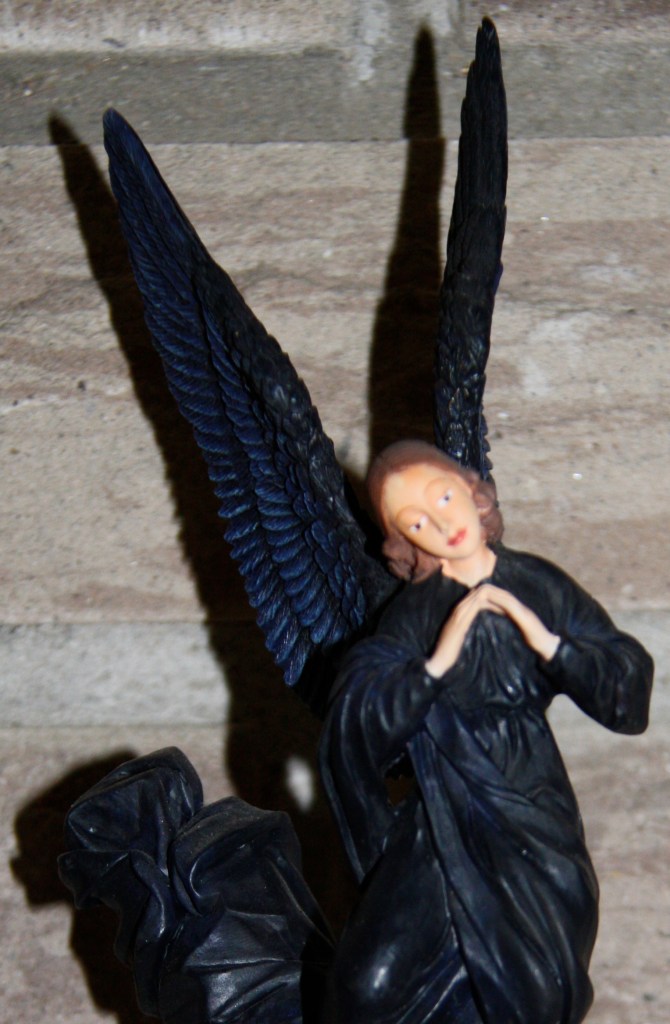
With my angel

IMG_0258

… with my angel …

            … with my angel … face to face … the one I have carried within me since the day I was born … the black-one … winged like a crow … the one that hovers over me as I lie asleep … the one who wraps me in his feathered wings when I am alone and chilled by the world around me … the one who flaps with me on his back when I can walk no further … the one who creates the single set of footprints that plod their path through the badlands when I can walk no more …

img_0122

… ‘the truth’ my black angel says to me … I say ‘he’ but he is a powerful spirit, not sexed in anyway I know it … and yet I think of him as ‘he’ …awesome in the tiny reflection he sometimes allows me to glimpse of his power and glory … for, like Rilke, I could not bear meeting his whole angelic being face to face … as I cannot bear the sun, not by day, and not in eclipse … not even with smoked glass … when earthly values turn upside down and earth takes on a new reality … wild birds and bank swallows roosting at three in the afternoon … and that fierce heat draining from the summer sky … I remember it well … and the dog whimpering as a portion of the angel’s wing erased the sun until an umber midnight ruled … a simple phenomenon, the papers said … the moon coming between the earth and the sun …but magic … pure magic … to we who stood on the shore at Skinner’s Pond and sensed the majesty of the universe … more powerful than anything we could imagine … and the dog … taking no comfort from its human gods … whimpering at our feet …
… I saw a single feather floating down and knew my angel had placed himself between me and all that glory … to protect me … to save me from myself … and I saw that snowflake of an angel feather bleached from black to white by some small trick of the sunlight … and knowledge filled me … and for a moment I felt the glory … the magnificence … and there are no words for that slow filling up with want and desire as light filters from the sky and the body fills with darkness … and I was so afraid … afraid of myself … of where I had been … of where I was … of what I might return to … of my lost shadow … snipped from my heels …
… I don’t know how I heard my angel’s words … ‘the time of truth is upon you’ … ‘all you have ever been is behind you now’ … ‘naked you stand here on this shore … like the grains of sand on this beach … your days are numbered by the only one who counts’ … I heard the sound of roosting wings … but I heard and saw nothing more … I felt only midnight’s cold when the chill enters the body and the soul is sore afraid …
… ‘it is the law’ my angel said … I saw a second feather fall … ‘and the law says man must fail … his spirit must leave its mortal shell and fly back to the light’ … ‘blood will cease to flow … the heart will no longer beat … the spirit must accept and go’ … ‘do not assume… nobody knows what lies in wait’ … ‘blind acceptance … the only way … now …  in this twilight hour …  now when you are blind … only the blind shall receive the gift of sight’ … ‘all you have … your wife … your house … your car … your child … everything you think of as yours … I own … and on that day … I will claim it from you and take it for my own … now I can say no more’ …
… the sea-wind rose with a sigh and one by one night’s shadows fled … the moon’s brief circle sped from the sun … light returned, a drop at a time, sunshine flowing from a heavenly clepsydra filled with light …
… birds ceased to circle … a stray dog saw a sea-gull and chased it back to sea … and the sun … source of all goodness … was once again a golden coin floating in the sky …
… on my shoulder a feather perched … a whisper of warmth wrapped its protective cloak around my shoulders … for a moment, just a moment, I knew I was the apple of my angel’s eye … and I hoped and still hope that one day I might meet him again and understand …

Comment: An article on Marcus Aurelius in this morning’s paper made me think of this piece that I wrote, way back when, in the days when I was studying Francisco de Quevedo and the Neo-Stoic movement, courtesy of my good friend and colleague Henry Ettinghausen. “The day we were born we took our first steps on the road to death,” Quevedo wrote in one of his poems. With my angel is my own Neo-Neo-Stoic attempt to come face to face with that very personal reality, one which we all face, and to stare it down, eyeball to eyeball. Alas, in these troubled times, we must confront the knowledge that troubled times have been here before, that other generations have suffered them, and luckily, other generations have survived. We wouldn’t be here if they hadn’t. As another good friend, of mine Victor Hendricken, wrote on this blog just yesterday: “We continue to live on between inhale and exhale; we continue to live on between intake and exhaust, food and faeces. And in this time of self-isolation, we still abide by many of the same personal rules, including morning ablutions, setting and shutting off the alarm. Chin up, old boy. This too shall pass.” I found these words from Victor very comforting. With friendship, solid advice, and the ability to learn from those who have gone before us how to confront difficult times, this too shall pass.

Doing Time

IMG_0687 (3)

Doing Time

Time bends like a boomerang,
flies away,
comes flying back to
the thrower’s hand.

Endless this shuffle.
Unmarked days
drop off the calendar.

Hands stop on the clock.
The pendulum
swings back and forth
but nothing else moves.

‘As idle as a painted ship
upon a painted ocean.’

Yet the seas seem to move,
the winds seem to blow,
the sails seem to swell,
while our garden
fills with birds
and squirrels,
light and dark.

Morning ablutions.
Each day is a twin
of the day before.
Like wise each week.

The TV screen fills up
its washbasin of tired
looking faces bore us
with their endless wisdom.

Time hands heavy:
an albatross around the neck,
or an emu, an ostrich,
a flightless dodo,
an overweight bumble bee,
too heavy to fly.

Comment: An interesting article that I read today suggests that the lock down is bending time out of shape and that we need to adapt our minds and our body clocks to a new temporal reality. Seconds hang heavy. Days present the same routine. The routine makes the divisions between each day seem irrelevant. This is what my Spanish friend and teacher, the poet José Hierro, meant when he wrote about his time in jail as a political prisoner after the Spanish Civil War: “El tiempo aquí no tiene sentido” / time in here has no meaning.

A similar effect is noticed by those of us who were imprisoned in boarding schools from an early age. The first day back, we draw a railway train at the beginning of a long track and we number each day from the beginning of term. Then we cross off the days, one by one. Often, before the first week is even over, we forget about counting the days: they are all the same, lookalikes with a rhythmic similarity that sends us to sleep as routine takes over and we sleepwalk through life.

How important is time? How important is it to distinguish Monday from Wednesday, Friday from Thursday, this Saturday from a week on Sunday? It becomes less and less important. The TV chatters on and on. The shows we follow illuminate our days. I turn on the radio at five on Friday for Cross Country Check Up, which airs on Sunday. I go without breakfast and don’t even notice that I haven’t eaten. I make a cup of coffee and it sits there on the table with the cup of tea that I forgot to drink this morning. Each time I take my tablets, I write that fact down so that later in the day, I can check that I have actually taken them. The notes mount up and the bottles of tablets run down. Each mandarin orange has a tiny key and I wind those oranges up so they will go tick-tock as I eat them. My Teddy Bear has an alarm clock between his legs and a flashlight in his ear so that I can tell the time on cloudy nights when I can no longer see the Platonic dance of the rotating stars.

Daffodils

IMG_0617

Daffodils

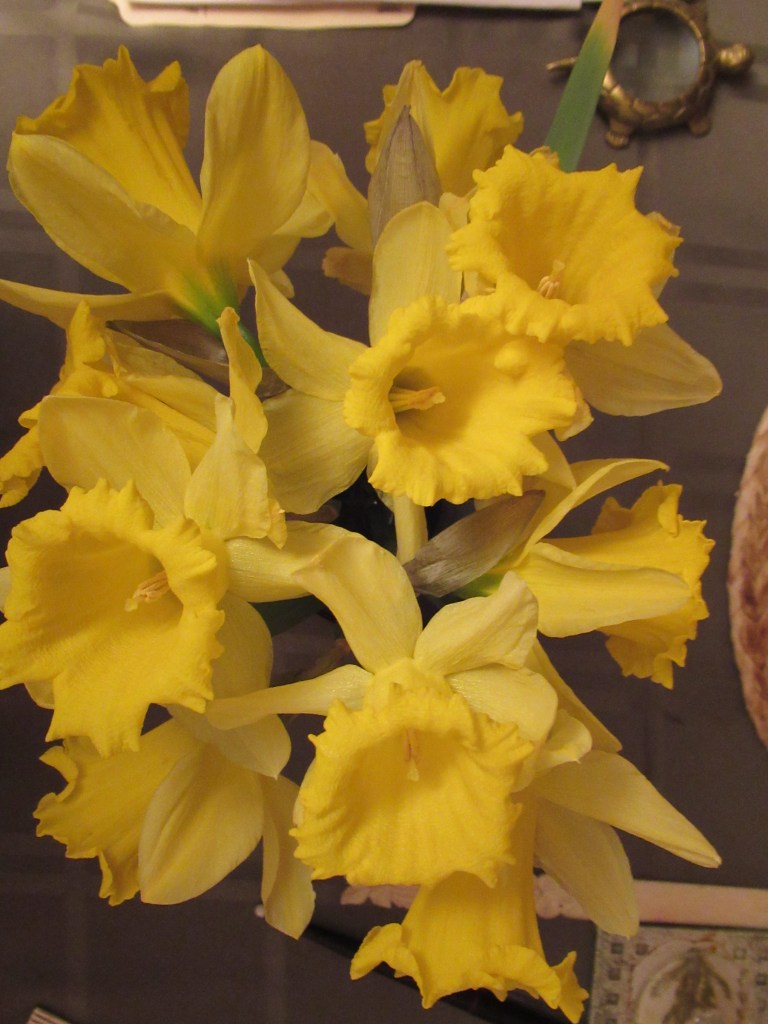
My daffodil day-dreams carry me back to Wales, that Land of Song where every valley conducts choirs of daffodils and their pale, brass voices are raised in an annual springtime hymn of hope. Beneath the trees, in Bishopston Valley, between Pyle Corner and Pwll Ddu, sheltered bluebells tinkle sweet tunes, lilies-of-the-valley bloom, and primroses raise their faces to the sky while hearkening to those springtime airs that sound where’er you walk. In Blackweir Gardens, the Feeder Brook flows into the castle moat and the castle’s central keep stands on the mound the Normans dug when they converted into a motte and bailey the old Roman camp that was built on an earthworks constructed by the Silures long before that countenance divine shone forth upon these clouded hills and long before the Roman came to Rye or out to Severn strode. Generation after generation, all those who witnessed the birth of these flowers and strove to be the first to hear the cuckoo’s call, come alive again in this floral tribute. Oh, Land of Song: the bluebells may have gone, the larks may sing no more, cuckoo and cowslip may have fled the valleys, but all is not lost, not while the daffodils still toss their heads in sprightly dance and spring breaks out its freckled sunshine.

Comment: Win some, lose some. Survival is all. At the same time as I mourn everything  that is lost, I also celebrate all that survive. The grosbeaks have left us, moving further north as the weather warms. They have left more room for cardinals and hummingbirds have moved in to replace them, as have turkey vultures. Turkey Vultures, Zopilote, The Trickster, in Oaxaca, the bird that flew high up into heaven, stole the fire of the gods, and brought it back on his wings, now flies over the St. John River Valley, having moved up here with the warmer air from the south.

“The olde order changeth lest one good custom should corrupt the world” … indeed it does. And we must mourn and celebrate the olde order while preparing for, and celebrating, the arrival of the new. For the world has changed and is changing as I sit here and type these words and it will have twitched and changed again by the time you read them. Who knows exactly what is coming? How do we prepare for the unknown? How do we open our arms and embrace an uncertain future? Good questions all. I cannot answer them for anyone but myself, but I must ask them. Many of them were discussed today by Suzanne Moore in an article entitled: The way we once lived is now redundant. We must reinvent ourselves. Read it and start thinking about how we can be strong, daring, caring, and best prepare ourselves, not for our own extinction, but for our own reinvention.


Scars

IMG_1095 (2)

Scars

It’s just a tiny splinter, lodged in my little finger. I take a needle from my sewing kit, put on my glasses, and break the skin around the small black spot in an effort to dig the splinter out.

Suddenly, the vision changes and I am back in my grandfather’s house. My father has bent me over his knee and is jabbing at the splinter in my thumb with a needle from my mother’s sewing kit.

“Hold still,” he pushes me down with the elbow of his left arm, then thrusts the needle again and again into the now bleeding spot on my thumb. “Hold still. Stop wriggling.”

“You’re hurting me.”

“Good.”

My mother comes into the room and inspects my thumb.

“Put your glasses on,” she tells my father. “At least you’ll be able to see what you’re doing.”

“Ow, ow!” I struggle with each piercing thrust of the needle but my father only holds me tighter.

Back in the present, I can hardly see this other splinter, let alone pull it out of my little pinky. I have broken the skin, so I place a band aid over the spot. Hopefully, the plaster will draw the splinter out, it usually does, quite painlessly. I put my sewing kit away and check my right thumb. My age-old splinter, still in there, winks its little black eye back at me from beneath the tear-filled eyelid of its tiny white scar.

We bear so many scars. Not all of them are visible.

Comment: So my granddaughter decided that she could polish up and improve my drawing notebook (top photo). And she did. Proof positive that a red pen in the hands of a young lady can work wonders. The thin red line of life, that link that joins us generation to generation, stretches back to times that only I can remember, stretches forward into times that I will never see. I wonder what my grandfather thought when he sat on his chair by the old Welsh fire and I climbed up, onto his knee. “Grandpa, tell me a story.” And he always did: “Once upon a time …  there was a thin red line …” And look, there’s my grandfather’s old chair down in my basement in Island View, New Brunswick, Canada. It’s a long way from my grandfather’s old home in Swansea. Just think, I used to climb up on the back of that chair, while he was sleeping, and blow on the bald spot on the back of his head … one long thin red line of inherited mischief …

18581930_1306791786107970_4016640231053970709_n-1

Limpet

fundy 05 mist+wolfepipers 081

Limpet

… like a limpet at the sea side
she clings to her inner rock
as the incoming tide
causes waters to rise,
threatening
to sweep her away.

A wind charges
over the bay,
brings a wave-surge,
white water urgent,
crashing against rocks.

Rock-face showered
and shocked,
the little limpet
clinging on,
knowing that this
is the way
limpets survive,
day after day,
generation
after generation.

Comment: We must also survive and we do so by hanging on as long as possible. The tides may rise, the mists come in, storms may send waves to come breaking over us … but they will not break us because we are limpets. So, imitate those limpets, cling to your rocks and hang on. However grim the situation might seem, the night will end, day will come, and we will survive. And remember that old Irish drinking song: “If Moonshine don’t kill me, I’ll live till I die.” And so will we all. And until then, enjoy the sunshine and the moonshine. This is your life, your planet, your set of circumstances. Hang in there and hang on, for as long as possible. Look for the good things in your life and when you find them, celebrate them and make the most of them. Remember the sundial: I count only the happy hours. Seek and you will find: for there is goodness all around you, even when the night seems to be at its darkest.

Purple


different kinf of doorway

Purple

 I write poems
in green ink,
but I prefer
purple.

Bruised clouds
on an evening sky,
dark depths
of a rainbow glow,
Northern Lights
singing at the deep
end of their scale …

… or just a desire
to be different …
slightly different …

as if that one thing,
the color of my ink,
might tip the scales
and turn me
from mediocrity
to celebrity

with a wave
of a violet wand,
or the click
of a pair
of ink-stained
fingers.

Comment: Juan Ramón Jiménez, Nobel Prize winner and author of Platero y yo, wrote a book entitled Almas de Violeta that was published in purple ink. He also wrote a book, printed in green ink. I used to have copies of them in my library, but alas, I gave my library away, so I cannot check for the title. I often wonder whether the color of the ink makes any difference to the quality of the writing. Same question with the keyboard or the pen. Some things seem to come more easily on keyboard or screen, but really, there is something about the smooth flow of pen and ink across the page that is enchanting just in itself. Now, back to my revisions for I am not just a writer, I am a re-writer. So off I go.

Butterflies


IMG_1053 (2)

Butterflies

“Poetry gives permanence to the temporal forms of the self.”
Miguel de Unamuno.

… butterflies … temporal forms … fluttering …
existing for one sweet day … they perch … spread
their wings … fan us with their beauty … flourish …
catch our attention … then caught by a gust
tear their wings on a thorn … and perish … blink
your eye and they are gone … yet reborn … they
cluster and gather in dusty ditches …
congregate on bees’ balm … smother Black-Eyed
Susan and Cape Daisy … shimmer in shade …
butterflies by day … fireflies by night …
terrestrial stars floating in their forest
firmament … dark tamarack … black oak … bird’s
eye maple … silver birch … impermanence
surrounds us … dances beneath stars … sings with
robins … echoes the owl’s haunting cry …
eternity held briefly in our hands …
then escaping like water or sand … black
words on white paper capturing nothing …
… my dialog … my time … my place … butterflies …

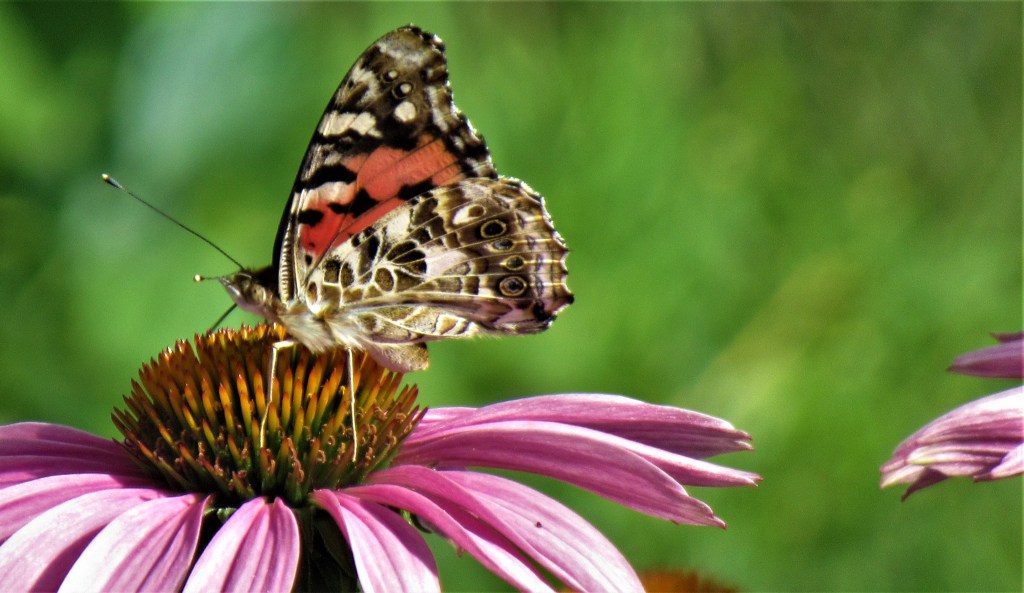
Comment: This is another golden oldie that gains in meaning day by day as the lock down continues. Miguel de Unamuno (1864-1936) was a respected academic, philosopher novelist, essay writer, story-teller and powerful poet. He is probably most famous internationally for the philosophy he espoused in The Tragic Sense of Life. Other works of his include Our Lord Don Quixote and Niebla / Mist. The photo shows one of the butterflies that adorn the garden by my kitchen window each summer.

Funny Old World


UNADJUSTEDNONRAW_thumb_2731

Funny Old World

It’s a funny old world,
this word-world of mine,
where one day
I am whirled off my feet
and the next
my toes seem to be set
in concrete.

Meaning?
I throw the question out,
a bone to the dog,
wet food for the cat,
sun-flower seeds for the chipmunk,
but there’s no reply.

Only the crows,
black-winged monarchs
destined to wear
a weighty crown,
cry out their anguish,
longing for the day
when they’ll come back to earth
and rule again.

Comment: A golden oldie, really. What indeed does it all mean and is survival the only thing that matters? For many of us, including the cats and the dogs and the birds in the garden “munchies in and munchies out, that’s what life is all about.”  And indeed it is. Some days I just look at the crow’s feet on the lawn or those growing beside my own and my beloved’s eyes and “What’s it all about, Alfie?” I ask myself.  It’s certainly a time when I question so much: my values, my life-style, my memories, the whole of my life, where I have been, where I might be going, the things I have done and left undone. My thoughts err and stray like lost sheep and then I realize that really, deep down, it doesn’t matter. Whether I am here, or not, the crows will continue to fly over the garden. The crows will leave their little footprints in the snow, and whether they like it or nor, crow’s feet will continue to grow in the corner’s of the old folks’ eyes, in spite of all the beauticians and all the rejuvenating lotions in the snake oil promises of this oh-so-beautiful world.

Fire and Flame

IMG_1571 (2)

Fire and Flame

The world is on fire.
Someone, somewhere
lit a match.
The world exploded.

Someone, somewhere
sneezed into their sleeve.
the world collapsed.

A match in the lungs:
the whole world burning.

Intelligence, give me
the exact name of things:
corona virus, vaccine, air
that’s pure,
drinkable water,
a new, fresh world
for my daughter
and her daughter.

It isn’t the cough
that carries you off.
It’s the coffin
they carry you off in.

I wish I could spare them
from all this slaughter.