Sonnet: Angel Choir

Angel Choir
(on seeing the Northern Lights at Ste. Luce-sur-mer)
Sonnet

Listen to the choristers with their red and green voices.
Light’s counterpoint flowering across this unexpected son et lumière,
we tremble with the sky fire’s crackle and roar.

Once upon another time, twinned with our heavenly wings,
we surely flew to those great heights and hovered in wonderment.
Now, wingless, our earthbound feet are rooted to the concrete.
If only our hearts could sprout new wings and soar upwards together.

The moon’s phosphorescent wake swims shimmering before us.
The lighthouse’s finger tingles up and down our spines.
Our bodies flow fire and blood till we crave light, and yet more light.
We fall silent, overwhelmed by the celestial response.

When the lights go out, hearts and souls are left empty.
Leaving the divine presence is a gut-wrenching misery.
Abandoned, hurt and grieving, we are left in darkness.

Comment: The Spanish mystics, St. John of the Cross, and St. Teresa of Avila, wrote, in the sixteenth-century, about the ‘dark night of the soul’. That dark night also arrives when the communion with the spiritual finishes and the communicants are left alone, in their loneliness, abandoned to their earthly selves. To leave the divine presence is a heart-breaking, gut-wrenching misery. To turn from the marvels of nature can produce lesser, but still deeply moving feelings of grief and sadness. The secret is to preserve that joy and to carry it with us always, warm, in our hearts. Doing so makes the pain of separation much more bearable.
Click on this link for Roger’s reading.
Sonnet: Angel Choir

Boxing Day

Boxing Day

Still Life with Hollyhock
Geoff Slater

How do you frame this beaver pond,
those paths, those woods? How do you
know what to leave, what to choose?
Where does light begin and darkness end?

Up and down: two dimensions. Easy.
But where does depth come from?
Or the tactility, the energy, water’s
flow, that rush of breathless movement
that transcends the painting’s stillness?

So many questions, so few answers.
The hollyhock that blooms in my kitchen
is not a real hollyhock. Intertextuality,
visible and verbal: this is a poem about
a painting of a digital photograph of a
hollyhock, a genuine flower that once
upon a time flourished in my garden.

A still life, naturaleza muerta in Spanish,
a nature morte in French, a dead nature,
then, portrayed in paint and hung alive,
on display, in this coffin’s wooden frame.

Click on this link for Roger’s reading.
Still Life with Hollyhock

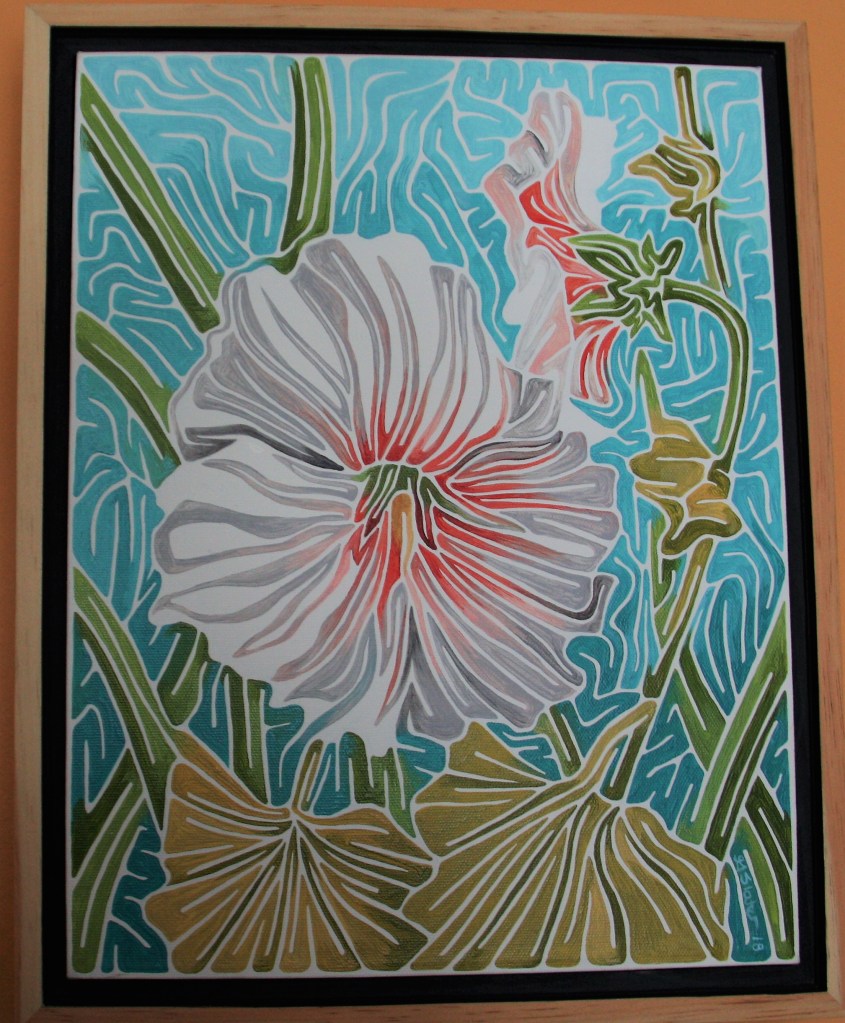
Comment: Back home in Wales, Christmas Day was for family and Boxing Day was for friends. I guess the same traditions still exist here in Island View. And what better friend than Geoff Slater? I met him in 2017 at the first KIRA residency and we have been friends ever since. We have worked on so many projects together: painting, creative workshops, videos, sound recordings, poetry, and short stories. He has illustrated several of my books, McAdam Railway Station, Tales from Tara, Scarecrow, and I have put some of his drawings to poetry, Twelve Days of Cat. Last, but by no means least, his painting of a hollyhock from my garden appears on the front cover of my latest poetry book, The Nature of Art and the Art of Nature (Cyberwit, 2021). The title of the collection, incidentally, came from sundry discussions we had on the nature of art and the Prelude: On Reading and Writing Poetry (pp. 7-31), was written at his suggestion. Poems to Geoff can be found on pp. 43, 44, and 61-62 of The Nature of Art.

So, Boxing Day is for friends. And I dedicate it to Geoff Slater and all the many friends I have made in KIRA, Kingsbrae, and throughout my multiple meanderings through the realms of academia, coaching with the NCCP and the NBRU, researching in communities like the ACH, the AATSP, and the MLA, various editorial positions on academic journals like the IFR, BACH, STLHE Green Guides, STLHE Newsletter, La Perinola, AULA, CJSoTL, Canadian Modern Language Review, Calíope, translating for different associations, including the Discalced Carmelite Nuns in St. Joseph’s Convent, Avila, and volunteering with STLHE and the 3M National Teaching Fellowship. To all those friends out there, including my friends and e-friends in TWUC, the LCP, and the WFNB, and those on Facebook, my blog, and my online Skype and Zoom courses and meetings, plus, of course, those I know via Quick Brown Fox, you are not forgotten. Here, for you, on Boxing Day, is a hug or a wave of the hand and a great, big thank you for being there.

Selection of my books
on the sea-shore at Holt’s Point.

Last Year’s Snow

Last Year’s Snow
Mais ou sont les neiges d’antan?
Villon.

Meditations on Messiaen
Inner Migrants

4

Last Year’s Snow

Last year’s snow: where did it go? The snow-blower
blew it around while my daughter made snow angels,
but that snow melted, so long ago. We made a snowman.

I remember rolling snowballs around the yard. They grew
so big we could hardly lift them, one large lump onto
another, and then we planted stick-arms, a hat, a nose.

Our dog visited him. Sniffed. Drilled yellow holes into his feet.
Crows sat on his arms, cawed and cawed, totally unafraid,
no scarecrow this, this fake man made entirely of snow.

The crows saw worse in the roadside snowbanks. Dead deer,
snow plowed into the banks and abandoned at roadside,
their bodies waiting for spring sun to resurrect them.

Our annual question: where did the snowman go?
And its sequels: last year’s snow, the birds that nested
in last year’s nests, what happened? Where did they go?

I have searched near and far, but I haven’t found them,
not a trace, not a song, not a feather floating down.
Where did they go?

No hay pajaros en los nidos de antano.
Miguel de Cervantes.

Click on this link for Roger’s reading.
Last Year’s Snow.

Click on this link for Georges Brassens
Ballade de temps du temps jadis

The Nature of Art

The Nature of Art

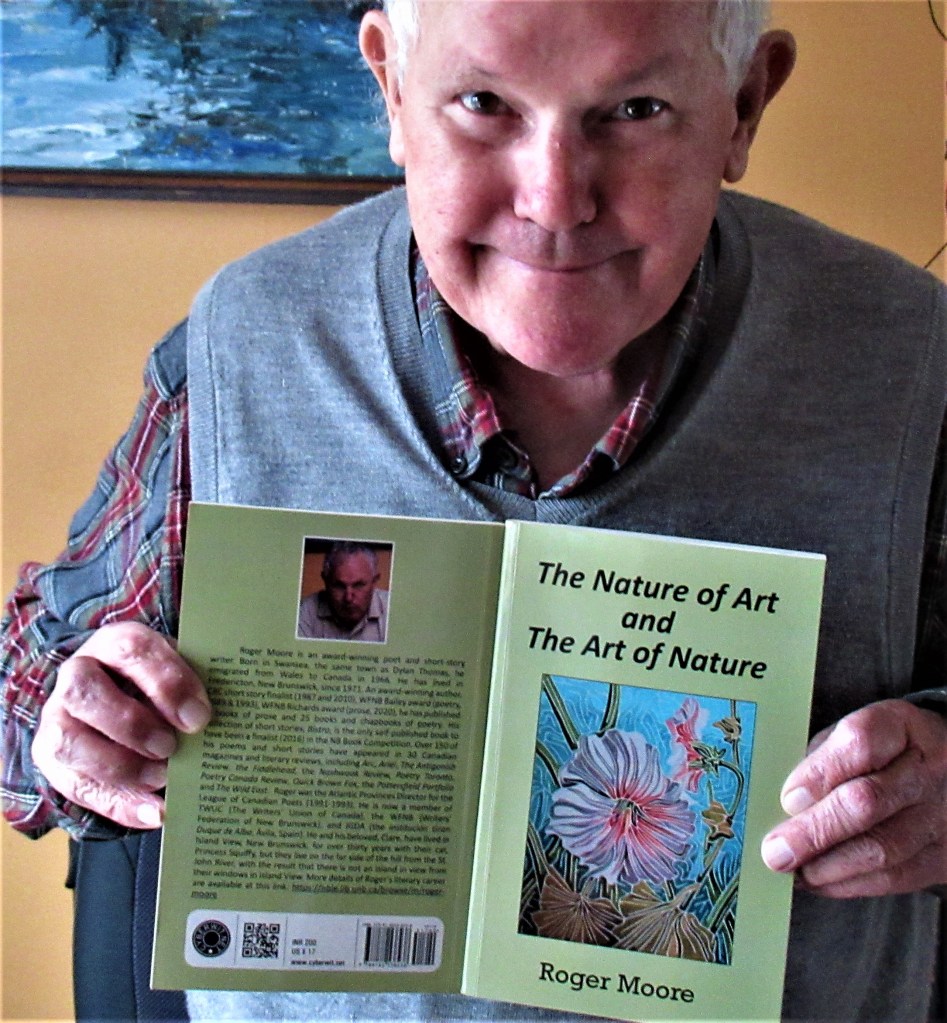
It’s here and it looks beautiful. The photo does not do the cover justice as Geoff Slater’s painting is just phenomenal. The book holder wishes to announce that the photo does not do him justice either. He is much more good-looking in real life. I don’t have the Amazon / Kindle details yet, but I’ll post them as soon as they arrive. meanwhile, you will all have to make do with one poem. But remember: “A poetry book is a dream you hold in your hands.”

Still Life with Hollyhock
Geoff Slater

How do you frame this beaver pond,
those paths, those woods? How do you
know what to leave, what to choose?
Where does light begin and darkness end?

Up and down: two dimensions. Easy.
But where does depth come from?
Or the tactility, the energy, water’s
flow, that rush of breathless movement
that transcends the painting’s stillness?

So many questions, so few answers.
The hollyhock that blooms in my kitchen
is not a real hollyhock. It is the painting
of a photo of a genuine flower that once
upon a time flourished in my garden.

A still life, then, a nature morte, a dead
nature, portrayed in paint and hung alive,
on display in this coffin’s wooden frame.

Click on this link for Roger’s reading.
Still Life with Hollyhock


Normality

Normality

In spite of grey skies,
blueish snow and early-
morning, under-cloud-
light combine to color
my garden several shifting
shades of blue-grey.

Light grows and the garden
starts to whiten. No deer as yet,
but they aren’t far away.

Two big ginger cats,
I think at first they are foxes,
stalk their marmalade path
through the trees towards the road.
I have never seen them
before. New neighbors?

One crosses the road
but the other hesitates, then flees,
as flashing school-bus lights
bring normality back to my early
-morning dream-filled world.

Click on this link for Roger’s reading.
Normality

First Snow

First Snow

Fell softly, quietly, soundless, in the night.
I knew it was there. A lightness in the air,
a subtle change in the quality of light.
Now everything has changed: yesterday’s bare
trees wear their winter dresses, frilly tresses
garnished with garlands of snow.

The deer will arrive, sooner or later.
They always do. They troop from right
to left, west to east, as day turns to night,
then troop back, east to west, in morning light.
They step dark and diligent, flitting shadows
beneath snowy trees, one after another,
forging a single passage from yard to road,
crossing it, then vanishing into dark woods.

I saw them one night in a midnight dream.
They stood on their hindlegs underneath
the mountain ash and danced, so delicate,
reaching up with long, black tongues,
to steal bright berries from lower branches.
They danced in a full moon’s spotlight
and filled my heart with joy and pain.
How I long to see them dance again.

Click on this link for Roger’s reading.
First Snow

Poetry Painting

Poetry Painting

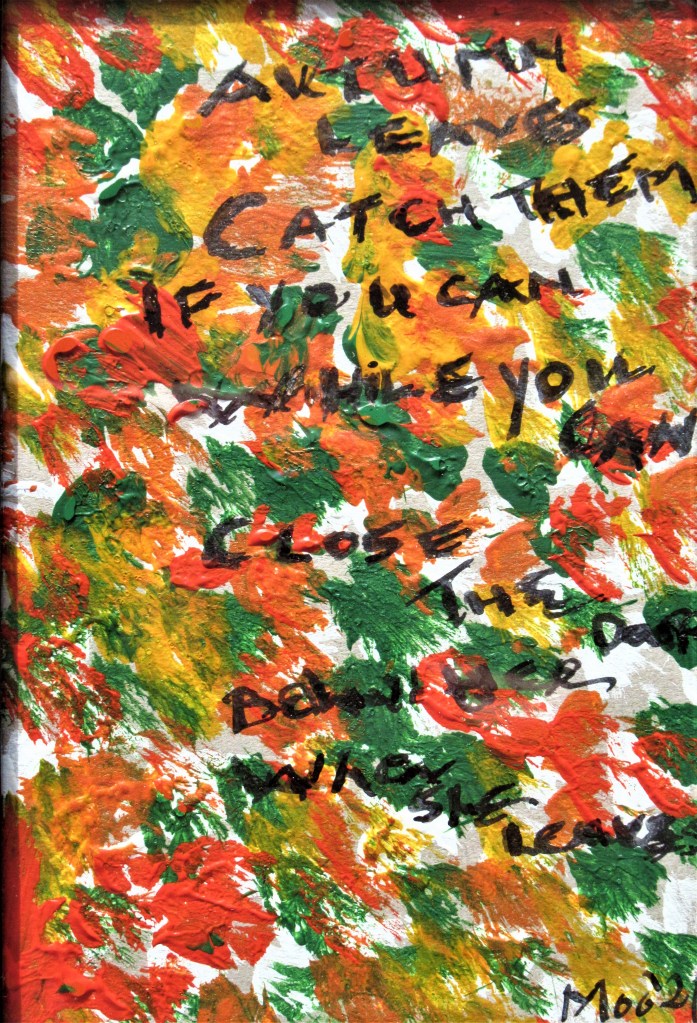
This was a totally new experience: a poem written over a painting that linked visual to verbal. I tried several versions of the words and have come up with a better one… but, once the words are on the canvas, it’s so hard to change them. The spoken word, once loosed, can never be recalled.

Our New Brunswick leaves have gone already. We are looking at ships’ masts, sails unfurled, in an anchored harbor. Further south, Thanksgiving is here. My distant neighbors and friends are contemplating turkeys and family gatherings and all that is good about harvest festivals and the end of the productive year, the agriculturally productive year, that is. Below them, in Mexico, the land of four continuous harvests, growth continues.

The cycle of the seasons rolls on and on. In the British Isles Woodhenge has turned into Stonehenge. Four thousand five hundred years of history measured in stone circles, seasonal star and sun points, times for sowing and harvesting. Absolutely bewilderingly marvelous. More than 5,500 standing stone calendars can be found in those islands.

And here, in my painting, leaves, letters, words deliver a message of intertextuality. Change is upon us. We live with it, focus on it, describe it in words. Each letter, each word, is a leaf on the tree, falling or soon to fall.

Autumn Leaves

Catch them
if
you can.


Catch them
while
you can.

Autumn Leaves.
Don’t grieve.
Close the door
when she is gone.

Click on this link for Roger’s reading.
Autumn Leaves

Sharp-shinned Hawk

Sharp-shinned Hawk

She surveys her empire
from a tall tree, then steps
into space, plunging her
body’s weight downwards,
diving into fragile air.

A feathered arrow,
she makes contact, feet first,
and pins the unsuspecting robin
to the ground. His shrill shriek
emerges from a beak
that shreds failing life.

The hawk’s claws clench.
Her victim weakens.
His eyes glaze over.
One final spasm,
a last quick twitch,
the robin is gone.

One wing drags, flaps weakly,
borne skywards in the hawk’s
triumphant claws.

Click on this link for Roger’s reading.
Sharp-shinned Hawk

Sometime

Sometime
with thanks to Seamus Heaney

Sometime, make the time to drive to Alberton
where the Great Blue Herons
stand thigh deep in the incoming tide.
Lobster boats spark stars from the waves.

They white-water surge through a gap
in the sandbank where the lighthouse
stands red and white, outlined against
blue sky, golden sand, sparkling bay.

Follow the fast-eroding coastline, a little
less each year, past Jacques Cartier Park
to Kildare Capes. Black-backed gulls ride
shotgun on the red sand beach. Piping
plovers charge up and down the wind-rush
of surf digging for treasure, the crustaceans
that will fill their bellies and enable them
to survive their long journey south.

Head north past Sea Cow Pond to North Cape.
Quixotic windmills wave their arms, like giants.
The sand and pebble reef stretches its low-tide
footpath out to the lazy seals basking in late
summer warmth. Sea-birds seethe in great
white clouds while fishing boats bob on wild
waves and a black horse hauls Irish Moss
off the beach to be sun-dried on the shore.

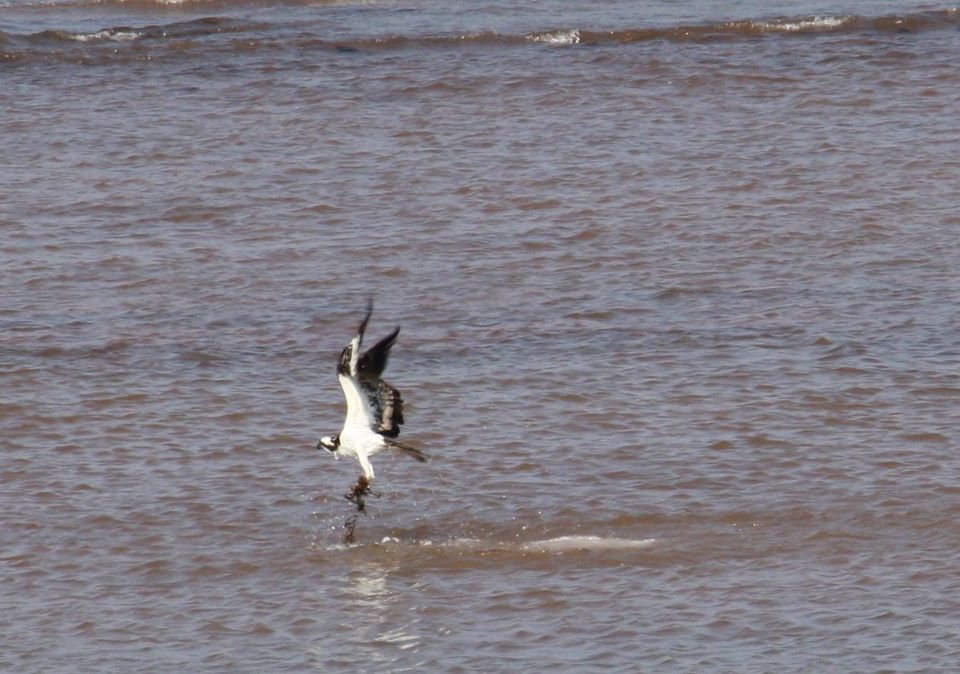
An osprey hovers, drops its lightning bolt
to spear a flapping flounder on sharp claws.
The magic of that great bird’s fall and rise will
drive a wedge through your heart and split it open.

Click on this link for Roger’s reading.
Sometime

Coal Face

Coal Face

My family never forced me underground.
Nobody ever made me kneel at the coal-
face altar and worship, on my knees,
that grimy god with its coal-black soul.

A child in body and heart, nobody ordered
me to squirm down diminishing seams,
much too narrow for men or machines
and fitting only for the smallest child.

Fitting indeed, an early coffin, made to
measure, lying in wait for the slightest
slip of the rocks above or below. Tight
fitting, indeed, no wiggle, wriggle room.

Billy Blake, my mate from Trinidad,
younger than me, saw the black faces
of miners emerge from the mine, enter
the pit-head baths and come out white.

He, too, wanted to be white. He dug
underground, grew even blacker, went
into the showers, gouged his black skin,
drew rivers of blood, never changed color.

He died when the roof above him fell
without warning. They pulled him out.
Brought him to the surface. Prepared
him for burial. Wrote on his tombstone:

“His body was as black as night,
but oh, his soul was white.”

Click on this link for Roger’s reading.
Coal Face.