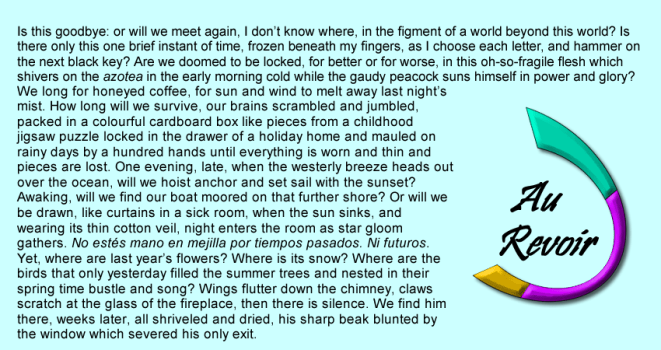
Au Revoir

Au Revoir

Au Revoir

Commentary:

This construction (verbal and visual) dates back to my visits to Oaxaca, Mexico (1995-2001). So many friends, so many happy relationships, and then the world turned and I never went back. I remember doing yoga early in the morning on the azotea. Zopilote, the turkey vulture, wings motionless, flew high above the world, the sun lighting up his wings with its fiery flame. Zopilote, aka Trickster, the bird who stole fire from the gods and brought it back to earth so women could make men their morning chocolate over the old wood stoves or open fires. Or was that all a myth, fake news as some would say today when everything we touch is fake? So much has been lost, destroyed. So much beauty, verbal and visual, has been laid aside, destroyed, and forgotten. Au revoir, good-bye, will we ever see it again? Adieu, goodbye, we will never see it again, it’s gone for good. So much meaning in these brief French phrases, synonyms in English, yet carrying such different meanings in French.

Amarrada nuestra barca a otra ribera … Antono Machado wrote those words. We will awake one morning, he suggested, to find our boat moored on the other side of the river between life and death. And so we will. But in our daily lives, we try to ignore that fact. We seize the day, drowning our sorrows in a sea of forgetfulness: for tonight we’ll merry, merry be, we sing, but tomorrow we’ll be sober. Or will we? And nowadays, who cares anyway? As Seamus Heaney writes “my friends and neighbors, let it flow. We’ll be stood no rounds in eternity.”

Yesterday, I met a man in a wheel chair sitting outside the store where I was shopping. He asked me if I could spare some change and I told him I only carried plastic (true). Then next man who approached gave him a cigarette. My beloved was sitting in the car and I gave her a five dollar bill from the parking money and asked her to give it to the man in the wheel chair. So: how did we feel? Good for an act of charity? Bad for not responding immediately? Terrible that we see people living in poverty in a supposedly rich country? Fearful that one day the money would run out and that we too would be out there, begging for money, grateful for a cigarette, a hand out, a helping hand … happy for anything that would help postpone the inevitable end?

And then there was the bird that fell don the chimney and perished in the fireplace. We never even knew he was there until we found his feathers and his body, lifeless among cold ashes. So which is it to be: au revoir or adieu? Or even worse, the middle finger, the scowl, and the old ‘screw you’?

Time-Spirits

IMG_0868.JPG

Time-Spirits

Zeitgeist

Zeitgeist is a concept from 18th- to 19th-century German philosophy, translated as “spirit of the age” or “spirit of the times”. It refers to an invisible agent or force dominating the characteristics of a given epoch.
Wikipedia

Those who cannot learn from history are doomed to repeat it.

“Plus ça change, plus c’est la même chose.”

Poems for troubled times.

Introduction

Our world finds itself in an incredible mess right now. Somehow, we have to sort it out. Images and metaphors tie past, present, and future together. We must pick our ways through the difficulties of these troubled times, as you must pick your way through the intricacies of these poems. Many of you will give up. Some of you, the chosen few, will make your way to the heart of each poem.

These poems are deliberately cryptic. Each one is a mind game I am playing with you. I do not underestimate you. I have placed clues throughout each poem and if you follow the clues you will arrive at many of the poem’s hidden meanings. Some poems are more difficult than others, their meaning more recondite. Others seem very straightforward, yet still contain secrets.

            This style of poetry has a long history going back to Anglo-Saxon riddles and way beyond, back into the mists of time. Luis de Góngora (1561-1627) and Francisco de Quevedo (1580-1645) specialized in similar forms of recondite poetry, often based on metaphor and the juego alusivo-elusivo, the game of alluding to something while eluding the act of saying what it is. Jorge Guillén (1893-1984) and Federico García Lorca (1898-1936) also played this game, as did Octavio Paz (1914-1998). In the works of all of these poets, the clues may rest in the poem or they may be found in a generic knowledge of the mythology of the poem’s exterior world.

             Always remember that “those who cannot learn from history are doomed to repeat it” (George Santayana). Otherwise expressed, in the words of T. S. Eliot: “Time present and time past / are both perhaps present in time future / and time future contained in time past” (Burnt Norton). The seeming anachronisms in these poems suggest that all time is ever-present and that each new day presents us with events that have already occurred on many occasions.

Commentary: The idea for Time-Spirits aka Zeitgeist was born around the kitchen table in Island View on Saturday, 22 December 2018, during a literary conversation between Gwen, Victor, and Roger. A poem at a time, one after another, grew from that table top chat. The result: 70 poems, not easy to read, deliberately difficult, that reflect our troubled times. My thanks to Geoff Slater, line-painter, who drew the cover picture: Robin Red in Claw and Breast, a symbol of nature ‘red in tooth and claw’. So are we in the words of Albert Camus who writes ‘nous sommes ou les meurtriers ou les victimes’ . Is it the early bird that catches the worm? Or is it the late worm that gets caught by the bird? Whichever: it’s the worm that gets eaten, until the robin bites the dust, when he is eaten in his turn. Just think of it as nature doing its regular recycling …


IMG_0865 (2).JPG


After the Floods

IMG_0144

After the Floods
(2004 BC)

as the crow flies
so the pigeon
holding straws
within its beak
time to rebuild

not so easy
mud walls fallen flat
rubble and rubbish
litter river banks

warped wooden planks
water-swollen
so much stolen
by wind and wave

who now knows
the unknown
perceives the abyss
beneath egg-frail
cockle-shell hulls

waters recede
islands re-emerge
bald skulls of hillocks
stripped of grass and trees
water-logged fields

old bones dug up
displayed in the ditch

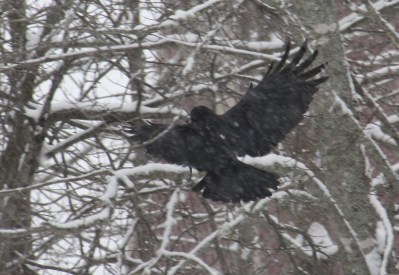
Crows

IMG_0146

Crows

one day
whirled off my feet
next day
toes set
in concrete

a single black feather
floats down from the sky
meaning?

a bone to a dog
sun-flower seeds
strewn before squirrels
red and grey
the occasional chipmunk

only crows
black-winged marauders
monarchs destined to wear
a weighty crown,
cry out their anguish

mobbing the hawk
longing for the day
when they’ll rule again

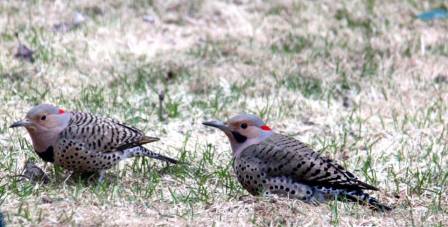
Flickers

10151178_277751725719138_1332118377692813633_n.jpg

Flickers
(1613 & 2019)

a watch spring
this cuckoo-clock heart
fully wound up
time’s ticker flickering
waiting to strike

black hole its beak
poked the world’s fabric
shredded into ribbons
robin’s nest torn
storm-tossed onto lawn

constant this love
its warm ashes lingering
searing holes in shoe soles
soul-sick with yearning
bright bonfires burning

metaphor and meaning
real and imagined
hammering on chimneys
territorial flickers
spring heartbeats drumming

losers of somethings
winners of others
wings lofting upwards
light above darkness
all creature comforts

a spring need to nest
an old man’s need to rest

10150582_277751602385817_3902308875883985667_n.jpg

Night Light


IMG_0535 (2).JPG

Night Light
(1578 -1591 AD)

quiet now the house
staircase winds up
that wooden hill
to Bedfordshire
down to drop
into darkness
wait in peace
starlight will break
its light-waves
over your eyes
into your heart

owls in the gloom
round eyes gleaming
a who-knows-what
what watches
a godsend now
this light house light
its lightning lightening
enlightening

sudden comfort
this hand on my shoulder
these fingers in my hair
this midnight witch
bewitching

Senseless

SD 16

Senseless
(19 April 2019 AD)

taste my words
lick them from your lips
feel the roll of your tongue
creating saliva
cranberry choruses
lemon librettos
vanilla vocabularies
gooseberry grammar

fooled are those
cheated of their senses
who cannot sample
savoury flavours
nor test the scent
of April flowers

cancer perhaps
chemo-therapy
Parkinson’s stealing
memories away
childhood tangs
chocolate unwrapped
a Christmas orange peeled

aren’t you pleased
your taste buds
are still teased
by such offerings

grieve
for all you’ve lost
all you are losing
sooner or later
everything will go

last dregs of meaning
draining from your cup

Samaritan

IMG_0437 (4).JPG


Samaritan
(1890 AD)

I lived with him
he treated me well

to him
I was the other
yet he fed me
when I hungered
gave water
when I ran dry

I fell ill
he cared for me
nursed me back
to health

he taught me
his language
culture history
traditional skills

he loved me
never forced me
to forget myself
and be like him

he made me
what I am today
a discerner
between
light and dark
still the other


Tara Pine


IMG_0003

Tara Pine
(1770 / 1977 AD)

maritime jack pine
arm-waving
declamation
sonnet to wild growth
a wilderness now

lop-sided
forest church
spired with birds
crows’s nest
crowning savage
extravagance

radical disorder
flustered
clicking needles
clustered
knitting the wind

salted the air
old man’s beard
sprouting fresh bristles
old salt sea salt

“ill fares the land
to hastening ills a prey”
without a helping hand
to point the way

each broken limb
an olive branch extended
scorched earth policy
salt-sown earth

Lament

IMG_0004.jpg

Lament

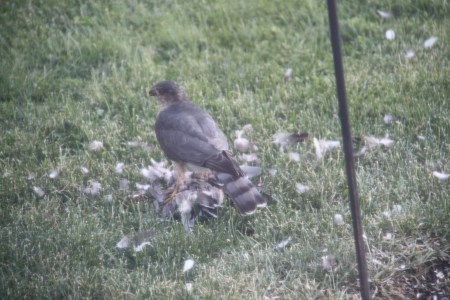
I remember the hawk well. One moment the garden was empty, next he was there, on the ground beneath the feeder, feeding, or rather, fed. I didn’t see the kill. I walked past the window on my way through the kitchen from somewhere to somewhere, and there he was, perched upon a pile of feathers. Whatever the victim was, all edible evidence had disappeared and only the feathers remained. I guess the hawk saw me, sensed, or caught the sound of the camera. Within a second, between click and click, he had flown.

IMG_0007.jpg

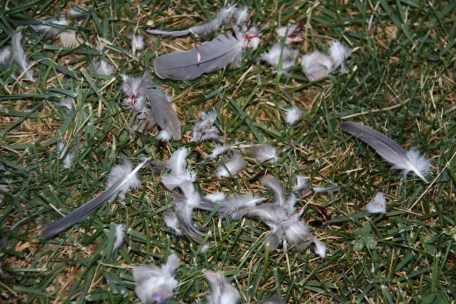
I went outside to look at the wreckage of what had once been alive. Feathers and blood. The grim reality of avian life in my Little World of Island View. Between cats and hawks, a great deal of destruction is handed on from generation to generation. But although I have witnessed nature ‘red in tooth and claw’, I have seen nothing like the devastation caused by the avian flu. We tried to follow all the appropriate instructions, but the passerines all vanished and they never came back. We still have a couple of mourning doves grubbing around on the porch and back step, but I can remember counting, one day, sixty or seventy perched in a cluster on the clothes line. Pine grosbeaks used to swarm, now to see one is a big event. We still get the occasional evening grosbeak, but the grey jays have vanished, as have the swallows who used to nest in our garage. We know of a pair of cardinals in the neighborhood, but they rarely visit us. We can hear a Greater Pileated Woodpecker in the distant woods, but they no longer dance and play among our trees. A few years back, we had a garden full of bees balm, but no bees. Last year we saw very few butterflies, though they used to be regular visitors. Our hummingbirds have become occasional visitors, and I do miss seeing them.

I long to see again all those beautiful creatures, the cat bird with his endless imitations, the orioles with their songs, even the sparrows seem fewer and further between. As for the garden, the crows have taken over. A family of seven caw in the trees and visit regularly. They are sharp, wise creatures and I am always bemused by their aerial manoeuvres. They still sit on the garbage cans once a week and announce their triumph to the world. But woe betide if you leave a plastic bag alone at the roadside. They make short work of it with their shiny beaks ad the bag’s interior is soon strewn all over the road for you to pick up and everyone to see.