Hummingbirds

Hummingbirds

IMG_1034 (2).JPG

Do hummingbirds hum? Only when they’re humming birds. Otherwise they are quite silent, when alone, and the whirring of their wings is what whisks them up and away. In Oaxaca, the colibris are the souls of dead warriors killed in action. Their bravery is rewarded by their transference to a colibri in the afterlife, for colibris are given the gift of serving the sun in Mexican Mythology.

IMG_1033 (2).JPG

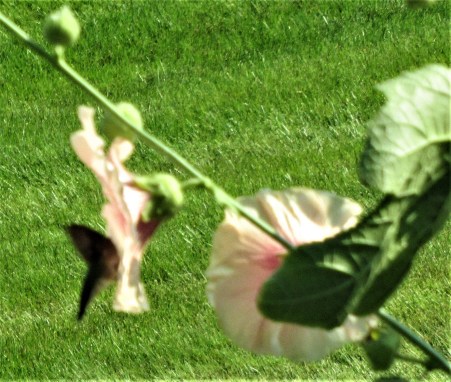
Here in Island View, New Brunswick, we only see the ruby-throated hummingbirds. No ruby throat, and they are usually females. Obviously, when they have their backs to us, then it is more difficult to determine male or female.

IMG_1035 (4).JPG


I desperately wanted to catch one feeding in the hollyhocks. Alas, they vanished inside the larger flowers. Also, they were much too quick for these old eyes and ageing fingers. So I just clicked away and hoped and this was the best I could do. I am still hopeful though… there’s still quite a bit of summer left.

IMG_1032 (2).JPG


Carousel

Carousel

carousel.png

Around and around a roundabout! I love it when the painted wooden horses open their mouths and rock up and down, and the little children hold out their hands to watching parents and grandparents, and big sisters and brothers hold them tight and keep them from falling off and the world passes by in a blur and open mouths are black holes in faces sucking the carousel in as it spins past in triumph.

And never forget the dodgem cars, weaving in and out, never dodging anything, but jousting like armor-clad knights of old, bumper to bumper, and ready, steady, charge! Or the old swing boats, twin-roped, non-mechanical, lifting us up to the skies and dropping us back to earth with that stomach-churning fall from stardom to the loss of innocence as the wooden break grinds, our thruppence is spent, and the ride is over.

Those days are as forgotten as one a penny, two a penny, or the tuppenny loaves that the elephants dropped, or the sing a song of sixpence where the twenty-four blackbirds descended like clothes pegs to devour the bread and honey and peck off the nose of the open-eyed innocent who never tired of the joke until the ultimate childhood squeal as his or her freckled or un-freckled nose was pinched and stolen away. So much lost, so much forgotten.

For two weeks now I have tried to photograph the hummingbirds, colibris, who visit the hollyhocks. Tonight, after a hundred or more photos, I managed to catch one in the fish-net of the camera. What joy: success after days and days searching for that delicate flash of red and green, only to find nothing there. Oh hummingbirds, I weep to see you, to capture you in the camera’s eye, to preserve you … for such a short, brief, moment of time.

IMG_1033 (2).JPG

Memory

IMG_0437 (4)

Memory

By the time I remembered your name, I had forgotten your face. Then I couldn’t recall why I wanted to talk to you. I trace dark landmarks on the back of scarred hands: blood maps, unremembered, encounters with door knobs and unseen furniture, dust covered photographs, grey, grim, anonymous, hanging on the walls, not belonging in any family album. At night I cruise among islands, emerald green against sapphire seas. Why didn’t I visit these places when I was able to? Golden sand trickles through night’s fingers and time’s hour glass trickles out as stars sparkle and planets dance in Platonic skies. My memory is gradually fading into the distance, like a sailing ship leaving harbour. Each day, I wave another couple of memories good-bye. Each morning I wake unaware of where I have been the night before. It’s not that I sleep walk, just that things pass me by in the blink of a blurred eye. I still track the sails of drifting ships. I think of them as white moths, caught in overnight traps, chloroformed into oblivion, their bodies sometimes soaked in formaldehyde. Occasionally they come to life in the morning, batter their wings briefly against my fingers, leaving them covered with the finest moth-dust, before fluttering away into dawn’s forgiving light. I give chase with pen and paper, the worst of butterfly nets for wild thoughts waiting to be caught, then tamed. I stare at the mesh of the snow-white page and strive to grasp something just beyond my fingertips, trying to decipher it and deliver its message, but I can’t quite remember what it is.

Crow’s Feet


img_0146

Crow’s Feet

So many meanings, so many possibilities. I remember them round my grandmother’s eyes, wrinkles, laughter lines, crow’s feet. And then there are the real crows, sauntering, swaggering, two roadside hops, and take off. So bold, that sometimes they will stand there and defy you and your car, refusing to fly, but always leaving their footprints, crows’ feet in the snow.

We have a family of seven. They own our garden. Visit us every day. Check us out. Nothing like the whistle of the wind in their pinions as they sweep low over our roof, summer and winter, all year round. We belong to them, not them to us.

IMG_0147

Crows: such shadows, hovering  in our minds, casting their shadows over our lives and our deaths, for ‘the coward dies a thousand deaths, the hero dies but one’ and down, deep down, we are all cowards, in one way or another, and the crows await each one of our thousand deaths.

Au Revoir

Au Revoir

Au Revoir

Commentary:

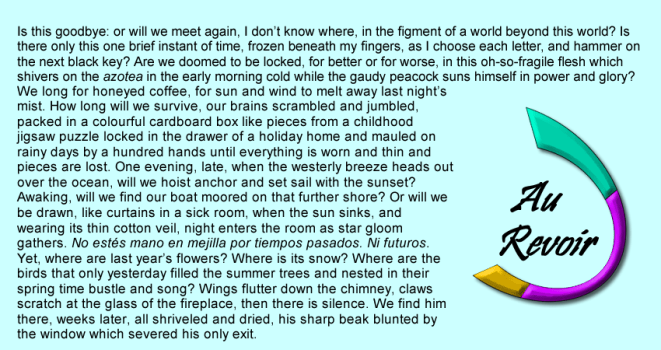
This construction (verbal and visual) dates back to my visits to Oaxaca, Mexico (1995-2001). So many friends, so many happy relationships, and then the world turned and I never went back. I remember doing yoga early in the morning on the azotea. Zopilote, the turkey vulture, wings motionless, flew high above the world, the sun lighting up his wings with its fiery flame. Zopilote, aka Trickster, the bird who stole fire from the gods and brought it back to earth so women could make men their morning chocolate over the old wood stoves or open fires. Or was that all a myth, fake news as some would say today when everything we touch is fake? So much has been lost, destroyed. So much beauty, verbal and visual, has been laid aside, destroyed, and forgotten. Au revoir, good-bye, will we ever see it again? Adieu, goodbye, we will never see it again, it’s gone for good. So much meaning in these brief French phrases, synonyms in English, yet carrying such different meanings in French.

Amarrada nuestra barca a otra ribera … Antono Machado wrote those words. We will awake one morning, he suggested, to find our boat moored on the other side of the river between life and death. And so we will. But in our daily lives, we try to ignore that fact. We seize the day, drowning our sorrows in a sea of forgetfulness: for tonight we’ll merry, merry be, we sing, but tomorrow we’ll be sober. Or will we? And nowadays, who cares anyway? As Seamus Heaney writes “my friends and neighbors, let it flow. We’ll be stood no rounds in eternity.”

Yesterday, I met a man in a wheel chair sitting outside the store where I was shopping. He asked me if I could spare some change and I told him I only carried plastic (true). Then next man who approached gave him a cigarette. My beloved was sitting in the car and I gave her a five dollar bill from the parking money and asked her to give it to the man in the wheel chair. So: how did we feel? Good for an act of charity? Bad for not responding immediately? Terrible that we see people living in poverty in a supposedly rich country? Fearful that one day the money would run out and that we too would be out there, begging for money, grateful for a cigarette, a hand out, a helping hand … happy for anything that would help postpone the inevitable end?

And then there was the bird that fell don the chimney and perished in the fireplace. We never even knew he was there until we found his feathers and his body, lifeless among cold ashes. So which is it to be: au revoir or adieu? Or even worse, the middle finger, the scowl, and the old ‘screw you’?

Time-Spirits

IMG_0868.JPG

Time-Spirits

Zeitgeist

Zeitgeist is a concept from 18th- to 19th-century German philosophy, translated as “spirit of the age” or “spirit of the times”. It refers to an invisible agent or force dominating the characteristics of a given epoch.
Wikipedia

Those who cannot learn from history are doomed to repeat it.

“Plus ça change, plus c’est la même chose.”

Poems for troubled times.

Introduction

Our world finds itself in an incredible mess right now. Somehow, we have to sort it out. Images and metaphors tie past, present, and future together. We must pick our ways through the difficulties of these troubled times, as you must pick your way through the intricacies of these poems. Many of you will give up. Some of you, the chosen few, will make your way to the heart of each poem.

These poems are deliberately cryptic. Each one is a mind game I am playing with you. I do not underestimate you. I have placed clues throughout each poem and if you follow the clues you will arrive at many of the poem’s hidden meanings. Some poems are more difficult than others, their meaning more recondite. Others seem very straightforward, yet still contain secrets.

            This style of poetry has a long history going back to Anglo-Saxon riddles and way beyond, back into the mists of time. Luis de Góngora (1561-1627) and Francisco de Quevedo (1580-1645) specialized in similar forms of recondite poetry, often based on metaphor and the juego alusivo-elusivo, the game of alluding to something while eluding the act of saying what it is. Jorge Guillén (1893-1984) and Federico García Lorca (1898-1936) also played this game, as did Octavio Paz (1914-1998). In the works of all of these poets, the clues may rest in the poem or they may be found in a generic knowledge of the mythology of the poem’s exterior world.

             Always remember that “those who cannot learn from history are doomed to repeat it” (George Santayana). Otherwise expressed, in the words of T. S. Eliot: “Time present and time past / are both perhaps present in time future / and time future contained in time past” (Burnt Norton). The seeming anachronisms in these poems suggest that all time is ever-present and that each new day presents us with events that have already occurred on many occasions.

Commentary: The idea for Time-Spirits aka Zeitgeist was born around the kitchen table in Island View on Saturday, 22 December 2018, during a literary conversation between Gwen, Victor, and Roger. A poem at a time, one after another, grew from that table top chat. The result: 70 poems, not easy to read, deliberately difficult, that reflect our troubled times. My thanks to Geoff Slater, line-painter, who drew the cover picture: Robin Red in Claw and Breast, a symbol of nature ‘red in tooth and claw’. So are we in the words of Albert Camus who writes ‘nous sommes ou les meurtriers ou les victimes’ . Is it the early bird that catches the worm? Or is it the late worm that gets caught by the bird? Whichever: it’s the worm that gets eaten, until the robin bites the dust, when he is eaten in his turn. Just think of it as nature doing its regular recycling …


IMG_0865 (2).JPG


After the Floods

IMG_0144

After the Floods
(2004 BC)

as the crow flies
so the pigeon
holding straws
within its beak
time to rebuild

not so easy
mud walls fallen flat
rubble and rubbish
litter river banks

warped wooden planks
water-swollen
so much stolen
by wind and wave

who now knows
the unknown
perceives the abyss
beneath egg-frail
cockle-shell hulls

waters recede
islands re-emerge
bald skulls of hillocks
stripped of grass and trees
water-logged fields

old bones dug up
displayed in the ditch

Crows

IMG_0146

Crows

one day
whirled off my feet
next day
toes set
in concrete

a single black feather
floats down from the sky
meaning?

a bone to a dog
sun-flower seeds
strewn before squirrels
red and grey
the occasional chipmunk

only crows
black-winged marauders
monarchs destined to wear
a weighty crown,
cry out their anguish

mobbing the hawk
longing for the day
when they’ll rule again

Flickers

10151178_277751725719138_1332118377692813633_n.jpg

Flickers
(1613 & 2019)

a watch spring
this cuckoo-clock heart
fully wound up
time’s ticker flickering
waiting to strike

black hole its beak
poked the world’s fabric
shredded into ribbons
robin’s nest torn
storm-tossed onto lawn

constant this love
its warm ashes lingering
searing holes in shoe soles
soul-sick with yearning
bright bonfires burning

metaphor and meaning
real and imagined
hammering on chimneys
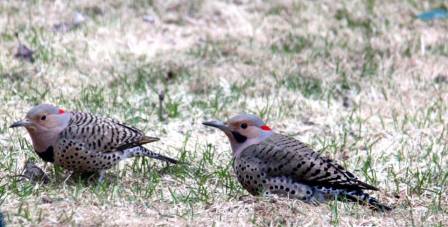
territorial flickers
spring heartbeats drumming

losers of somethings
winners of others
wings lofting upwards
light above darkness
all creature comforts

a spring need to nest
an old man’s need to rest

10150582_277751602385817_3902308875883985667_n.jpg

Night Light


IMG_0535 (2).JPG

Night Light
(1578 -1591 AD)

quiet now the house
staircase winds up
that wooden hill
to Bedfordshire
down to drop
into darkness
wait in peace
starlight will break
its light-waves
over your eyes
into your heart

owls in the gloom
round eyes gleaming
a who-knows-what
what watches
a godsend now
this light house light
its lightning lightening
enlightening

sudden comfort
this hand on my shoulder
these fingers in my hair
this midnight witch
bewitching